Section Modulus calculation and optimization
Section Modulus calculation and optimization
Aim:
To find the section modulus of hood and it’s optimization to improve the overall section modulus.
Objective:
Take a section of our Hood design and calculate the section modulus (S) using the formula
S= I/Y
Section Modulus:
The section modulus (S) is geometric property of the cross section used for designing beams and flexural members. This represents a direct measure of the strength of the given member.
It may be defined as the ratio of total moment resisted by the section to the stress in the extreme fibre (which is equal to yield stress).
Therefore
S = I/Y = M/σ
Where
S= Section modulus (mm^3)
I = Moment of inertia of the section to the stress in the extreme end of the object (mm^4)
Y= Distance between the neutral axis and extreme fiber of the cross-section of object (mm).
Area Moment of Inertia:
The area moment of inertia of a beam cross section measures the beam ability to resist bending. The larger the moment of inertia lesser will be the bending stresses developed.
Flexural Formula:
M/I = σ/Y = E/R
Where,
M = Bending Moment
σ = bending stress
I = Area moment of Inertia
E = Young’s modulus
R = Radius of curvature
Neutral Axis:
When beam is subjected to pure bending the top most fibers of the beam are subjected to maximum compression while the bottom most fibers of the beam are subjected to maximum tension or vice-versa.
The following picture depicts how the strength of a beam can be changed by changing the geometry (cross-section) of the member when subjected to the loading. For case 1 there is less deflection in comparison to case 2 when subjected to same load. So for case 1 beam is said to be stronger than case 2.
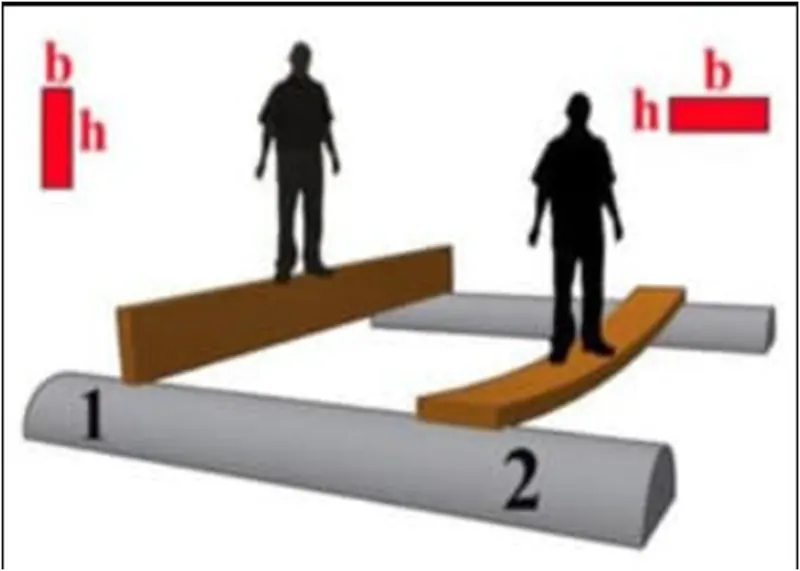
Fig.1
Calculation:
Case 1: Before Optimization
The hood which was already created has been imported and the section inertia analysis is done.
Make sure that the curve obtained is a single/closed curve.
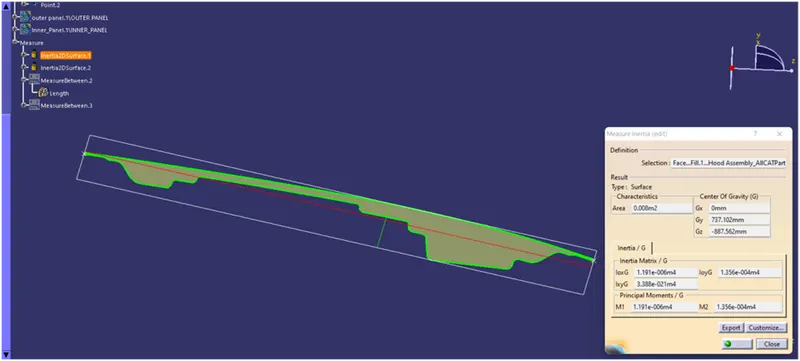
Fig.2
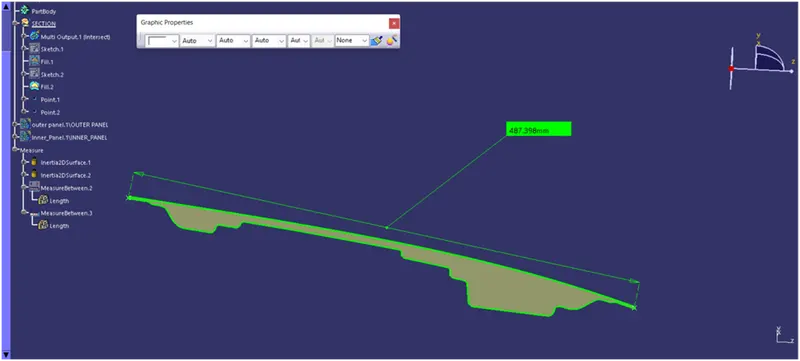
Fig.3
I (MAX) = 1.356e+08 (mm^4)
I (MIN) = 1.191e+06 (mm^4)
As per the section modulus equation,
S = I/Y
I = MOI (min Value is considered)
Y = Total distance / 2
Y = 487.389 / 2
= 243.964 mm
Therefore, S = 1.191e+06 mm^4 /243.964 mm
S = 4881.867 mm^3
Case 2: After Optimization
The hood inner panel curve is offset by 0.5mm outwards and section inertia analysis is done same as case 1 for a closed curve.
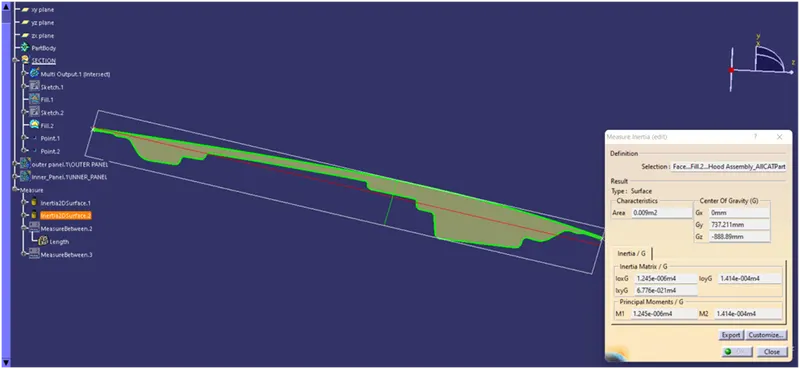
Fig.4
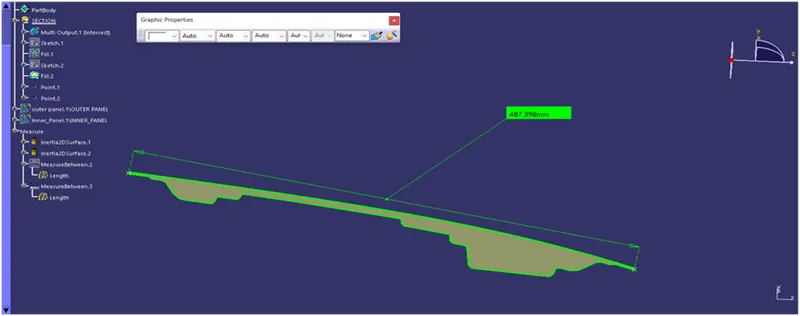
Fig.5
I (MAX) = 1.414e+08 (mm^4)
I (MIN) = 1.245e+06 (mm^4)
As per the section modulus equation,
S = I/Y
I = MOI (min Value is considered)
Y = Total distance / 2
Y = 487.389 / 2
= 243.964 mm
Therefore, S = 1.245e+06 mm^4 / 243.964 mm
S = 5103.212 mm^3
Conclusion:
By comparing case 1 & case 2, the section modulus value for case 2 is higher than that of case 1.
For a given length and breadth of hood outer panel as we increase the cross-section area by modifying inner panel, the moment of inertia and hence section modulus can be increased which means strength and load carrying capacity of the given member will also increase.