Fender Design - Wheel Arch Challenge
FENDER WHEEL ARC
OBJECTIVE:
Calculate the Wheel Arc area offender as per European Standards and prove whether the car will pass the standards or Not.
FENDER WHEEL ARC
The wheel arch is the semicircular part of the fender positioned above the wheel of a vehicle. The wheel arch area has some specific standards to measure the clearance between the tire outer periphery and fender arc. If the tire lies entirely inside the fender, it serves safety for pedestrians and other cars because the wheel is situated inside the body of a vehicle. The second function is to protect the car from the sticky materials, such as mud. It also protects from stones thrown out (embedded temporarily in the tread grooves) as the tire while rolling over the ground because of the kinetic energy of the vehicle. Because of all these reasons we need to position the tire entirely inside the fender. For that we have certain standard regulations.
US REGULATIONS:
Make clearance check details on all positions from -100O to 100 O & make the clearance check table.
All values should be greater than 5 mm to satisfy the regulations. The value of 'a' shall be more than 5 mm at a line 30 O forward and 50 O rear ward from the central vertical axis of axis of wheel.
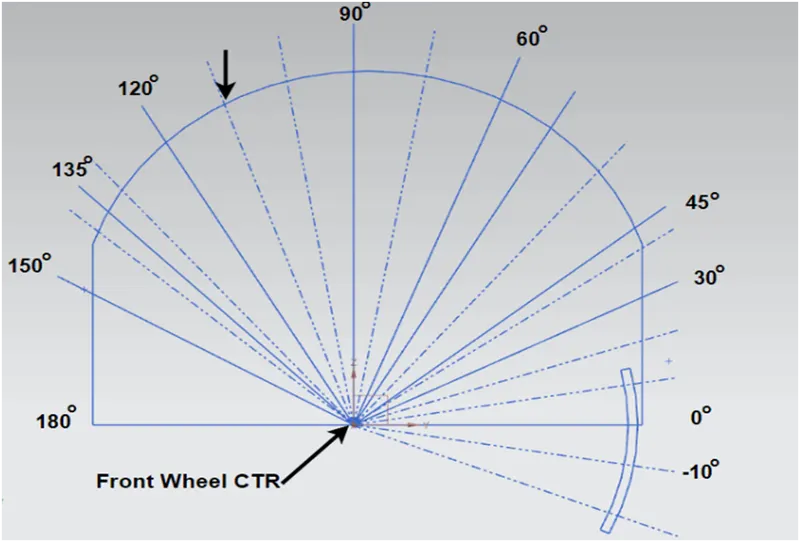
Fig:1
JAPANESE REGULATIONS:
Measure clearance L of tire, hub, cap & fender in three different positions within area K and produce clearance check chart to validate.
Clearance must be greater than 5 mm in all the three positions.
Wheel guard requirement: The value of ‘a’ shall be more than 5 mim at a line 30" forward and 50 rearward from the central vertical axis of axis of wheel.
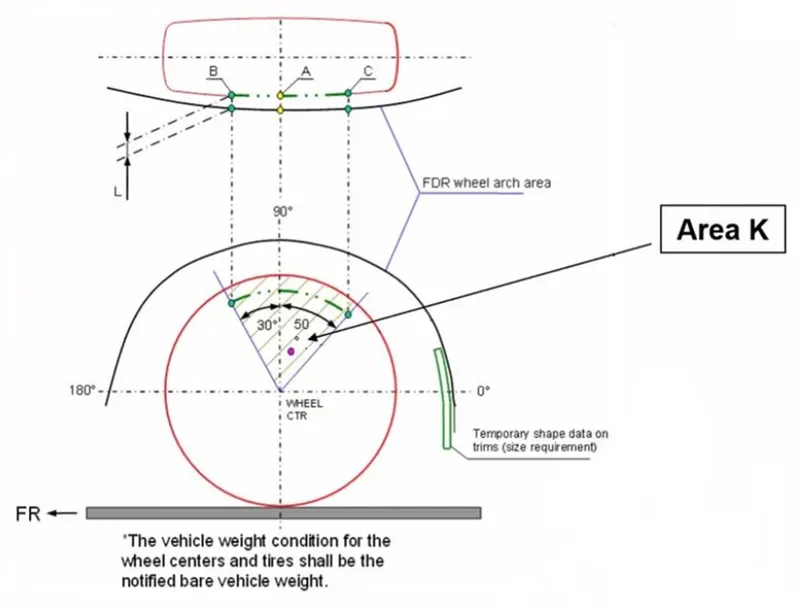
Fig:2
EUROPEAN REGULATIONS:
Measure clearance “L” at sections SA-SA SB-SB SC-SC SD-SD SE-SE and produce CL check chart to validate.
At all five sections the CL L value should be greater than 10 mm to satisfy the European regulations.
Wheel guard requirement: The value of 'a’ shall be more than 5 mm at a line 30o forward and 50 o rearward from the central vertical axis of axis of wheel.
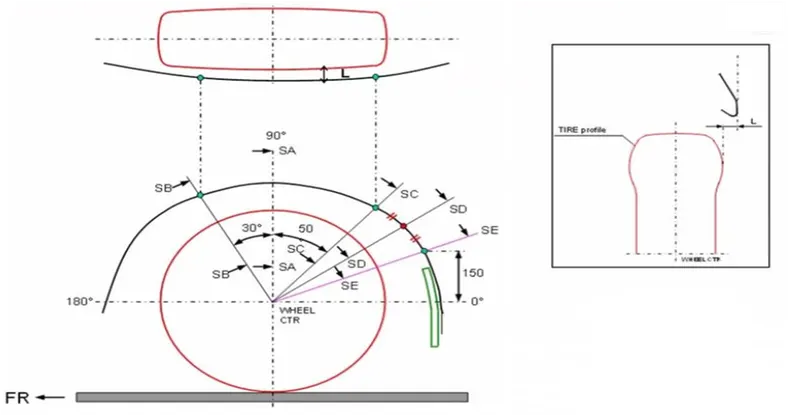
Fig:3
Here the main objective of the challenge is to test whether the give tire and fender is eligible to qualify with European regulations for Fender design or not.
Measuring Criteria is as following:
- A sketch is created on the datum plane which is at the outer most portion of the wheel.
- Create the intersection points on the line which are intersecting at the fender outermost portion.
- Project those points on to the fender part.
- Measure the distance between sketch intersection points and the project point.
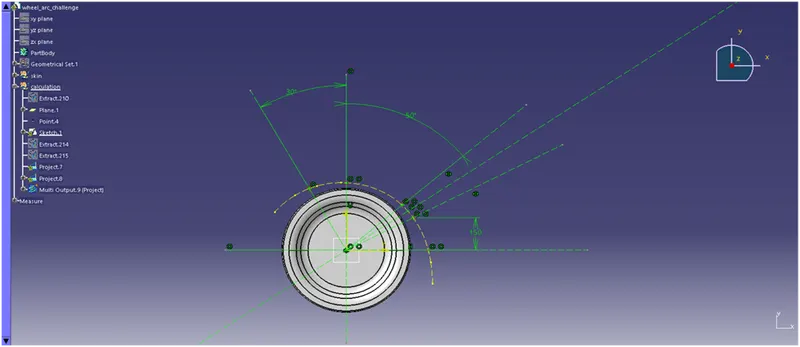
Fig:4
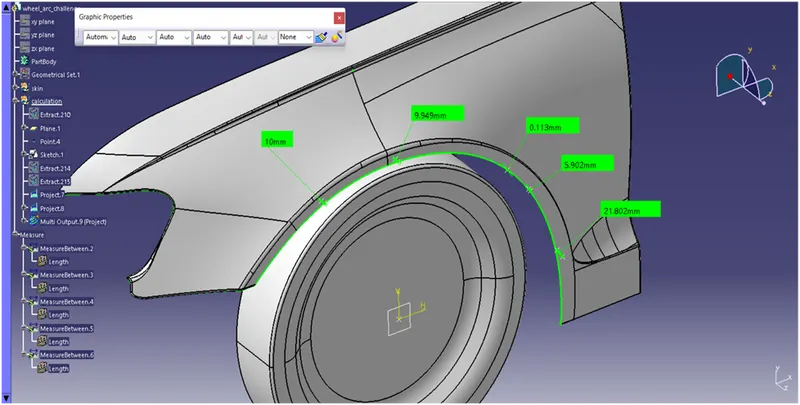
Fig:5
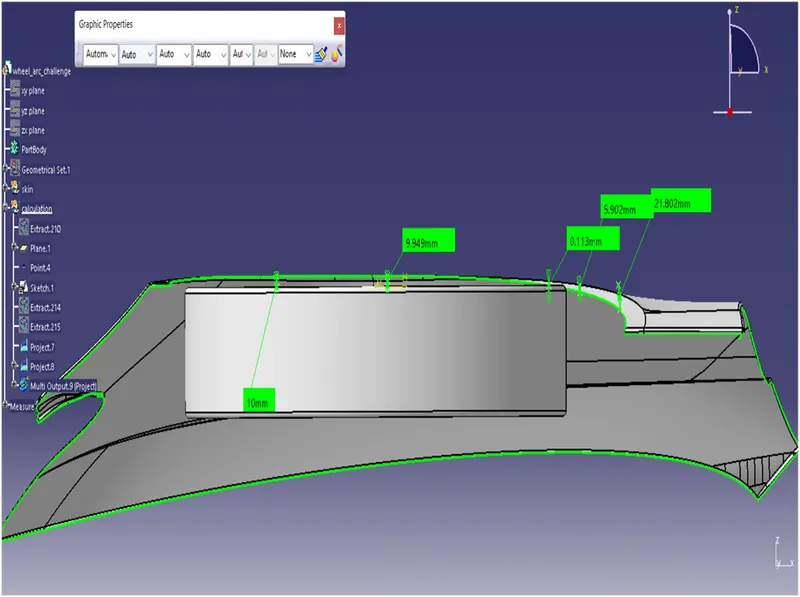
Fig:6
|
SECTION |
MIN. REQUIRED CLEARANCE |
MEASURED CLEARANCE |
REMARKS |
|
SB |
10 |
10 |
PASS |
|
SA |
10 |
9.949 |
FAIL |
|
SC |
10 |
-0.113 |
FAIL |
|
SD |
10 |
-5.902 |
FAIL |
|
SE |
10 |
-21.802 |
FAIL |
“-“ indicates that the measured distance inside the car i.e. the wheel is protruding outside of vehicle.
CONCLUSION:
The Clearance (L) is measured at all five locations are tabulated. The table shows that at section SB qualifies 10 mm clearance condition and at remaining four sections gap is less than 10mm so the given fender does not qualify the European standards for wheel arc area.
SUGGESTIONS TO STYLING TEAM:
The styling team is required to modify the styling surface of the fender such that the clearance "L" at sections SA, SC, SD and SE satisfies the minimum clearance condition of 10 mm by increasing the curvature at those sections towards outside.