Roof Design
ROOF-DESIGN
OBJECTIVE:
- The objective of this project is to design car roof with essential flanges and reinforcements like, front-roof rail, bow roofs, central-roof rail, rear-roof rail and ditch area for the given styling surface as per the given master-sections.
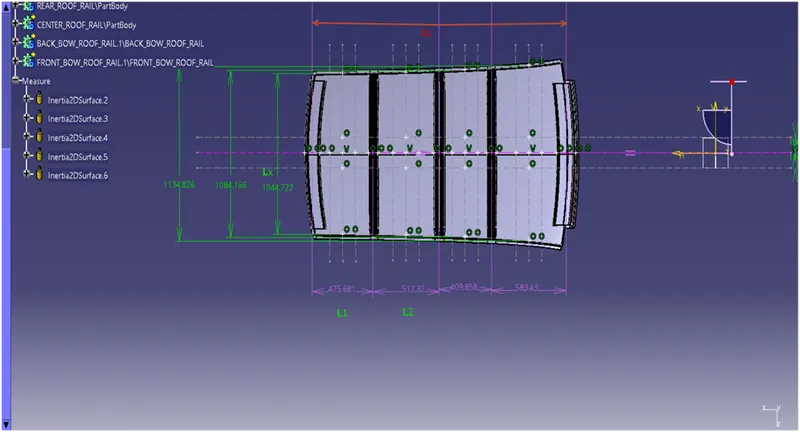
- Perform a curvature study on the roof and perform the calculations for the heat distortion and snow load criteria to determine whether the bow roofs are at the correct positions.
- Finding moment of inertia and section modulus for Bow roofs, central roof rail. Front roof rail and rear roof rail .
- Perform the draft analysis for each reinforcements
SOFTWARE USED FOR MODELLING:
CATIA-V5
- Thickness of each part is 0.75mm.
INTRODUCTION:
CAR ROOF:
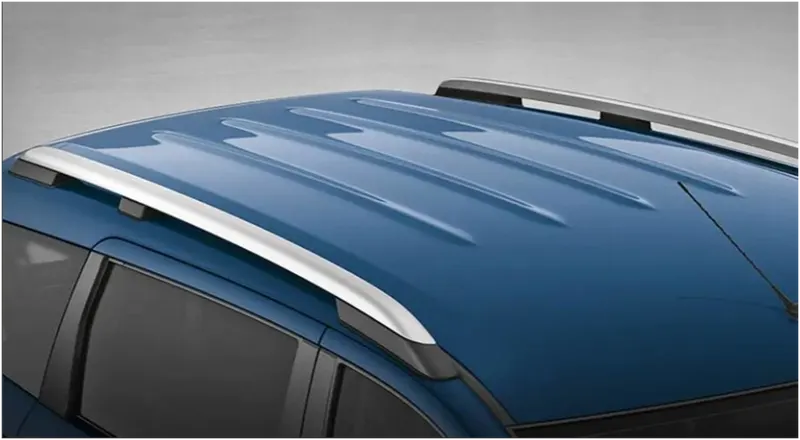
An automobile roof or car top is the portion of an automobile that sits above the passenger compartment. It protects the vehicle occupants from sun, wind, rain, and other external environmental elements. Roof also supports the wind shield glass having the reinforcements to provide strength to the overall structure and to withstand the over head forces like snow.
TYPES OF AUTOMOBILE ROOFS:
- Convertible: A convertible, cabriolet or spyder is a passenger car that can be driven with or without a roof in place.
- Hardtop: A hardtop is a rigid form of automobile roof, which for modern cars is typically constructed from metal. A hardtop roof can either be fixed, detachable for separate storage or retractable within the vehicle itself.
- Sunroof: An Automotive sunroof is a movable panel that is operable to uncover a window in an automobile roof which allows light and fresh air into the passenger compartment.
- T-top: A T-top is an automobile roof with a removable panel on each side of a rigid bar running from the center of one structural bar between pillars to the center of the next structural bar. The panels of a traditional T-top are usually made of auto-grade safety glass.
- Targa Top: It is a semi-convertible car body style with a removable roof section and a full-width roll bar behind the seats.
- Vinyl roof: Vinyl roof refers to a vinyl conversion for an automobile’s top. This conversation was originally designed to give the appearance of a convertible to models with a fixed roof but eventually, it evolved into a styling statement in its own.
WHY REINFORCEMENTS?
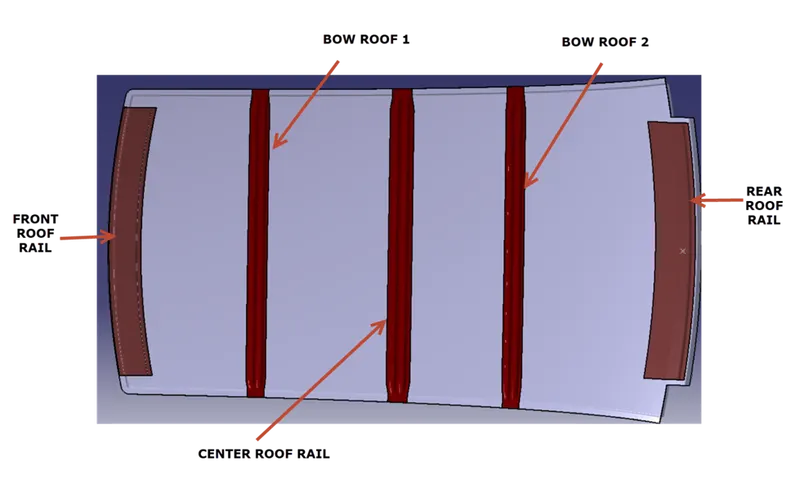
As the thickness of roof is very small so it is very weak and cannot withstand the forces as in case of snow, roll-over etc so in order to increase the strength of the roof these reinforcements like front roof rail, central roof rail, rear roof rail and the bow roofs are introduced and joined to the flat surface of the roof with the different joining process.
Different types of reinforcements that are provided to car roof include:
- Front roof rail
- Bow roofs
- Central roof rail and
- Rear roof rail
FRONT ROOF RAIL:
Front roof rail is the one which supports the wind shield glass, body side outer and the inner panel also.
REAR ROOF RAIL:
Rear roof rail is the one which joins the back door and the body side outer
CENTRAL ROOF RAIL:
Central roof rail helps in providing effectively support to the flat area of the roof as it is more susceptible to failure under the action of load. Generally central roof rail is placed at the center of the roof which is connected to the B-pillar support structure. This central roof rail helps in adding the strength to the roof during the roll-over test.
BOW ROOFS:
The bow roofs improve torsional stiffness and load bearing capacity of the roof structure. The number of bow roof present is depends on the overall size of the roof . Presently in this project two bow roofs are added.
JOINING PROCESS:
Mastics are used between the roof outer panel and the reinforcements for joining these so that no surface deterioration of the outer panel takes place. They also improve NVH by increasing the strength of the roof using mastic sealants.
Spot welding is used to join the reinforcements and the outer panel where there is no direct visibility to the customer.
DESIGN CONSIDERATIONS FOR A ROOF:
- Visibility criteria
- Head clearance
- Curvature study
- Heat distortion and snow load criteria
- Draft analysis for manufacturability
ROOF CRUSH TEST:
Safety point of view vehicle roof plays a very crucial role, especially in rollover kind of accidents, in which the vehicle tips over onto its side of the roof. And vehicle rollover crashes are the cause of many fatalities e.g head, neck, and spine trauma around the world.
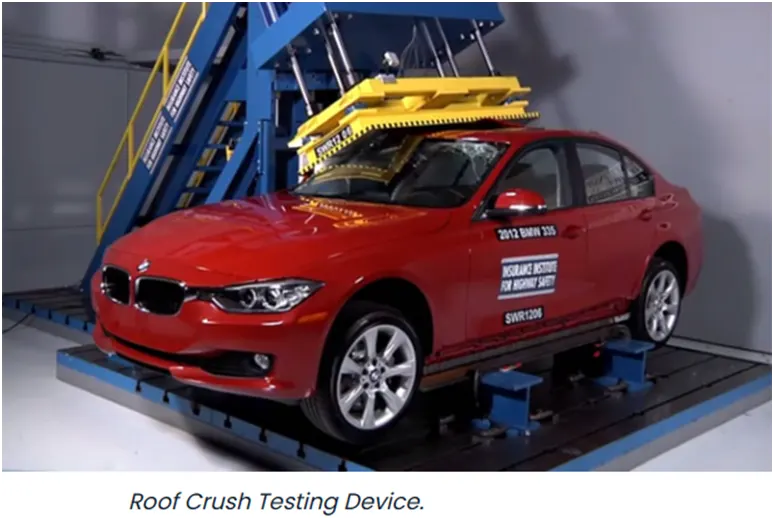
Roof crush test is the design given by the IIHS (insurance institute of highway safety). The strength of the roof structure for occupant protection in real-world rollover crashes, requiring the maximum moving distance of the roof structure should be less than 127 mm (5 in.) when the induced load is 1.5 times the vehicle weight.
For the test, the passenger car shall be rigidly placed or positioned on a horizontal surface with the doors locked and the window closed. Furthermore, a flat, rigid block with a lower surface a rectangle measuring 30 inches wide by 72 inches long (762mm X 1829mm) shall not move more than 5 inches(127mm), measured as the distance between the original location of the lower surface of the test device and its location as the specified force level is reached, when it is used to apply a force of 1.5 times the unloaded vehicle weight or 5000 lbs(22224N), whichever is less, to either side or forward edge of the vehicle.
This test can be conducted on either side of the roof structure, the front left or the front right side but not on both sides in one single test and still meet the requirements of the test. The rigid plate shall not move faster than 0.5 inches/second and the force applied on the plate shall not exceed the lesser of 1.5 times the unloaded vehicle weight expressed in kilograms multiplied by 9.8 or 5000lbs (22240N). Also, the direction of the force shall be downward and perpendicular to the lower surface of the rigid plate such that it moves in a straight line without rotation. The duration of the test shall not exceed 120 seconds. The longitudinal axis of the plate is pitched forward at a 5 º angle as viewed from the side of the passenger car as shown in the below figure:
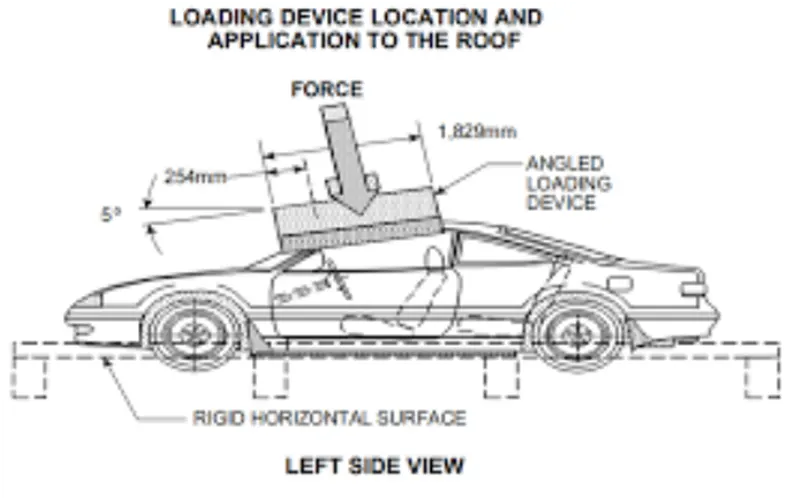
Loading on the Roof at 5°
The lateral axis or the roll of the plate is such that it forms a 25 º outboard angle with a horizontal surface as viewed from the front of the passenger car as shown in below figure:
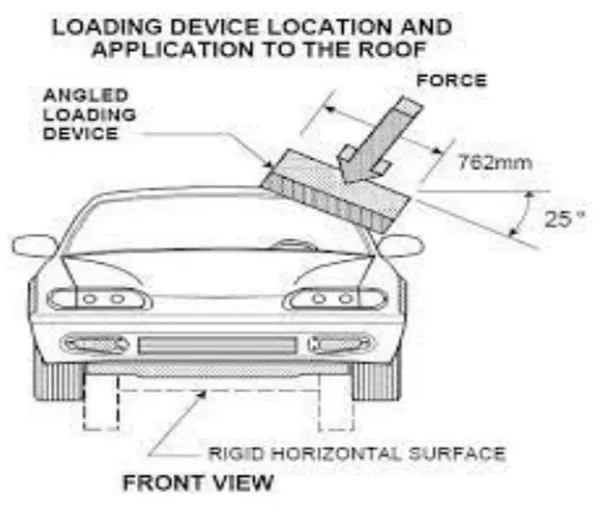
Loading on the Roof at 25°
CAR ROLL-OVER TEST:
The rollover test is conducted because a rollover is a type of vehicle crash in which a vehicle tips over onto its side or roof. Rollovers have a higher fatality rate than other types of vehicle collisions.
Vehicle rollovers are divided into two categories: tripped and untripped. Tripped rollovers are caused by forces from an external object, such as a curb or a collision with another vehicle. Untripped crashes are the result of steering input, speed, and friction with the ground.
Vehicles which have a higher center of gravity like SUVs or Small Trucks are more prone to rollover. Rollover accidents typically involve a singular vehicle that loses control due to icy or snowy road conditions, soft road shoulders, uneven ground, collision with curbs or guardrails after a vehicle has lost traction, or hitting an obstacle while driving.
During a rollover accident, the regional body distribution of injuries normally affects five main areas: head and neck, thorax, abdomen, upper limbs, and lower limbs. The majority of rollover crash victims sustain multiple injuries throughout these regions with the head and neck being the most vulnerable area. Some of the most common rollover injuries include traumatic brain injury, spinal cord injury, broken bones, cuts, scrapes, and bruises. These injuries are caused by slamming into another vehicle or obstacle, impact with unsecured cargo, contact with broken glass or torn metal, or being tossed within the vehicle or ejected from the vehicle.
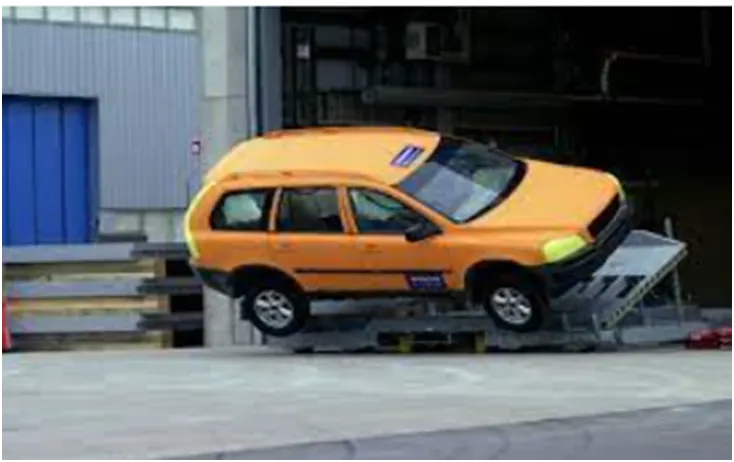
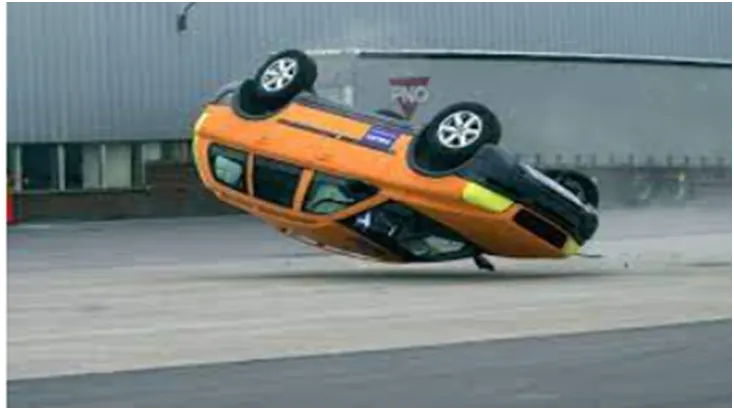
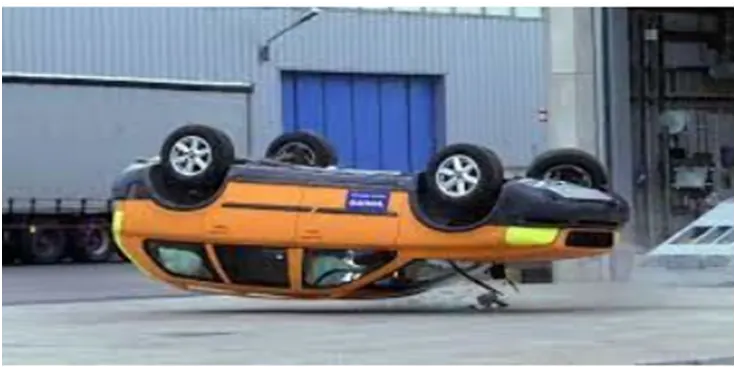
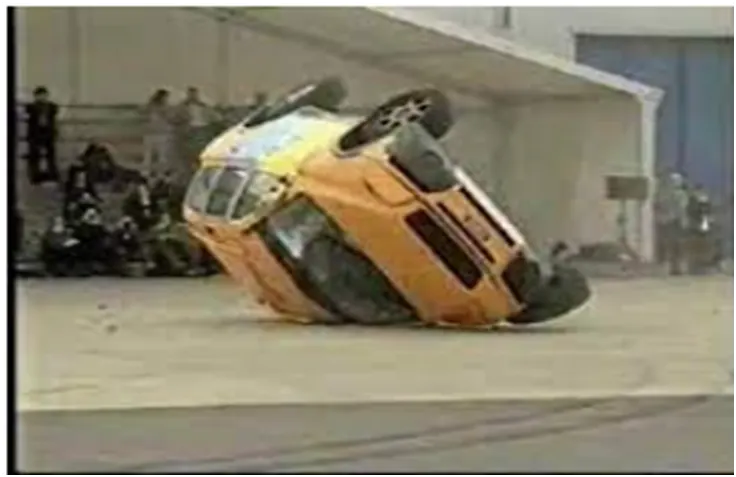
Images of Car Roller Test carried out by Volvo.
If the displacement is more than the permissible limit then we have to increase the bow roof thickness or add more mastics points to increase the strength. Stronger the roof the better it can protect the occupants in the roll-over crash.
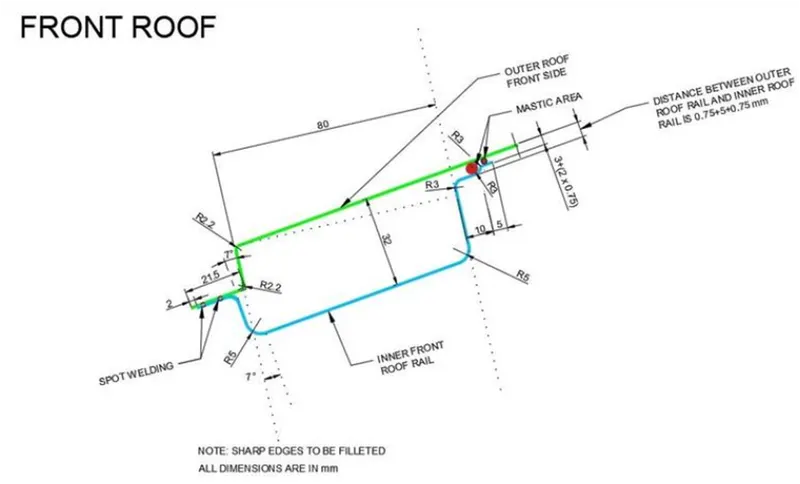
GIVEN MASTER SECTION
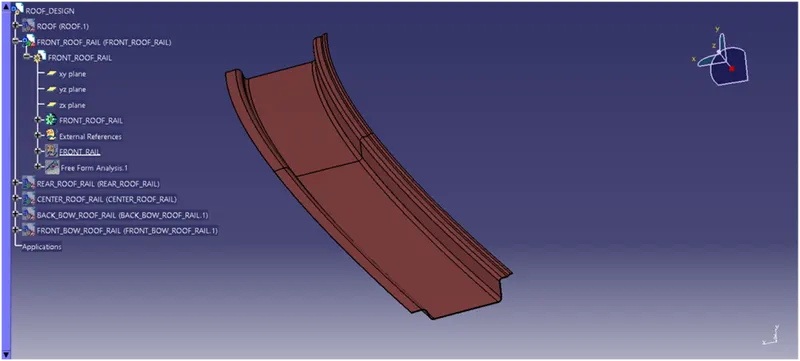
CREATED PART
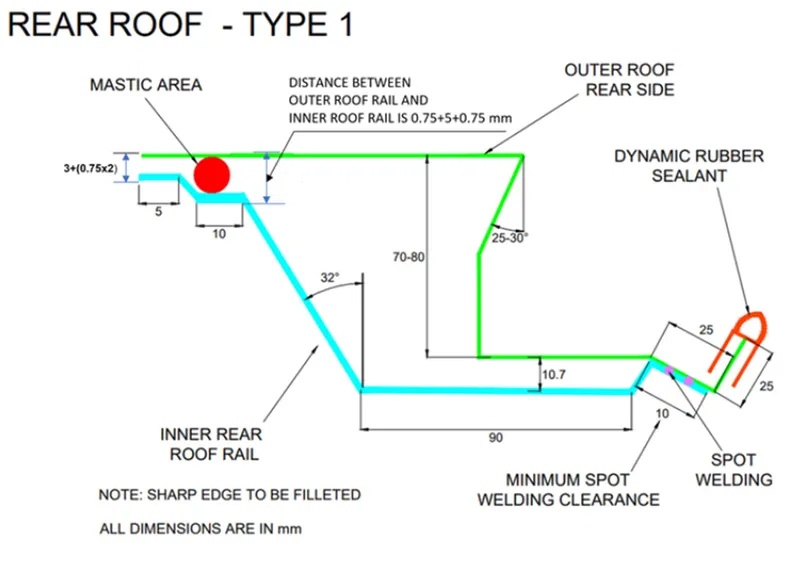
GIVEN MASTER SECTION
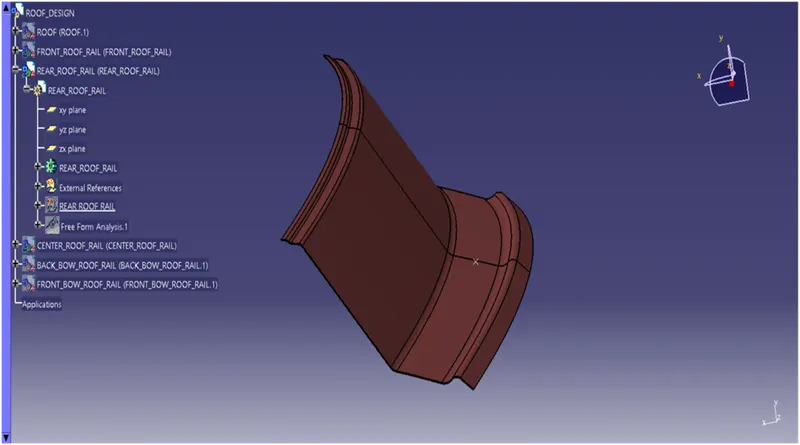
CREATED PART
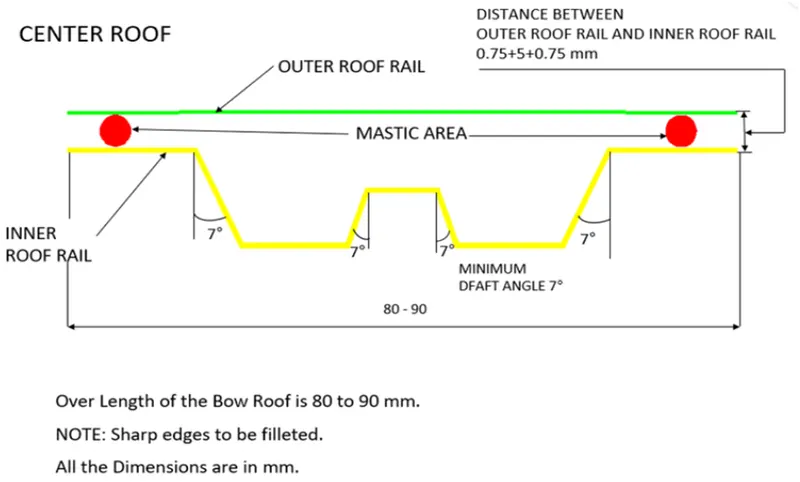
GIVEN MASTER SECTION
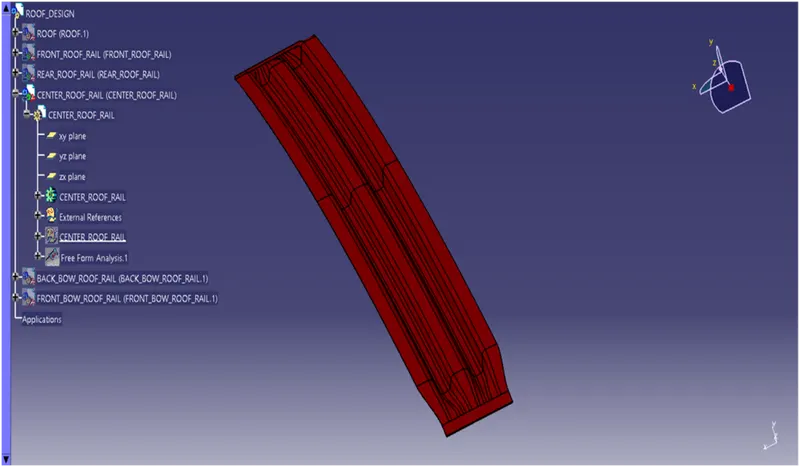
CREATED PART
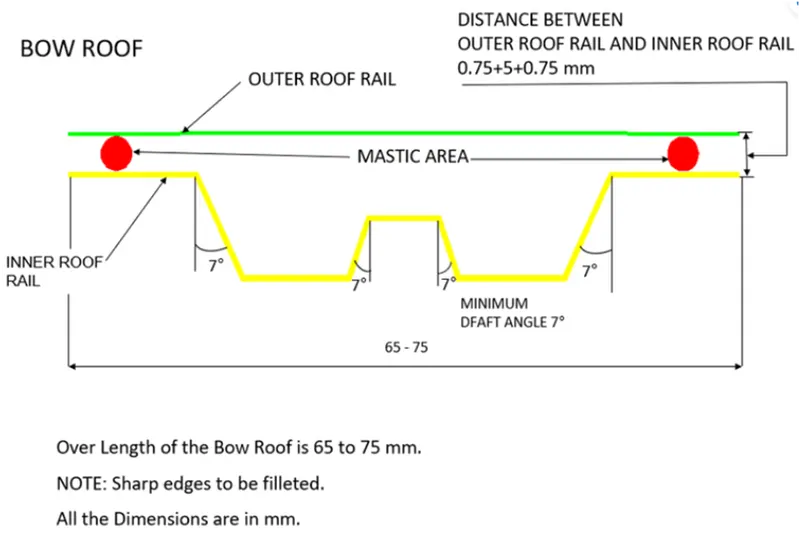
GIVEN MASTER SECTION BOW ROOFS
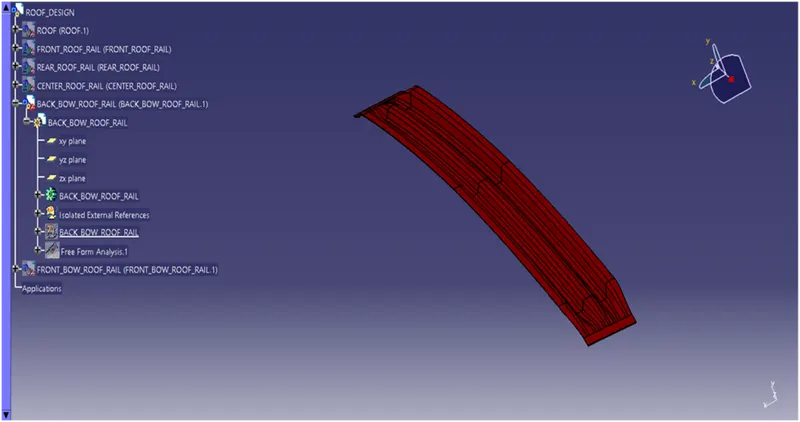
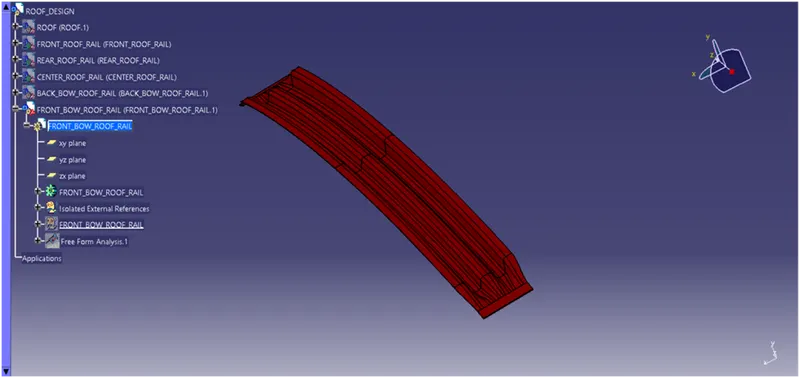
CREATED PARTS
HEAT DISTORTION STUDY ON THE ROOF:
Heat distortion temperature is a temperature limit above which the material cannot be used for the structural applications. This study is used to predict the heat distortion temperature at where the material starts to soften when exposed to a fixed load at elevated temperature. In order to avoid bending or damages on the roof, based on the heat distortion temperature, this study will predict the bow roof position which helps to strengthen the roof.
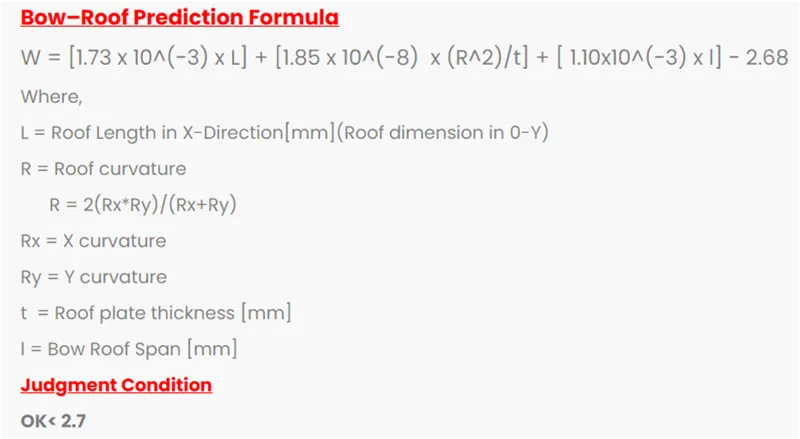
Bow – roof prediction Formula
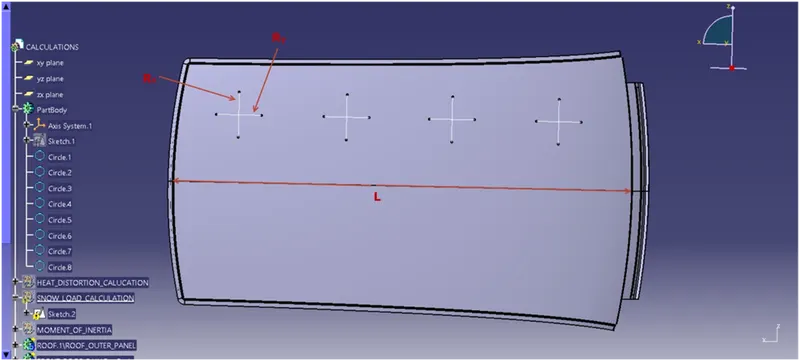
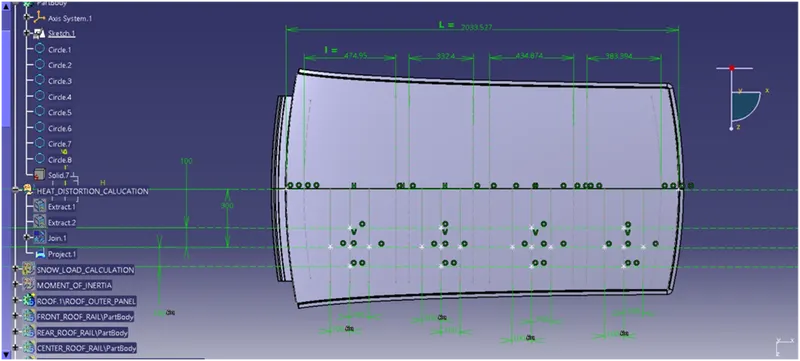
CALCULATIONS:
Calculations have been performed in the EXCEL sheet

Where
FRR = front roof rail
FBRR = front bow roof rail
CRR = center roof rail
BBRR = back bow roof rail
SECTION MODULUS:
Section modulus is a geometric property for a given cross-section used in the design of beams or flexural members. Other geometric properties used in design include area for tension and shear, radius of gyration for compression, and moment of inertia and polar moment of inertia for stiffness. Any relationship between these properties is highly dependent on the shape in question. Equations for the section moduli of common shapes are given below.
The elastic section modulus is defined as
S = I / y
Where:
S= Section modulus
Imin = minimum area moment of inertia
y = the distance from the neutral axis to the extreme fibre.
Create an intersection curve with the help of the plane and select the respective roof rail.
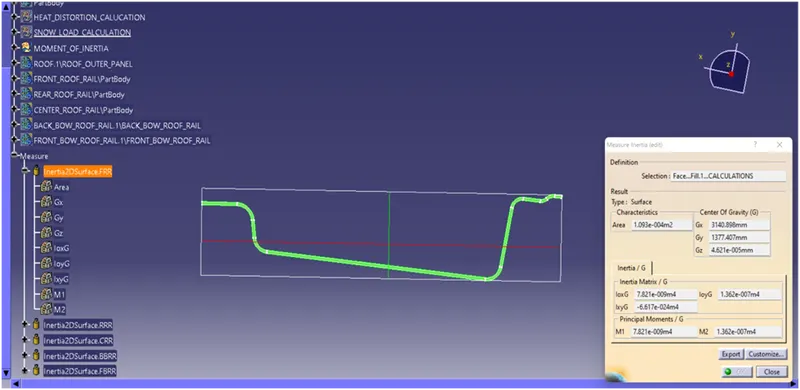
FRR CROSS SECTION
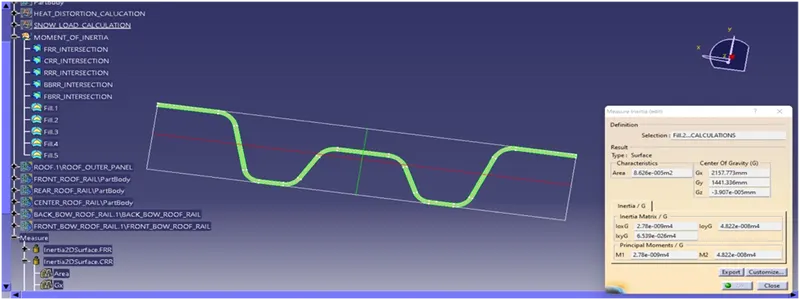
CRR CROSS SECTION
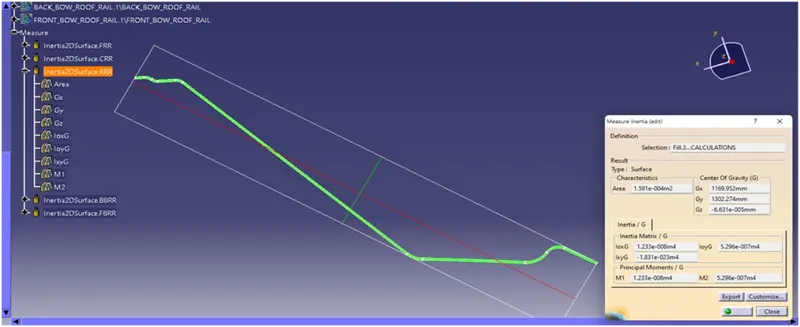
RRR CROSS SECTION
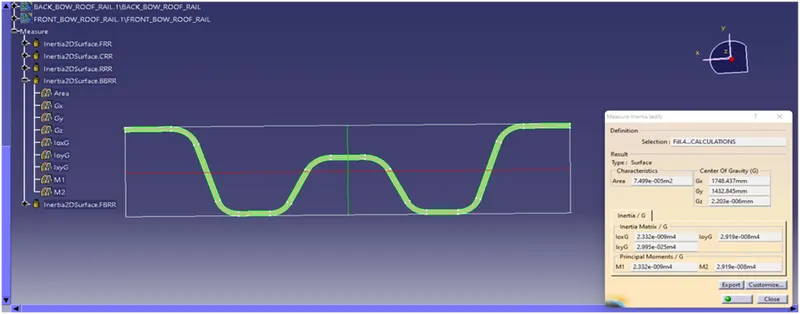
BBRR
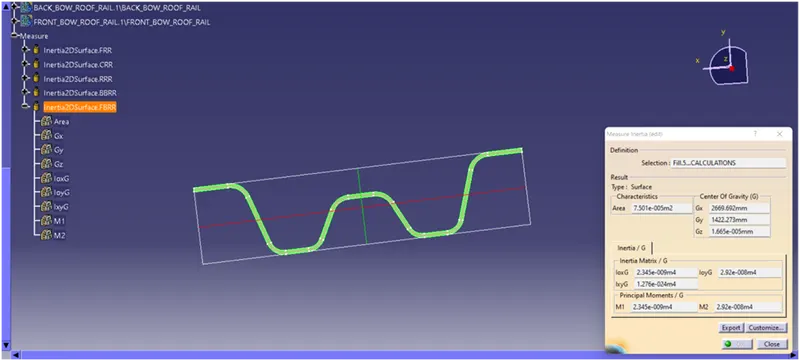
FBRR
SNOW LOAD CRITERIA STUDY:
This test is done to know how the roof will behave when there is a snow over the roof. But the roof should be designed in such a way that when the snow is removed the roof should go it its original position. This is the basic requirements for snow load criteria.
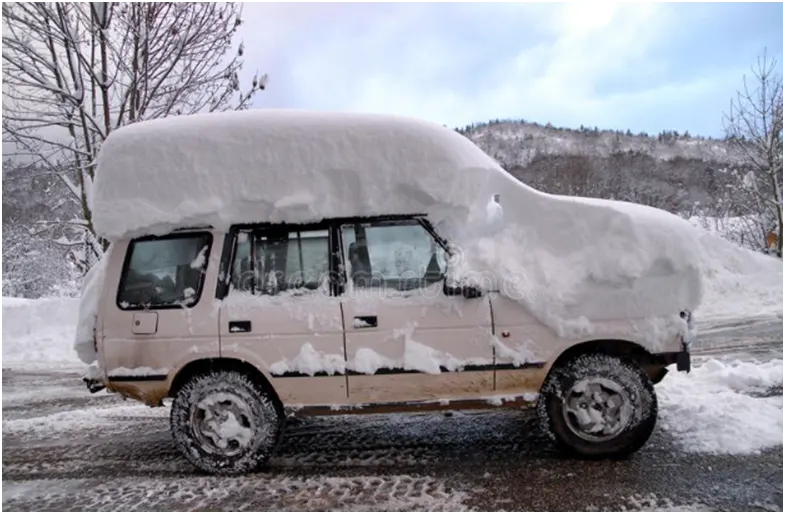
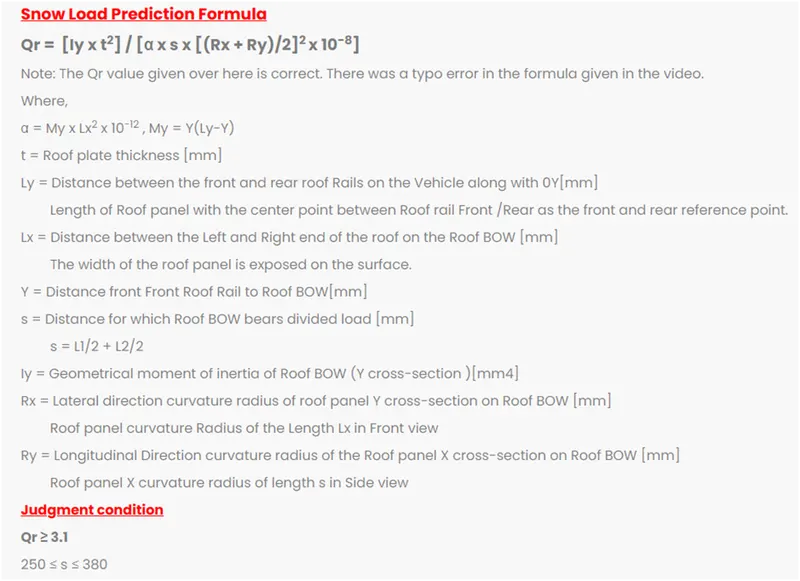
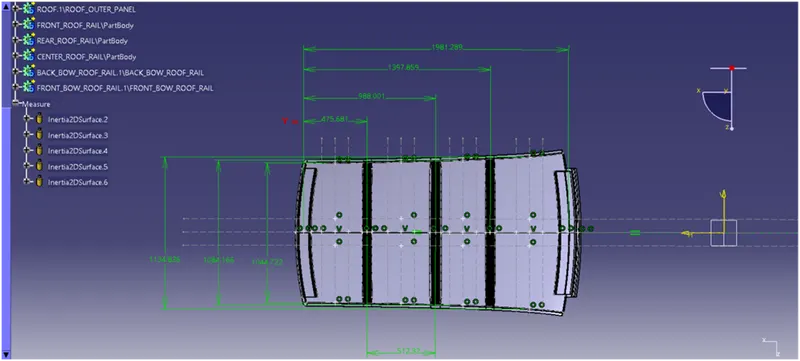
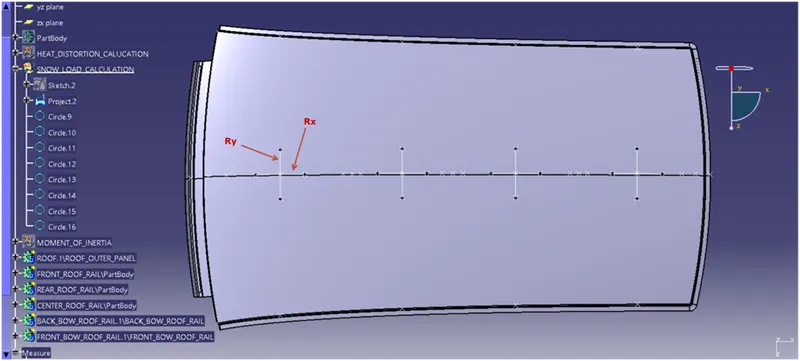
In order to find the snow load criteria put all the necessary values from the roof in the given above formula:
CALCULATIONS:
Calculations have been performed in the EXCEL sheet

DRAFT ANALYSIS:
The Draft Analysis command enables us to analyze if the part created will be easily removed from the die.
This type of analysis is based on color zones ranges from zero to specified value of draft angle on the surface of the part created.
Minimum draft angle of 70 has been considered for analysis.
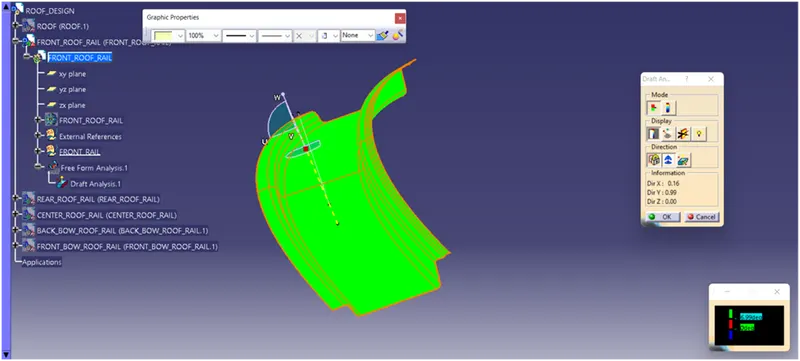
Draft analysis of FRR at 70
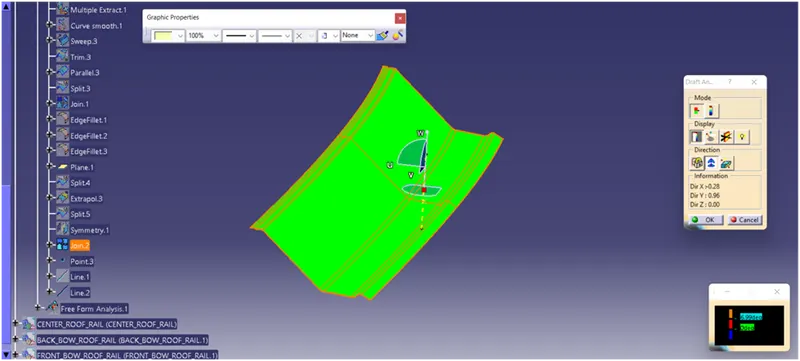
Draft analysis of BRR at 70
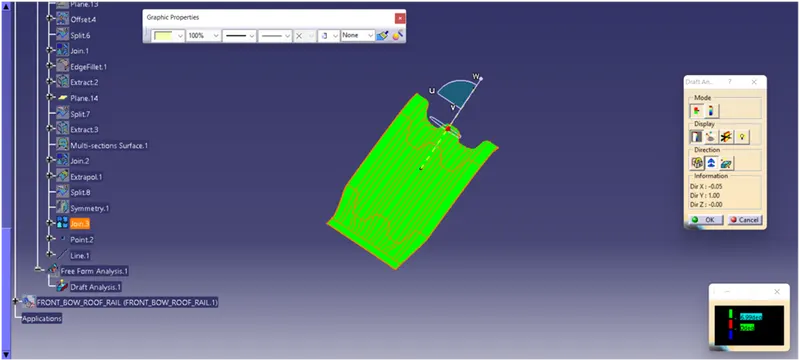
Draft analysis of CRR at 70
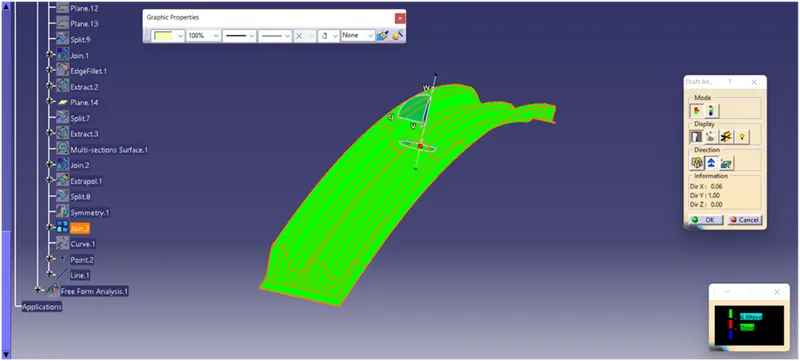
Draft analysis of BBRR at 70
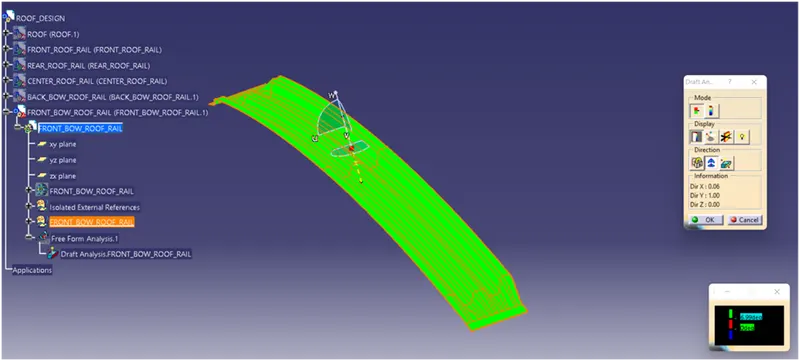
Draft analysis of FBRR at 70
CONCLUSION:
It is observed from the values that obtained values of
W < 2.7
Qr > 3.1
But values of S does not satisfy the range
250<S<380
For snow load criteria as Qr must be satisfied first and then S. So as far as deflection is within permissible range we can go for the manufacturing as Qr is satisfied.
When it comes the question of safety of passengers then we need to adjust the position and number of roof rails since the span criteria between the roof rails is not satisfied in case of a roll-over of car.