Fender Design - Wheel Arch Challenge
Introduction:
Fender is a part of an automobile, cycle or any other vehicle Its primary purpose is to prevent sand, mud, rocks, liquids, and other road spray from being thrown into the air by the rotating tire. For a vehicle moving forward, the top of the tire is rotating upward and forward, and can throw objects into the air at other vehicles or pedestrians in front of the vehicle.
Types of fender:
The type of fender is based upon the area covered i.e.. full fender type and half fender type.
- Full fender type:
Full fender type is traditional type of fender where more material consumption is observed. This type is used in old design of automobiles where it increases the overall weight and thus reduces performance. The maintenance also relatively more due to more surface.
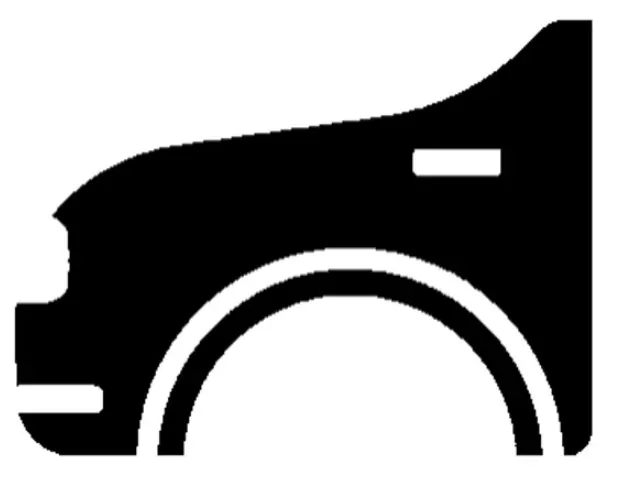
- Half fender type:
Half fender type is modern design where less material consumption is observed, so productivity increases by reducing size of blank and thus providing more performance. The maintenance also relatively low compared to full fender type.

Some of the regulations which provide clearance as per the requirement in different regions are US. Japan and Europe. Some manufacturers provide the clearances which meet standards in different regions.
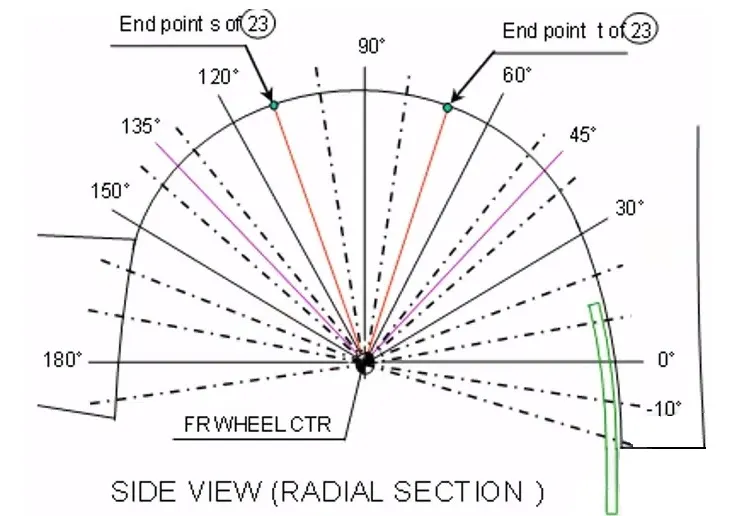
US Regulation Standards: The clearance L is calculated from -100 to 100 axes on all the positions. The minimum clearance requirement is 5mm which satisfy the regulation. The value shall be more than 5mm at a line 20 forward and 20 rear side from the centre vertical axis of the wheel. The schematic diagram represents various positions at which clearance L is calculated and measured.
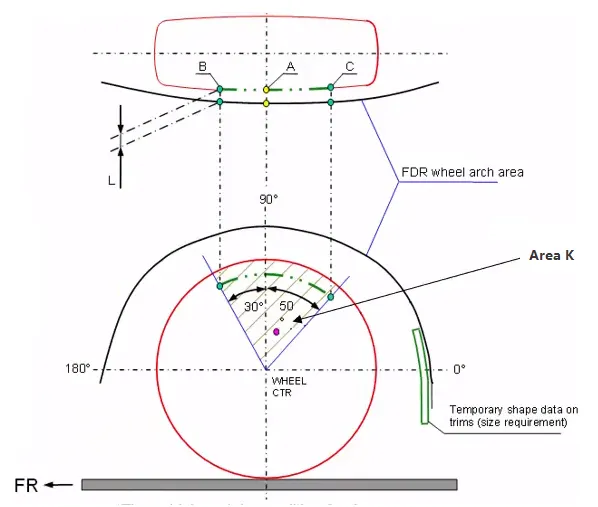
Japan Regulation Standards: The clearance L is measured at the tire, hub, cap and fender in three different positions. Area K is generated from vertical axis of wheel centre and from vertical axis on both sides 30 line and 50 line in forward and rearward respectively. The Clearance is calculated within the area K. The minimum clearance is requirement is similar to US regulation i.e., more than 5mm at the required points.
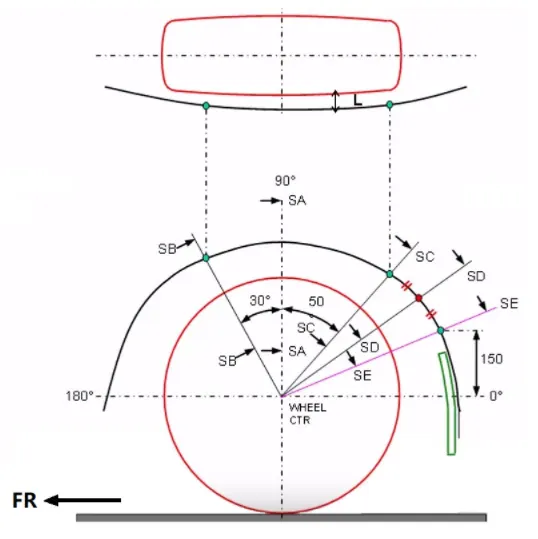
European Regulation Standards: The clearance L is calculated at 5 different points which are produced from SA, SB, SC, SD & SE axes respectively. SA is the vertical axes and SB is 30 degree forward from SA and SC is 50 degree rear side from SA. SE is obtained from point of intersection of wheel arch and a horizontal axis about 150mm from wheel center horizontal. SD is the median of SC & SE. The minimum clearance L should be more than 10mm.
All the above standards are required to be achieved according to the particular region.
Objective: To Calculate the Wheel Arc area as per European regulation standards and prove whether the car will pass the standards or not.
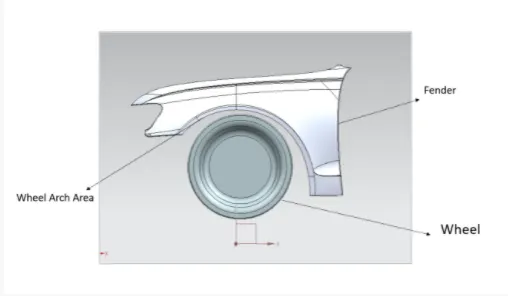
First of all, A plane is created on the outer most edge of the wheel to produce the required axes on that plane.
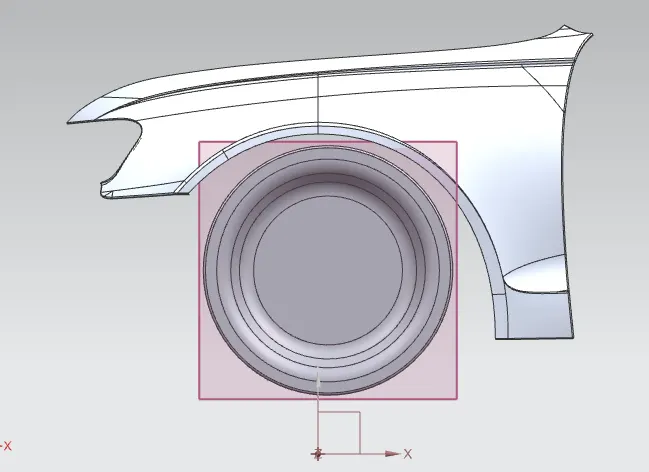
Now, A horizontal axis taken from wheel center and mark 0 and 180 degrees on both sides of fender from wheel center. A vertical axis is taken from wheel center and named it as SA. A line 30 forward to SA through wheel center is named as SB. Similarly, A line 50 rearwards is taken and name as SC A horizontal line at distance of 150mm from wheel center axis meet at the wheel arch edge. Line passing through wheel center and obtained point is named as SE A median between SC & SE is named as SD. Thus, all the Required Five axes are obtained as below:
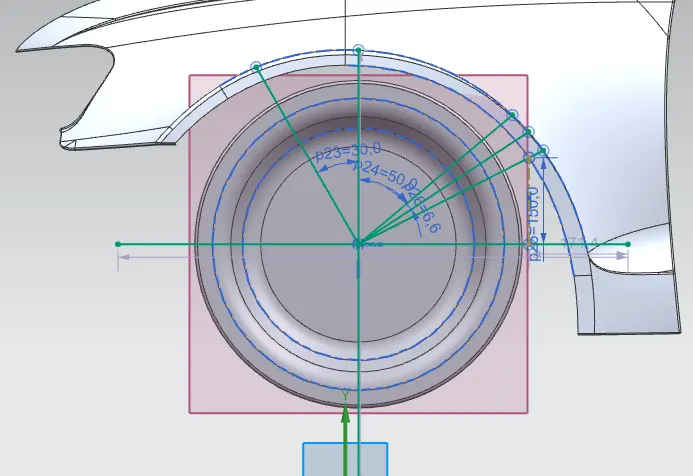
Then the axes are projected in both direction on the outermost edge of the wheel arch to obtain points to measure the clearance.
The clearance L at SA (wheel edge) and SA’(wheel arch edge):
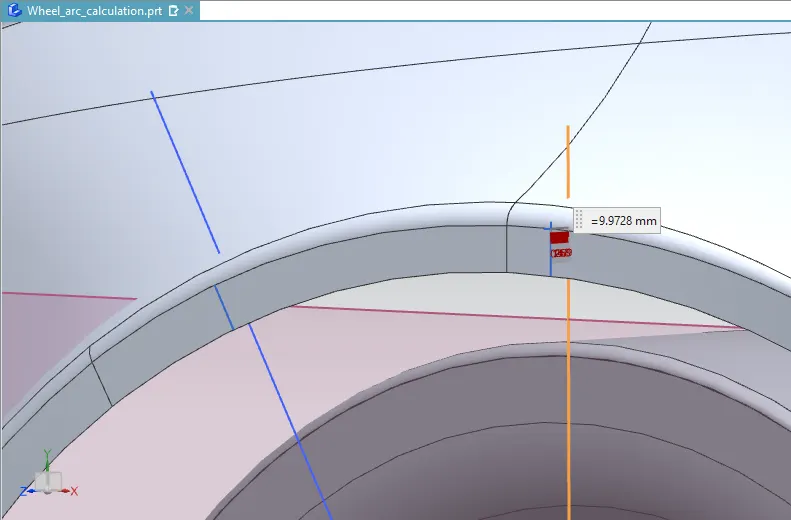
The clearance L at SB (wheel edge) and SB’(wheel arch edge):
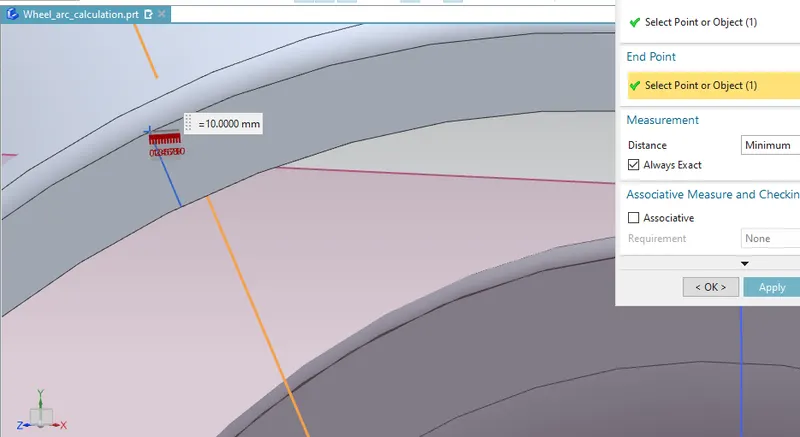
The clearance L at SC (wheel edge) and SC’(wheel arch edge)
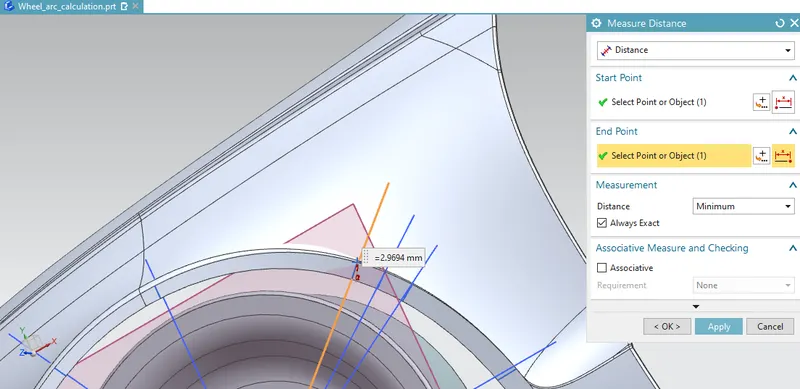
The clearance L at SD (wheel edge) and SD’(wheel arch edge)
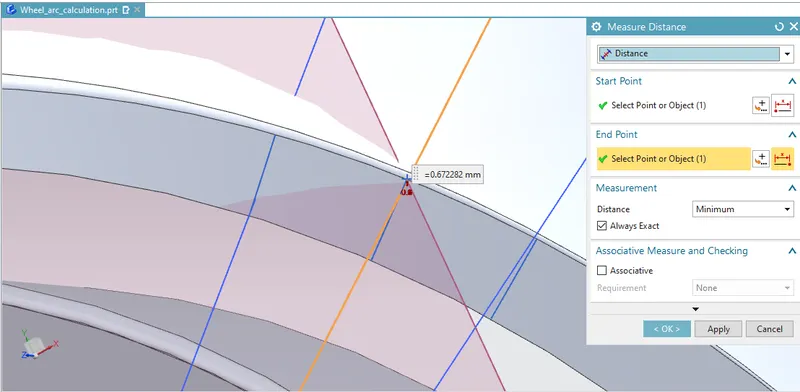
The clearance L at SE (wheel edge) and SE’(wheel arch edge)
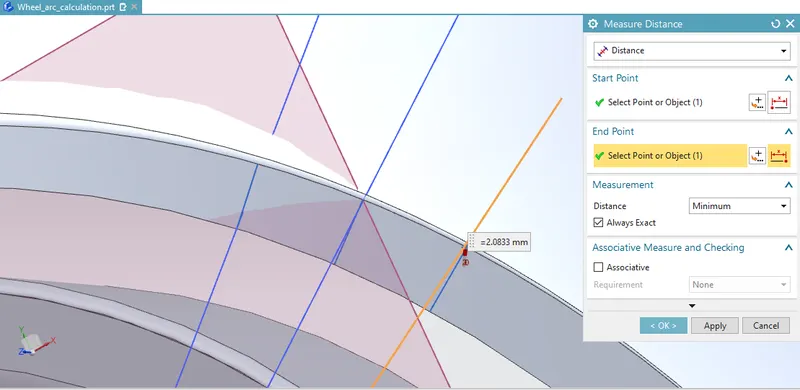
From all the measured clearance value at the required points they are tabulated as below:
POSITION MEASURED VALUE REQUIRED VALUE QUALIFIED(YES/NO)
SA 09.9728 10 NO
SB 10.0000 10 YES
SC 02.9694 10 NO
SD -00.67228 10 NO
SE -02.0833 10 NO
Obtaining value of clearance 'a' for the wheel guard:
a. Finding the value of "a" at line 30 degree forward from central vertical axis of the wheel
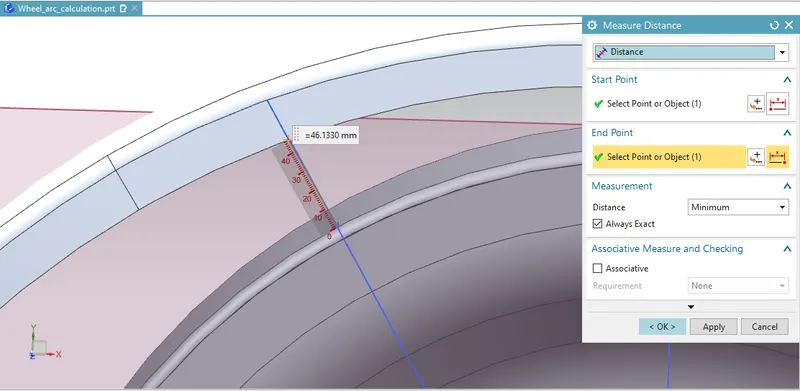
It is found to be a=46.1330 mm
b. Finding the value of "a" at line 50 degree rearward from central vertical axis of the wheel
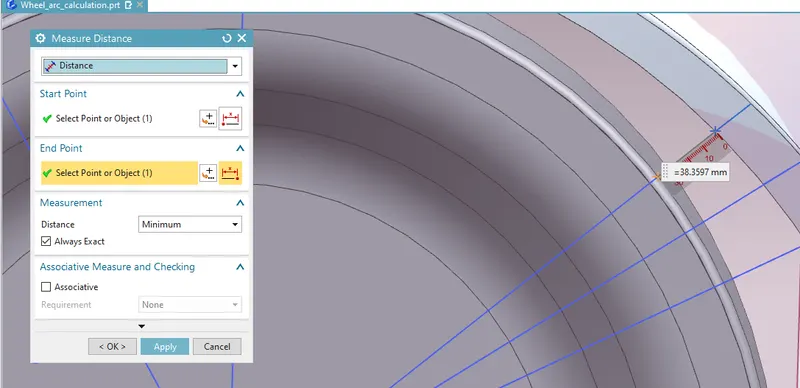
It is found to be a=38.3597 mm
POSITION MEASURED VALUE REQUIRED VALUE QUALIFIED(YES/NO)
SB 46.1330 5 YES
SC 38.3597 5 YES
Wheel Arch area of the fender:
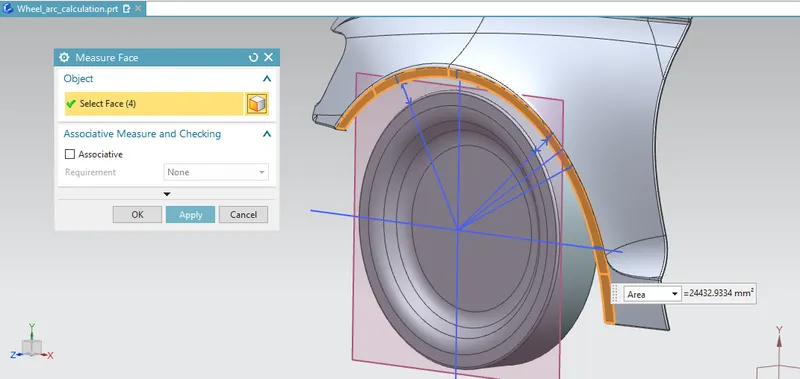
Wheel Arch Area=24432.9334 mm^2
Conclusion:
After measuring the clearance values as per the European regulation standards at all the five points only one value i.e. at SB satisfies the condition and Rest all are below 10mm. In order to qualify the European standards, all the clearance values should be above 10mm. Hence the given model doesn't not pass through the European regulation standards. The model is sent for styling department to make necessary changes to qualify.