Week 4 - CHT Analysis on Exhaust port
REPORT ON CHT ANALYSIS ONEXHAUST PORT
AIM
- Give a brief description of why and where a CHT analysis is used.
- Maintain the y+ value according to the turbulence model and justify the results.
- Calculate the wall/surface heat transfer coefficient on the internal solid surface & show the velocity & temperature contours in appropriate areas.
- How would you verify if the HTC predictions from the simulations are right? On what factors does the accuracy of the prediction depend on?
THEORY
Conjugate Heat Transfer (CHT):
Conjugate Heat Transfer is the method of heat transfer between the fluid and the solid. This type of heat transfer includes both convection (between fluids) and conductive (between solids) heat transfer, as well as both forced and natural convection. Common applications and use cases of this thermal simulation type include electronics cooling, heat exchangers, industrial machinery, some AEC cases, and more. Also it describes the heat transfer between a body and a fluid flowing over or inside it as a result of the interaction of two objects. The physical processes and solutions of the governing equations are considered separately for each object in two subdomains. Matching conditions for these solutions at the interface provide the distributions of temperature and heat flux along the body–flow interface, eliminating the need for a heat transfer coefficient.
Applications
The conjugate heat transfer methods have become a more powerful tool for modeling and investigating nature phenomena and engineering systems in different areas ranging from aerospace and nuclear reactors to thermal goods treatment and food processing, from complex procedures in medicine to atmosphere/ocean thermal interaction in meteorology, and from relatively simple units to multistage, nonlinear processes.
Conjugate heat transfer methods have improved as a modelling and investigational tool for natural phenomena and engineering systems in a variety of fields, including aerospace and nuclear reactors, thermal goods treatment, food processing, complex medical procedures, and ocean thermal interaction in metrology.
Through the design of heat sinks and heat exchangers for the waste treatment plant, CHT has greatly improved the cooling performance of electronic equipment in recent years. The exhaust port system is one such CHT use.
Heat Transfer Coeffiicent: It is a constant used to calculate the flow rate inside or over a body.
It is used in calculating the heat transfer, typically by convection or phase transition between a fluid and a solid. The heat transfer coefficient has SI units in Watts per square meter Kelvin (W/m2/K).
The overall heat transfer rate for combined modes is usually expressed in terms of an overall conductance or heat transfer coefficient, U. In that case, the heat transfer rate is:

where (in SI units):
- A: surface area where the heat transfer takes place (m2)
- T2: temperature of the surrounding fluid (K)
- T1: temperature of the solid surface (K)
-
The general definition of the heat transfer coefficient is:

where:
- q:heat flux(W/m2); i.e., thermal power per unit area, `q = (d dotQ)/(dA)`
- ΔT: difference in temperature between the solid surface and surrounding fluid area (K)
There are numerous methods for calculating the heat transfer coefficient in different heat transfer modes, different fluids, flow regimes, and under different thermohydraulic conditions. Often it can be estimated by dividing the thermal conductivity of the convection fluid by a length scale. The heat transfer coefficient is often calculated from the Nusselt number. There are also online calculators available specifically for Heat transfer fluid applications. Experimental assessment of the heat transfer coefficient poses some challenges especially when small fluxes are to be measured (e.g. < 0.2 W/cm2).
PROCEDURE
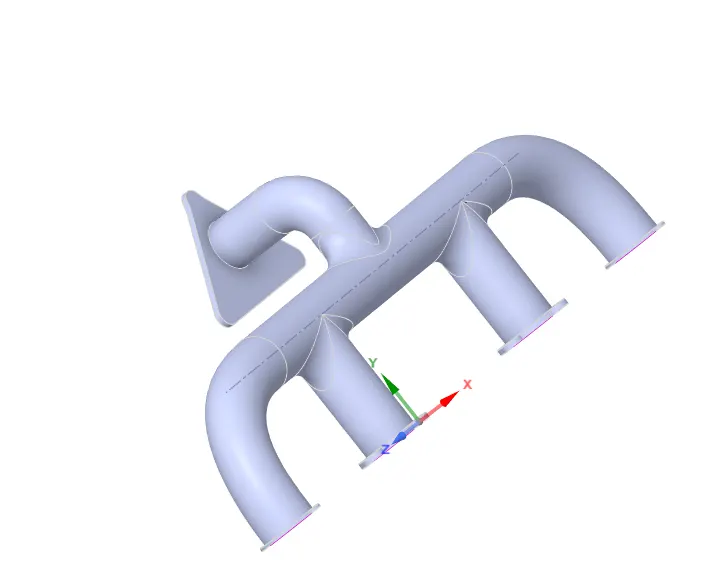
At first we create the geometry that is being provided to us
Then we extract the fluid volume using volume extract feature in the geometry and also we use the Share Topology for sharing the mesh at the interface of the two volumes. For CHT we want the mesh of two volumes overlap each other. The step Share Prep takes care of creating the interfaces, so that we have only one interface between te two volumes
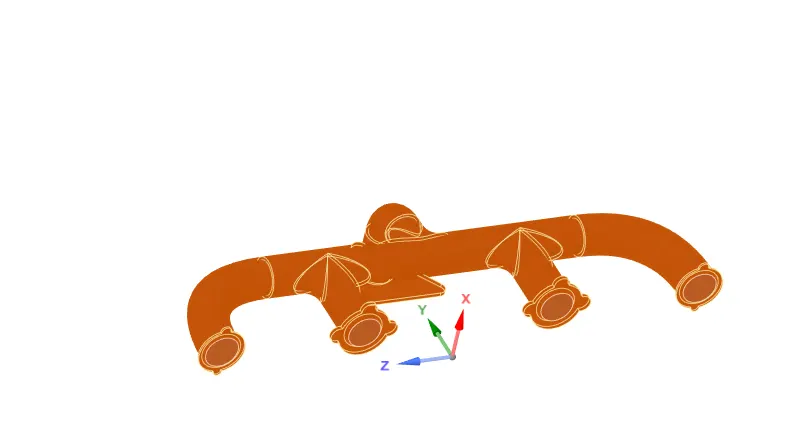
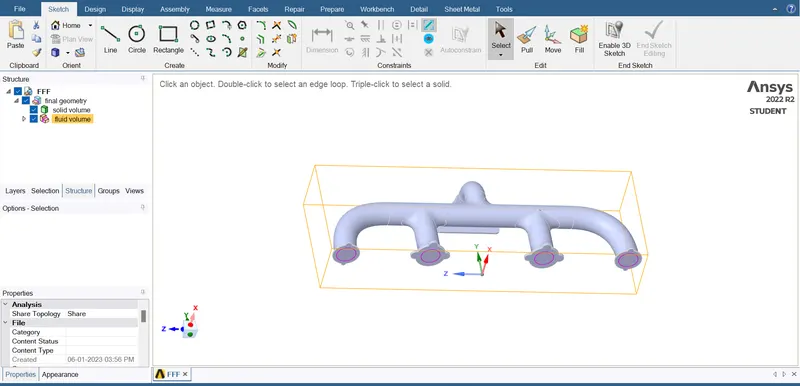
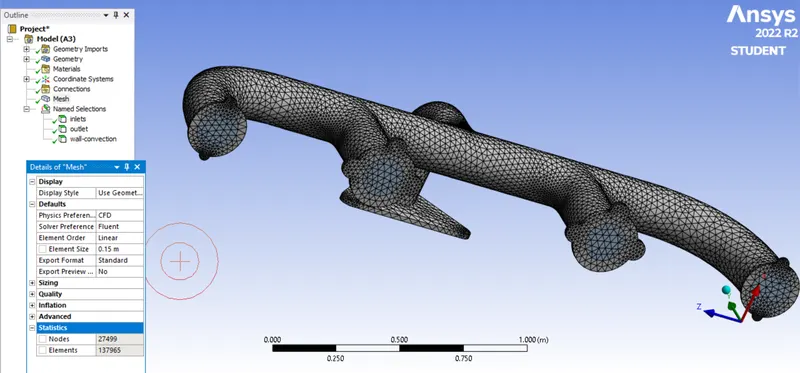
After generating the mesh with the share prep activated we get the following image
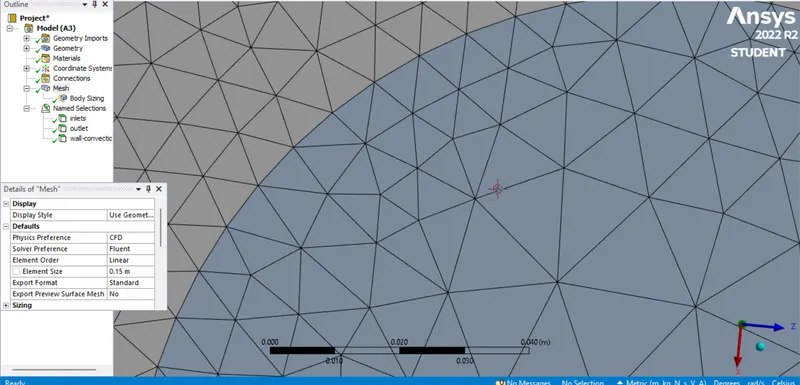
Here we can see that there is an interface between the two volumes which is properly shared.
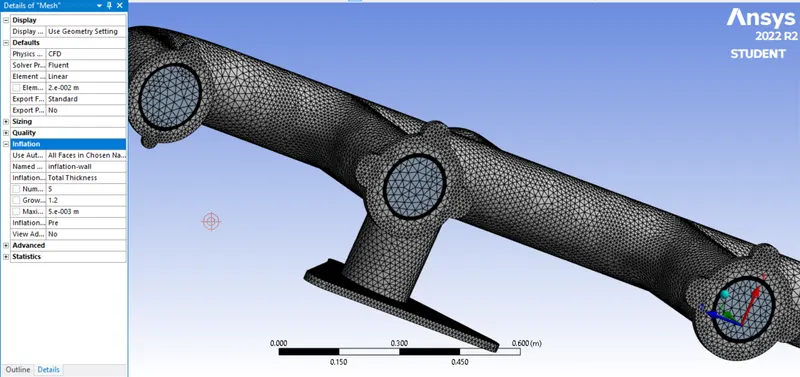
Then we create the mesh for the geometry with the default element size of 0.15
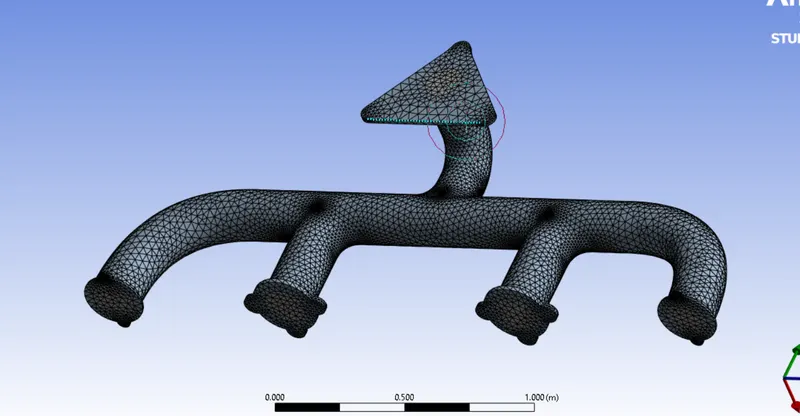
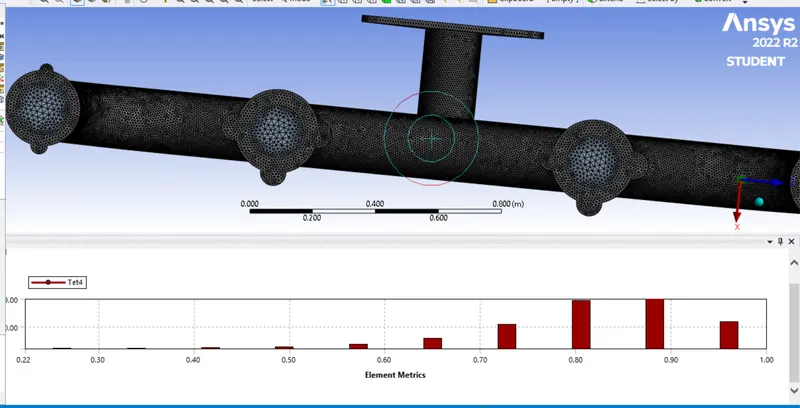
We also checked whether the element quality is on the required level or not, which is on the required level of above 5%
Now we start setting up the physics by giving the initial and boundary conditions such as inlet velocity = 5 m/s temperature = 700 k and heat transfer coefficient of 20 W/m^2K
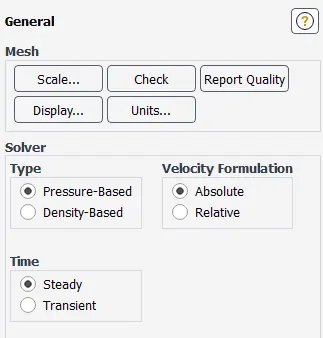
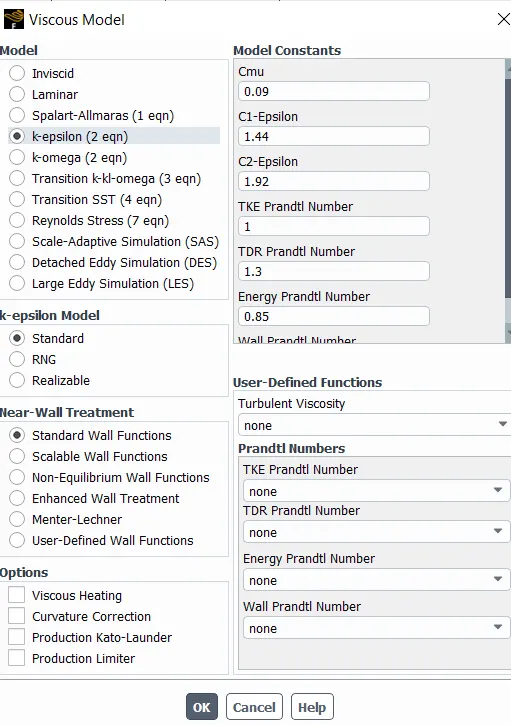
We use the pressure based steady state solver with K-epsilon as the viscous model
The materials used are fluid with air as the fluent fluid material and aluminium as the Fluent solid material for solid material
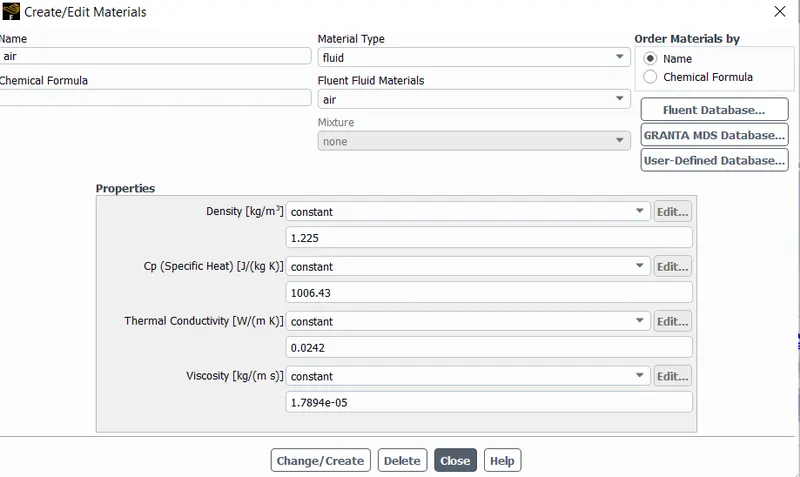
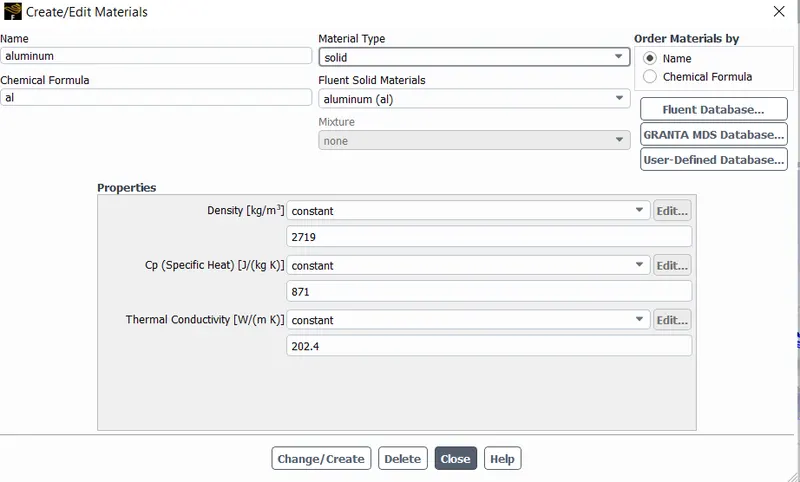
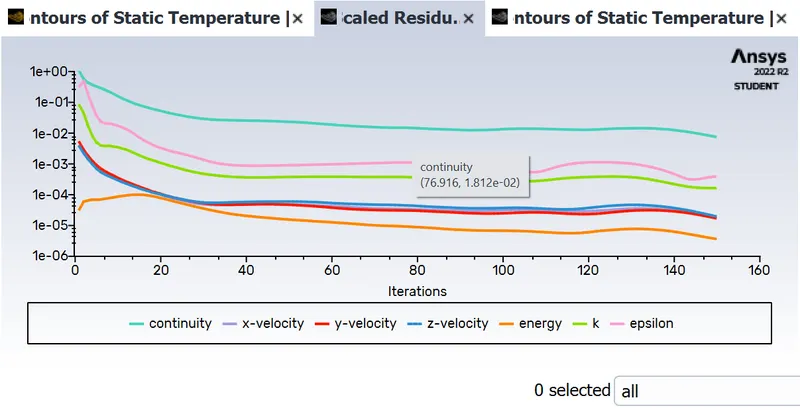
Then we create the animation and velocity contour plots after initialization and then we run the program for 150 iterations.
RESULTS
Case 1: Running the program for 150 iterations with element size of 0.15m and without inflation layer
Residuals
Velocity contour
Temperature contour
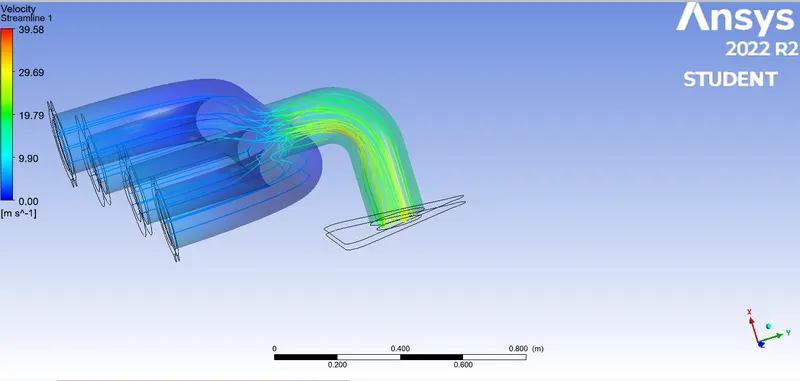
Velocity streamlines
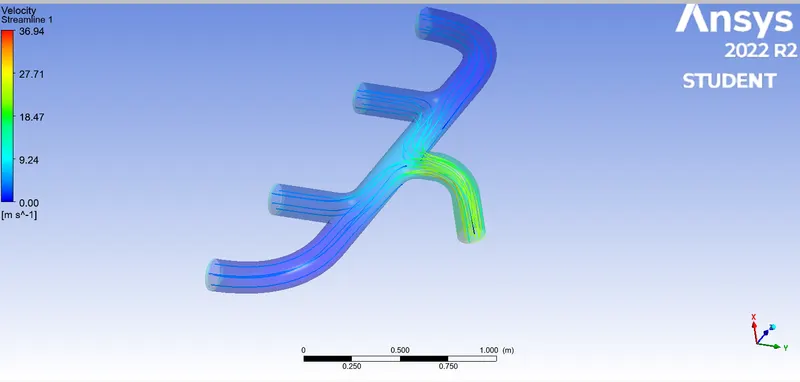
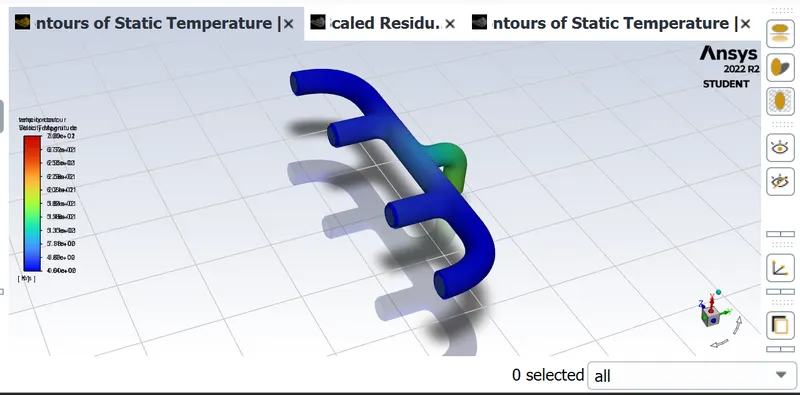
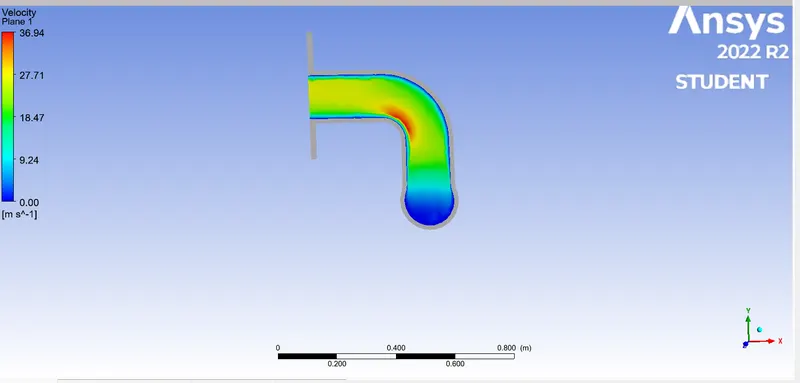
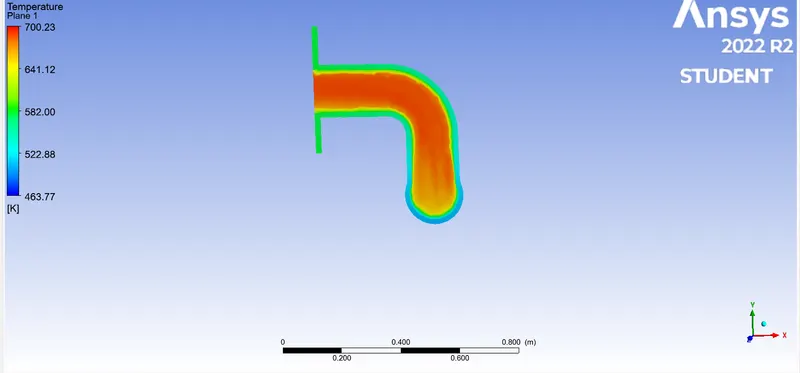
Here we can see that velocity at outlet is higher as compared to the inlet because of the higher volume flow rate from the 4 inlet to the single outlet. Thus Re will be high, which results in higher heat transfer coefficient. Thus more heat transfer from thee fluid to the solid is at the outlet. Thus temperature at outlet is also higher.
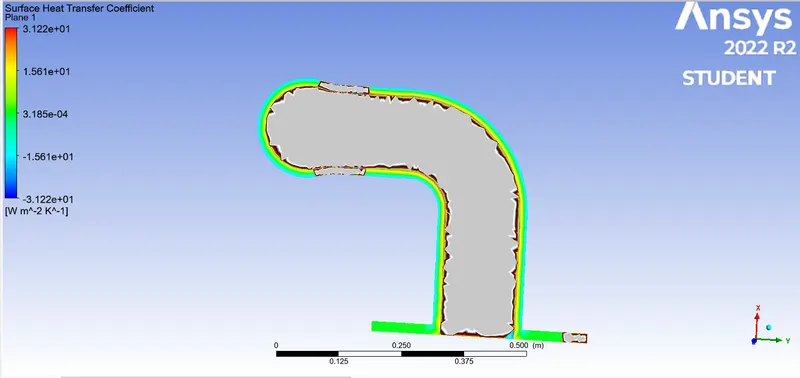
Heat transfer coefficient
Case 2 : Running the program for 150 iterations with element size of 0.02m and with inflation layer
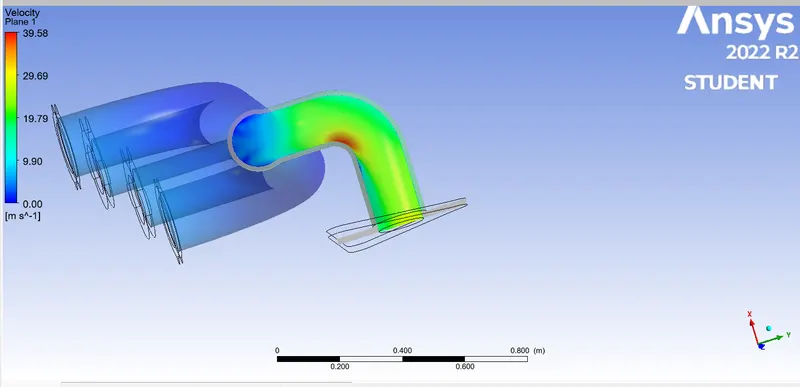
Velocity contour
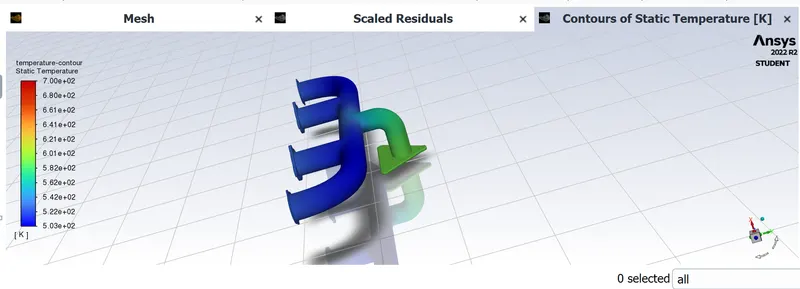
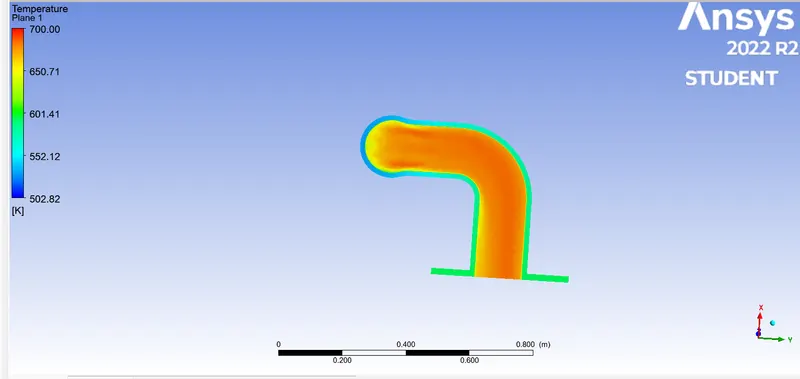
Temperature contour
Velocity streamlines
Heat transfer coefficient
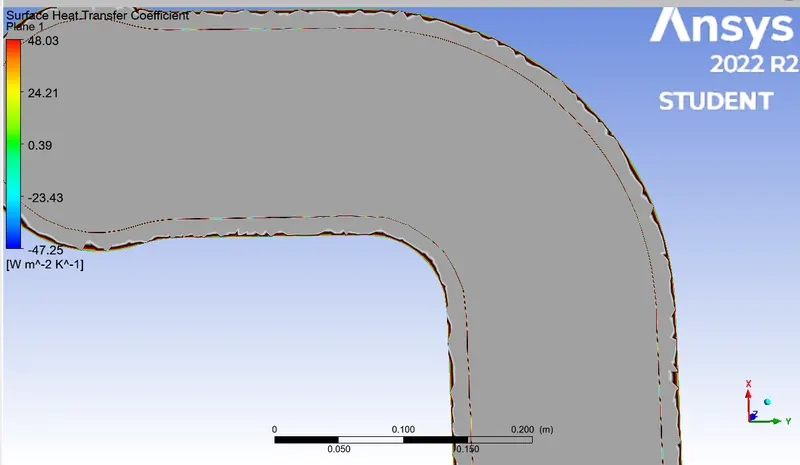
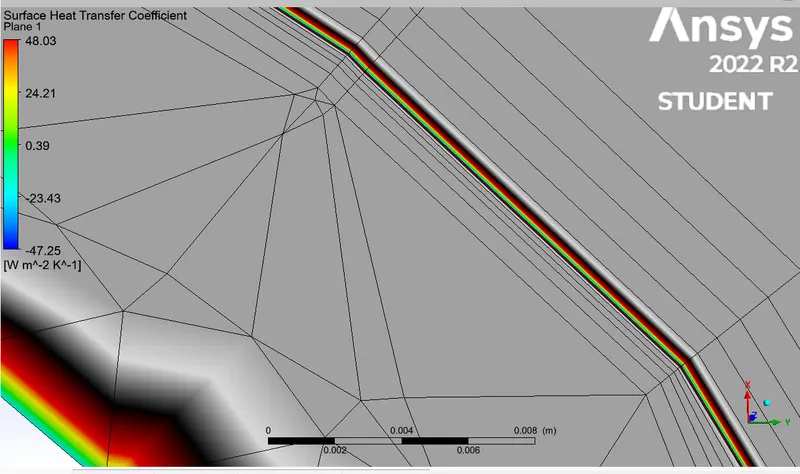
The heat transfer coefficient decreases away from the wall from the above two figures we can conclude that the heat transfer coefficient is higher at the curved area of the outlet port where velocity is maximum, thus velocity at outlet is higher as compared to the inlet because of the higher volume flow rate from the 4 inlet to the single outlet. Thus Re will be high, which results in higher heat transfer coefficient. Thus more heat transfer from thee fluid to the solid is at the outlet. Thus temperature at outlet is also higher.
CONCLUSION
How would you verify if the HTC predictions from the simulations are right? On what factors does the accuracy of the prediction depend on?
The numerical value of heat transfer coefficient can be calculated using the Dittus Bolter heat transfer coefficient relation in natural turbulent flowe the Diltus Bolter HT coefficient is determined by the Nusselt number which is related by the formula of
`Nu(D) = 0.023* Re^(4/5)*pr^n` here n = 0.3 . D = diamter of the pipe = characteristics length = 0.166 m
the prandtl number is of the following
`P_r = mu*(C_p)/k` here mu = 1.789*10^-5 C_p = 1006.43 J/kg-k and k = thermal conductivity = 0.0242 w/mk
= (1.789*10^-5*20)/0.0242 = 0.744
the Nusselt number is calculated as NUd = 0.023*56867.66^(4/5)*0.744^0.3 = 131.792
Nud = hD/k = 131.792 = h*0.166/0.0242
so h = 19.52 w/m^2k.
In the analysis, the heat transfer coefficient obtained is of h = 20.66 w/m^2-k
Factors that influence accuracy of predictions:
- Mesh quality greatly impacts the accuracy of prediction value in our simulations which can be observed from above contours and maximum values of related parameters like velocity and heat transfer coefficient.
- An appropriate turbulence model has to be used in accordance with the y+ value which is very important.
- Appropriate y+ value helps in calculating total layer thickness from the wall for the better capturing of effects near wall, which is Heat transfer coefficient in our case.