Week 2:- BiW Fixture Basics Challenge
1Q) What is the process of project execution activity?
Ans: PROCESS OF PROJECT EXECUTION ACTIVITY:
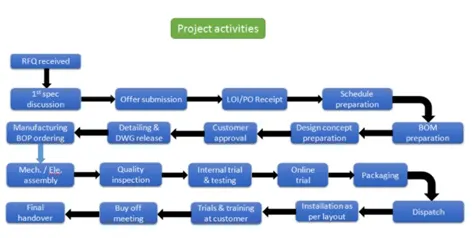
Fig shows the project activities
- The above figure shows the process involved in process execution activities.
- It is a general activity which is involved in BIW fixture & Tooling
- It is a starting phase of every project
- It starts with basic requirement/RFQ we received from the customer
- As shown in the figure there are various steps involved in project activities. They will be explained in detail below.
1 RFQ:
- RFQ – Request for Quotation.
- In this where the customer gives the requirement/specifications in detail for the given projects in the form of data or documents.
- Also, the customer specifies its technical offer, commercial offer etc, how the project will be executed & the timeline of the project also will be mentioned.
2 FIRST SPEC: DISCUSSION MEETING:
- After RFQ received, Technical offer, commercial offer, a timeline of the project etc,. will be discussed and prepared from outside.
- In this time required for data study, 3D design concept, simulation validation, quality check, 2d drawing release, bought outs, manufacturing, assembly, installation & commissioning will be discussed and prepared in the technical offer.
- Based on the technical offer, the commercial offer will be finalized.
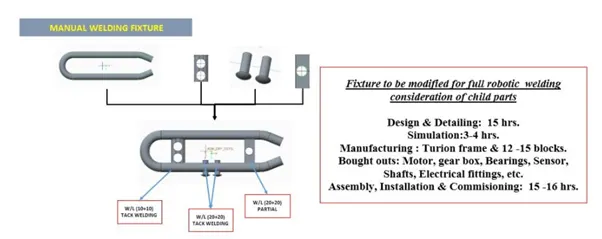
Fig:2 A basic example of a technical offer for manual welding fixture
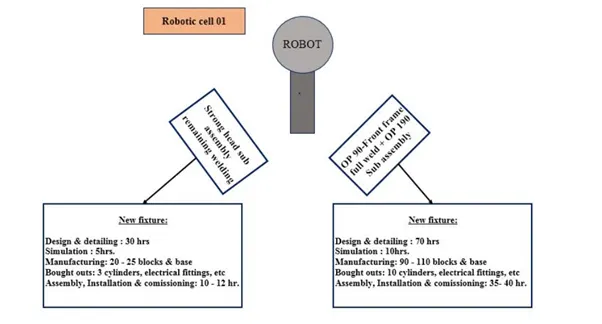
Fig 3: Technical offer for design & manufacturing of Robotic cell
3 OFFER SUBMISSION:
- After the finalization in the meeting, the offers will be submitted to the customer end.
- Customer will arrange to get an offer from other suppliers too.
- Based on the technical, cost, quality, standard and name in the industries, the customer will be finalizing the offer.
4 LOI/PO RECEIPT:
- After an offer has been finalized customer will be releasing the LOI/PO (Purchase Order).
- Once PO is released, we have to start the work.
- After getting PO from the customer, we have to prepare the schedule.
5 SCHEDULE PREPARATION:
- Once the PO released from the customer, we will be working on preparation of schedule which should be matched our planned commitment in the technical offer/customer required time.
- Schedule preparation is nothing but dividing the different activities like kick off meeting, design data study, DAP, simulate, Quality check 2D detailing, drawing check, Release of BOM, Manufacturing, bought outs of electrical & mechanical components, Assembly of fixture, paint, trial run out, installation and commissioning at customer end etc.
- These activities will be traced in the schedule preparation chart.
- The date wise schedule should be matched the committed date. Otherwise have to revised the schedule and prepare accordingly by discussing in the meetings.
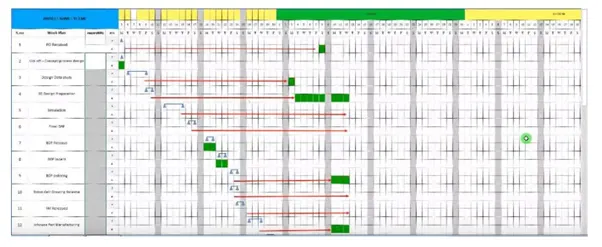
Fig shows Example of schedule preparation chart
6 BOM PREPARATION:
- Bill of materials like cylinders, motors, etc, which is required for the project are prepared.
7 DESIGN CONCEPT PREPARATION:
- Before design concept, we have to study the data of consumer requirement thoroughly which is carried out in design data study activities.
- During the design data study, we will proceed with rough sketches to get a flow while designing concepts.
- The concept preparation would include the process like load act on panels, clamping process, which spot should be welded first, travel of the gun.
- In this concept preparation, we should conceptualize the basic data like spot plan, cycle time etc,
- The weld gun should not collapse while travelling, so by considering this have to make a concept preparation.
- To avoid collapses of weld gun or robots during travelling, spot plan will be done at the initial stage.
- In design concept preparation, the design of the layout is been prepared at a very initial level which gives the information of placements of robots and fixtures.
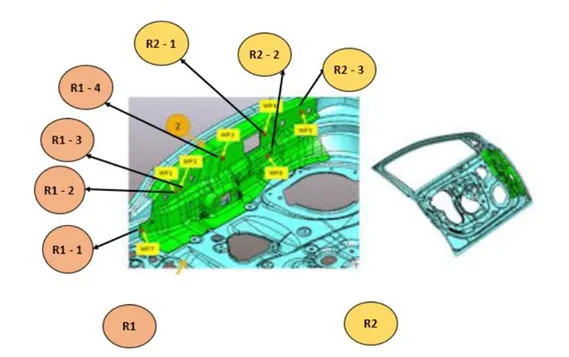
Fig shows spot plan
The red spot marks are the area to be welded & R1 & R2 are the robots.
- Spot plan should be taken into consideration during concept design preparation
- Spot plan clears us that how much robots are to be used and the sequence of the spot will be decided along with which robot will be cover certain spot places.
- Also, the cycle time should be considered while preparing concept design.
- To calculate the cycle time, we should go to cycle time study.
- Cycle time study includes min per shifts, No. of shifts, No. of days per year, No. of component per year, the total number of minutes.
- Cycle time study includes min per shifts, no. of shifts, no of days per year, no of component per year, the total number of minutes, efficiency, Total no of seconds, take time seconds, average time per spot, total no of spot, no of robots placed.
- From the cycle time study, we can get time taken per spot, time is taken for a single component, efficiency of production.
- If the efficiency is not satisfied, we have to do some reconsideration in the design.
8 CUSTOMER APPROVAL:
- It is also known as the Design Approval Process (DAP).
- After design concepts, the customer will review the design concepts.
- If the design needs to be made simple or some other correction needs to be done in concept design will be discussed and after meeting the requirement of the customer, they will give approval to the design to go on with further activities.
9 DETAILING & DRAWING RELEASE:
- Once the customer approved the process, the detailing of the fixture parts which is to be manufactured has been done with giving appropriate dimensions and GD&T symbols.
- All the dimensions which are the necessity for manufacturing should be included with GD&T in the drawing before releasing the drawing to the manufacturing team.
10 MANUFACTURING/BOP ORDERING:
- The mechanical & electrical parts like sensors, cylinders etc, which needs for a fixture are ordered as per design specifications.
11 MECHANICAL / ELECTRICAL ASSEMBLY:
- After the materials ordered received to our end. The quality will check the working conditions and technical specs, which meets our requirement.
- After the quality check, the mechanical & the electrical parts are assembled as per design.
12 QUALITY INSPECTION:
After the assembly again the quality check is done.
- In all dimensions, positional accuracy, coordinates are checked using CMM.
13 INTERNAL TRIAL:
- After QC check, internal trials are made to check the operation of the fixture.
- It is a first trial taken in house, so we will see by putting the assembly in the fixture whether the seating of assembly/panel suited correctly, whether the clamping operation is done properly, also whether the pins are getting into the holes etc.
14 ONLINE TRIAL:
- The trail will be done in automatically made through the control panel.
- The process sequence of operation is checked as by the designed way.
15 PACKAGING:
- To avoid damage, occur in fixture while transportation which may also lead to affect the Aesthetic look & proper function of fixture packaging has been done.
- After the trials taken have to get the QC confirmation whether the panels met the standards/specs, given by the customer also whether the fixture meets the customer standards.
- After approval of QC, packaging is been done as per standards. Certain companies follow certain packaging standards, So the packaging should be one as per customer standards.
16 DESPATCH:
- After the fixture has been packed for delivery as per standards.
- It’s been despatched to the customer.
17 INSTALLATION AS PER LAYOUT:
- As we discussed in design concept preparation, the design of the layout are been prepared at a very initial level which gives the information of placements of robots and fixtures.
- According to the design the installation & commissioning team will install the fixtures.
18 TRAILS & TRAINING AT CUSTOMER:
- Production trials will be taken at the customer end.
- During the technical offer, we will be confirmed that n-number of assemblies will be produced within 8hrs/12hrs shifts.
- So in customer trial, we have to achieve the confirmed quantity of assemblies.
- Once it is achieved training will be given to the operator, staffs, engineers who involved in this process.
- The sequence of the working process by the fixture will be explained in detail.
- The checkpoints which have to be done after placing the panels into the fixture will be made clear to them.
19 BUYOFF MEETING:
- After trials and training at customers end, buyoff meeting will be held.
- In this meeting customer will give reviews about the fixtures, sometimes a customer may need/feels better to do some additional work also. It will be discussed and finalize in the meeting.
20 FINAL HANDOVERS:
- The fixture and the documents support the fixtures/production will be handed over.
- Documents like clamp validation document, ergo sheets, BOMs, charts will be delivered and handed over to customers.
- Documents will play a vital role in the industry. We should always have a proof for out work done. The sequence of quality of work will be seen through the documents.
- Every automobile industry will follow some standards to maintain documents as per ISO, IATF.
- Now every automobile industries/vendors/supplier are maintaining the documents as per IATE (International Automotive Task Force).
- IATE – The international Automotive Task Force is a group of automotive manufactures which aims at providing improved quality products to automotive customers worldwide.
2Q) What are the types of joining process?
Ans: Joining processes are the processes that are used for joining metal parts. Also defined as joining of two metal parts either temporarily or permanently with or without the application of heat or pressure.
There are many joining processes used in BIW like welding, gluing.
The durability and performance of any structure is largely depends on quality & design of components joints. Whole structure can’t be made in one piece. Two fundamental option for joining material & components.
- Metallurgical joining
- Mechanical joining
- Metallurgical joining: In welding two or more parts are heated & melted or forced together, causing the joined parts to function as one. In some welding method filler material is added to make the merging of materials easier.
Different types of metallurgical joining are described below:
a. Welding: welding is process of permanently joining material welding joins different metal/alloys with a number of processes in which heat is supplied either electrically or by means of torch. Welding is done by application of heat or both heat & pressure. Pressure may be employed, but this is not in many processes essential. The welding process involves applying heat to the workpiece. The heat applied should be such that the workpiece should melt, i.e, the temperature at which welding is done, should be more than the melting point of the workpiece to be welded. Welding is a fabrication or sculptural process that joins materials, usually metals or thermoplastics, by using high heat to melt the parts together and allowing them to cool, causing fusion,. Welding is distinct from lower temperature metal joining techniques such as brazing and soldering, which do melt the base metal. In addition to melting the base metal a filler material is typically added to the joint to form a pool of molten material (the weld pool) that cools to form a joint that, based on weld configuration, (butt, full penetration, fillet etc.), can be stronger than the base material (parent metal). Pressure may also be used in conjunction with heat or by itself to produce a weld. Welding also requires a form of shield to protect the filler metals or melted metals from being contaminated or oxidized. Many different energy sources can be used for welding, including a gas flame (chemical), an electric arc (electrical), a laser, an electron beam, friction, and ultrasound. While option an industrial process, welding may be performed in many different environments, including in open air, under water, and in outer space. Welding is a hazardous undertaking and precautions are required to avoid burns, electric shock, vision damage, inhalation of poisonous gases and fumes, and exposure to intense ultraviolet radiation.
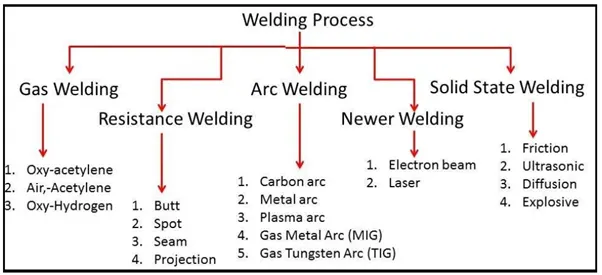
There are many different types of welding operations, such as the various arc welding, resistance welding and oxyfuel gas welding methods. Below fig illustrate different types of welding process.
b. Brazing: During brazing process a filler metal is melted & distributed in between multiple solid metal components after they have been heated to proper temperature. The filler metal must have been melting point that is above 840 degrees. Brazing is a metal-joining process in which two or more metal items are joined together by melting and flowing a filler metal into the joint, the filler metal having a lower melting point than the adjoining metal.
Brazing differs from welding in that it does not involve melting the workpieces and from soldering in using higher temperature for a similar process, while also requiring much more closely fitted parts than when soldering. The filler metal flows into the gap between close-fitting parts by capillary action. The filler metal Is brought slightly above its melting (liquids) temperature while protected by a suitable atmosphere, usually a flux. It then flows over the base metal (in a process known as wetting) and is then cooled to join the workpieces together. A major advantage of brazing is the ability to join the same or different metals with considerable strength.
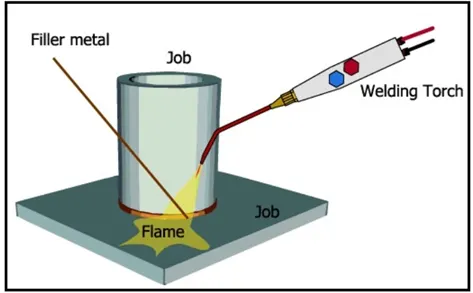
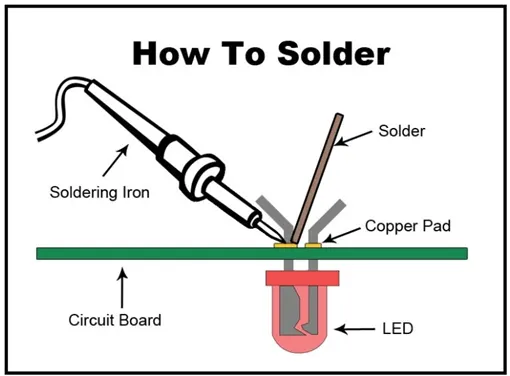
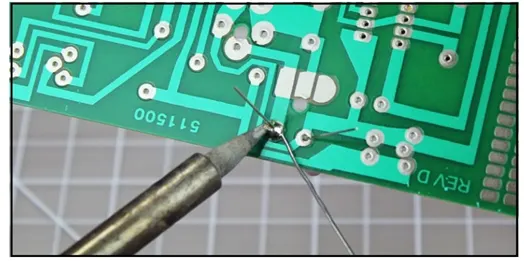
c. Soldering: Soldering is a process in which two or more items are joined together by melting and putting a filler metal (solder) into the joint, the filler metal having a lower melting point than the adjoining metal. Unlike welding, soldering does not involve melting the workpieces. In brazing, the work piece metal also does not melt, but the filler metal is one that melts at a higher temperature than in soldering. In the past, nearly all solders contained lead, but environmental and health concerns have increasingly dictated use fo lead-free alloys for electronics and plumbing purposes. Soldering is used in plumbing, electronics, and metal work from flashing to jewellery and musical instruments.
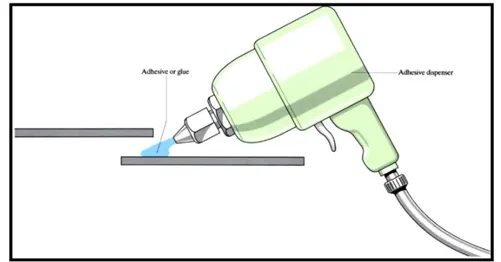
d. Adhesive bonding: Adhesive bonding (also referred to as gluing or glue bonding) describes a wafer bonding technique with applying an intermediate layer to connect substrates of different types of materials. Those connections produced can be soluble or insoluble. The commercially available adhesive can be organic or inorganic and is deposited on one or both substrate surfaces. Adhesives, especially the well-established SU-8 and benzo cyclobutene (BCB), are specialized for MEMS or electronic component production. The procedure enables bonding temperatures from 1000 degree centigrade down to room temperature. The most important process parameters for achieving a high bonding strength are adhesive material, coating thickness, bonding temperature, processing time, chamber pressure, tool pressure.
Adhesive bonding has the advantage of relatively low bonding temperature as well as the absence of electric voltage and current. Based on the fact that the wafers are not in direct contact, this procedure enables the use of different substrates, e.g.: silicon, glass, metals and other semiconductor materials. A drawback is that small structures become wider during patterning which hampers the production of an accurate intermediate layer with tight dimension control. Further, the possibility of corrosion due to out-gassed products, thermal instability and penetration of moisture limits the reliability of the bonding process. Another disadvantage is the missing possibilities of hermetically sealed encapsulation due to higher permeability of gas and water molecules while using organic adhesives.
e. Diffusion Bonding: Diffusion bonding or diffusion welding is a solid-state welding technique used in metal working, capable of joining similar and dissimilar metals. It operates on the principle of solid-state diffusion, where in the atoms of two solid, metallic surfaces intersperse themselves over time. This is typically accomplished at an elevated temperature, approximately 50-70% of the absolute melting temperature of the materials. Diffusion bonding is usually implemented by applying high pressure, in conjunction with necessarily high temperature to the materials to be welded, the technique is most commonly used to weld “sandwiches” of alternating layers of thin metal foil, and metal wires or filaments. Currently the diffusion bonding method is widely used I the joining of high strength and refractory metals within the aerospace and nuclear industries.
2. Mechanical joining: Mechanical joining is a process for joining parts through clamping or fastening using screws, bolts or rivets. Advantages of mechanical joining include versatility, ease of use and the option to dismantle the product in cases where regular maintenance requires it. The ability to join dissimilar materials is another benefit. A drawback of using mechanical joining is the lack of a continuous connection between parts, because the joint is achieved through discrete points. Also, holes created for joining are vulnerable to fractures and corrosion.
Mechanical Joining also called joining by forming, has become interesting for the automotive industry due to the request to reduce fuel consumption and there by emissions. In order to reduce weight on the car body, the usage of light weight materials in the body-in-white application has increased. This includes aluminium, high-strength steel alloys, polymers, and composites. Here the different type of mechanical joining becomes important. All mechanical joining methods are cold forming techniques. One general benefit for all mechanical joining methods is the mobility of the material after joining. At the same time mechanical joining offers an impressive strength.
a. Mechanical Fastening: The joining of material combinations which cannot be easily welded such as pre-painted steel or very dissimilar metal. Ex AL application in autobody makes use of mechanical fastening to overcome the poor inherent weld ability of Al.
- The joining of materials where in application where high fatigue life is critical compared to static strength.
- The joining of materials where high tool life is of relative importance.
E.g.: Screw, bolts etc.
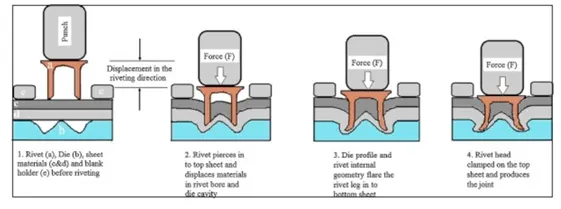
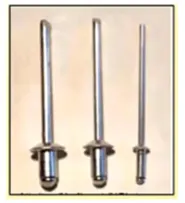
b. Self-Piercing Riveting: Self piercing riveting is high speed mechanical fastening for point joining sheet material, typically steel & aluminium alloys. It is single step technique generally using a semi tubular rivet to clinch the sheet in mechanical joint. There is also process variant which utilizes solid rivets.
As name suggest pre drilled hole are not required, allowing joint to be made rapidly in one operation. The process cycle is shown in cross section below.
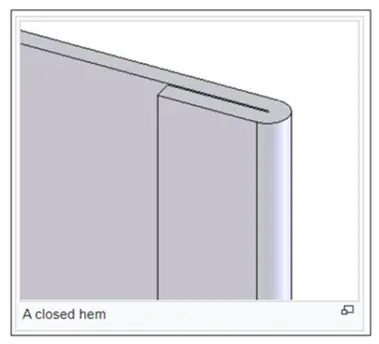
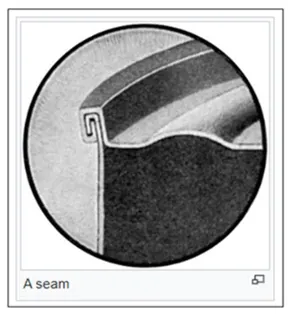
c. Hemming & Seaming Process: Hemming & seaming are two similar metal working processes in which a sheet metal edge is rolled over on to itself. Hemming is process in which edge is rolled flush to itself, while seam joins edges of two materials. Hems are commonly used to reinforce an edge, hide burrs and rough edges and improve appearance. Seams are commonly used in the food industry on canned goods, on amusement park cars, in metal rooting (with a roof seamer), and in the automotive industry. The process for both hemming & seaming are the same, except that the tonnage requirement is greater for seaming. The process starts by bending the edge to an acute angle. A flattening die is then used to flatten the hem.
3Q) What is Resistance Welding & its application in the automotive sector?
Ans: Resistance welding: Resistance welding is the joining of metals by applying pressure and passing current for a length of time through the metal area which is to be joined. The key advantage of resistance welding is that no other materials are needed to create the bond, which makes this process extremely cost effective.
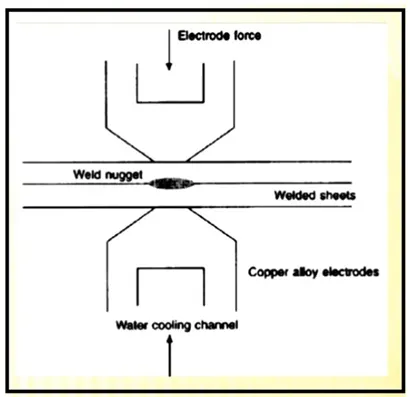
There are several different forms of resistance welding (e.g. spot and seam, projection, flash and upset welding) which differ primarily by the types and shapes of weld electrodes that are used to apply the pressure and conduct the current. The electrodes, typically manufactured from copper-based alloys due to superior conductive properties, are cooled by water flowing through cavities inside the electrode and the other conductive tooling of the resistance welding machine.
Resistance welding machines are designed and built for a wide range of automotive, aerospace and industrial application. Through automation, the action of these machines is highly controlled and repeatable allowing manufactures to staff production readily.
TYPES OF RESISTANCE WELDING APPLICATIONS:
A. SPOT WELDING: Resistance spot welding, like all resistance welding processes, creates welds using heat generated by resistance to the flow of welding current between the faying surfaces, as well as force to push the workpieces together, applied over a defined period of time. Resistance spot welding uses the face geometries of the welding electrodes themselves to focus the welding current at the desired weld location, as well as to apply force to the workpieces. Once sufficient resistance is generated, the materials set down and combine, and a weld nugget is formed.
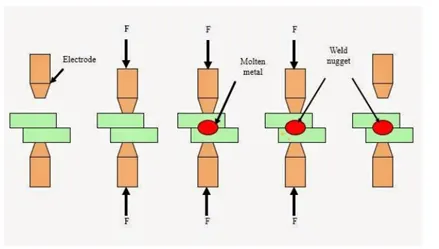
Fig shows Resistance spot welding
Resistance spot welding is automated and used in the form of robotic spot welding in automotive industries to weld the sheet metals to form car body. Industrial robots spot welding the car body in production line is shown in the photograph given.
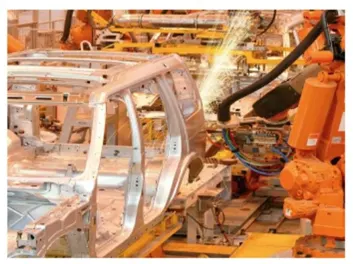
Fig shows industrial robot welding on car body
Following are advantages of resistance spot welding:
- Short weld time & hence high weld speed.
- Highly adaptable to automation & robotic technique. Typical BIW contains 500 welds.
- RSW is automated and used in the form of robotic spot welding in automotive industries to weld the sheet metals to form car body.
B. SEAM WELDING: Resistance seam welding is a subset of resistance spot welding using wheel-shaped electrodes to deliver force and welding current to the parts. The difference is that the workpiece rolls between the wheel-shaped electrodes while weld current is applied. Depending on the particular weld current and weld time settings, the welds created may be overlapping, forming a complete welded seam, or may simply be individual spot welds at defined intervals.
Resistance seam welding is mostly applied in manufacturing of containers, radiators & heat exchangers etc.
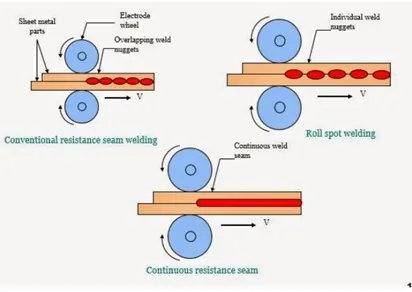
Fig shows resistance seam welding
C. RESISTANCE PROJECTION WELDING: Like other resistance welding processes, projection welding uses heat generated by resistance to the flow of welding current, as well as force to push the workpieces together, applied over a defined period of time. Projection welding localizes the welds at predetermined points by using projections, embossments or intersections, all of which focus heat generation at the point of contact. Once the weld current generates sufficient resistance at the point of contact, the projections collapse, forming the weld nugget.
Solid projections are often used when welding fasteners to parts. Embossments are often used when joining sheet or plate material. An example of projection welding using material intersections is cross-wire welding. In this case the intersection of the wires themselves localizes heat generation, and therefore resistance. The wires set-down into one another, forming a weld nugget in the process. It is used mechanical fixing of Autobody structures example weld nut.
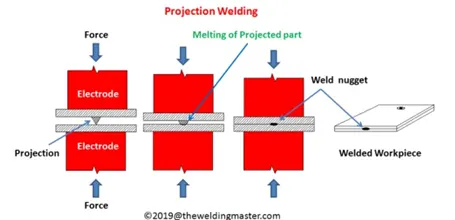
Fig shows the resistance projection welding
4Q. What is fusion welding & types of fusion welding with its application in the automotive sector?
Ans: In fusion-welding processes, heat is applied to melt the base metals. In many fusion welding processes, a filler metal is added to the molten pool during welding to facilitate the process and provide strength to the welded joint. When no filler metal is used, that fusion welding operation is referred to as autogenously weld. Fusion welding is unique however, because of its ability to “fuse” the respective objects. Assuming the objects are made of the same or similar materials, the heat produced by a welding rig will melt their surfaces, thereby allowing the objects to fuse together.
Classification of Welding Process.: The types of welding process classified into:
- Fusion welding
- Electric Resistance welding
- Solid – state welding.
a. Fusion welding:
- In fusion welding, the metal at the joint is heated to a molten state and then it is allowed to solidify.
- Pressure is not applied during the welding process and hence it is also called as ‘non – pressure welding’.
- Filler materials may be required during this type of welding
- Classification of fusion welding are,
- Thermit welding
- Arc welding
- Gas welding
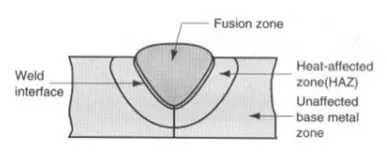
Fig shows Fusion Weld Joint
- Thermit welding:
- Welding the parts by using liquid thermit steel around the portions to be welded is called thermit wielding. Since it is a fusion welding process, neither arc is produced to heat parts nor flames are used.
- Welding principle is the heat of the thermit reaction used for welding in plastic state & mechanical pressure is applied for the joint.
- It is depending on the chemical reaction between iron oxide & aluminium,
- The reaction in thermit welding is 8Al + Fe3O4 = 9Fe = 4Al2O3. This reaction takes place about 30 sec only and the heat liberation temperature is about 2800-degree Celsius. It is twice the melting temperature of steel.
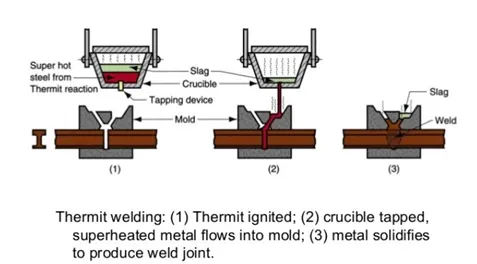
Fig shows Thermit welding process
2. Arc welding:
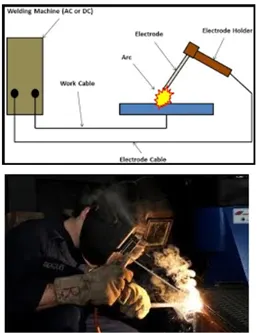
- In arc welding process, the heat is developed by an electric arc. The arc is produced between an electrode and the work. This is a process of joining two metal pieces by melting their edges by an electric arc. In arc welding the electrical energy is converted into heat energy.
- The electrode & the work piece are brought nearer with similar a small air gap of 3mm approximately. Then the current is passed through the workpiece and the electrode to produce an electric ar.
- The work piece is melted by an arc. The electrode is also melted and hence both the workpieces become a single piece without applying any external pressure. The temperature of arc is about 5000 to 6000 degree centigrade. The electrode supplies additional filler metal into the joints and is deposited along the joint. A transformer or generator is used to supply a current. The depth to which the metal is melted and deposited is called depth of fusion. To obtain better depth of fusion, the electrode is kept at 70-degree inclination to the vertical.
- Electrode used in arc welding are generally coated with a flux. The flux is used to prevent the reaction of the molten metal with atmospheric air. Also, it removes the impurities of the molten metal and forms a slag. This slag gets deposited over the weld metal. This slag protects the weld seam from rapid cooling.
- The molten metal is forced out of the pool by electric arc. Hence a small depression is formed in the parent metal where the molten metal is oiled up. This is known as “arc carter”. The distance between the tip of the electrode and the bottom of the arc crater is called “arc length”/
- The types of arc welding are.
- Manual Metal Arc Welding
- MIG Welding
- TIG Welding
- Plasma Arc Welding
- Submerged Arc Welding
- Atomic Hydrogen Arc Welding
- Carbon Arc Welding
- Electroslag Welding
Here I have detailed the some of Arc welding’s:
a. Manual Metal Arc Welding:
- Manual metal arc welding (MMA or MMAW) also known as shielded metal arc welding (SMAW), flux shielded arc welding or stick welding is a manual arc welding process that uses a consumable electrode covered with a flux to lay the weld.
- An electric current, in the form of either AC or DC from a welding power supply, is used to form an electric arc between the electrode and the metal to be joined. The workpiece and the electrode melts forming a pool of molten metal that cools to form a joint. As the weld is laid, the flux coating of the electrode disintegrates, giving off vapours that serve as a shielding gas and providing a layer of slag, both of which protect the weld area from atmospheric contamination.
- Because of the versatility of the process and the simplicity of its equipment and operation, shielded metal arc welding is one of the world’s first and most popular welding processes. It dominates other welding processes in the maintenance and repair industry, and though flux coated arc.
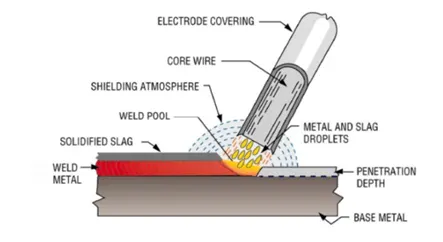
Fig shows SMAW welding
b. Metal Inert Gas Welding (MIG)/ Metal Active Gas Welding (MAG):
- Also known as Gas Metal arc welding (GMAW). MIG and MAG welding are the most common arc welding processes, in which an electric arc forms between a consumable wire electrode and the workpiece leading them to melt and join. Both use a shielding gas to protect the weld from airborne contaminates or oxidation in the case of MIG welding.
- The process can be semi-automatic or automatic. A constant voltage, direct current power source is most commonly used with GMAW, but constant current systems, as well as AC, can be used. There are four primary methods of metal transfer in GMAW, called globular, short-circuiting, spray and pulsed-spray, each of which has distinct properties and corresponding advantages and limitations.
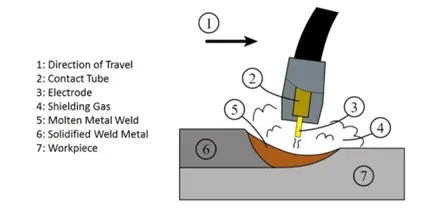
Fig shows MIG Welding
c. Tungsten Inert Gas Welding (TIG):
- Also known as Gas Tungsten Arc Welding (GTAW). This arc process uses a non-consumable tungsten electrode to create the arc between the electrode and the base plate. An inert shielding gas is used to protect from oxidation or other atmospheric contamination.
- This process can be used autogenously on thin parts, but will require the addition of a wire, rod, or consumable electrode to be added for thicker parts.
- A constant current welding power supply produces electrical energy, which is conducted across the arc through a column of highly ionized gas and metal vapors known as a plasma.
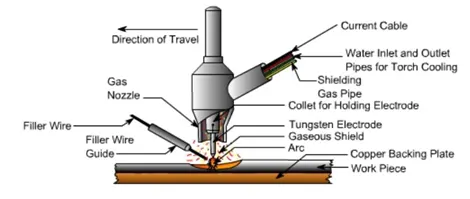
Fig shows TIG Welding
d. Plasma Arc Welding (PAW):
- This process uses an electric arc created between an electrode and the torch nozzle.
- The electrode arc ionises the gas (usually argon) in the chamber creating what is called a ‘plasma’.
- It is then forced through a fine bore copper nozzle that constricts the arc and directs it to the workpiece, allowing the plasma arc to be separated from the shielding gas (which is usually made from a mixture of argon and hydrogen).
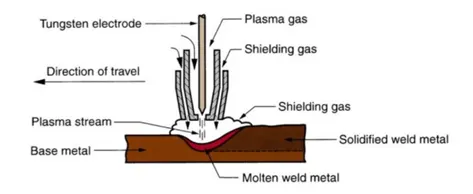
Fig shows plasma arc welding
3. Gas Welding:
- Gas welding is one type of welding process in which the edges of the metals to be welded are melted by using gas flame.
- No pressure is applied during welding except pressure gas welding
- The flame is produced at the tip of the welding torch.
- The gases commonly employed for gas welding are acetylene, hydrogen, propane & butane.
- Metal 2mm to 50mm thick are welded by gas welding.
- There are three types of welding process used in industries such as,
- Oxy – acetylene welding
- Oxy – hydrogen welding
- Air – acetylene welding
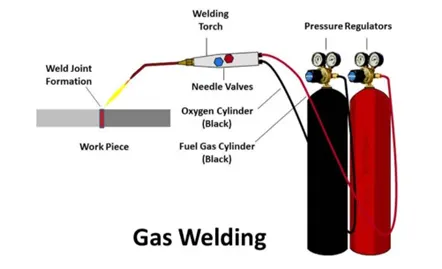
Here I have detailed about the most commonly used gas welding
a. Oxy – acetylene welding:
- In this welding the heat is obtained by burning a mixture of oxygen & combustible gas. The gases are mixed in the required proportion in a welding torch which provides control for the welding flame. The most common form of gas welding is Oxy – Acetylene welding.
- The flame only will melt the metal. So additional metal to the weld is supplied by the filler rod. A flux is used during welding to prevent oxidation and to remove impurities.
- The temperature of oxy – acetylene flame in its hottest region is about 3200 degree centigrade.
- The cost of acetylene is low. The gases O2, C2, & H2 can be stored at high pressure in separate steel cylinders. But the acetylene is very harmful if it is not handled carefully.
- There are two types oxy – acetylene systems employed depending upon the manner in which acetylene is supplied for welding. They are, High pressure system & Low-pressure system.
- In High pressure system, both oxygen & acetylene are supplied from high pressure cylinders.
- In Low pressure system, the acetylene produced at the place of welding by interaction of calcium carbide & water in acetylene generator.
b. Electric Resistance Welding: Resistance welding is a welding technique widely used in the manufacturing industry for joining metal sheets & components. This type of welding is very much used in BIW assemblies most common. The weld is made by conducting strong current through the metal combination to heat up & finally melt the metals at localized points predetermined by design of the electrodes or the workpiece to be welded. A force is always applied before, during and after the application of the current to confine the contact area at the weld interfaces and in some application to forge the workpieces. Types of Resistance welding are:
- Resistance Spot Welding
- Resistance Seam Welding
- Resistance Projection Welding
- Butt welding
- Precision welding
Here I will discuss some of important types of resistance welding in detailed.
1. Resistance spot welding:
- The process is used for joining sheet material & uses shaped copper – chromium or zinc conium alloy electrodes to apply pressure and convey the electrical current through the work piece.
- Heat is developed mainly at the interface between two sheets, eventually causing the material being welded to melt, forming a molten pool, the weld nugget.
- The molten pool is contained by the pressure applied by the electrode tip & the surrounding solid metal.
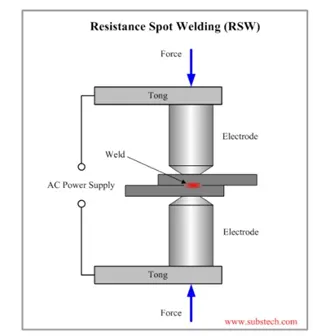
2. Resistance Seam Welding:
- Seam welding is a resistance welding process for joining metal sheets in continuous, often leak – tight, seam joints by directly applying opposing forces with electrodes consisting of rotary wheels.
- The current & the heat generation are localized by the peripheral shapes of electrode wheels.
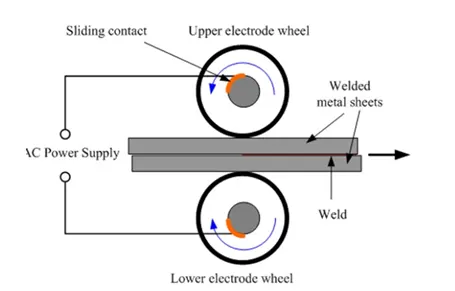
3. Resistance Projection Welding:
- Projection welding is a resistance welding process for joining metal components or sheets with embossments by directly applying opposing.
- The current & the heat generation are localized by the shape of the workpiece either with their natural shapes or with specially designed projection.
- Large deformation or collapse will occur in the projection part of the workpieces implying high.
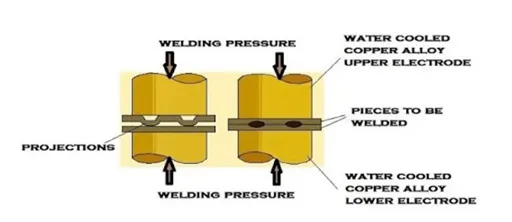
c. Solid state welding: Solid-state welding is a welding process, in which two workpieces are joined under a pressure providing intimate contact between them and at a temperature essentially below the melting point of the parent material. Bonding of the materials is a result of the diffusion of their interface atoms.
The following processes are related to solid state welding:
- Forge welding
- Cold welding
- Friction welding
- Explosive welding
- Diffusion welding
- Ultrasonic welding
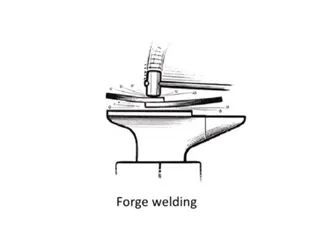
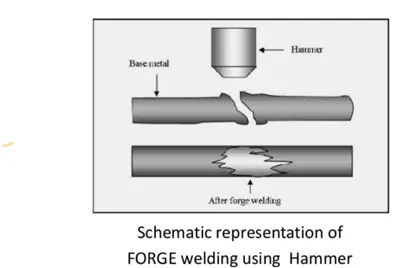
1. Forge welding:
- Forge welding is a solid-state welding process, in which low carbon steel parts are heated to about 1800-degree F (1000 degree centigrade) and then forged (hammered).
- Forge welding is used in general blacksmith shops and for manufacturing metal art pieces and welded tubes.
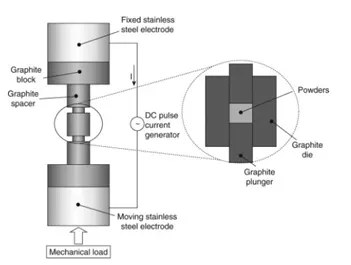
2. Cold Welding (CW):
- Cold welding is a solid-state welding process in which two work pieces are joined together at room temperature and under a pressure causing a substantial deformation of the welded parts and providing an intimate contact between the welded surfaces.
- As a result of the deformation the oxide film covering the welded parts breaks up, and clean metal surfaces reveal. Intimate contact between these pure surfaces provides a strong and defect less bonding.
- Aluminium alloys copper alloys, low carbon steels, Nickel Alloys, and other ductile metals may be welded by cold working. Cold working is widely used for manufacturing bi-metal steel-aluminium alloy strips, for cladding of aluminium alloy strips by other aluminium alloys or pure aluminium (corrosion protection coating). Bi-metal strips are produced by Rolling technology, presses are also used for cold welding.
- Cold welding may be easily automated.
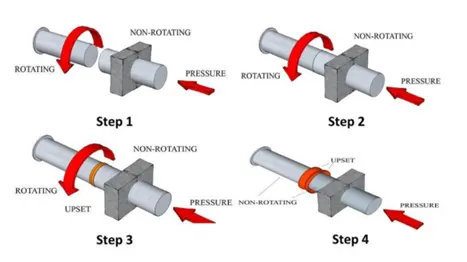
3. Friction Welding (FRW):
- Friction welding is a solid-state welding process in which two cylindrical parts are brought in contact by a friction pressure when one of them rotates. Friction between the parts results in heating their ends. Forge pressure is then applied to the pieces providing formation of the joint.
- Carbon steels, alloy steels, Tool & Die steels, adequate steels, aluminium alloys, copper alloys, magnesium alloys, Nickel alloys, titanium alloys may be joined by friction welding.
Friction Welding
4. Explosive Welding (EXW):
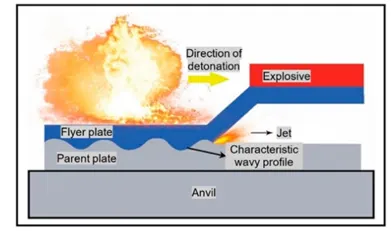
- Explosive welding is a solid-state welding process in which welded parts (plates) are metallurgically bonded as a result of oblique impact pressure exerted on them by a controlled detonation of an explosive charge.
- One of the welded parts (base plate) is rested on an anvil, the second part (flyer plate) is located above the base plate with an angled or constant interface clearance.
- Explosive charge is placed on the flyer plate. Detonation starts at an edge of the plate and propagates at high velocity along the plate.
- The maximum detonation velocity is about 120% of the material sonic velocity.
- The slags (oxides, nitrides and other contaminants) are expelled by the jet created just ahead of the bonding front.
- Most of the commercial metals and alloys may be bonded (welded) by explosive welding.
- Dissimilar metals may be joined by explosive welding: Copper to steel: Nickel to steel: Aluminium to steel: Tungsten to steel: Titanium to steel: Copper to aluminium.
- Explosive welding is used for manufacturing clad tubes and pipes, pressure vessels, aerospace structures, heat exchangers, bi-metal sliding bearings, ship-structures, weld transitions, corrosion resistant chemical process tanks.
5. Diffusion Welding (DFW):
- Diffusion welding is a solid-state welding process, in which pressure applied to two workpieces with carefully cleaned surfaces and at an elevated temperature below the melting point of the metals. Bonding of the materials is a result of mutual diffusion of their interface atoms.
- In order to keep the bonded surfaces, clean from oxides and other air contaminations, the process is often conducted in vacuum.
- No appreciable deformation of the work pieces occurs in Diffusion Welding.
- Diffusion welding is often referred more commonly as solid-state welding.
- Diffusion welding is able to bond dissimilar metals, which are difficult to weld by other welding processes: Steel to tungsten: Steel to niobium, Stainless steel to titanium: Gold to copper alloys.
- Diffusion welding is used in aerospace and rocketry industries, electronics, nuclear applications, manufacturing composite materials.
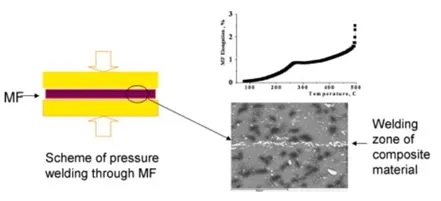
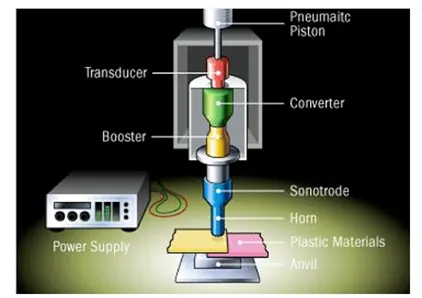
6. Ultrasonic welding (USW):
- Ultrasonic welding is a solid-state welding process, in which two workpieces are bonded as a result of a pressure exerted to the welded parts combined with application of high frequency acoustic vibration (ultrasonic).
- Ultrasonic vibration causes friction between the parts, which results in a closer contact between the two surfaces with simultaneous local heating of the contact area. Interatomic bonds, formed under these conditions provide strong joint.
- Ultrasonic cycle takes about one sec. The frequency of acoustic vibrations is in the range 20 to 70KHz.
- Thickness of the welded parts is limited by the power of the ultrasonic generator.
- Ultrasonic welding is used mainly for bonding small work pieces in electronics, for manufacturing communication devise, medical tools, watches, in automotive industry.
Automotive application of arc welding technology:
- Arc welding is used to weld the chassis parts in automotive industry.
- Arc welding is used to weld body parts in automotive industry. Low heat input welding of thin steel sheets prevention of burn through due to excessive heat input is important in the welding of car body parts of thin sheets. For this reason, thin welding wire with a diameter of 0.9mm, which enable welding at low currents & low heat input welding power source.
- TIG welding is used to join thin stainless-steel parts & various piping parts in automobile industry. TIG welding can work on both AC and DC power sources. One of the greatest strengths of TIG welding is that it can be used for welding non-ferrous metals like aluminium, copper, magnesium, copper, nickel, titanium etc.
- Rebuilding: MIG welding is used for repairing work In automobile industry. To repair especially to dismantle & reassemble with new parts. Example to rebuild an old car. When It comes to fixing broken parts in the field, there are three steps to master: cutting & removal of the failed component, preparation of the new joint/part, welding & clean-up. Worn parts can be repaired using MIG welding in variety of coating (stainless steel, bronze, nickel, aluminium or hard surfacing) & in a range of hardness, for a fraction of the cost of purchasing a new part.
5Q) What is 3-2-1 principle?
Ans: Degree of freedom: The degree of freedom defines as the capability of a body to move. Consider a rectangular box, in space the box is capable of moving in twelve different direction (sim rotational & six axial).
6 translational degrees of freedom: +X, -X, +Y, -Y, +Z, -Z and 6 rotational degree of freedom.
- Clockwise around X axis (CROT – X)
- Anticlockwise around X axis (ACROT – X)
- Clockwise around Y axis (CROT -Y)
- Anticlockwise around Y axis (ACROT -Y)
- Clockwise around Z-axis (CROT-Z)
- Anticlockwise around Z axis (ACROT-Z)
Each direction of movement is counted as one degree of freedom i.e., a body in space has twelve degree of freedom.
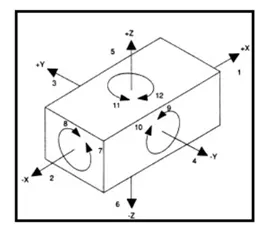
Above fig shows a body in space & its possible direction of movement. The body can move two directions along each axis of three mutually perpendicular axes: also can rotate about this axis either clockwise or anticlockwise. There ae twelve degree of freedom for body in space.
In machining process, in order to attain specific results, the degrees of freedom is constrained by using work holding devices, jig & fixture & locating devices. There must be a definite relationship between cutting tool & surface of workpiece in order to perform the accurate cutting operation. To achieve high precision in machining, the workpiece must be located accurately: it is called locating of workpiece. Location of components is significant to the design of jig & fixture so that it influences the accuracy of final product. The locating device designed so that each successive workpiece loaded must occupy the same position in work handling devices.
Locating: the positional & dimensional relationship between workpiece & cutting tool.
Locator: the device to establish & maintain the position of the workpiece in work holders such as jig & fixture to ensure repeatability of work holder.
The best & most effective method of part location is 3-2-1 principle. Holding fixtures used in assembly operations often follow a 3-2-1 locating scheme to position parts. Under this scheme, three locators position a part in a primary plane or direction (e.g., high/low). Two locators then position the part in a secondary direction (e.g., in/out), leaving one locator for the tertiary direction (e.g., fore/aft). This approach fixes the part in 3-dimensional space and satisfies the six degrees of freedom constraint.
(3) minimum plane: Three locator blocks to establish part plane. Three locator or supports are placed under the workpiece. Three locators are usually positioned on primary locating surface. This restricts one axial movement downward, & 4 radial movements. Together, the three locators restrict five degrees of freedom.
(2) Round locating pin in a round hole that defines location in four direction (4 ways) perpendicular to the plane previously established. This restricts four axial movements.
(1) Round locating pin in slot that defines two of the other pin (2 way). This restricts two axial movements.
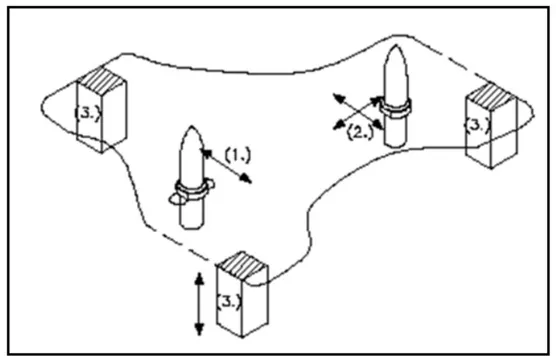
The better way of understanding of 3-2-1 principle that considers 12 degrees as of 6 degrees of freedom. It includes clockwise & anticlockwise as one rotation. Movement in positive & negative direction as one translation motion. So, we have three translation motion in x, y, z axis & three rotational motion about x, y, z axis.
In this, (3) means restricting three degree of freedom as translation motion in z axis i.e., upward & downward, two rotational motion about x & y axis.
Secondly, (2) means restricting two degrees of freedom. Translation motion in x i.e. (positive or negative) & y direction i.e., (positive or negative)
& (1) means restricting one degrees of freedom i.e., rotational motion about z axis clockwise or anticlockwise. So car panel or body cannot move in any direction with or without application of external force so properly fixed in fixture. This is basic concept of designing fixture.
Conclusion:
The jig & fixture are tools used for holding the workpiece in a correct location for mass production. Various types of fixtures (like drilling fixtures, milling fixtures, and welding fixtures) are used in industry. The 3-2-1 method is the fundamental principle for all types of fixture design.
6Q) Define body Co-ordinate system?
Ans: BODY COORDINATE SYSTEM (Part Locating System):
The body coordinate system has been widely used in the automotive industry for drawing of body parts, product & process design. A coordinate system is a reference system consisting of a set of points, lines & surfaces, used to define the positions of points in space in either two or three dimensions. In general, BCS is also called as car line & body line.
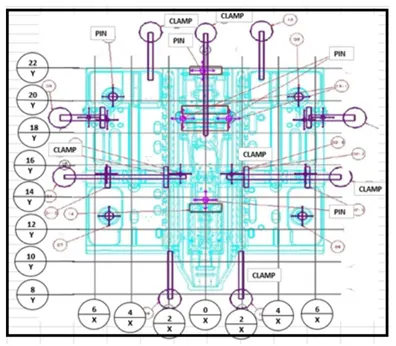
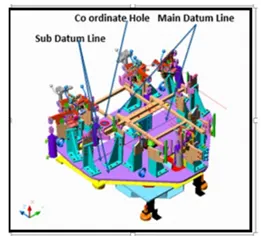
Car lines are the (grid lines) shown on the fixture, which virtually represent the same location in BIW. All the car line on fixture displays the coordinate at corner for reference. With these lines one can easily relate the location in BIW.
Sometimes single coordinate hole is given in fixture that also represents the car line coordinates, from that reference point fixture is made & can be inspected. Body coordinate are mentioned near hole. Below fig shows car line on fixture.
Automotive sheet metal components are designed in CAD (Computer Aided Design) software e.g., CATIAv4, UG, Pro-E, Ideas,
In any cad tool, there is a default axis system X, Y, Z.
Let’s us consider if every designer starts the design of the BIW Door Assembly part a default axis system, then it will be difficult to assembly or position the part with respect to each other.
Due to avoid this issue, BIW car panels are designed with reference to car axis means at their, Original position of the final car built.
Reference axis system of the software is used for the design of the various features of the parts (e.g., hole, fillet, threads,). To correlate the position of all the automotive components during the final assembly the axis system of the vehicle is used. Most of the time vehicle axis system and software axis system is the same, e.g. In most of European OEM, The X-axis represents the length of the vehicle Y-axis represents the width of the vehicle Z-axis presents the height of the vehicle. Y-axis is considered to be located at the front axle. All BIW welding fixtures are designed with reference to the car line.
These datum schemes provide a reference system for all part surfaces and features using body coordinates. Fig below illustrates a typical body coordinate system. This system replaces the traditional X, Y, and Z directional designations with fore/aft (X), in/out (Y) and up/down or high/low (Z). the O, O, O point of the car is the front, lower, and center position.
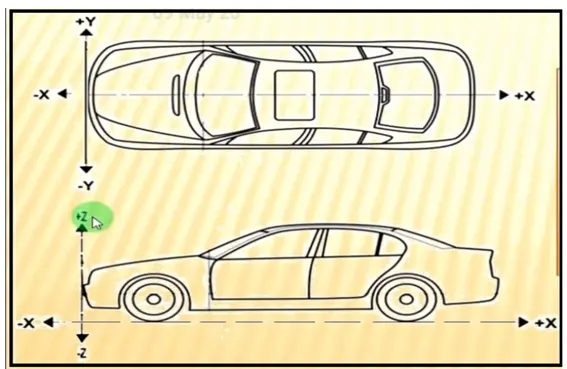
VEHICLE ORIENTATION: All vehicle product drawings are identified numerically relative to three vehicle planes described and shown below.
X = longitudinal direction (fore & after -F/A) or (Front O line-FOL).
Y = transverse direction (Cross car -C/C) or (Centre O line-COL).
Z = vertical direction (Up & down – U/D) or (Bottom O line-BOL).
The origin of the body coordinate system (OX) is defined at the front centre of a vehicle. It indicates a length of car & the coordinate system (OZ) is below its underbody indicates height of car & the coordinate system (OY) its starting point is the centre of car body indicates width of car.
Maintaining X, Y & Z coordinates in fixture is very important factor.
We should try that the coordinates of locating & clamping points should not be in three decimals (e.g., X=100.124, Y= 245.127, Z= 450.458)
They should be in the whole no’s or max up to 1 decimal. Once these coordinates are maintained automatically the BIW base structure is maintained.
7Q) Elaborate Body plane system & its essentials?
Ans: Body planes are the reference plane in an automotive car. These planes are used to define the GD&T of all car parts in a automotive domain.
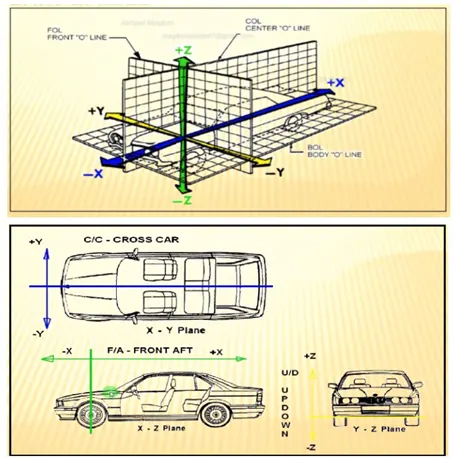
Body planes are three mutually perpendicular imaginary planes. These are generally considered to be present at the driver position or sometimes at the engine location or at the front end of the car depending on the customer.
The measurements from the body planes to the parts are called as body line dimension.
These body planes are called as
FOL Front “O” line.
COL Centre “O” line.
BOL Body “O” line.
The measurement along FOL or X – axis is called as F/A Front aft.
The measurement along COL or Y – axis is called as C/C Cross Car.
The measurement along BOL or Z – axis is called as U/DUP down.
In below fig origin is somewhere below driving sheet as it depends or changes from customer to customer. But axis system is commonly same.
Bodyline dimensions are essential for the reasons stated below.
- It defines the exact position of each product in the vehicle w.r.t a fixed origin.
- It ensures flawless design for assembly.
- While designing lines, all the designs are carried out relative to the bodyline, viz, fixture, turn table etc.
- It assists in easy location of different parts in a vehicle.
- It aims in creating a standardized system.
- It assists in quality checks.
These are basic essential thing that body line dimension would help in BIW. It could help in designing lines like welding lines, assembly lines or car body through fixture & turntable etc. This help in designing every tools. Particular assembly or parts are designed w.r.t body lines or an axis system or car line also helps in quality while doing CMM of that system. CMM is basically done with the help of coordinate. It has related particular fixture with that car part, because that dimension, coordinates of hole & pin should match so it will help in quality check also. we just give co-ordinates, that belong to that hole both coordinates should match, with this matching means quality is approved. Below fig shows some examples.
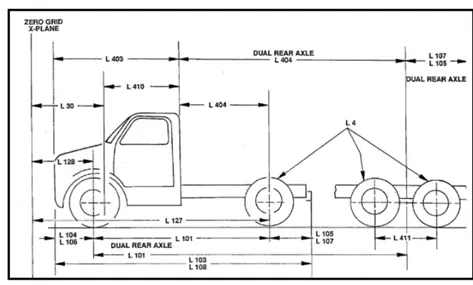
Below fig show use of X plane to define the length of car
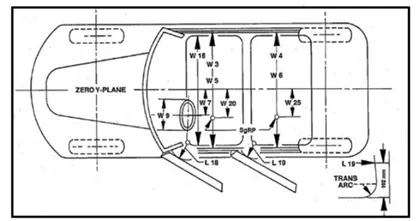
Below fig show use of Y plane to define width of car
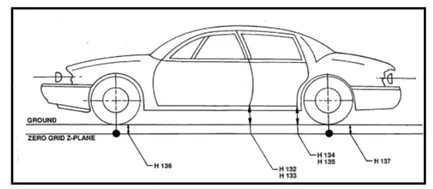
Below fig shows use of Z plane to define height of car