Week 2:- BiW Fixture Basics Challenge
1) What is the process of project execution activity?
Ans: 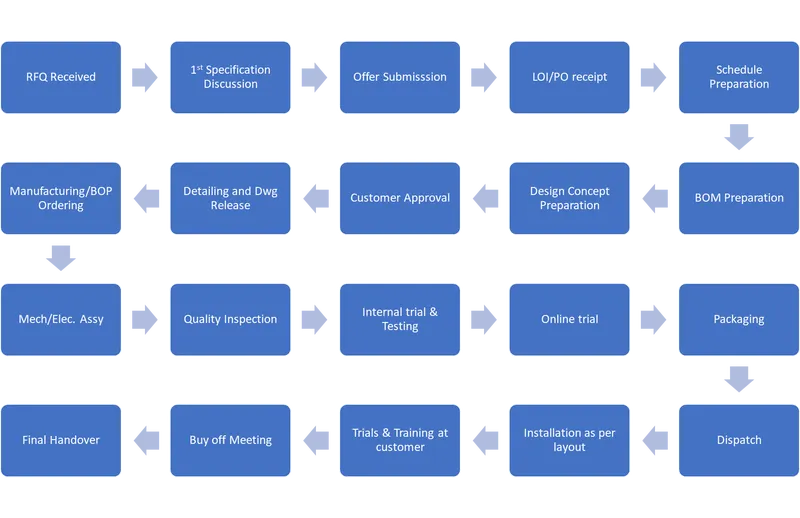
Quotation request is received from the customer
Meeting is called for specifications confirmation
Offer is prepared as per the request which includes all the technical, date of dispatch and cost description
Purchase Order(PO) is received from the customer
Job Schedule is prpepared for the initiation of the process and fix date of beginning and date of despatch
BOM is prepared listing the materials required and the quantity for manufacturing
Design is made for the received order
Approval is taken from the customer for the design prepared
Once the approval is received, design and drawing details are released
Drawing is sent to the manufacturing unit
Once the parts are manufactured, mechanical and electrical assembly is done and further sent for Quality inspection.
Internal trial and testing is done to check the functionalities as per expectation and it is tested online to make analysis
Once the product is approved, it is sent to packaging department from where it is despatched
Product is installed at the site and trials are made by the customers along with training is provided about the usage of the product
Final buy off meeting is scheduled where the product is final handed over with all formalities
2) What are the types of joining processes?
Ans: Types of joining process are
Welding
Brazing
Soldering
Adhesive bonding of materials
3) What is Resistance Welding & its application in the automotive sector?
Ans: Resistance Welding is a technique used to join the metal sheets and components.
It consists of a welding head, which holds the metal between its electrodes and applies pressure, and a welding power supply, which applies electric current to the metal to be welded.
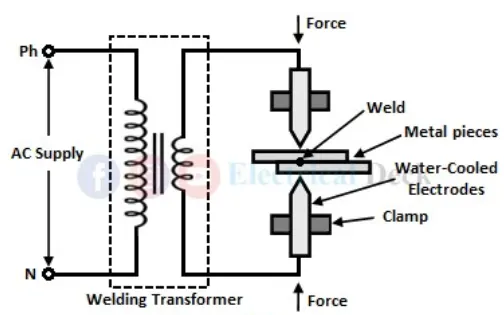 1. Resistance welding is used in mass production for welding sheet metal, wire and tubes.
2. It is used in welding bars, boxes, cans, rods, pipes and frames metals of medium and high resistance materials such as steel, stainless steel, monei metal and silicon bronze which are easy to weld.
3. It is used in welding aircraft and automobile parts
4. It is used for making cutting tools.
5. It is used for making fuel tanks of cars, tractors etc.
6. It is used for making wire fabrics, grids, grills, mesh weld, containers etc.
4) What is fusion welding & types of fusion welding with its application in the automotive sector?
Ans: Fusion welding is a process of joining 2 or more materials by heating them to their melting point. It is a process which works by the application of heat and pressure.
Types of fusion welding are-
1) Arc Welding
Arc welding is a process which joins the metal pieces together using arc which produces high amount of heat that liquifies the materials and join them together and solidifies on cooling. Arc welding uses an intermediate filler metal.
1.1 Shielded Metal Arc welding
It is a process which uses electrode having flux around it that develops gas shield during welding. It is used for both ferrous and non-ferrous materials regardless of the position.
1.2 Metal Inert Gas welding (MIG)
MIG welding are the most common arc welding processes, in which an electric arc forms between a consumable wire electrode and the workpiece leading them to melt and join. Both use a shielding gas to protect the weld from airborne contaminants, or oxidation in the case of MIG welding.
1.3 Tungsten Inert Gas welding
This arc process uses a non-consumable tungsten electrode to create the arc between the electrode and the base plate. An inert shielding gas is used to protect from oxidation or other atmospheric contamination. This process can be used autogenously on thin parts, but will require the addition of a wire, rod, or consumable to be added for thicker parts.
1.4 Plasma Arc welding
This process uses an electric arc created between an electrode and the torch nozzle. The electric arc ionises the gas (usually argon) in the chamber creating what is called a 'plasma.' It is then forced through a fine bore copper nozzle that constricts the arc and directs it to the workpiece, allowing the plasma arc to be separated from the shielding gas (which is usually made from a mixture of argon and hydrogen).
1.5 Submerged Arc welding
This welding process uses a continuously-fed consumable electrode and a blanket of fusible flux which becomes conductive when molten and provides a current path between the workpiece and the electrode. The flux also prevents spatter and sparks while suppressing ultraviolet radiation and fumes.
1.6 Flux Cored Arc welding
This process uses a continuously fed consumable electrode with a flux and a constant voltage or constant current power supply. Sometimes using a shielding gas this process can also just use the flux to provide protection from the atmosphere. This process is developed as an alternative to Submerged Arc welding
2) Gas Welding
This process involves using a blowpipe held in the hand that combines both oxygen and acetylene gas to produce a flare. It is a solvent-based fusion welding that requires a flame to meltdown and connects the surface. Oxygen acts the primary fuel source for the flame.
2.1 Oxy-Fuel Welding
Oxy-fuel welding uses a filler rod to join two pieces together. The difference is that instead of an open flame, oxygen and fuel gases are used to heat the metal. This type of welding works well on thicker metals that cannot join with gas welding. This type of welding can get done manually or with a machine. Depending on the project’s size and scale, it can be semi-automatic or automatic if a machine is used.
3) Resistance Welding
It is a welding process in which metal poeces are joined together by the application heat and pressure. The heat created by the current melts the metal and joins after cooling.
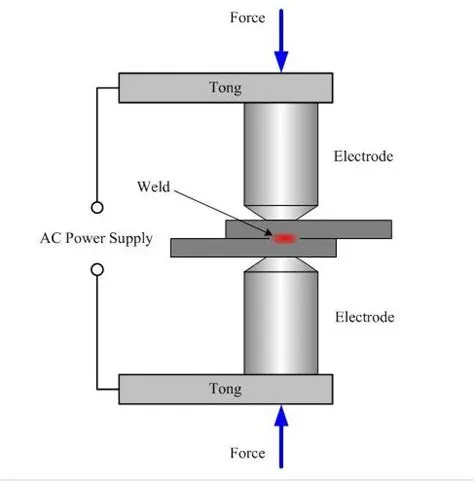
3.1 Resistance Spot Welding
This is a resistance welding where current is concentrated at the spot where the two workpieces are clamped together and making them to join together.
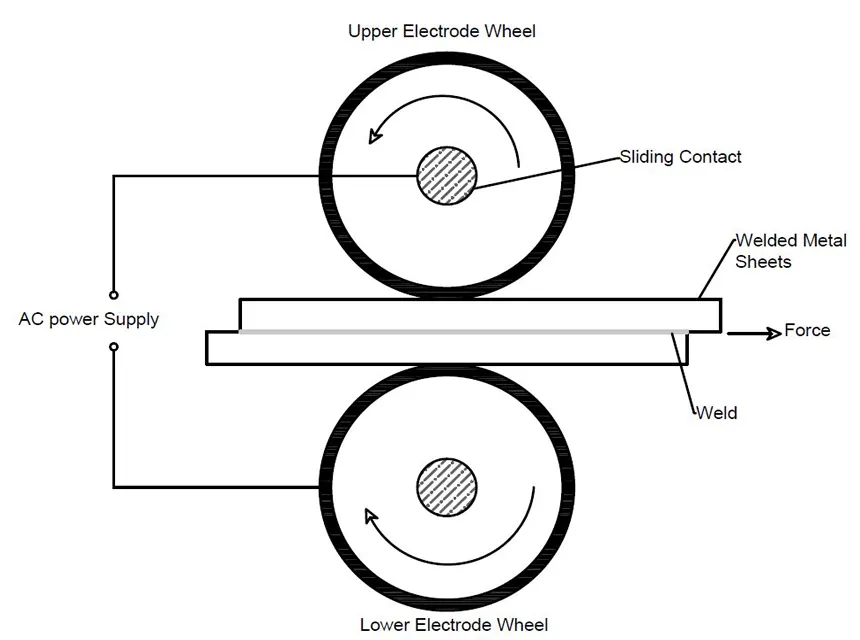
3.2 Resistance Seam Welding
It is a resistance welding which produces a series of overlapping nuggets of a continuous joint by replacing conventional spot welding electrodes with wheels which rotate as the workpieces are fed between them.
4) High Energy Welding
High energy welding is a type of fusion welding that uses light radiation to produce heat. Welders blast the radiation on the material’s surface, turning them into a molten state. The two pieces will join once they cool down.
4.1 Electron Beam Welding
This high-energy welding uses high-velocity electrons to join two different materials. The process takes place under normal atmospheric pressure, and the electrons produce heat in the material as they enter. The welts are mostly deep and narrow.
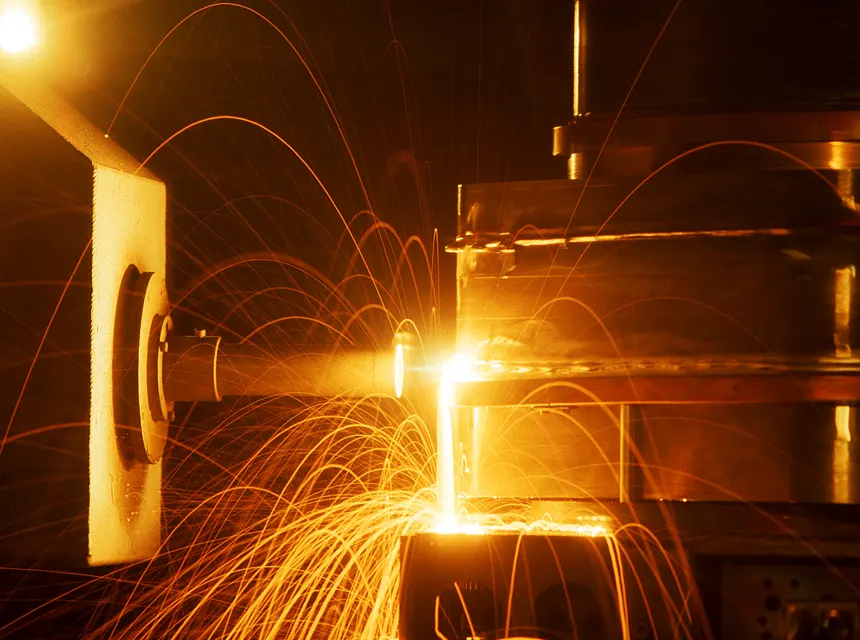
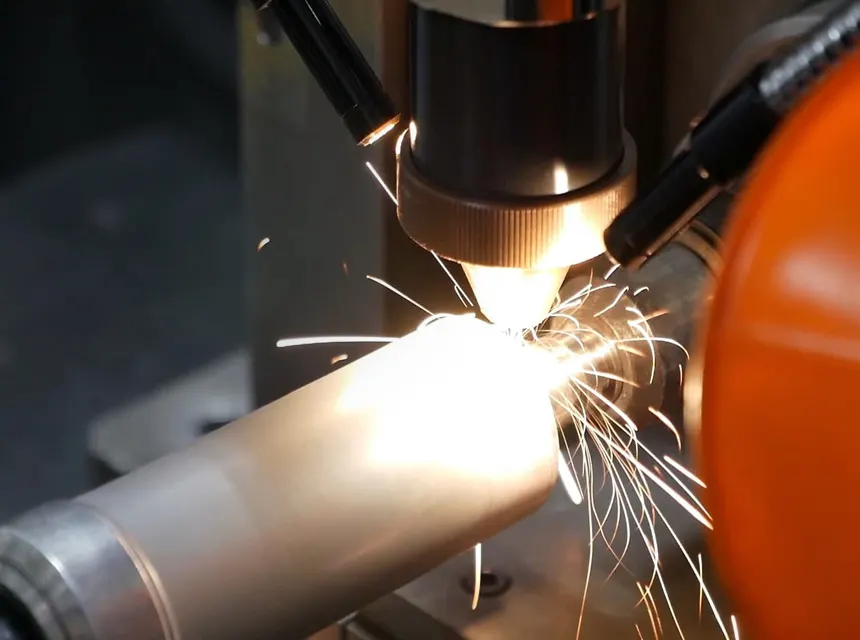
4.2 Laser Welding
Laser beam welding utilizes a laser beam as the primary source of heat. The use of the laser beam helps maintain a highly focused energy source that is used to join different metal pieces of plastics. It uses light energy to produce heat. The rig produces dissipated light that warms the surface with every single blast.
5) What is the 3-2-1 principle?
Ans: The 3-2-1 principle of location is used to constrain the movement of workpiece along the three axes XX, YY, and ZZ. Before designing the fixture, designer should confirm how and where to locate the workpiece in the fixture. For this purpose, 3-2-1 principle is followed. Workpiece is held firmly in the desired location by the jigs and fixtures which will help for mass production. There are 12 degrees of freedom for the body in free space as below- 6 translational degrees of freedom +X, -X, +Y, -Y, +Z, -Z 6 rotational degrees of freedom clockwise and anticlockwise around X, Y and Z axis.
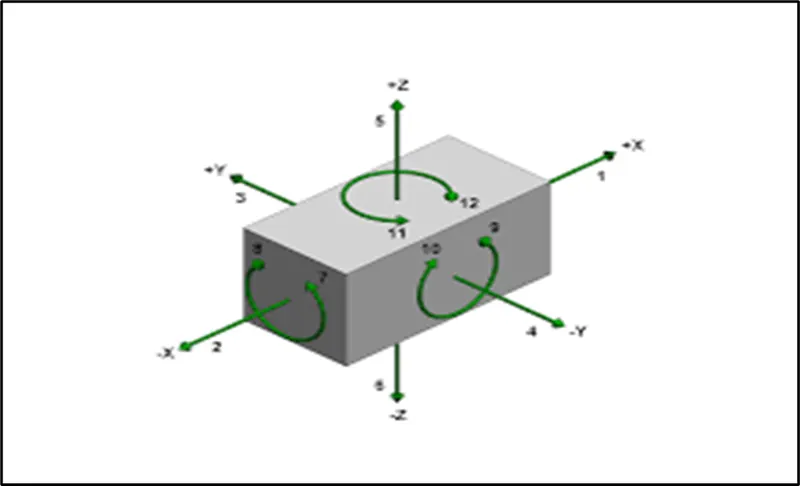
In order to fix the workpiece all, the 12 degrees of freedom need to be restricted. According to this principle only 6 locators are enough to restrict the degrees of freedom where 3 pins are located on the 1st principle plane i.e., either XY, YZ, ZX. Two pins on the 2nd plane which is perpendicular to the 1st plane and the last one pin is located on the plane which is mutually perpendicular to the 1st and 2nd planes.
6) Define Body coordinate system?
Ans: The coordinate system is the reference system consisting of set of points,lines and surfaces used to define the positions of the points in space in either 2 or 3 dimensions.
BCS is also known as car line and body line.
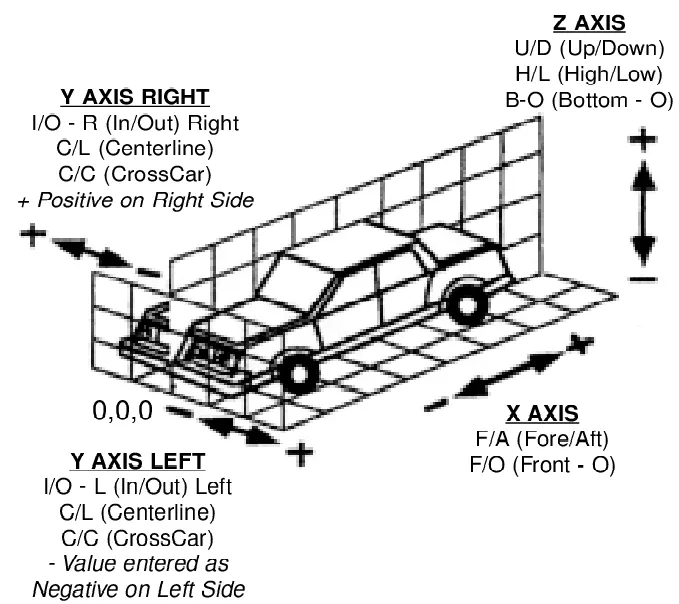
X direction- Longitudinal direction
Y direction- Transverse direction
Z direction- Vertical direction
The origin of the body coordinate system is defined at the front center of the vehicle. Along X axis it indicates the length of the car, along Z axis indicates height of the car, and along Y axis indicates width of the car.
Body coordinate system is mainly used in automotive industry for designing the body parts
7) Elaborate Body plane system & its essentials.
Ans: Body Planes are the reference planes in an automotive car.
Body planes are used to define the GD&T of all car parts in a automotive domain.
Body planes are the three mutually perpendicular imaginary planes and are considered to be present at the driver position/ at the engine location/ at the front end of the car.
Body planes are called as Front 'O' line, Center 'O' line, Body 'O' line
Body plane system essentials-
- It defines exact position of the body part.
- Ensures flawless design for assembly
- While designing lines, all the designs are carried out relative to the bodyline
- It assists in easy location of different parts in a vehicle
- Aims in creating a standardized system
- Assists in Quality Checking