Battery technology courses online
Every Skill-Lync course on Li-ion cells, battery pack design, BMS and battery cooling, with fees, projects and the pack maths behind them.
- 7
- courses and programs
- ₹40,000 to ₹2,75,000
- fees
- 3,064+
- student battery projects
- 6
- battery job titles in our records
As of 16 Nov 2026 · Fees are the list price on each course page, inclusive of all charges
Skill-Lync teaches battery technology in 7 online courses and programs: 4 short courses on Li-ion cells, pack design, battery management systems and battery cooling, and 3 programs that include them. Here they all are with fees, duration and projects, the pack maths they start with, which one fits the job you want, and an honest note on battery jobs.
Every Skill-Lync course that teaches Battery Technology
| Course | Level | Duration | Projects | Fee |
|---|---|---|---|---|
| Battery Thermal Management using Ansys Fluent and MATLAB | Short course | 6 weeks | 2 | ₹40,000 |
| Introduction to Battery Technology for Electric Vehicle | Short course | 12 weeks | 3 | ₹40,000 |
| Li-ion Battery System design in EV & ES | Short course | 12 weeks | 2 | ₹40,000 |
| Battery Cooling System using GT Suite | Short course | – | 2 | ₹40,000 |
| Pre-Graduate Program in Electric Mobility | Pre-graduate program | 16 weeks | 9 | ₹1,50,000 · EMI from ₹7,841/mo |
| Pre-Graduate Program in Hybrid Electric Vehicles | Pre-graduate program | 16 weeks | 6 | ₹1,50,000 · EMI from ₹7,841/mo |
| Post Graduate Program in Battery Technology for Mechanical Engineers | PG program | 32 weeks | 14 | ₹2,75,000 · EMI from ₹14,375/mo |
Projects is the number of industry projects listed on the course page. Programs also include the courses' smaller assignments. EMI figures are the lowest monthly plan shown on the course page.
Which one should you pick?
- You are new to batteries and want one course. Take Introduction to Battery Technology for Electric Vehicle (12 weeks, ₹40,000, 22 h of video, 3 projects: mechanical design of a battery pack, thermal modelling of a pack, and a BMS model in Simulink). It covers the widest ground: cells, models, packs, BMS, charging and thermal.
- You want BMS and pack electrical design. Take Li-ion Battery System design in EV & ES (12 weeks, ₹40,000, 12 h): safe operating area, pack design and modelling, three weeks of BMS, SOC measurement, BMS communication, range estimation and high-voltage safety; project: voltage-based SOC with a 1-RC model in MATLAB. It overlaps the introduction course on packs, BMS and thermal, so take it second or instead.
- You are a mechanical engineer interested in cooling. Battery Thermal Management using Ansys Fluent and MATLAB (6 weeks, 6 h, ₹40,000) builds a 1D liquid-cooling model in Simulink and 3D air- and liquid-cooled pack models in Fluent. Battery Cooling System using GT Suite (16 h over a 12-week syllabus, ₹40,000) is about cooling circuits: pumps, plates and heat exchangers, their sizing and selection, modelled in GT-SUITE.
- You want the full program. The Post Graduate Program in Battery Technology for Mechanical Engineers (32 weeks, ₹2,75,000, EMI from ₹14,375 a month, 14 projects) combines the three battery courses above with three CFD courses. Battery content is 40 of its 81 hours; the rest is CFD that also qualifies you for general CFD roles (see Before you pay).
- You want batteries as part of an EV career. The Pre-Graduate Program in Electric Mobility and the Pre-Graduate Program in Hybrid Electric Vehicles (16 weeks, ₹1,50,000 each, EMI from ₹7,841) each include the introduction course next to EV modelling (hybrid vehicles, Simscape, power converters or hybrid drives). Three more programs contain one battery course: the IIT Roorkee EV program (Li-ion Battery System Design is one of seven mandatory courses), PG Embedded Systems for EV and the EV System and Wiring track of PG EV. All of them are listed on the electric vehicle courses page (linked under Tools).
What is Battery Technology?
A battery technology course teaches how a lithium-ion battery works and how engineers turn single cells into a safe pack: the electrochemistry of the cell, the terms engineers use (capacity, C-rate, state of charge, state of health, internal resistance), models that predict the cell's voltage, the mechanical design of the pack, the battery management system (BMS) that watches every cell, charging, and the cooling that keeps cells in their safe temperature window.
Most battery work in industry is modelling and design rather than chemistry. Engineers model cells as an equivalent circuit (a voltage source with a resistor and one or two resistor-capacitor pairs) in MATLAB and Simulink, estimate the state of charge from voltage and current, size packs for a vehicle's energy and power needs, write BMS logic for cell balancing and protection, and simulate the pack's temperature with 1D tools such as GT-SUITE or 3D CFD in ANSYS Fluent. Cell chemistry and manufacturing are mostly research and factory roles.
Here is the pack arithmetic every battery course starts with. Take a cylindrical Li-ion cell rated 3.6 V nominal (4.2 V full, 2.5 V empty), 5 Ah, with 20 mΩ internal resistance. Cells in series add voltage; cells in parallel add capacity. A 3s4p pack (3 groups in series, each of 4 cells in parallel) gives 10.8 V and 20 Ah; a 4s3p pack of the same 12 cells gives 14.4 V and 15 Ah. Both store 216 Wh, because energy is cells × 3.6 V × 5 Ah however you wire them. Pack resistance is the cell resistance × series count ÷ parallel count: 15 mΩ for 3s4p and 26.7 mΩ for 4s3p. Asked for the same 200 W, the 3s4p pack carries 18.5 A and the 4s3p pack 13.9 A, and both lose 5.1 W as heat, because every cell carries the same current either way. The choice is about the voltage your motor or charger needs, not about energy or efficiency.
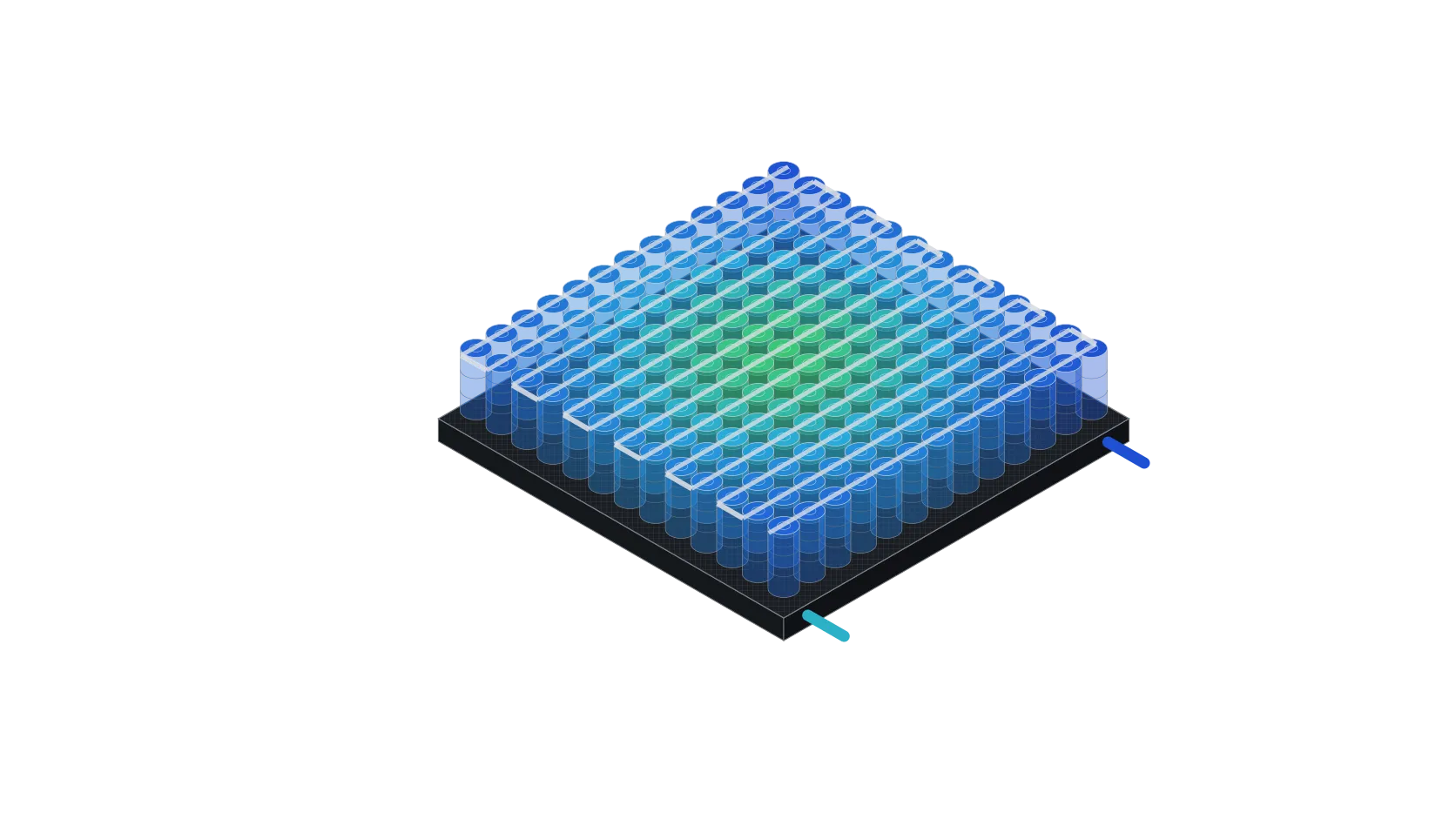
Now size a 48 V class scooter pack for at least 3 kWh. 13 cells in series give 46.8 V nominal (32.5 to 54.6 V from empty to full, which the motor controller must accept). 3,000 Wh ÷ 46.8 V needs 64.1 Ah, so 13 cells in parallel (65 Ah): a 13S13P pack of 169 cells storing 3,042 Wh. Its resistance is 20 mΩ. A 3 kW motor draws 64.1 A, 4.9 A per cell (about 1C), and the pack turns 82 W into heat. Double the power to 6 kW and the current doubles but the heat quadruples to 329 W, because heat is I²R. With 11.8 kg of cells at 70 g each and a specific heat of about 1,000 J/kg·K, ten minutes at 3 kW warms the pack by about 4.2 °C without cooling; ten minutes at 6 kW, about 16.7 °C. Cell resistance also rises in the cold and as the cell ages, so real packs heat faster than this. That is why battery courses spend weeks on thermal management: the cooling plate under the pack in the picture at the top of this page exists to remove that I²R heat.
What a Battery Technology course covers
- Cell fundamentals. Electrochemistry and energy, cell chemistries, capacity, C-rate, energy and power density, state of charge (SOC) and state of health (SOH), the safe operating area of a Li-ion cell (voltage, current and temperature limits), and new storage technologies.
- Cell models. Mathematical and equivalent-circuit models of a cell in MATLAB and Simulink, the 1-RC model used for voltage-based SOC estimation, and the thermodynamics of the cell (where its heat comes from).
- Pack design. Series and parallel configuration, pack construction, mechanical design of a pack, pack modelling, range estimation for a vehicle, and high-voltage electrical safety.
- Battery management systems. What a BMS measures and protects against, BMS design, cell balancing, SOC measurement, BMS communication, and charging methods.
- Thermal management. Heat transfer and fluid flow basics, air and liquid cooling, a 1D thermal model of a liquid cooling system in Simulink, 3D CFD of air- and liquid-cooled packs in ANSYS Fluent, and cooling-circuit design (pumps, heat exchangers, sizing and selection) modelled in GT-SUITE.
- CFD (PG program only). The PG Program adds three general CFD courses: CFD meshing in ANSA, CFD with MATLAB and OpenFOAM, and GUI-based CFD in ANSYS Fluent.
The courses in detail
Battery Thermal Management using Ansys Fluent and MATLAB
6-week online course using ANSYS Fluent, MATLAB, with 2 industry projects. Learn how to design, model, and analyze battery thermal management systems using…
Projects include: 1D Thermal System Model for Liquid Cooling System using MATLAB Simulink; 3D Modelling of Liquid and Air Cooled Cooling Systems using Ansys Fluent.
Tools: ANSYS Fluent, MATLAB
Introduction to Battery Technology for Electric Vehicle
12-week course on battery technology for electric vehicles: cells, packs, SOC and thermal models in MATLAB and Simulink, with 3 projects.
Projects include: Mechanical Design of Battery Pack ; Thermal Modelling of Battery Pack ; Modeling & testing of battery management system with Simulink .
Tools: MATLAB, Simulink
Li-ion Battery System design in EV & ES
Get to know more about the li-ion batteries and how it is used in an electric vehicle with Skill-Lync's Li-ion Battery System design in EV & ES Course.
Projects include: Estimating the Voltage-based SOC of the Battery using 1 RC Model in MATLAB; Project-Based on a Real-world Scenario.
Tools: MATLAB, Simulink
Battery Cooling System using GT Suite
Online course using ANSYS Fluent, GT-SUITE, with 2 industry projects. Battery Cooling System using Ansys Fluent and GT Suite.
Projects include: Design of simple cooling system; Simulation & analysis of cooling circuit .
Tools: ANSYS Fluent, GT-SUITE
Pre-Graduate Program in Electric Mobility
16-week online course using Simulink, MATLAB, with 9 industry projects. A comprehensive program covering various aspects of electric mobility designed…
Projects include: Simulation of All-Terrain Vehicle; Modelling of Electric Vehicle Using DC Motor Drive; Design of Electric Powertrain ; Mechanical Design of Battery Pack .
Tools: Simulink, MATLAB
Pre-Graduate Program in Hybrid Electric Vehicles
16-week online course using MATLAB, Simulink, Simscape, with 6 industry projects. A comprehensive program covering various aspects of hybrid electric vehicle…
Projects include: Double-acting Actuator Model using Simscape ; Development of Forward Energy Based Fuel Consumption Model of a Conventional Vehicle; Development of a Forward Energy Based Fuel Consumption Model of a P1 Hybrid Vehicle; Mechanical Design of Battery Pack .
Tools: MATLAB, Simulink, Simscape
Post Graduate Program in Battery Technology for Mechanical Engineers
32-week PG program in EV battery technology: cell chemistry, pack design, thermal management (ANSYS Fluent) and BMS models (MATLAB, Simulink), 14 projects.
Projects include: Mechanical Design of Battery Pack ; Thermal Modelling of Battery Pack ; Modeling & testing of battery management system with Simulink ; 2D Heat Conduction Simulation.
Tools: ANSYS Fluent, SpaceClaim, CFD Post, MATLAB, Simulink, OpenFOAM, Octave, ANSA
Jobs after a Battery Technology course
Typical job titles: battery systems or battery pack engineer, BMS engineer (hardware, software or algorithms), cell modelling or SOC estimation engineer, battery thermal engineer, battery testing and validation engineer, and high-voltage safety engineer. Employers include EV makers (cars, two- and three-wheelers, buses), battery pack makers, cell manufacturers, energy storage companies and the engineering services companies that work for them.
We can't show a battery salary figure, and here is why. As of 16 Nov 2026, Skill-Lync's 3,905 placement records contain no placement from the Post Graduate Program in Battery Technology for Mechanical Engineers, and only 6 job titles that mention batteries or BMS (2021 to 2024): a battery design engineer at Tata Elxsi, a battery systems engineer at Grinntech, a BMS engineer at Tata AutoComp, a BMS design engineer at Boson Auto, a power electronics and BMS role at VTOL Aviation, and an R&D role in powertrain and battery modelling at HBL Power Systems. Salaries ranged from 2.1 to 9 LPA, too few for a median. 5 of the 6 came from the PG Program in EV Design and Development, not a battery program.
Battery skills are mostly hired inside EV roles. Our 502 EV and HEV placements, with salaries, employers and job titles, are on EV engineer salaries and electric vehicle courses; for who hires freshers, see companies hiring EV engineering freshers. These are learners who told us they were placed, so treat every figure as a starting point, not as today's market rate.
Projects students built
Skill-Lync learners have published at least 3,064 battery project reports (1,020 students, as of 16 Nov 2026; 1,753 of them in 2022). We count only reports whose title names a battery task. The most common:
understanding different battery chemistries (851), state-of-charge estimation (673), mechanical design of a battery pack (652), thermal modelling of a battery pack (518), an electric car model with a Li-ion battery (221), battery behaviour over a drive cycle (61), building a multi-cell pack in Simulink (49).
Three that people search for: a 3s4p and 4s3p pack built from Simulink's battery block, specifications of a lithium-ion battery and a mathematical model of a battery. More in latest battery technology projects by Skill-Lync students and the EV section of electrical engineering project ideas (SOC estimation, pack sizing).
Battery software, course by course
Each tool has its own page listing every Skill-Lync course that uses it, with fees and syllabus notes:
- MATLAB and Simulink courses (cell models, SOC estimation, BMS logic)
- ANSYS courses (Fluent CFD of battery packs)
- GT-SUITE courses (cooling circuits, vehicle systems)
- CFD courses (the CFD half of the PG Battery program)
- Electric vehicle courses (where battery skills get used)
- Embedded systems courses (BMS firmware, CAN)
Free battery lessons before you pay
Try the basics free before you pick a course:
Free Battery Technology tutorials
Start here before you pay for anything. These are written by Skill-Lync learners and engineers:
- Different Types of Batteries used in EV vehicles
- Top 10 Differences between Lead-Acid Batteries and Lithium-Ion Batteries
- Lithium-Ion Cell Make-Up: The Science Behind Modern Batteries
- What Are the Metals Used in Lithium-ion Battery?
- LFP vs NMC Batteries: Chemistry, Safety, Cost and What It Means for BMS
- Understanding Lithium-Ion batteries in the EV domain - Part 1
- Modeling a Li-ion Battery Equivalent Circuit
- All You Want To Know About Battery Blocks in Simulink
- Understanding Battery Charging and Discharging
- Charging Modes of a Li-ion Battery
- How Does a Battery Management System (BMS) Work? A Guide for EV Engineers
- Battery packed heat generation
- The Importance of Battery Thermal Management Systems in Electric Vehicles
- How are EV Batteries Manufactured?
- Lithium-Ion Battery Recycling in India: The Black Mass Export Ban Explained
- Latest Projects on Battery Technology by Skill-Lync Students
- The Ultimate Guide to Become a Skilled Battery Management Systems Engineer
- BMS Engineer Interview Questions: 14 Answers With Worked Numbers
Before you pay
Half of the PG Battery program is CFD. Of its six courses, three are battery courses (40 of 81 hours) and three are general CFD (ANSA meshing, MATLAB and OpenFOAM, ANSYS Fluent). That suits a mechanical engineer who wants battery thermal or CFD jobs. If you want BMS or electrical pack design, the two battery short courses cost ₹80,000 together.
Do the bundle maths. The six PG Battery courses cost ₹2,40,000 one by one and ₹2,75,000 as the program, ₹35,000 more. The program adds the career services listed on its page (mentorship, mock interviews, access to recruiters); ask what that includes before choosing it over separate courses. We have no placement records from this program (see Jobs).
The two Li-ion courses overlap. Introduction to Battery Technology for Electric Vehicle and Li-ion Battery System design in EV & ES both teach pack construction, BMS and thermal basics. The first adds electrochemistry, cell models and charging; the second adds the safe operating area, SOC measurement, BMS communication and high-voltage safety. Pick by that list, or take the introduction first.
Compare hours, not weeks. Every short course costs ₹40,000, but Li-ion Battery System design in EV & ES is 12 h of video over 12 weeks and Battery Thermal Management using Ansys Fluent and MATLAB is 6 h. Battery Cooling System using GT Suite shows no duration on its page (its syllabus runs 12 weeks, 16 h) and, despite the name, covers cooling of electronic components and energy storage in general, modelled in GT-SUITE rather than Fluent. Introduction to Battery Technology for Electric Vehicle is sold as 12 weeks; its syllabus lists 10.
Battery jobs are fewer than the hype suggests. Only 6 of our 3,905 placement records have battery or BMS job titles. Learn batteries as one part of an EV, thermal or embedded skill set, and ask the counsellor for recent battery placements before you pay.
Battery Technology course FAQs
What is the fee for a battery technology course at Skill-Lync?
As of 16 Nov 2026: each of the 4 battery short courses is ₹40,000. The PG Program in Battery Technology for Mechanical Engineers is ₹2,75,000 (EMI from ₹14,375 a month), and the Pre-Graduate Programs in Electric Mobility and in Hybrid Electric Vehicles, which each include the battery introduction course, are ₹1,50,000 (EMI from ₹7,841). Fees are inclusive of all charges.
Which battery course is best for beginners?
Introduction to Battery Technology for Electric Vehicle (12 weeks, 22 h of video). It starts from electrochemistry and covers cell models, pack construction, BMS, charging and thermal management, with three projects. Take Li-ion Battery System design in EV & ES next if you want BMS and pack electrical design.
What is the difference between a BMS course and a battery technology course?
A battery technology course covers the whole battery: cell chemistry, cell models, pack design, charging and thermal management, with the BMS as one part. A BMS course goes deeper into the electronics and software that monitor and protect the cells: voltage and temperature sensing, cell balancing, SOC and SOH estimation, protection logic and communication. At Skill-Lync, Li-ion Battery System Design spends three of its twelve weeks on BMS plus a week each on SOC measurement and BMS communication.
Is a 3s4p battery the same as a 4s3p battery?
They use the same 12 cells and store the same energy, but not the same voltage. With 3.6 V, 5 Ah cells, 3s4p gives 10.8 V and 20 Ah, and 4s3p gives 14.4 V and 15 Ah; both store 216 Wh. For the same power each cell carries the same current, so both packs lose the same heat. Choose by the voltage your motor, inverter or charger needs.
Can mechanical engineers do a battery course?
Yes. The PG Program in Battery Technology is designed for mechanical engineers, and pack mechanical design, thermal modelling and cooling-system design are mechanical work. The electrical side (cell models, BMS, SOC) is taught from the basics in MATLAB and Simulink.
Which software is used in battery engineering courses?
MATLAB and Simulink for cell models, SOC estimation, BMS logic and 1D thermal models; ANSYS Fluent for 3D CFD of air- and liquid-cooled packs; GT-SUITE for cooling circuits; and, in the PG program, ANSA and OpenFOAM for CFD meshing and solving.
What is the salary of a battery engineer in India?
We don't have enough of our own data to say. Only 6 of Skill-Lync's placement records (2021 to 2024, as of 16 Nov 2026) have battery or BMS job titles, with salaries from 2.1 to 9 LPA. For a larger sample of related roles, see the EV engineer salary page, built from 502 EV and HEV placements.
Can I learn battery technology for free?
Yes, the basics. Start with the free battery management systems and EV fundamentals courses on resources.skill-lync.com and the EV fundamentals lessons on Skill-Lync Grow, then build a 1-RC cell model and estimate SOC in MATLAB or Python. A paid course adds reviewed projects, mentor feedback and career support.