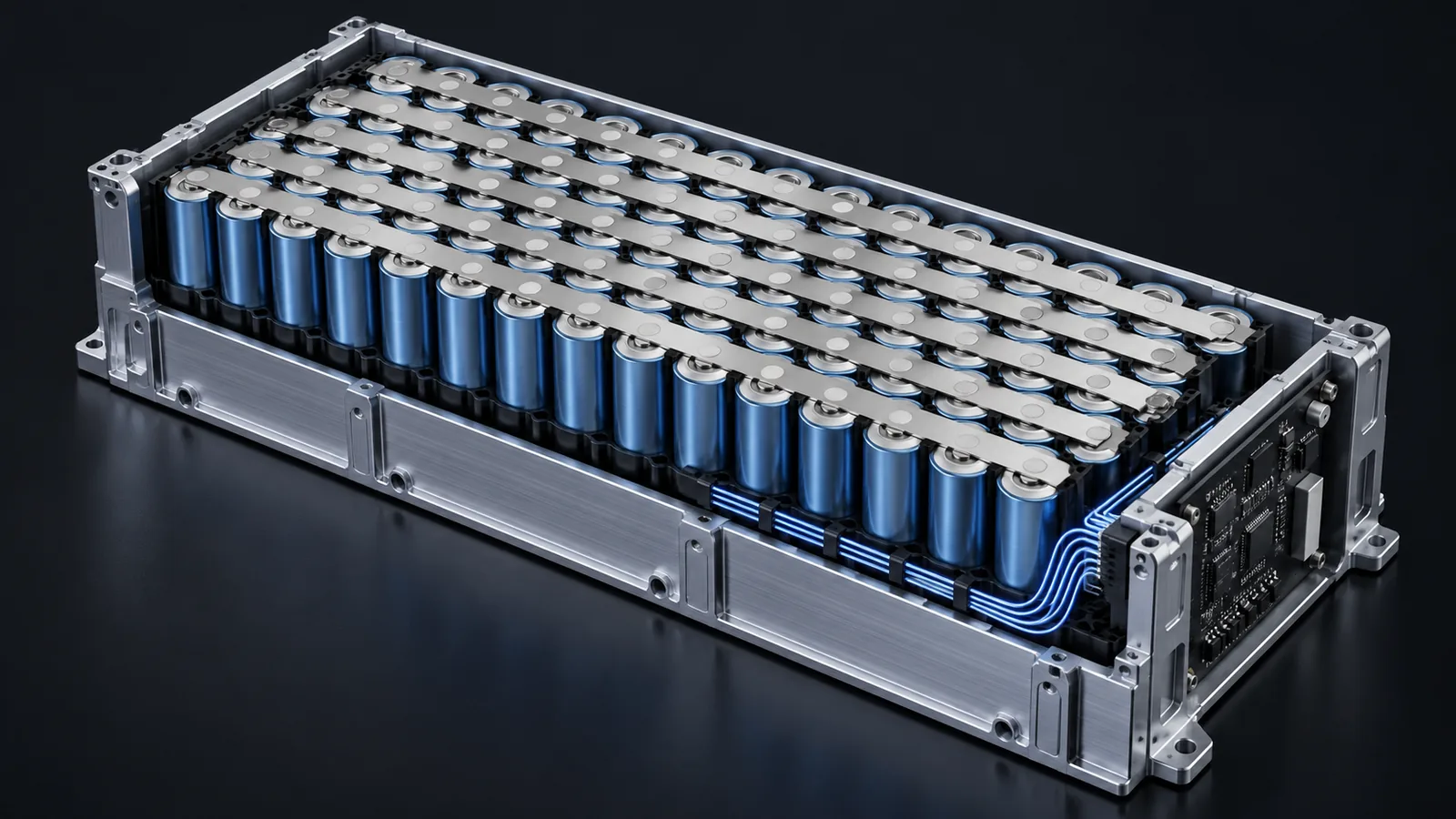
LFP vs NMC Batteries: Chemistry, Safety, Cost and What It Means for BMS
LFP is cheaper, longer-lasting and more heat-tolerant; NMC stores far more energy per kilogram. Here is the chemistry, the voltage curves that make LFP's state of charge hard to read, thermal runaway and cost data, which Indian EVs use which, and what each means for BMS and thermal design.

In short
- LFP (lithium iron phosphate) cells run at about 3.3 V, store about 160 Wh/kg at cell level, last thousands of cycles, start self-heating later and release far less heat and gas in thermal runaway. LFP packs cost $81/kWh on average in 2025.
- NMC (lithium nickel manganese cobalt oxide) cells run at about 3.6 V and store 270 Wh/kg or more in the latest nickel-rich versions. That means more range per kilogram, but shorter cycle life, an earlier and hotter thermal runaway, and $128/kWh packs.
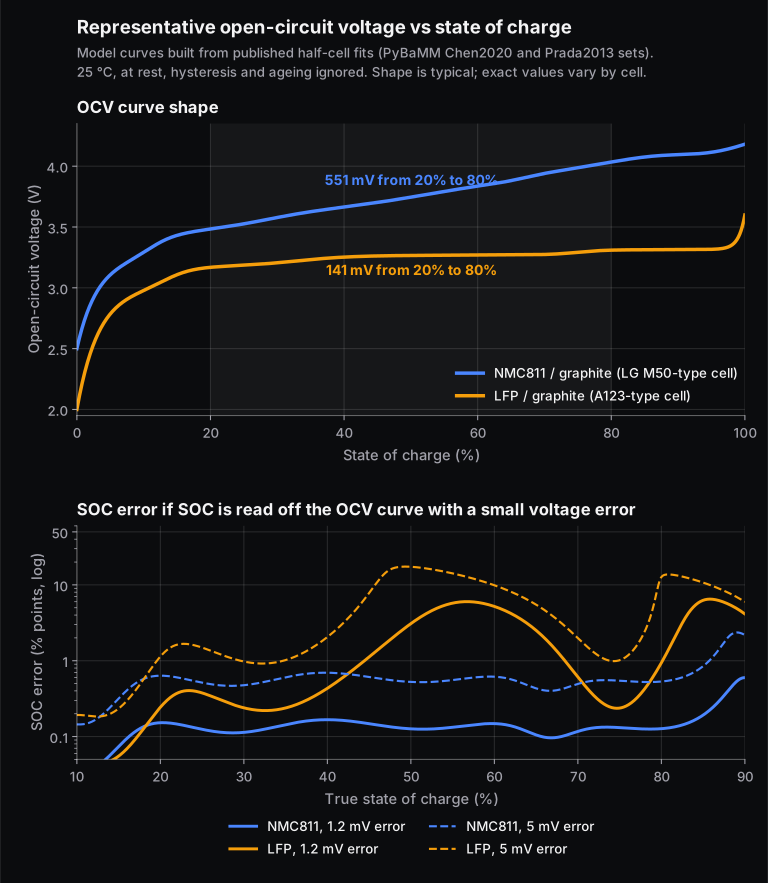
- LFP's open-circuit voltage curve is almost flat between about 20% and 80% charge. In our representative model it rises only 141 mV across that range, against 551 mV for NMC811. That makes state of charge much harder for the BMS to read from voltage alone.
- In India, most new electric cars use LFP (Tata, Mahindra, Maruti, MG, BYD), while Hyundai's Creta Electric, Ather's 450, TVS iQube and Ola's in-house cell use NMC. Indian cell makers are starting with LFP.
LFP and NMC are the two lithium-ion cathode chemistries that power almost every electric vehicle sold today. Choose LFP when cost, safety and cycle life matter most and the vehicle can carry some extra mass. Choose NMC when energy per kilogram (range or a light pack) matters most, or the vehicle must work well in severe cold. The choice also changes how you design the battery management system (BMS) and the thermal system, which is the part most comparisons skip.
This guide compares the two on structure, voltage curve, energy density, cycle life, thermal runaway, cold behaviour and cost, using published data drawn into charts. It then shows which Indian EVs use which chemistry, with a source for each.
What are LFP and NMC batteries?
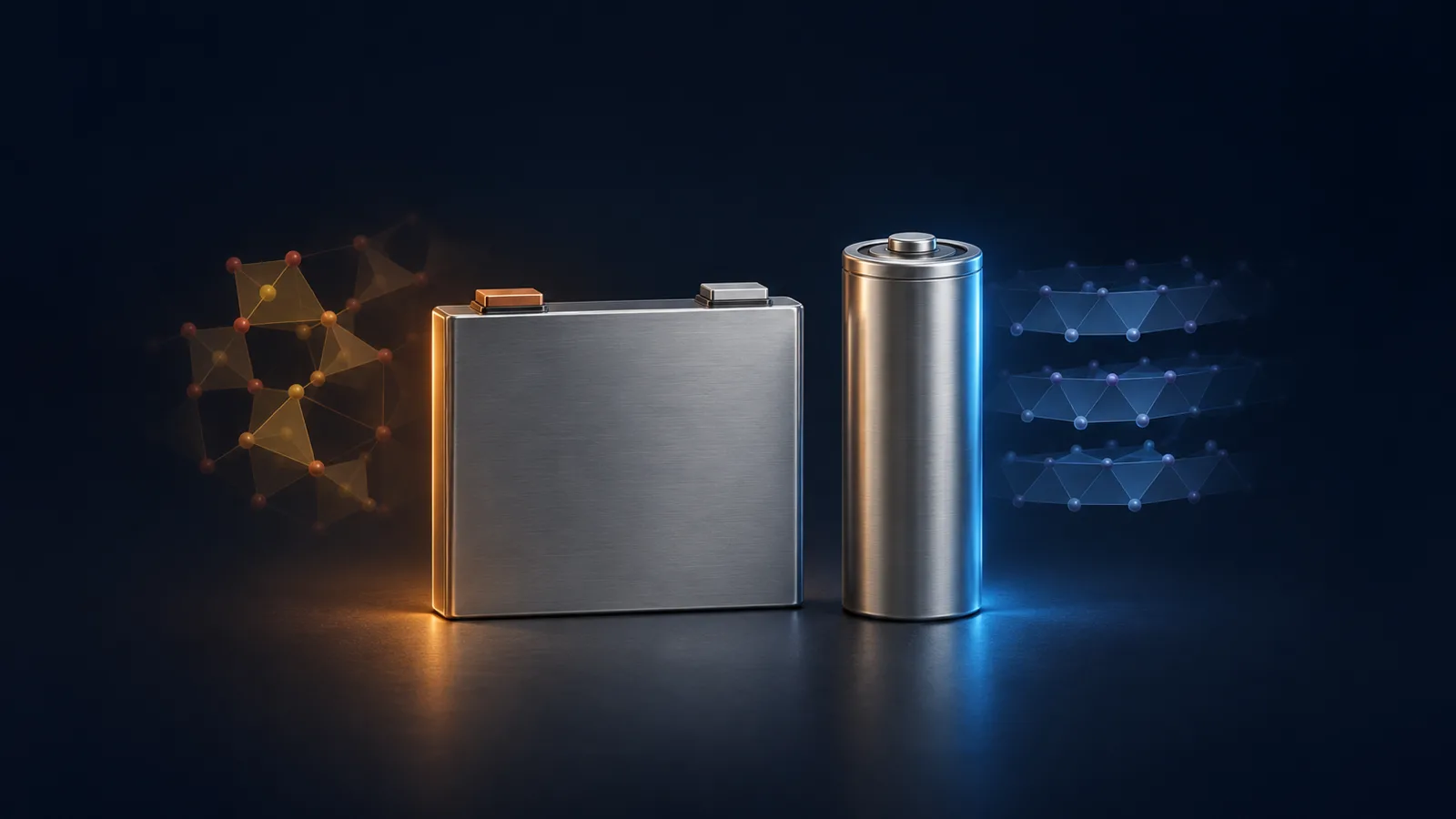
Both are lithium-ion cells with a graphite negative electrode (anode). They differ in the positive electrode (cathode), the material that holds lithium when the cell is discharged.
- LFP: LiFePO₄, an olivine. Iron, lithium and oxygen sit in a framework held together by phosphate (PO₄) groups. Goodenough's group first reported phospho-olivines as cathodes in 1997. The strong phosphorus-oxygen bonds keep oxygen locked in the crystal even when the cell is hot and charged, and that is the root of LFP's safety advantage. A charged LFP cathode (iron phosphate, FePO₄) ranks as the most thermally stable of the common cathode materials in calorimetry studies.
- NMC: LiNixMnyCozO₂, a layered oxide. Lithium sits in sheets between layers of nickel, manganese and cobalt oxide. The number in the name gives the metal ratio: NMC111 has equal parts, while NMC811 is 80% nickel, 10% manganese and 10% cobalt. Nickel adds capacity, cobalt helps the structure and rate capability, and manganese adds stability. The industry has moved toward more nickel for range and less cobalt for cost.
Think of it like this: NMC packs more lithium into every gram and pushes it out at a higher voltage, but its layered structure can shed oxygen when overheated. LFP stores less, at a lower voltage, in a structure that is much harder to break.
LFP vs NMC at a glance
| Property | LFP | NMC | Source |
|---|---|---|---|
| Typical nominal cell voltage | ≈3.3 V (window 2.0–3.6 V) | ≈3.6 V (window 2.5–4.2 V) | Golubkov 2014; LG HG2 datasheet; Preger 2020 |
| Open-circuit voltage curve | Long flat plateau | Steady slope | Model curves below |
| Cell specific energy | ≈160 Wh/kg, 330 Wh/L | ≥270 Wh/kg, ≥650 Wh/L (NMC811) | Frith et al. 2023 |
| Pack specific energy | ≈135 Wh/kg, 210 Wh/L with cell-to-pack | Depends on pack design | Frith et al. 2023 |
| Cycles to 80% capacity (one lab study) | 2,500–9,000 | 200–2,500 | Preger et al. 2020 |
| Self-heating onset (one ARC study) | ≈195 °C | ≈168 °C | Golubkov et al. 2014 |
| Peak temperature in thermal runaway | ≈404 °C | ≈678 °C | Golubkov et al. 2014 |
| Average pack price, 2025 | $81/kWh | $128/kWh | BloombergNEF |
| Cold-weather behaviour | Weaker | Better | IEA (via electrive) |
Read the lab numbers as ranges from specific cells and conditions, not as guarantees for any one product. Each row's source and caveats are discussed below.
Why is LFP's voltage lower and flatter than NMC's?
A cell's voltage is the difference between the two electrode potentials. Iron phosphate sits at a lower potential against lithium than nickel-rich oxides, so an LFP cell works at about 3.3 V against about 3.6 V for NMC. A Sandia study cycled its LFP cells between 2.0 and 3.6 V and its nickel-oxide cells up to 4.2 V.
The shape of the curve matters even more than the level. LFP charges and discharges through a two-phase reaction: lithium-rich LiFePO₄ and lithium-poor FePO₄ coexist inside the particles, and while both phases are present the electrode potential barely moves. NMC is a solid solution: lithium leaves the layers gradually, and the potential falls steadily with it. LFP also shows a small but real voltage hysteresis, meaning its resting voltage after charging differs from its resting voltage after discharging at the same state of charge. That has a thermodynamic origin in many-particle insertion electrodes.
One practical consequence of the lower voltage: an LFP pack needs more cells in series for the same pack voltage. For about 400 V nominal you need roughly 400 / 3.3 ≈ 121 LFP cells in series, against 400 / 3.6 ≈ 111 NMC cells. That is more cell-voltage channels for the BMS to measure and balance.
Why is state-of-charge estimation harder with LFP?
A BMS estimates state of charge (SOC, the "fuel gauge") mainly by coulomb counting, which integrates current in and out. Small current-sensor errors accumulate over hours of driving, so the count drifts. The BMS corrects the drift by checking against the open-circuit voltage (OCV) whenever the cell rests: if you know the resting voltage and the OCV-SOC curve, you can read off SOC.
That correction works well on a sloped curve and poorly on a flat one. The lower panel of the chart above shows how much SOC error a small voltage error causes if you read SOC off each curve:
- A good battery monitor IC such as Analog Devices' LTC6811 specifies a maximum total cell-voltage measurement error of 1.2 mV. With that error, the median SOC error between 10% and 90% SOC is 0.13 percentage points for NMC811 and 0.56 points for LFP in our model.
- Real voltage error at rest is usually larger, because of temperature, incomplete relaxation, hysteresis and cell-to-cell differences. At a 5 mV error, NMC811's median is 0.55 points while LFP's is 2.5 points. On the flattest part of LFP's plateau the error reaches about 17 points.
Here is the catch: these are model curves. Real LFP curves vary between cell makers, and the plateau in some cells is flatter than this model's. The direction of the result does not change.
In practice, LFP BMS designs lean on:
- Accurate current sensing, to slow the coulomb-counting drift.
- Recalibrating SOC at the steep ends of the curve: near full charge and near empty.
- Model-based estimators, such as an extended Kalman filter on an equivalent-circuit model, that include hysteresis.
- Careful temperature compensation.
If you are learning BMS design, how a battery management system works walks through coulomb counting and OCV correction with worked numbers.
How do LFP and NMC compare on energy density, at cell and pack level?
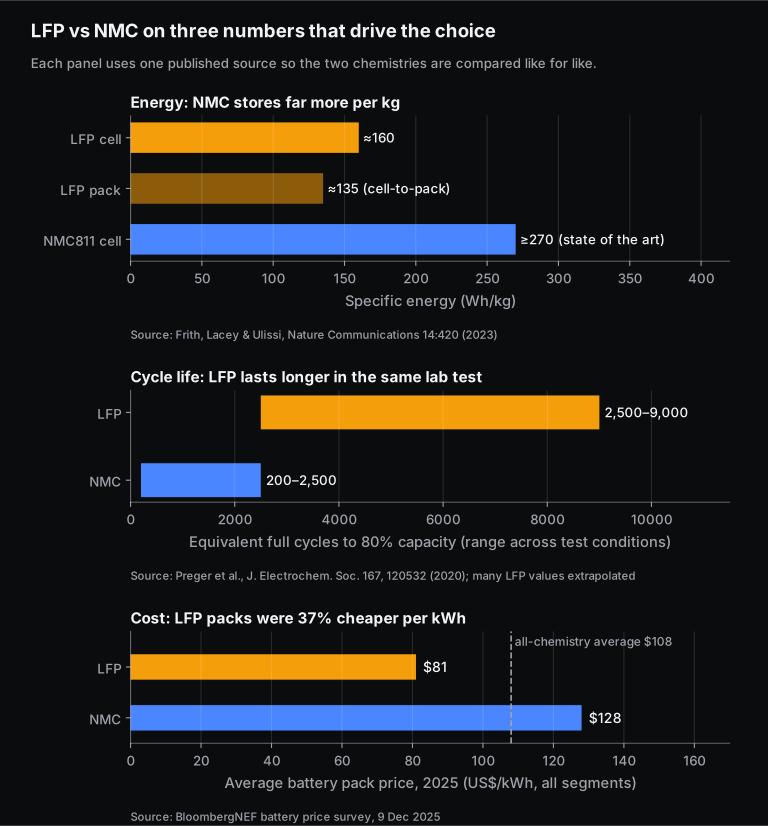
At cell level, NMC wins clearly. A 2023 industry review in Nature Communications by Frith, Lacey and Ulissi puts state-of-the-art nickel-rich NMC811 cells at 270 Wh/kg and 650 Wh/L or more, against about 160 Wh/kg and 330 Wh/L for an LFP cell.
A worked example shows what that means for mass. For 60 kWh of cells:
- LFP: 60,000 / 160 ≈ 375 kg
- NMC811: 60,000 / 270 ≈ 222 kg
That is about 150 kg of cell mass, before housing, cooling and wiring.
At pack level, LFP closes part of the gap through cell-to-pack design. Large prismatic or "blade" LFP cells go straight into the pack without intermediate modules, so a bigger share of the pack's volume is active cell. The same review estimates that a 160 Wh/kg LFP cell can give a pack of about 135 Wh/kg and 210 Wh/L. That works out to 64% volumetric packing efficiency, against roughly 35–40% for a conventional module-based pack. BYD, which introduced the Blade battery in 2020, has since moved all its passenger EVs to LFP.
Which lasts longer: LFP or NMC?
LFP, by a wide margin in controlled tests. Sandia National Laboratories cycled commercial 18650 cells (A123 LFP, LG HG2 NMC and Panasonic NCA) across temperatures, depths of discharge and currents. They reported 2,500 to 9,000 equivalent full cycles to 80% capacity for LFP, against 200 to 2,500 for NMC and 250 to 1,500 for NCA. At the same number of cycles, LFP cells had kept on average 9% more capacity than the NMC cells. NMC and NCA cells also degraded noticeably faster when cycled over the full 0–100% range.
Two honest caveats from the paper itself:
- Many LFP lifetimes were extrapolated, because the cells had not yet reached 80% when the paper was written.
- The gap narrows when you compare total energy delivered rather than cycles, because each LFP cycle delivers less energy.
For a design engineer, that means LFP suits high-utilisation vehicles that cycle daily (buses, fleet cars, three-wheelers, stationary storage), while a well-managed NMC pack kept away from 100% and from heat can still last a private car's life.
Is LFP safer than NMC? What the thermal runaway data shows
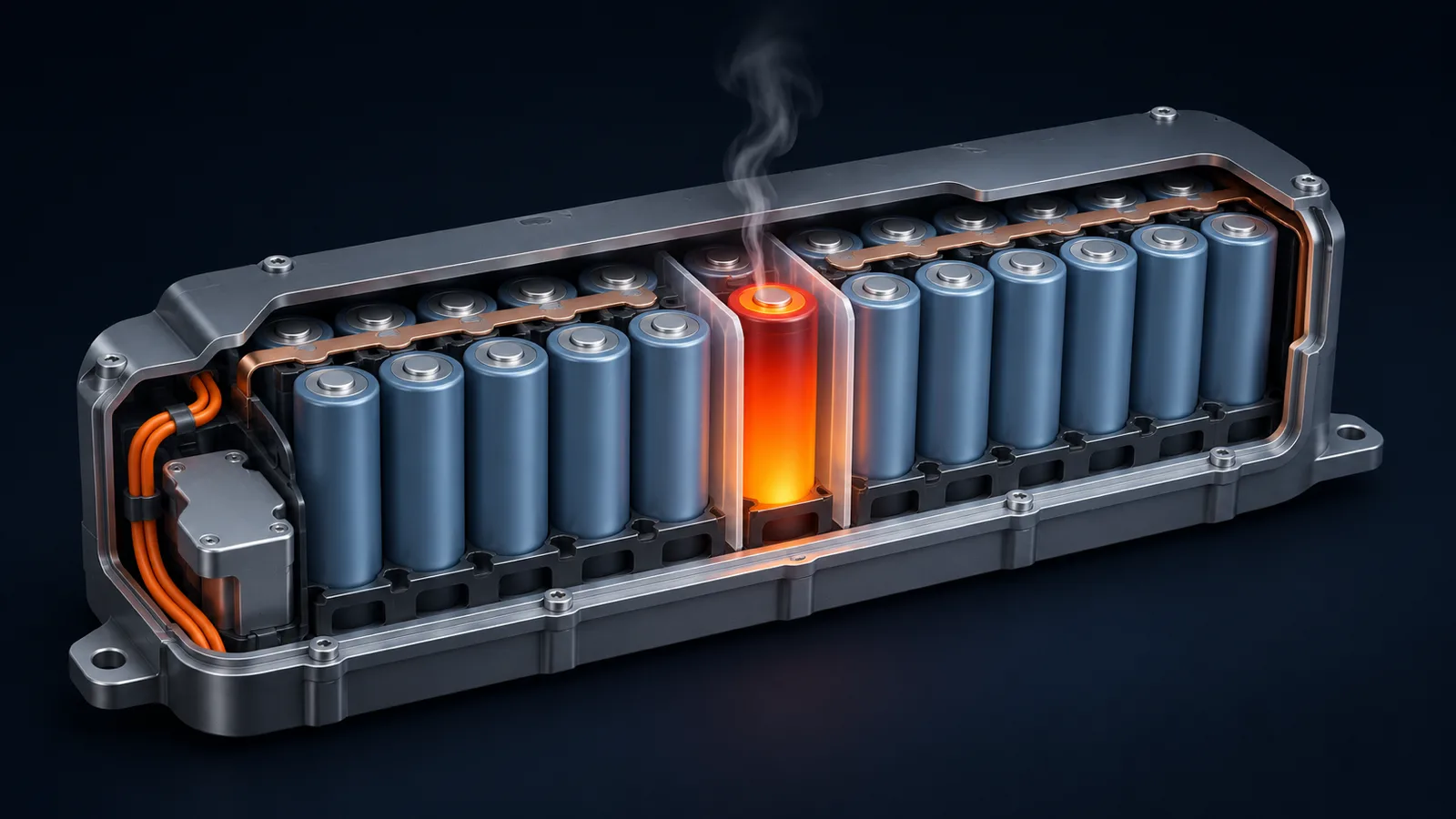
Thermal runaway is a chain reaction: heat speeds up the cell's internal side reactions, the reactions release more heat, and the cell vents, sometimes with fire. In a widely cited 2014 study, Golubkov and colleagues heated fully charged 18650 cells in a sealed reactor and measured three temperatures:
- where self-heating began
- where it turned into rapid runaway
- the peak temperature reached
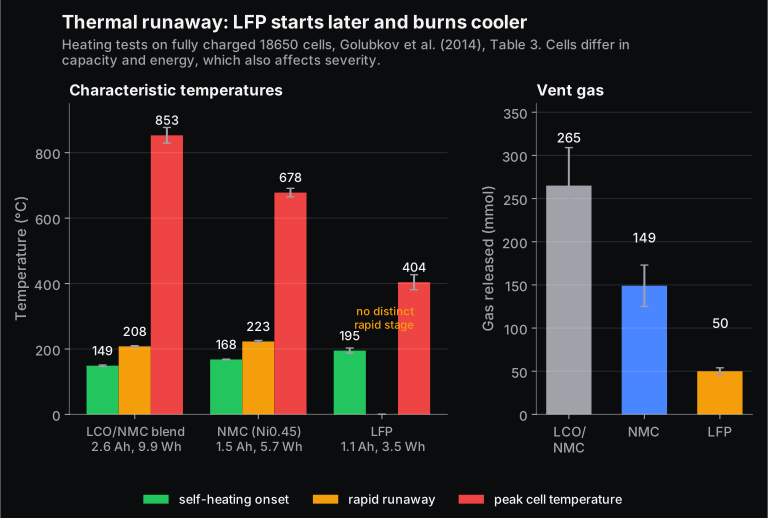
The LFP cell started self-heating at about 195 °C against 168 °C for the NMC cell. It showed no distinct rapid-runaway stage, peaked at about 404 °C against 678 °C, and released about a third of the gas (50 mmol against 149 mmol).
The authors point to the likely reason: oxygen released by the breakdown of charged metal-oxide cathodes, which then burns the electrolyte inside the cell. The trend gets worse with more nickel. A study from Brookhaven National Laboratory found that the first oxygen-releasing phase change in charged NMC starts at about 245 °C for NMC433 but only about 135 °C for NMC811.
Here is the catch: "safer" does not mean "safe". An LFP cell can still vent flammable gas and catch fire if it is abused, badly made or poorly protected. BYD's own nail-penetration demonstration, which reported 30–60 °C surface temperatures for a Blade cell against more than 500 °C for a ternary (NMC) cell, is a manufacturer's test, not an independent one. Pack design, cell-to-cell propagation barriers, venting paths and BMS protection decide real-world safety. Skill-Lync's post on why electric vehicles catch fire in India covers the pack-level causes.
How do LFP and NMC behave in cold weather?
LFP is the weaker chemistry in the cold. The IEA's 2025 Global EV Outlook, as summarised by electrive, notes that NMC keeps its advantage for long range and that LFP does worse in cold climates. LFP's lower voltage leaves less margin before the cut-off when internal resistance rises in the cold. Its flat curve also makes SOC even harder to estimate when the cell is cold.
Both chemistries share one constraint: charging a cold cell risks lithium plating on the graphite anode. Cell makers therefore allow a narrower temperature window for charging than for discharging. LG's HG2 NMC cell, for example, is rated for charging at 0–50 °C but discharging at −20 to 75 °C.
For most of India, heat is the bigger design problem, and cold matters mainly in Ladakh, Himachal Pradesh, Uttarakhand and Kashmir winters. There, an LFP vehicle needs pack heating before fast charging, and its BMS needs to limit charge current at low temperature. We could not find an independent, peer-reviewed comparison of LFP and NMC capacity loss at −10 to −20 °C that we could verify, so we have not quoted a percentage.
How much cheaper is LFP per kWh?
About a third cheaper at pack level in 2025. BloombergNEF's December 2025 survey put the average lithium-ion pack price at $108/kWh, down 8% from 2024. Average LFP packs were $81/kWh against $128/kWh for NMC packs, so LFP was 37% cheaper. The IEA's 2025 outlook similarly describes LFP as almost 30% cheaper per kWh than NMC.
LFP avoids nickel and cobalt, and China's large LFP supply chain keeps pushing its prices down.
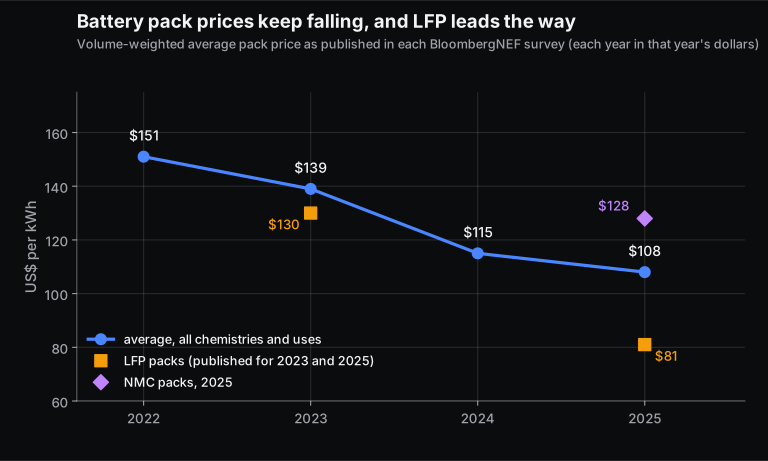
Cost is why LFP took over. The IEA reports that LFP made up almost half of the global EV battery market in 2024 and about three-quarters in China. It also expected LFP's share in emerging markets, India included, to pass 50% in 2025.
Which Indian EVs use LFP and which use NMC?
Indian electric cars have largely moved to LFP, while premium two-wheelers have mostly stayed with NMC. This is what manufacturers and the trade press have reported (models change packs during their life, so check the variant):
| Vehicle or company | Chemistry | What was reported |
|---|---|---|
| Tata Nexon.ev 45, Punch.ev (2026), Harrier.ev, Tiago.ev (2026) | LFP | Nexon.ev 45 uses the same LFP prismatic cells as the Curvv.ev (CarWale, Oct 2024). Punch.ev has a 40 kWh LFP prismatic pack (Autocar Professional, Feb 2026). Tata described Harrier.ev's LFP choice as suited to Indian conditions (Mobility Outlook, Jun 2025). Tiago.ev 2026 is LFP (EVTechNews, May 2026). |
| Mahindra BE 6, XEV 9e, XEV 9S | LFP (BYD Blade cells in BE 6 and XEV 9e) | 16 Blade cells per module in 59 and 79 kWh packs (Autocar Professional, Jan 2025). The XEV 9S has an "advanced LFP battery" (Mahindra, Nov 2025). |
| Maruti Suzuki e Vitara | LFP (BYD Blade) | 49 and 61 kWh packs with BYD LFP blade cells (Autocar India, Jan 2025). |
| MG Windsor EV, MG Comet EV | LFP | Windsor: 38 kWh LFP with prismatic cells (Autocar India, Sep 2024). Comet: 17.3 kWh LFP pack from Tata AutoComp (Autocar Professional, Apr 2023). |
| BYD Atto 3, Seal | LFP (Blade) | Seal: both pack options use Blade cells (Autocar India, Mar 2024). BYD has moved all its passenger EVs to LFP Blade cells (Frith et al. 2023). |
| Hyundai Creta Electric | NMC | NMC cells imported from Indonesia, possibly from Hyundai and LG Energy Solution's joint venture. Hyundai has an LFP cell deal with Exide Energy (electrive, citing Autocar Professional, Jan 2025). |
| Ather 450; Ather Rizta | 450: NMC. Rizta: LFP on smaller packs | The Rizta's smaller variants moved to LFP, while the 450 stays NMC-only (Autocar India, Jul 2026). |
| TVS iQube | NMC | Stated on TVS Motor's own blog (Aug 2024). |
| Ola Electric | NMC (4680 Bharat Cell); LFP 46100 cell coming | Ola's in-house cell uses an NMC cathode (Autocar Professional, Jul 2022; pv magazine India, Jun 2026). An LFP cell in 46100 format was announced for product integration (Autocar Professional, Apr 2026). |
| Exide Energy (cell maker) | LFP first, then NMC | 6 GWh Phase I at Bengaluru, starting with LFP cells and adding NMC for OEMs (Energetica India, Sep 2026). |
| Agratas, Tata group (cell maker) | LFP pilot; NMC from early 2027 | LFP pilot line at Sanand; NMC under licence expected early 2027 (Business Today, Aug 2026). |
The pattern makes engineering sense. Indian car buyers are price-sensitive and Indian summers are hot, which favours LFP's cost, cycle life and thermal margin. Scooters have tight space and weight budgets, which favours NMC's energy density, though even there the cheaper variants are switching.
What does the chemistry choice mean for BMS and thermal design?
Battery management system
- SOC estimation: LFP needs better current sensing, end-of-curve recalibration and a hysteresis-aware model (see above). NMC's sloped curve gives the BMS a usable voltage-based correction across most of the range.
- Voltage limits: LFP works roughly between 2.0 and 3.6 V per cell; NMC charges to 4.2 V. The over-voltage and under-voltage thresholds, and the balancing targets, are different.
- Balancing: on LFP's plateau, cells at different SOC can sit at almost the same voltage, so voltage-based balancing sees imbalance only near the top of charge. Balancing is usually done there.
- Cell count: more LFP cells in series for a given pack voltage means more measurement channels.
- Charging limits: both chemistries need temperature-dependent current limits. LFP needs them more in the cold.
Thermal management
- NMC runs hotter in abuse and goes into runaway sooner. Its pack needs tighter temperature control, stronger cell-to-cell propagation barriers and well-designed vent paths.
- LFP tolerates heat better and supports large cell-to-pack designs. But large cells have long internal heat paths, so cooling-plate design and cell temperature spread still need simulation. Cold climates need heating.
- Either way, the thermal system is designed with CFD and 1D system models before hardware. Skill-Lync's Battery Thermal Management using Ansys Fluent and MATLAB course covers that workflow, and this post on battery thermal management explains the options.
So which should you choose: LFP or NMC?
- Choose LFP for cost-sensitive cars, fleets, buses, three-wheelers and energy storage; for hot climates; for high daily cycling; and where you can carry about 1.7 times the cell mass for the same energy (270 / 160 Wh/kg).
- Choose NMC for long range in a limited mass or space (premium cars, performance vehicles, scooters with small battery bays), for very cold markets, and where fast charging at low temperature matters.
- Either way, design the BMS and thermal system for the chemistry from the start: the SOC algorithm, voltage limits and safety strategy all differ.
To go deeper, Skill-Lync's Introduction to Battery Technology for Electric Vehicles covers cell chemistry and modelling in MATLAB and Simulink. The Post Graduate Program in Electric Vehicle Design & Development takes you from battery to powertrain.
Frequently asked questions
Is LFP better than NMC?
Neither is better overall. LFP is cheaper ($81 against $128 per kWh for packs in 2025), lasts more cycles and is more thermally stable. NMC stores much more energy per kilogram (≥270 against about 160 Wh/kg at cell level) and copes better with cold. The right choice depends on range, cost, climate and duty cycle.
Why do LFP batteries show inaccurate battery percentage?
Because LFP's resting voltage barely changes between about 20% and 80% charge, the BMS cannot correct its current-counting estimate from voltage in that range. Small errors build up until the cell reaches the steeper ends of its curve. Charging to full occasionally lets the BMS recalibrate. NMC's sloping voltage curve makes this correction easier.
Can I charge an LFP battery to 100%?
LFP cells tolerate full charge better than NMC, and the Sandia data shows LFP's cycle life is far less sensitive to depth of discharge than NMC's. Charging to 100% also gives the BMS a reference point for SOC. Always follow the vehicle maker's guidance, since the usable window is set by the pack design and BMS.
Do Indian electric cars use LFP or NMC?
Most recent Indian electric cars use LFP: Tata (Nexon.ev 45, Punch.ev, Harrier.ev), Mahindra (BE 6, XEV 9e, XEV 9S), Maruti e Vitara, MG Windsor and Comet, and BYD. Hyundai's Creta Electric uses NMC. Among scooters, Ather 450, TVS iQube and Ola's in-house cell use NMC, while Ather's smaller Rizta packs moved to LFP in 2026.
Which battery is safer in a fire?
In laboratory heating tests, LFP cells start self-heating at a higher temperature (about 195 °C against 168 °C), reach much lower peak temperatures (about 404 °C against 678 °C) and release about a third of the gas. LFP is more forgiving, but any lithium-ion pack can catch fire if it is damaged, badly made or poorly protected.
Sources and further reading
- Padhi, A. K., Nanjundaswamy, K. S. and Goodenough, J. B., Phospho-olivines as positive-electrode materials for rechargeable lithium batteries, J. Electrochem. Soc. 144, 1188 (1997)
- Frith, J. T., Lacey, M. J. and Ulissi, U., A non-academic perspective on the future of lithium-based batteries, Nature Communications 14, 420 (26 Jan 2023)
- Preger, Y. et al. (Sandia National Laboratories), Degradation of commercial lithium-ion cells as a function of chemistry and cycling conditions, J. Electrochem. Soc. 167, 120532 (2020); accepted manuscript on OSTI
- Golubkov, A. W. et al., Thermal-runaway experiments on consumer Li-ion batteries with metal-oxide and olivin-type cathodes, RSC Advances 4, 3633 (2014)
- Bak, S.-M. et al., Structural changes and thermal stability of charged LiNixMnyCozO₂ cathode materials studied by combined in situ time-resolved XRD and mass spectroscopy, ACS Appl. Mater. Interfaces 6, 22594 (2014)
- Huang, Y. et al., Thermal stability and reactivity of cathode materials for Li-ion batteries, ACS Appl. Mater. Interfaces 8, 7013 (2016)
- Dreyer, W. et al., The thermodynamic origin of hysteresis in insertion batteries, Nature Materials 9, 448 (2010)
- Chen, C.-H. et al., Development of experimental techniques for parameterization of multi-scale lithium-ion battery models, J. Electrochem. Soc. 167, 080534 (2020); open-circuit-potential fits as implemented in PyBaMM Chen2020 and PyBaMM Prada2013 (LFP fit from Afshar et al., arXiv:1709.03970)
- LG Chem, INR18650HG2 product specification (2014): 3.60 V nominal, 4.20 V max charge, charge 0–50 °C, discharge −20 to 75 °C
- Analog Devices, LTC6811-1 multicell battery stack monitor: 1.2 mV maximum total measurement error
- BloombergNEF, Lithium-ion battery pack prices fall to $108 per kilowatt-hour (9 Dec 2025); $115 per kWh (10 Dec 2024); $139/kWh (27 Nov 2023); $151/kWh (6 Dec 2022)
- electrive, IEA report: dimensions and trends of the global battery market (3 Jun 2025, summarising the IEA Global EV Outlook 2025)
- BYD Europe, BYD's Blade Battery (29 Mar 2020)
- Indian EV chemistry reports: CarWale, Tata Nexon EV 45 launched (8 Oct 2024); Autocar Professional, updated Punch.ev (20 Feb 2026); Mobility Outlook, Tata Harrier.ev is a platform-first SUV (5 Jun 2025); EVTechNews, Tiago.ev 2026 (28 May 2026); Autocar Professional, component suppliers to Mahindra's latest BEVs (16 Jan 2025); Mahindra, XEV 9S unveiled (27 Nov 2025); Autocar India, Maruti e Vitara revealed (17 Jan 2025); Autocar India, MG Windsor launched (11 Sep 2024); Autocar Professional, MG Comet EV launch (26 Apr 2023); Autocar India, BYD Seal launched (5 Mar 2024); electrive, Hyundai opens an EV battery plant in India (27 Jan 2025); Autocar India, Ather scooters get new battery packs (16 Jul 2026); TVS Motor, Maximizing electric scooter battery life (1 Aug 2024); Autocar Professional, Ola unveils indigenously made Li-ion cells (12 Jul 2022) and Ola's LFP cell (7 Apr 2026); pv magazine India, Ola Electric (23 Jun 2026); Energetica India, Exide commissions 6 GWh Phase I (28 Sep 2026); Business Today, Tata's battery unit prepares to manufacture cells (4 Aug 2026)