Lithium-Ion Battery Recycling in India: The Black Mass Export Ban Explained
On 10 November 2026 India prohibited exports of lithium-ion battery black mass. Here is what black mass is, how recycling turns it back into battery chemicals, how much lithium, nickel and cobalt a tonne holds (worked for NMC and LFP), what the Battery Waste Management Rules require now, and who does this work in India.

In short
- On 10 November 2026, DGFT Notification No. 49/2026-27 moved lithium-ion battery black mass (ITC (HS) 8549 14 00) from "Free" to "Prohibited" for export, with immediate effect and until further orders (DGFT notification).
- Black mass is the dark powder left after spent cells are discharged, shredded and screened. It carries the cathode metals (lithium, nickel, cobalt and manganese, or lithium, iron and phosphorus in LFP) plus the graphite anode.
- In Skill-Lync's worked example (black mass that is half cathode material by weight), one tonne of NMC811 black mass holds about 36 kg of lithium, 241 kg of nickel, 28 kg of manganese and 30 kg of cobalt. The same tonne of LFP black mass holds about 22 kg of lithium and no nickel or cobalt.
- India's Battery Waste Management Rules now count EPR (extended producer responsibility) certificates in kilograms of recovered metal actually sold. FY 2026-27 is the first collection year for electric two-wheeler batteries: 70% of what was sold in 2022-23.
- The ban follows two Cabinet schemes: ₹1,500 crore for critical-mineral recycling (3 Sep 2025) and ₹2,814 crore of capital support for lithium and nickel processing (4 Nov 2026).
Lithium-ion battery recycling in India means collecting spent cells, making them safe, shredding them into "black mass", and then refining that powder back into lithium, nickel, cobalt and manganese compounds that can go into new batteries. Since 10 November 2026, black mass made in India can no longer be exported. It has to be refined here.
That one notification changes the economics for every shredding unit, refiner and battery maker in the country. This guide explains what was banned and why, what black mass contains (with a worked mass balance for NMC and LFP), how each recycling route works, what the Battery Waste Management Rules actually require today, who is doing the work in India, and which engineering skills the industry needs.
What did DGFT ban on 10 November 2026?
DGFT Notification No. 49/2026-27, dated 10 November 2026 and signed by Director General of Foreign Trade Lav Agarwal, changed the export policy of ITC (HS) code 8549 14 00 from "Free" to "Prohibited". The notification's own title names the item as lithium-ion battery black mass. It took effect immediately and applies until further orders.
The legal wording of that tariff line is "waste and scrap of primary cells, primary batteries and electric accumulators; spent primary cells, spent primary batteries and spent electric accumulators – Unsorted and not containing lead, cadmium or mercury". The notification was issued under Sections 3 and 5 of the Foreign Trade (Development & Regulation) Act, 1992, and says the transitional arrangement in Para 1.05 of the Foreign Trade Policy 2023 applies. That para is the clause that deals with export consignments already in the pipeline when a policy changes. DGFT's notifications page shows the PDF uploaded at 21:32 on 10 November. News reports followed on 11 November.
What is confirmed and what is reported. The policy change itself is confirmed by the notification text, which we read on DGFT's site. The government's reasons come from the Commerce Ministry statement as carried by DD India (credited to PIB) on 11 November. That statement says India's battery recycling capacity is under-used for lack of feedstock, that some recyclers have had to import material while home-grown black mass was being shipped out, and that the ban should improve capacity use, attract investment and cut import dependence.
One scope detail matters for engineers in the trade. The notification amends a single tariff line, the one for unsorted battery scrap free of lead, cadmium and mercury. The Harmonized System has neighbouring lines, including 8549 13 for scrap sorted by chemical type. For comparison, the US export rule of August 2026 listed 8549.13, 8549.14 and 8549.19 together (Davis Wright Tremaine). India's notification names only 8549 14 00. Anyone classifying a consignment should follow DGFT and customs guidance rather than this article.
What is black mass in a lithium-ion battery?
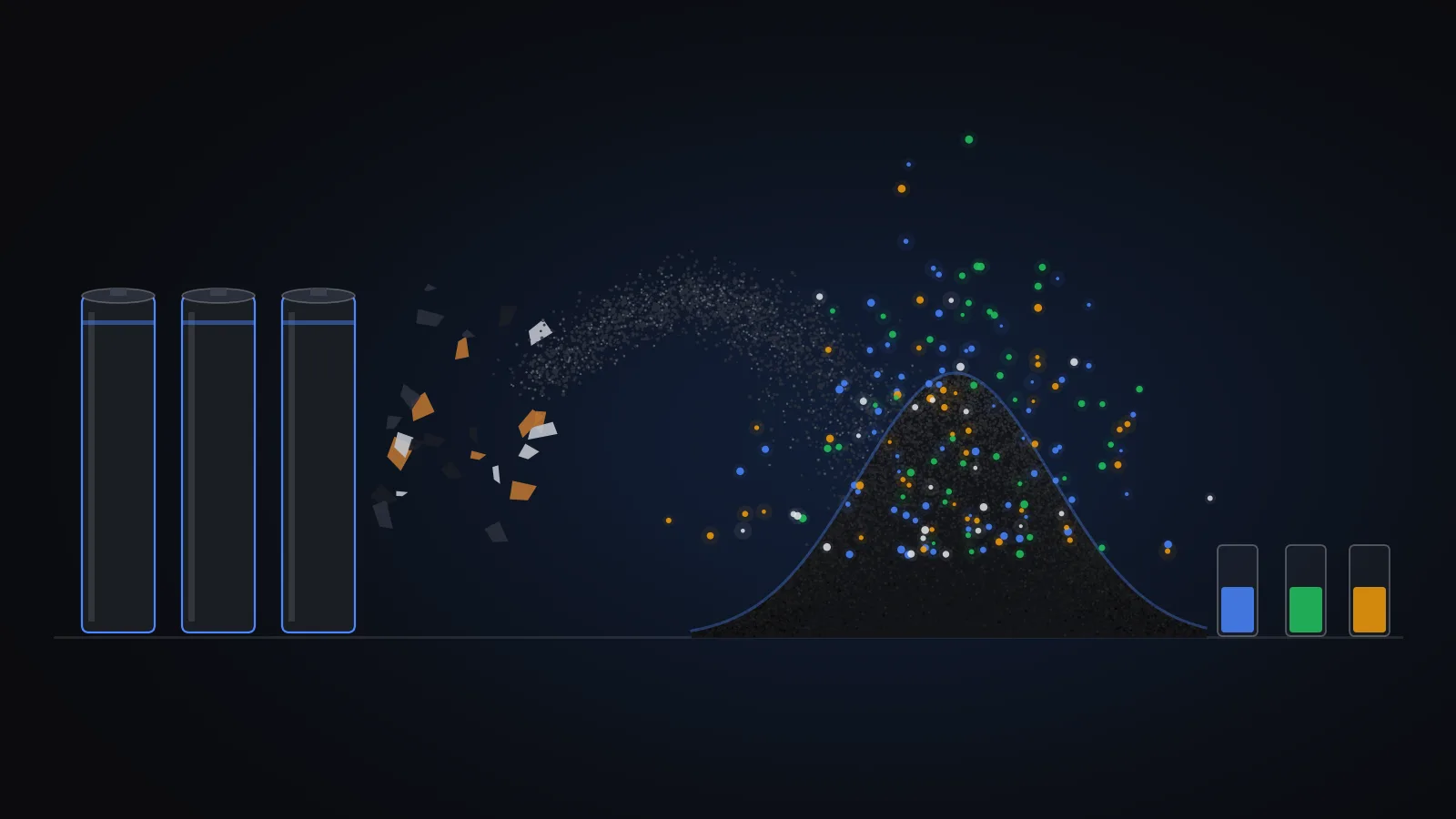
Black mass is the fine, dark powder produced when spent lithium-ion cells are discharged, shredded and screened, after the steel, aluminium, copper and plastic pieces are separated out. It contains the cathode active material (the lithium metal oxide or phosphate) and the graphite anode, plus some binder, carbon black, electrolyte residue and metal fines. For where each metal sits in a cell, see the metals used in a lithium-ion battery.
Think of a cell as a sandwich: cathode powder pasted on aluminium foil, graphite pasted on copper foil, all rolled up in a can. Shredding breaks the sandwich, and screening shakes the "filling" loose from the "bread". The filling is black mass, and it is where almost all the value sits.
Its composition depends on the chemistry and on how well the plant separates it. Two certified reference samples sold for laboratory calibration show the spread (AnalytiChem):
- A black mass from NMC 622/811 cells: about 4.1% lithium, 23.1% nickel, 5.3% manganese, 6.1% cobalt and 11.6% graphite carbon by weight.
- A black mass from NMC 622 cells: about 1.8% lithium, 9.2% nickel, 2.8% manganese, 2.9% cobalt and 35.3% graphite carbon.
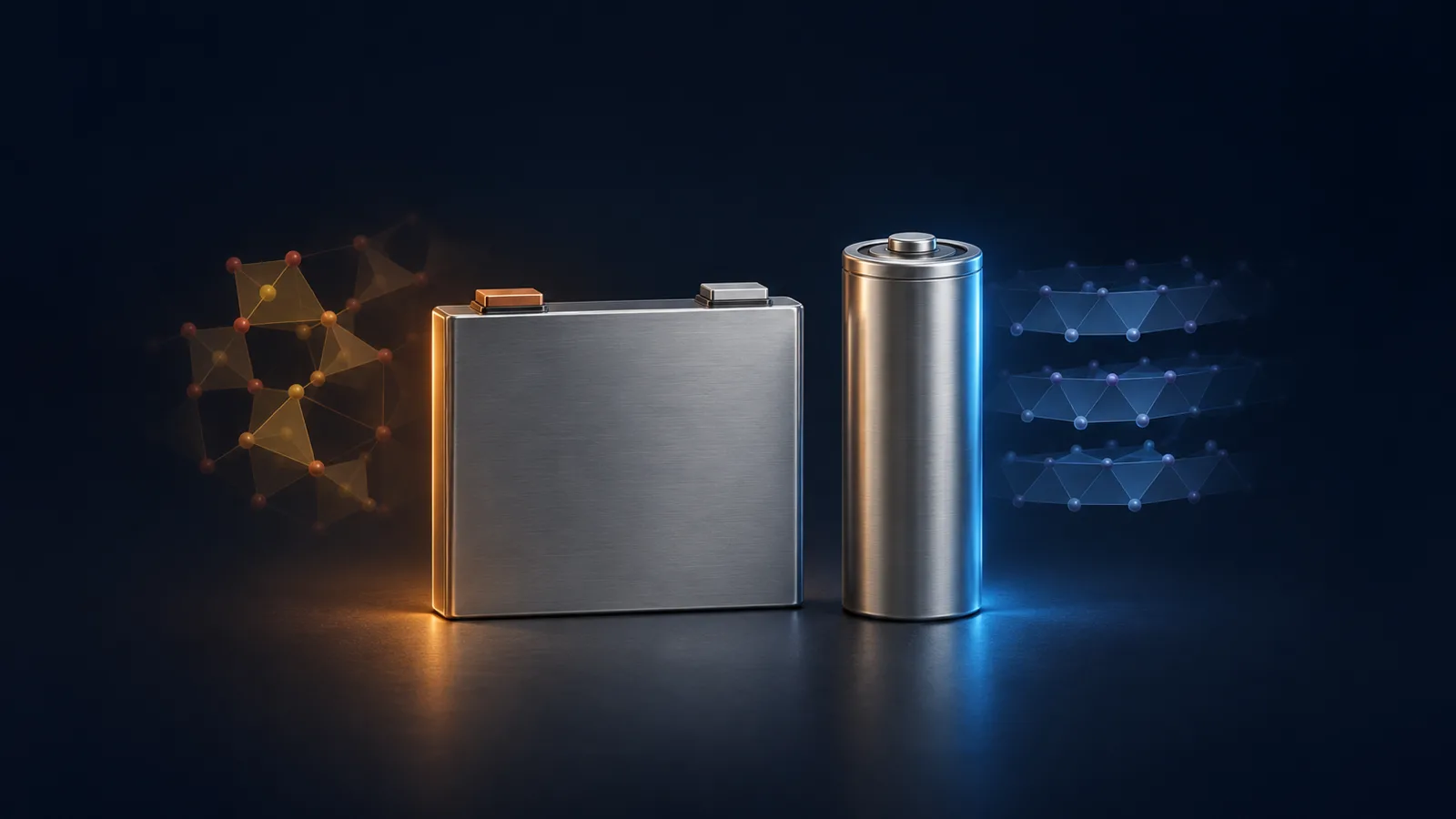
So "a tonne of black mass" can carry more than twice the metal of another tonne. That is why refiners buy on assay (a lab analysis of each lot), and why calls for black mass grading standards come up in the industry debate below. LFP black mass is a different material again: no nickel or cobalt, but iron and phosphate. For the chemistry behind the two families, see our comparison of LFP vs NMC batteries.
How is a lithium-ion battery recycled, step by step?
A lithium-ion battery is recycled in two stages. First comes physical processing: sorting, discharging, dismantling, shredding and separating the scrap into black mass. Then comes chemical refining of the black mass into metal salts. In India, CPCB says refining today is done by hydrometallurgy, which uses acids and solvents rather than furnaces.
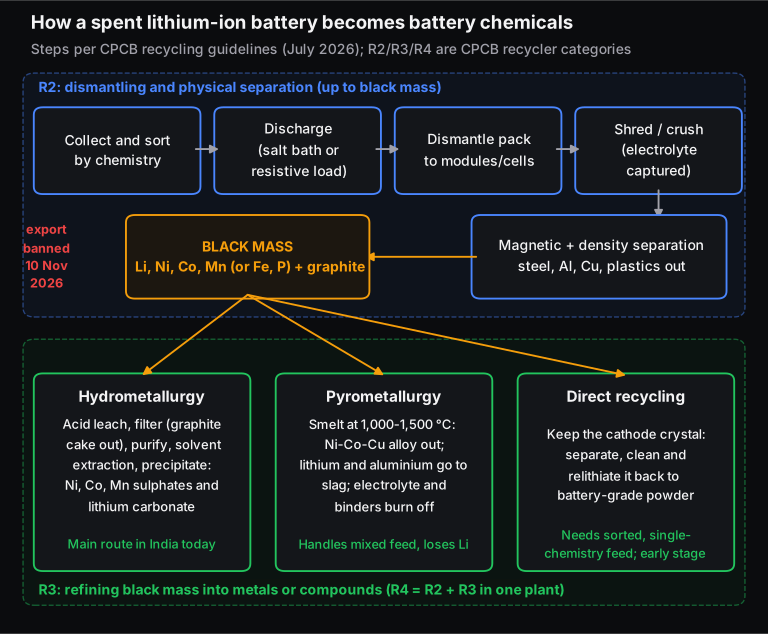
The Central Pollution Control Board's Guidelines for Recycling of Waste Batteries (July 2026) set out the steps and the plant each step needs:
- Collect and sort. Batteries are sorted by type, size and chemistry, and inspected to pull out any that can be refurbished for a second life.
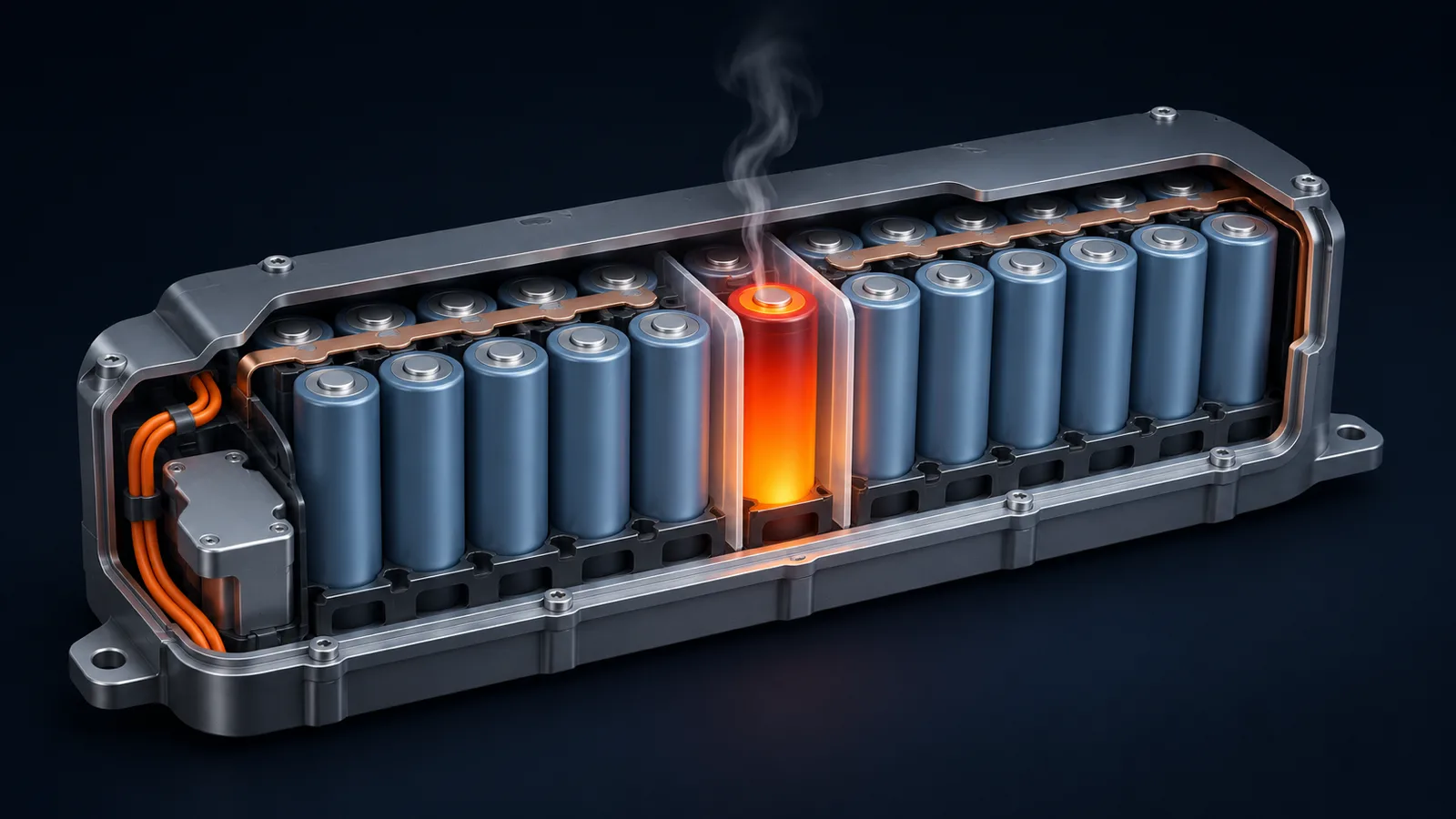
- Discharge. Residual charge is drained with a resistive or electronic load, or by soaking in a salt (alkaline) solution. A shorted, charged cell in a shredder is a fire.
- Dismantle. Packs are opened and the casing, BMS boards, cables and covers are removed down to modules or cells. Voltage is measured and heat scans flag hot cells, which are isolated and watched.
- Shred or crush. This is done with flame-proof electrics, controlled feed rates, temperature control and capture of the electrolyte vapours.
- Separate. Magnets pull out iron, and density separators split copper from aluminium. Bag filters and cyclones catch the dust. What is left is black mass.
- Refine. The black mass is leached and purified into metal salts (below).
CPCB's guideline also defines the recycler categories used in India. R2 units do only dismantling and physical separation, up to black mass. R3 units are refiners that take black mass and produce metal compounds. R4 units do both on one site. The export ban hits R2 units hardest, because black mass is their product.
Hydrometallurgy: how is black mass refined in India?
In hydrometallurgy, black mass is dissolved in acid and each metal is pulled out of the solution in turn. CPCB states that this is the process currently deployed in India. The sequence in its guideline runs as follows:
- Black mass and reagents (acid, water) go into a reactor at controlled pH and temperature.
- The leach liquor is filtered. The undissolved cake is washed and collected as graphite.
- The liquor is purified, then a solvent extraction circuit recovers manganese, cobalt, nickel and lithium one after another.
- Each metal is stripped with sulphuric acid and precipitated as a sulphate or carbonate. Typical products are nickel sulphate, cobalt sulphate, manganese sulphate and lithium carbonate.
- The leftover solution is mostly sodium sulphate. It goes through a multiple-effect evaporator, and the condensed water is reused.
Solvent extraction works like a very selective sponge. An organic liquid that grabs one metal ion at a particular pH is mixed with the solution, then separated and stripped. A train of these stages, each tuned to a different pH, splits metals that are chemically close cousins, such as nickel and cobalt.
Pyrometallurgy and direct recycling: how do they compare?
Pyrometallurgy smelts batteries or black mass at roughly 1,000-1,500 °C. Nickel, cobalt and copper come out as an alloy. Lithium and aluminium mostly end up in the slag, and recovering them needs extra hydrometallurgical steps. Before smelting, roasting removes the electrolyte and burns off organic binders. The method tolerates large, mixed, unsorted feed, but it is energy-intensive and gives off gases such as HF, CO₂ and SO₂ that must be treated (Łach et al., 2025 review).
Direct recycling tries to skip the "dissolve everything" step. The cathode powder is separated, cleaned and topped up with lithium (relithiated) so that its crystal structure is reused as is. The same review notes that it can cut energy use, reagent cost and carbon footprint. The catch is that it is sensitive to chemistry: a process tuned for one cathode may not work on another, so it needs sorted feed. In India, Exigo Recycling says it is the first to run direct cathode-to-cathode recycling for LFP. That is a company claim, reported by EVreporter in November 2025.
| Route | What comes out | Strength | Weakness |
|---|---|---|---|
| Hydrometallurgy | Ni, Co, Mn sulphates; lithium carbonate or sulphate; graphite cake | Recovers lithium; high-purity, battery-grade salts | Acid, solvent and wastewater handling; feed must be fairly consistent |
| Pyrometallurgy | Ni-Co-Cu alloy; slag holding Li and Al | Tolerates mixed, unsorted feed | Energy-intensive; lithium needs extra processing; off-gas treatment |
| Direct recycling | Regenerated cathode powder | Least energy and reagent use | Needs sorted, single-chemistry feed; still emerging |
How much metal is in one tonne of black mass? A worked example
A tonne of black mass that is half NMC811 cathode by weight holds about 36 kg of lithium, 241 kg of nickel, 28 kg of manganese and 30 kg of cobalt. A tonne that is half LFP cathode holds about 22 kg of lithium, 177 kg of iron and 98 kg of phosphorus, and no nickel or cobalt. The working is below. Skill-Lync calculated it from the cathode formulas, and the script is kept with this article.
Step 1: metal share of the cathode, from its formula. NMC811 is LiNi0.8Mn0.1Co0.1O2. Using standard atomic weights:
The lithium share is then , and the nickel share is . Manganese comes to 5.65% and cobalt to 6.06%. For LFP (LiFePO4, 157.75 g/mol), lithium is 4.40%, iron 35.40% and phosphorus 19.63%.
Step 2: an assumption about the black mass. We take a representative black mass of 50% cathode active material, 35% graphite and carbon, and 15% other material (binder, foil fines, electrolyte residue). This is our assumption, not a standard. As a check, it puts lithium, nickel, manganese and cobalt together at 33.6% of the black mass. That sits between the two certified NMC samples above (38.6% and 16.7%) and above the 22-26% that a TNO pilot shredding trial measured.
Step 3: metal contained, and metal recovered. For lithium in NMC811 black mass:
For recovery, we use the factors CPCB applies in its worked example for EPR certificates: 0.75 for lithium and 0.9 for other metals (CPCB mechanism note). That gives kg of lithium recovered (26.8 kg in the table). Lithium carbonate is 18.8% lithium by mass, so that is kg of lithium carbonate.
| Per tonne of black mass (model) | Contained | Recovered | As a saleable compound |
|---|---|---|---|
| NMC811: lithium | 35.7 kg | 26.8 kg | 142 kg lithium carbonate |
| NMC811: nickel | 241.3 kg | 217.2 kg | 973 kg nickel sulphate hexahydrate |
| NMC811: manganese | 28.2 kg | 25.4 kg | 78 kg manganese sulphate monohydrate |
| NMC811: cobalt | 30.3 kg | 27.3 kg | 130 kg cobalt sulphate heptahydrate |
| LFP: lithium | 22.0 kg | 16.5 kg | 88 kg lithium carbonate |
| LFP: iron | 177.0 kg | 159.3 kg | 430 kg iron phosphate (FePO4) |
| LFP: phosphorus | 98.2 kg | 88.4 kg | (in the iron phosphate) |
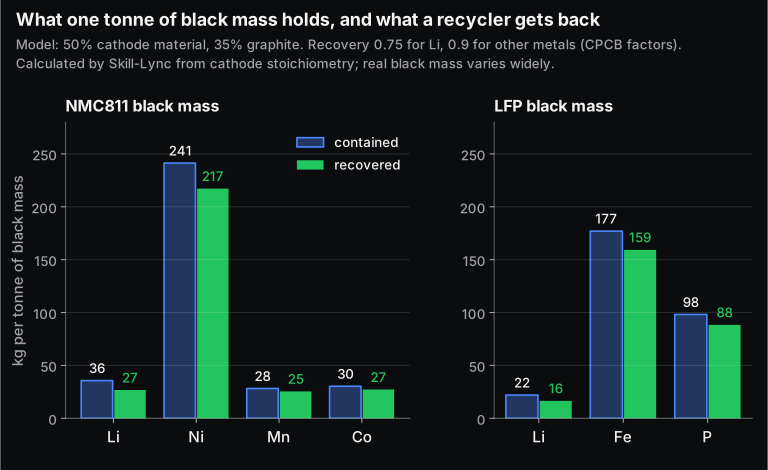
What the numbers tell an engineer. Per tonne, LFP black mass carries 62% as much lithium as NMC811 black mass (22.0 against 35.7 kg), and none of the nickel or cobalt. The same plant and the same tonnage give a very different product slate. That is why sorting by chemistry upstream matters so much, and why "black mass" on its own is not a grade.
What do the Battery Waste Management Rules 2022 require from recyclers and producers?
The Battery Waste Management Rules, 2022 (notified 22 August 2022) make producers (battery makers, importers and brands) collect and recycle a share of the batteries they sell. They prove it by buying EPR certificates from registered recyclers. For electric two-wheeler batteries, FY 2026-27 is the first target year: at least 70% by weight of the batteries placed on the market in 2022-23.
The targets in Schedule II of the rules are set by vehicle type, against sales four or more years earlier:
- E-rickshaw (three-wheeler) batteries: from 2024-25, 70% of 2021-22 sales.
- Two-wheeler EV batteries: from 2026-27, 70% of 2022-23 sales.
- Four-wheeler EV batteries: from 2029-30, 70% of 2021-22 sales.
The "70/80/90% recovery target" is no longer in the rules. The 2022 text had a table requiring recyclers to recover 70% (2024-25), 80% (2025-26) and 90% (2026-27 onwards) of an EV battery's dry weight as materials. The Battery Waste Management (Amendment) Rules, 2023 (25 October 2023) omitted that sub-rule. Certificates are now generated from the weight of battery processed and the weight of battery material produced, under CPCB guidelines. Many articles still quote the old table.
The same 2023 amendment says no EPR certificate can be generated for recycling imported waste batteries. Imported scrap can keep a plant busy, but it earns nothing towards producers' obligations. Domestic feedstock is what counts.
Under CPCB's mechanism note, a lithium-ion certificate is simply the kilograms of a key metal (Li, Ni, Mn, Co, Al, Fe, Cu) that the recycler recovered and sold, backed by sales invoices. A producer's obligation is worked out per metal:
Worked EPR example. Take a hypothetical electric two-wheeler brand that placed 100 tonnes of NMC packs on the market in 2022-23. Its 2026-27 target is tonnes. CPCB lists an NMC battery as 1-2% lithium, 12-16% nickel, 4-8% manganese, 8-12% cobalt, 20-25% aluminium, 5-10% iron and 12-18% copper by weight. Using the midpoints and CPCB's conversion factors:
Adding manganese (3,780 kg), aluminium (14,175 kg), iron (4,725 kg) and copper (9,450 kg) gives about 48,038 kg of certificates in total. Each kilogram has to match metal a recycler actually recovered and sold. The certificate trading price is bounded between 30% and 100% of the environmental compensation for non-compliance, under the March 2024 amendment (G.S.R. 190(E)).
Two more dates are close. Producers' annual returns for FY 2025-26 are due by 30 November 2026, after a Ministry extension (MoEFCC office memorandum, 27 Aug 2026). And from FY 2027-28, new EV batteries must contain domestically recycled material: 5% of dry weight in 2027-28, rising to 10%, 15% and 20% by 2030-31 (Second Amendment, 20 June 2024). That recycled content has to come from refiners, not from exported black mass.
Why does the black mass export ban matter for India?
The ban keeps the most valuable stage of recycling in India. Shredding a battery into black mass is the simple part. Turning black mass into battery-grade lithium, nickel and cobalt salts is where the critical minerals are actually recovered. Until now, that powder could be sold abroad, and India's refiners were short of feedstock.
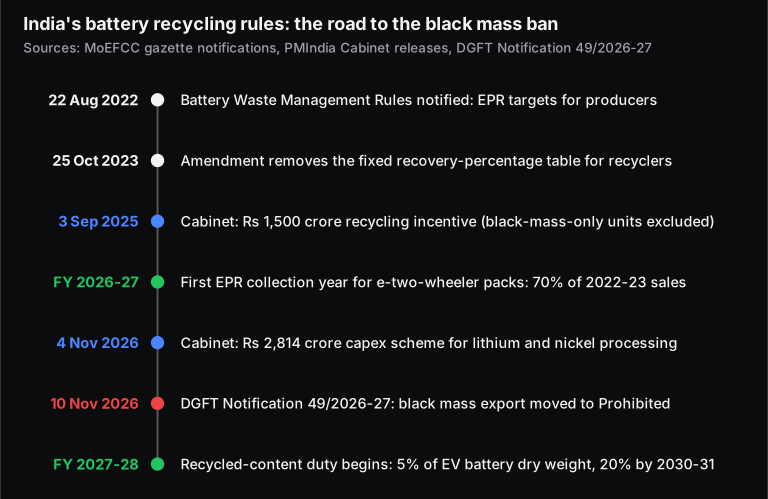
The ban fits a pattern of policy since 2025:
- 3 Sep 2025: the Cabinet approved a ₹1,500 crore incentive scheme for critical-mineral recycling (FY 2025-26 to 2030-31). It explicitly rewards the part of the chain that extracts critical minerals, "and not the value chain involved in only black mass production". It targets at least 270 kilotonnes a year of recycling capacity and about 40 kilotonnes a year of critical-mineral output.
- 4 Nov 2026: the Cabinet approved a ₹2,814 crore capex support scheme for critical-mineral processing (FY 2026-27 to 2030-31). It offers a 30% capital subsidy for two lithium plants (at least 30 kt each) and two nickel plants (at least 50 kt each), capped at ₹500 crore per lithium beneficiary and ₹900 crore per nickel beneficiary. The release says India remains "substantially dependent on imports for refined intermediates and high-purity materials".
- 10 Nov 2026: the export ban makes sure the feedstock those plants need stays in the country.
Read together, the message is that India wants to own the refining step, not just the shredding step. It also matters beyond India. The US restricted black mass exports from 27 August 2026 under a temporary rule, so the global market for this powder is tightening on several fronts.
What are the risks and open questions?
A ban moves material. It does not by itself build refining capacity, set fair prices or stop losses inside the plant. Four issues are worth watching.
- Price and grading. Before the ban, an Exigo executive told EVreporter that some R2 units claimed Indian refiners paid about 2% less for black mass than overseas buyers. LICO Materials' CEO called for national black mass standards, and Recykal's sustainability head proposed accredited assay labs and an "India Black Mass Index". These are stakeholder views from November 2025, not verified market data.
- Who absorbs the hit. The founder of Namo E-waste Management estimated that R2 units make up over 80% of India's lithium-ion recycling industry and argued for phased, consultative curbs. That is one founder's estimate. R2 units now have to sell inside India.
- Losses before the refinery. Black mass recovery is not the same as metal recovery. In TNO's 2024 pilot trials on NMC packs with casing, only 25 g of the roughly 74 g of cathode metals per kilogram of batteries reached the black mass, about 34%. The rest stayed trapped in the coarse fraction. In the LFP trial, the figure was 25 g out of 170 g. Better pre-treatment is an engineering problem the ban does not solve.
- Downstream demand. Battery-grade salts need buyers. Inventus Battery Energy Technologies' founder told EVreporter that India has no legitimate producers of battery-grade NMC powder, and that cathode active material manufacturing here is practically non-existent. Refining at home pays off fully only when cathode makers are here to buy the salts.
Who recycles lithium-ion batteries in India?
India's lithium-ion recycling industry is a mix of a few integrated refiners (R3/R4) and many smaller shredding units (R2). The capacities below are what the companies themselves stated to EVreporter in November 2025. We have not verified them independently.
| Company | Stated capacity or role |
|---|---|
| Attero | Can refine up to 15,000 t of black mass a year |
| Rubamin | 10,000 t/yr black mass refining at its Gujarat plant |
| Exigo Recycling | 7,600 t/yr refining at Karnal (lithium-ion, zinc-carbon and alkaline); claims direct recycling for LFP |
| ADV Metal Combine | R4 facility licensed for 2,500 t/yr of lithium-ion battery waste |
| Lohum | Recycler; its executive argued for meeting domestic cobalt demand and phasing any curbs |
CPCB registers recyclers on the EPR battery portal, and only registered entities can generate certificates. If you are evaluating an employer or a supplier, that registration is the first thing to check.
What engineering skills and jobs does battery recycling need?
Battery recycling needs mechanical, chemical, electrical and safety engineers at almost every step. The most in-demand skills are hydrometallurgical process design, safe dismantling and automation, battery diagnostics for second-life triage, analytical chemistry for assays, and EPR compliance.
| Step | Typical role | What you work on |
|---|---|---|
| Sorting and triage | Battery diagnostics / BMS engineer | Reading BMS data, state-of-health tests, deciding between second life and recycling |
| Discharge and dismantling | Mechanical / automation engineer | Fixtures, robotic disassembly, safe discharge rigs, pack design-for-disassembly feedback |
| Shredding and separation | Process / mechanical engineer | Shredders, conveyors, magnetic and density separators, dust and electrolyte capture |
| Refining | Chemical / metallurgical engineer | Leaching, solvent extraction circuits, crystallisation, evaporators, mass balances like the one above |
| Quality | Analytical chemist / QC engineer | ICP-OES and XRF assays of black mass and products, calibration with reference materials |
| Safety and environment | EHS / fire-safety engineer | Thermal runaway risk, HF and stack emission limits, wastewater, CPCB and SPCB consents |
| Compliance | EPR / sustainability analyst | Portal returns, certificate accounting, recycled-content tracking |
The thread running through all of these is a solid grasp of how a lithium-ion cell is built and how it fails. If you are building that foundation, Skill-Lync's battery technology for EVs course and the post graduate program in battery technology cover cell chemistry, pack design and modelling. Our guide to why EVs catch fire explains the thermal runaway behaviour that makes discharge and shredding hazardous.
Frequently asked questions
Is lithium-ion battery recycling profitable in India?
It depends on chemistry and on owning the refining step. NMC black mass carries nickel and cobalt as well as lithium, while LFP black mass carries mainly lithium. Government support targets extraction, not shredding: the ₹1,500 crore scheme excludes black-mass-only units, and the ₹2,814 crore scheme funds lithium and nickel processing plants.
Is all battery scrap export banned now?
No. Notification 49/2026-27 changes one tariff line, 8549 14 00: unsorted battery waste and scrap free of lead, cadmium and mercury, which the notification identifies as lithium-ion battery black mass. Other lines, such as lead-acid scrap, are not mentioned. Check DGFT and customs guidance for any specific consignment.
What is the difference between R2, R3 and R4 recyclers?
Under CPCB's guidelines, R2 units only dismantle and physically separate batteries, up to black mass. R3 units refine black mass into metals or metal compounds. R4 units do both on one site. The export ban means R2 units must now sell their black mass to Indian R3 or R4 refiners.
Can black mass be made from LFP batteries too?
Yes. LFP black mass contains lithium, iron phosphate and graphite, with no nickel or cobalt. In our worked example, a tonne holds about 22 kg of lithium against about 36 kg in NMC811 black mass. Lithium is therefore the main metal to recover from it.
What are the EPR targets for EV batteries in India?
Producers must collect and recycle at least 70% by weight of the batteries they placed on the market four or more years earlier. That means 2021-22 sales for e-rickshaws (from 2024-25), 2022-23 for two-wheelers (from 2026-27) and 2021-22 for four-wheelers (from 2029-30). They prove it with certificates for recovered metal sold by registered recyclers.
Sources and further reading
- Directorate General of Foreign Trade, Notification No. 49/2026-27: Amendment in export policy of waste and scrap of primary cells, primary batteries and electric accumulators (lithium-ion battery black mass) under ITC (HS) 85491400 (10 Nov 2026); DGFT notifications list
- DD India (credited to PIB), DGFT bans export of lithium-ion battery black mass to boost domestic recycling (11 Nov 2026); ThePrint (ANI feed), Govt bans export of specified lithium-ion battery black mass (11 Nov 2026)
- PMIndia, Cabinet approves capex support scheme to promote critical mineral processing with an outlay of Rs 2,814 crore (4 Nov 2026); Cabinet approves Rs 1,500 crore incentive scheme to promote critical mineral recycling (3 Sep 2025)
- MoEFCC, Battery Waste Management Rules, 2022, S.O. 3984(E) (22 Aug 2022); Amendment Rules 2023, S.O. 4669(E) (25 Oct 2023); Amendment Rules 2024, G.S.R. 190(E) (14 Mar 2024); Second Amendment Rules 2024, S.O. 2374(E) (20 Jun 2024); office memorandum extending FY 2025-26 annual returns to 30 Nov 2026 (27 Aug 2026)
- Central Pollution Control Board, Guidelines for Recycling of Waste Batteries (Lead Acid and Lithium-ion) (July 2026); Mechanism for Generation of EPR Certificates (2024)
- AnalytiChem, Black Mass CRMs: recycled Li-NMC batteries (product release 30 Dec 2024)
- C. van Beek-Hagemans et al., TNO, D6.3 Li-ion battery pretreatment process assessment (5 Sep 2024)
- M. Łach, A. Przybek, P. Duda, P. Bielaczyc, A review of direct recycling processes for lithium-ion battery cells, Materials 18 (2025) 5608, doi:10.3390/ma18245608
- EVreporter, Government tightens lithium-ion battery black mass export curbs: stakeholders share perspective (8 Nov 2025)
- Davis Wright Tremaine, BIS black mass and tungsten export restrictions (2 Sep 2026)
- CIAAW, Standard atomic weights (used for the stoichiometry)