Mechanical Design Courses in 2026: CATIA, NX, SOLIDWORKS and GD&T
Mechanical design courses for 2026: which CAD tool, GD&T and projects to learn, course lengths, and what 1,463 Skill-Lync design placements were offered.

The best mechanical design courses in 2026 teach one CAD tool deeply (CATIA V5, Siemens NX or SOLIDWORKS), engineering drawing, GD&T and tolerance stack-up, and then one design domain such as sheet metal, plastics or BIW, with projects you can show. Pick the tool by the industry you want: CATIA V5 and NX for automotive, SOLIDWORKS and AutoCAD for industrial machinery. Design is the biggest hiring area in Skill-Lync's placement records, but most fresher offers are modest and come from engineering services firms.
In short
- Design is the largest domain in Skill-Lync's placement records: 1,463 of 3,711 placements (39%), median offer 3.5 LPA, middle half 3.0-4.4 LPA (snapshot 15 Nov 2026).
- Learners hired with the title Design Engineer: median 3.4 LPA, middle half 3.0-4.2 LPA (n = 1,053). Graduate Engineer Trainees in design: median 3.8 LPA (n = 236).
- Engineering services firms made 626 of the 764 placements (82%) at the 20 largest design hirers. Cyient alone hired 212.
- The Skill-Lync design courses in this post run from 2 weeks (Part Design using SolidWorks) to 48 weeks (Post Graduate Program in CAD).
- No course guarantees a job. Recruiters test whether you can model, draw and tolerance a part, so projects matter more than certificates.
About the data. Based on 3,711 Skill-Lync placement records up to 7 Nov 2026 (data snapshot of 15 Nov 2026). It is a starting point that we will update as new placements come in. Three caveats: it is a self-selected sample of learners who reported a placement, not the whole job market; most records are starting offers from 2021 to 2023; and recent years are thin (133 Design records in 2024, 20 in 2025, 24 so far in 2026). LPA means lakh rupees per annum, as reported. For the live picture, see design engineer salaries.
This post is only about design (CAD) courses. If you are still choosing between design, CAE, CFD, EV and embedded, start with our top 10 mechanical engineering courses, ranked by hiring data.
What does a fresher mechanical design engineer do in India?
A fresher design engineer builds and edits 3D CAD models of parts and assemblies, makes the 2D drawings a supplier manufactures from, adds tolerances, and updates designs when a change request comes in. Most start on one sub-system, such as a door trim, a bracket or a fixture, under a senior engineer who checks every drawing.
A typical week mixes four kinds of work:
- Modelling: turning a concept or a "master section" (a 2D cross-section that fixes the shape) into a solid or surface model.
- Drafting: drawings with views, sections, dimensions and GD&T (geometric dimensioning and tolerancing, the symbol language that says how much a feature may vary).
- Feasibility checks: can the part be moulded, stamped or machined? Draft angles for plastic parts, bend radii for sheet metal, tool access for machining.
- Change work: applying an engineering change, updating the bill of materials (BOM) and the drawing revision.
Titles vary (Design Engineer, Design GET, Trainee Design Engineer), but the work is the same. In our data, 1,053 of the 1,463 Design placements fall in the Design Engineer role group.
Which skills should a mechanical design course teach, and in what order?
Learn six skills in order: engineering drawing, one CAD tool in depth, limits and fits with GD&T, tolerance stack-up, one design domain (sheet metal, plastics or BIW), and finally DFM and DFA. Each step uses the one below it, so a course that jumps straight to a car-body project without drawing and GD&T leaves gaps an interviewer will find.
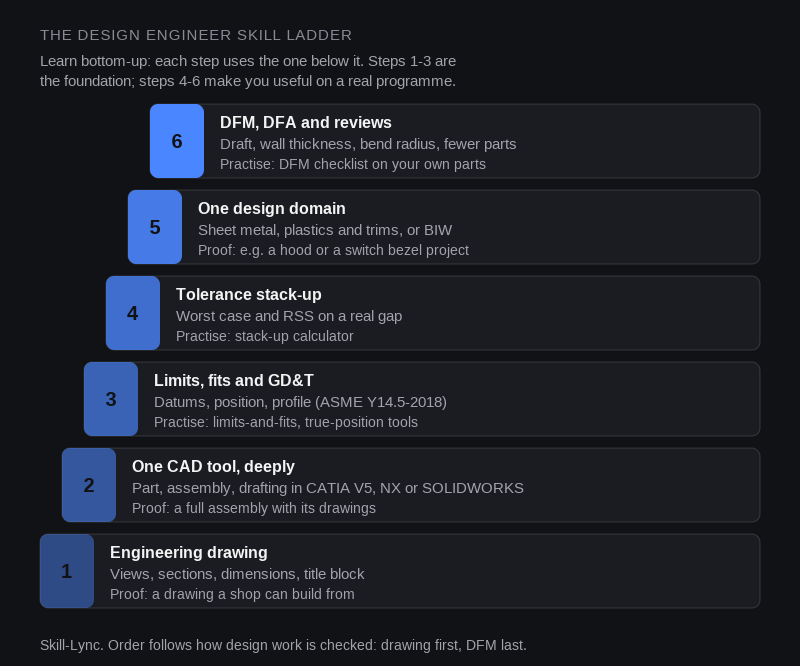
- Engineering drawing. Orthographic views, sections, dimensioning rules, surface finish symbols and the title block.
- One CAD tool, deeply. Sketching, part modelling, surfaces, assemblies and drafting. Depth in one tool beats a little of four; the concepts carry over when a new employer uses something else.
- Limits, fits and GD&T. Hole and shaft tolerances (ISO 286), datums, position, profile and runout. The current US standard is ASME Y14.5-2018, reaffirmed in 2024 (ASME). Check your answers with our free limits and fits calculator and true position calculator.
- Tolerance stack-up. Adding up the tolerances along a chain of parts to see whether a gap or fit still works. Worst case adds every tolerance; RSS (root sum square) assumes they rarely all go wrong at once. Try the tolerance stack-up calculator and our guide to stack-up analysis.
- One design domain. Sheet metal (stamped panels and brackets), plastics and trims (moulded interior parts), or BIW. BIW, short for body in white, is a car's welded sheet-metal shell before paint and trim.
- DFM and DFA. Design for manufacturing (can the plant make it cheaply and repeatably?) and design for assembly (fewer parts, easier fastening). Run your own projects through our DFM checklist.
Which mechanical design courses are there, and how long do they take?
Design courses fall into three groups: short tool courses (2-12 weeks) that teach one software, domain courses (8-12 weeks) that teach one kind of part, and programmes (16-48 weeks) that string several together with projects. The table lists Skill-Lync's design courses by type; lengths and projects are from our course catalogue, read 16 Nov 2026.
| Course type | Example course (length) | What it teaches | Who it suits |
|---|---|---|---|
| Drawing and GD&T | Geometric Dimensioning and Tolerancing (12 weeks) | GD&T rules and symbols, datums, MMC/LMC, position, runout, reading a GD&T drawing; butterfly valve project | Everyone, before or alongside CAD |
| 2D drafting | AutoCAD Essentials for Mechanical Engineers (12 weeks) | 2D drafting and editing, dimensioning, a GD&T overview, xrefs and plotting; screw jack drawing and a venturi sub-assembly | Machinery, plant and layout roles |
| CATIA V5 basics | Basics of CATIA V5 (4 weeks), Basic Modelling using CATIA V5 (8 weeks) | Sketching, part, assembly, surface and drafting basics; door trim panel and rear lamp from a master section | Beginners aiming at automotive |
| SOLIDWORKS | Part Design using SolidWorks (2 weeks), PG Program in Solidworks Design and Analysis (24 weeks) | Part and surface modelling, assemblies, plus FEA, flow and motion studies in the programme | Machine design, special-purpose machines, smaller manufacturers |
| Sheet metal (NX) | Automotive Sheet Metal Design using Siemens NX CAD / CATIA V5 (12 weeks), Advanced Sheet Metal Design using NXCAD (12 weeks) | Hood, fender drip area, roof and tailgate; enclosures, brackets and casings | Automotive body and enclosure design |
| Plastics and trims | Automotive Plastic Design using CATIA V5 (12 weeks) | Plastic part design, tooling feasibility, mould considerations; switch bezel, B-pillar cover, door panel | Automotive interiors, consumer products |
| Mould design and DFM | Mold Design using SOLIDWORKS (12 weeks) | Designing the mould that makes a plastic part | Tooling and consumer-product roles |
| BIW | PG Program on Automotive BIW Design and Development (24 weeks) | BIW panels in NX, welding fixtures in CATIA V5, gap and flushness with stack-up analysis, plus crash analysis in HyperMesh and Radioss | Car body roles at OEMs and design service firms |
| Beginner programme | Pre-Graduate Program in Engineering Design (16 weeks) | Engineering drawing (limits and fits, tolerancing), GD&T, plastic design and BIW fixture design in CATIA V5 | Final-year students who want the foundation in order |
| Full programmes | PG Program in Automotive Design using CATIA V5 (24 weeks), PG Program in Manufacturing Design (24 weeks), PG Program in CAD (48 weeks) | Several domain courses in sequence: sheet metal, plastics, wiring harness, fixtures, lighting, seating; manufacturing design adds GD&T and mould design | Graduates committing to a design career |
You will also see PTC Creo in some job posts. Skill-Lync does not teach Creo, so it is not in this table. If your target company uses it, your CATIA or SOLIDWORKS skills transfer, but check before you commit months to a tool.
CATIA, NX or SOLIDWORKS: which design course should I pick?
Pick by the industry you want to join. For automotive OEMs, tier-1 suppliers and engineering services firms, learn CATIA V5 or Siemens NX. For industrial machinery and special-purpose machines, learn SOLIDWORKS with AutoCAD drawings. For consumer products, focus on plastic part design and mould design in whichever tool you learn.
| Target industry | Typical fresher work | Tools to learn | Domain to add |
|---|---|---|---|
| Automotive OEM, tier-1 supplier, engineering services | Body panels, interior trims, brackets, fixtures for an OEM programme | CATIA V5 or Siemens NX | BIW, sheet metal or plastics, GD&T, stack-up |
| Industrial machinery and special-purpose machines | Frames, weldments, guards, mechanisms, shop drawings | SOLIDWORKS, AutoCAD | Sheet metal, limits and fits, DFM for machining |
| Consumer products and appliances | Plastic housings, snap fits, bosses, mould inputs | Any one 3D tool you know well | Plastic design, mould design, DFM and DFA |
This is the common pattern, not a rule. Before you enrol, open five fresher job posts from companies you want and note the software they list. Our list of companies hiring mechanical freshers is a good place to start. For course fees and a side-by-side view of providers, see the CATIA course comparison and the SOLIDWORKS course comparison, or browse the hubs for CATIA, Siemens NX, SOLIDWORKS and AutoCAD.
What salary does a fresher design engineer get in India?
In Skill-Lync's placement records (snapshot 15 Nov 2026), learners hired as Design Engineers had a median reported offer of 3.4 LPA, with the middle half between 3.0 and 4.2 LPA (n = 1,053). Across the whole Design domain the median was 3.5 LPA (n = 1,463), and one in ten offers was 5.0 LPA or more.
A few patterns stand out:
- Design held a steady share. It made up 38-40% of every year's placements from 2021 to 2024, so demand for design freshers has been consistent in our data.
- Medians crept up. The Design median was 3.0 LPA in 2021 (n = 183), 3.5 in 2022 (n = 678) and 3.6 in both 2023 (n = 411) and 2024 (n = 133). 2025 and 2026 have only 20 and 24 records, too few to read a trend.
- Employer matters more than tool. Among the larger design hirers, the median at Hyundai Motor was 5.0 LPA (n = 48) and at Tata Technologies 4.6 LPA (n = 98), while Cyient, the largest hirer, was 3.3 LPA (n = 212). These company groups are small, so treat them as signals, not quotes.
Remember the caveats: these are mostly 2021-23 starting offers from learners who reported a placement. Experienced hires earn more; across all domains, learners marked experienced had a median of 4.5 LPA (n = 444).
Which companies hire mechanical design freshers?
In our records, most design freshers were hired by engineering services firms that do design work for car makers and aerospace companies. The largest were Cyient (212 placements), Tata Technologies (98), Hyundai Motor (48), Expleo Engineering (44) and Tata Elxsi (38). Of the 764 placements at the 20 largest design hirers, 626 (82%) were at engineering services firms.
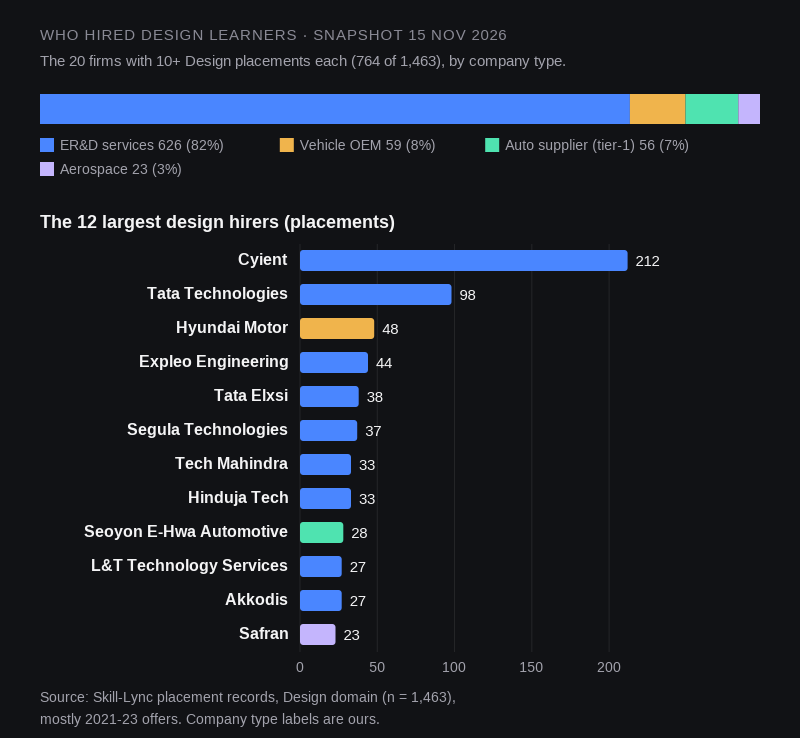
What this means for you: engineering services firms (often called ER&D or design services companies) work on design programmes for many OEM clients, so they look for freshers who already know CATIA V5 or NX and can follow a client's drawing standard. Direct OEM and tier-1 supplier jobs (Hyundai Motor, Seoyon E-Hwa Automotive, Tata Autocomp, Grupo Antolin) are fewer, and aerospace (Safran, 23) is a small route.
What projects should a mechanical design portfolio have?
Show two or three complete projects that each go from requirement to model to drawing with GD&T, plus a short note on the design decisions you made. A recruiter will ask why a wall is 2.5 mm thick or why a datum sits where it does, so pick projects you can defend line by line.
- Automotive: a plastic trim part (switch bezel or B-pillar cover) with draft analysis, ribs and bosses; a sheet-metal panel (hood inner or a bracket) with flanges and hemming; a simple welding fixture with a BOM.
- Machinery: a gearbox, screw jack or jig with a full assembly drawing, fits on every shaft and bearing, and a weldment frame.
- Consumer products: a moulded housing with snap fits, plus the mould split and a DFM review.
For more ideas, browse our CATIA project ideas and mechanical engineering project ideas. Add one tolerance stack-up on a real gap in your assembly; it shows you understand how parts fit together, not just how to model them.
Can I learn mechanical design for free?
Yes, you can learn the basics for free. FreeCAD is open-source 3D CAD software with no licence fee or sign-up (FreeCAD project, read 16 Nov 2026). On Grow by Skill-Lync, the first lessons of Basics of CATIA V5 are free to watch; the full course is paid.
Our free tools let you practise the maths design engineers use daily: limits and fits (ISO 286 hole and shaft tolerances), tolerance stack-up (worst case, RSS and Monte Carlo), true position (with MMC bonus tolerance) and the DFM checklist for moulded, sheet-metal and machined parts. Our explainer on GD&T symbols covers the 14 symbols with examples.
Frequently asked questions
Which is the best mechanical design course for freshers in 2026?
The best course is one that teaches one CAD tool deeply, engineering drawing, GD&T and one design domain, with projects you can show. For automotive jobs, choose a CATIA V5 or Siemens NX course with sheet metal or plastics; for machinery, SOLIDWORKS with AutoCAD. Design was the largest hiring domain in Skill-Lync's records (1,463 placements, snapshot 15 Nov 2026).
Is CATIA or SolidWorks better for a mechanical design job in India?
CATIA V5 is the safer pick for automotive and engineering services jobs, which were most design hires in our records (Cyient, Tata Technologies, Hyundai Motor). SOLIDWORKS suits industrial machinery and smaller manufacturers. The concepts transfer, so the second tool takes weeks, not months.
How long does it take to become job-ready in mechanical design?
Plan for three to six months of steady work: a tool course of 4-12 weeks, GD&T alongside, then one domain course and two or three portfolio projects. Skill-Lync's design programmes run 16 to 48 weeks. Speed depends on how much you practise between lessons.
Is GD&T necessary for a design engineer?
Yes. Every production drawing carries tolerances, and automotive and aerospace drawings widely use GD&T. Expect an interviewer to hand you a drawing and ask you to read a feature control frame or explain a datum. Learn it alongside CAD, not after.
Does a mechanical design course guarantee a job?
No. No course can promise a job. Our figures describe learners who reported a placement, mostly in 2021-23. Employers test whether you can model, draw and tolerance a part, so finished projects you can explain matter most. Skill-Lync's public list of recent placements shows where learners have gone.
Sources and further reading
- Skill-Lync placement records, aggregates from placement-stats.json: 3,711 records with salary up to 7 Nov 2026, snapshot 15 Nov 2026 (Design domain, Design Engineer role, yearly and employer groups). Public list: Skill-Lync recent placements.
- Skill-Lync course catalogue (course titles, durations in weeks, tools, syllabus modules and projects), read 16 Nov 2026.
- Y14.5 - Dimensioning and Tolerancing (2018, reaffirmed 2024), ASME, read 16 Nov 2026.
- FreeCAD: open-source parametric 3D modeler, FreeCAD project, read 16 Nov 2026.
- Design engineer salaries and the design engineer career path, Skill-Lync.