Week-11 Challenge: Braking
AIM:- To study braking and braking energy calculation with the help of MATLAB.
OBJECTIVES:-
1) For a defined driving cycle, calculating the energy required for braking.
2) comparing braking torque at starting to high-speed condition
3) Studying the co-ordination of mechanical brake and electric brake.
4) Make a MATLAB program that plots the contour of given motor speed, torque, and efficiency values.
***************************************************************************************************
Q.1.For a defined driving cycle, calculate the energy required for braking.
Braking:-
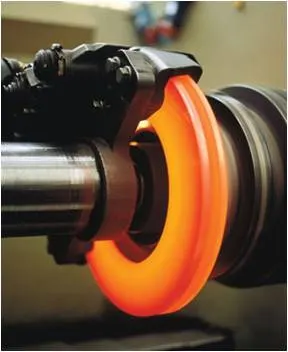
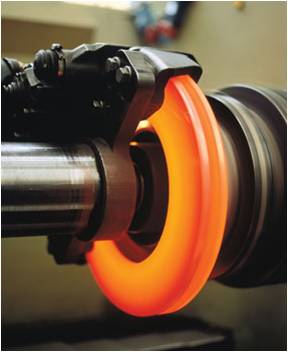
Braking is the process of controlling the velocity of an object by inhibiting its motion. An object in motion possesses kinetic energy and to bring the object to a stop this kinetic energy must be removed. Removing the kinetic energy can be accomplished by dissipating the energy to the atmosphere through friction or by converting it into another form of energy. The most common type of braking is a mechanical brake which inhibits motion through friction brake pads. A mechanical brake applies a friction force to convert the kinetic energy of the vehicle into thermal energy which then dissipates into the atmosphere.[2] Braking systems that don't use friction are referred to as regenerative braking systems (RBSs). In RBSs, the kinetic energy is converted into other forms of useful energy, which can be stored for later use, increasing fuel efficiency.
Background
As with any system, the process of braking must follow the principle of conservation of energy. Energy cannot be created or destroyed but only converted from one form to another,
ΣEin=ΣEout">ΣEin=ΣEout
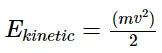
The energy present in an object in motion is given by the following equation:
where,
• m">m is the mass of the object in kilograms (kg).
• v">v is the velocity of the object in meters per second (m/s).
• Ekinetic">Ekinetic is the kinetic energy in joules (J)
From this equation, and assuming the mass of the object is constant, it is clear the to remove the kinetic energy from the system, the velocity must be brought to zero.
Friction braking
Friction braking is the most commonly used braking method in modern vehicles. It involves the conversion of kinetic energy to thermal energy by applying friction to the moving parts of a system. The friction force resists motion and in turn generates heat, eventually bringing the velocity to zero. The energy taken from the system is given by the following equation:
Ethermal=Ff×d">Ethermal=Ff×dEthermal=Ff×d where,
• Ff">FfFf is the force of friction in newtons (N).
• d">dd is the stopping distance in meters (m).
• Ethermal">EthermalEthermal is the thermal energy produced by the brakes in Joules.
Applying conservation of energy to the above two equations, the thermal energy produced must equal the kinetic energy dissipated:
Ff=(mv2)2d">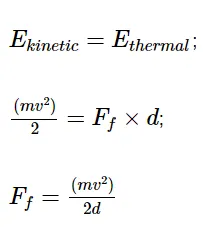
From this equation, it can be seen that increasing the velocity or mass of an object means the applied friction force must be increased to bring the object to a stop at the same distance.
Braking in motor vehicles
Mechanical braking
The most common method of braking in motor vehicles is mechanical or friction braking. In this method, some or all of the vehicle's wheels are fitted with brake pads that apply a friction force that inhibits the motion of the wheels. Frictional braking results in a conversion of the kinetic energy gained from fuel consumption to thermal energy. This thermal energy then dissipates to the atmosphere in the form of waste heat.
Large friction forces can be needed to inhibit a vehicle's motion, particularly in large machines and trucks which have a high mass and therefore high kinetic energy. The brake pads, which are responsible for applying the friction force, experience wear over the course of their life due to this friction force. The brake pad wear causes the brakes to become less effective over the course of their life and need regular replacement.
Regenerative braking
A regenerative braking system involves the removal of the kinetic energy of a moving object by converting it into another form of useful energy, such as electric, pneumatic, or stored kinetic energy. The use of regenerative braking can increase the overall efficiency of a motor vehicle by conserving some of its kinetic energy which can then be used to bring the vehicle back up to speed.
-calculate the energy required for braking for a defined drive cycle
-we created a drive cycle excel file with random data of velocity concerning that time and plotted them to see the drive cycle
-we created three columns time, speed in kmph, and speed in m/s
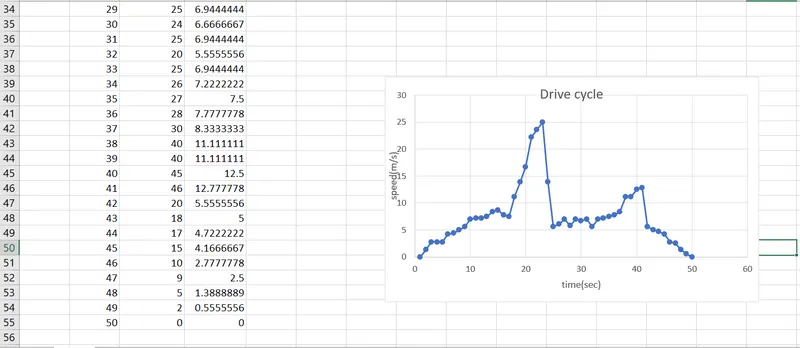
excel sheet link:-https://drive.google.com/file/d/1PAjyoO55j9ngY0kKs3iAD-ZD9A-6HTqS/view?usp=sharing
-then import that excel file into Matlab.
-then to create an array into the command window by entering code 'braking_energy=[TIME Speedms].
-then write a code to calculate the braking energy and avg braking energy.
MATLAB CODE:-
%inputs
Mass = 950   %mass of vedrhicle in kg
t = braking_energy(:,1); %time in sec
v = braking_energy(:,2); %velocity in m/s

for i=1:(length(braking_energy)-1)
    if v(i)>v(i+1)
        E(i) = 0.5*Mass*(v(i+1)-v(i))^2;
    end
end

%printing the results in command window

fprintf('Total Braking Energy is %d',sum(E))
fprintf('nAverage Braking energy is %d',mean(E))
figure(1)
subplot(2,1,1)
plot(t,v,'linewidth',3,'color','r')
xlabel('Time(sec)')
ylabel('Velocity(m/s)')
title('Drive cycle')
grid on
hold on
subplot(2,1,2)
plot(E,'linewidth',3,'color','g')
xlabel('Time(sec)')
ylabel('Velocity(m/s)')
title('Braking Energy')
grid on
RESULTS:-
1)Total Braking Energy is 1.206559e+05
2)Average Braking energy is 2.462365e+03
GRAPHS:-
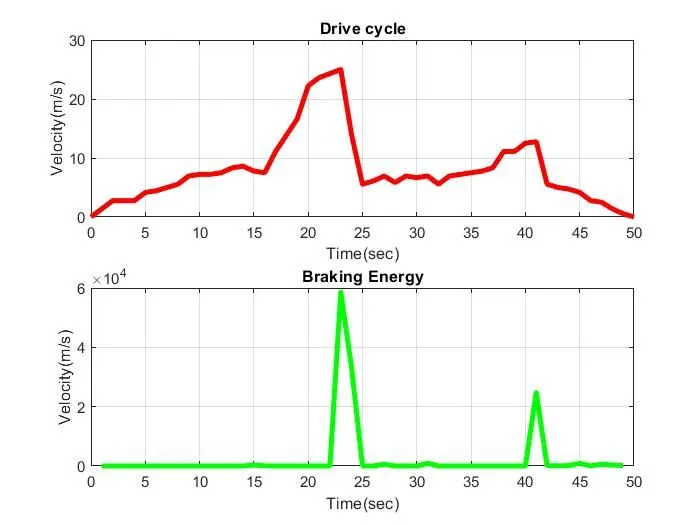
steps that we followed to execute the code for braking energy.
-after importing the excel sheet to Matlab we gave inputs and call the columns of time and speed(m/s)which we are going to use.
-then created for loop to execute the formula for braking energy for no all the values.
-then inside that created if command and created a condition after that include the braking energy formula which is BE=1/2*m*v^2
-also wrote the code to print the values of total braking energy and avg braking energy into the command
-after that plotted the first graph for time vs speed to see the drive cycle.
-then plotted the braking energy plot
-running the code we got our both plots of drive cycle and braking energy
****************************************************************************
Q.2.Why electric motor can’t develop braking torque at a high speed similar to starting? How electric and mechanical brakes are coordinated?
Typical torque-speed Curve of a Cage Induction Motor
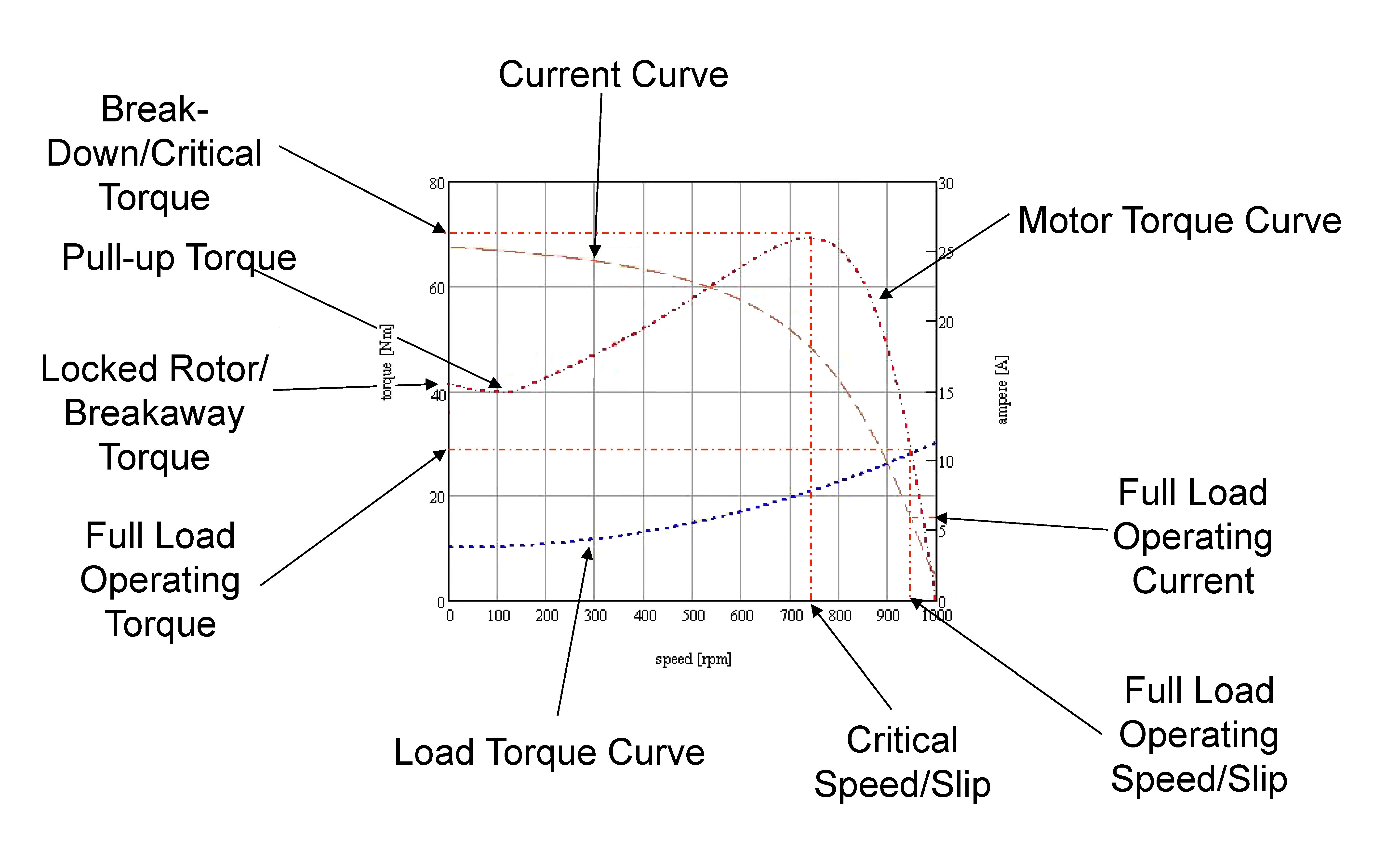
Fig 1.2 Torque-speed curve
Types of Torques
Starting Torque/Locked Rotor Torque
Starting torque also referred to as locked rotor torque, is the torque that the motor develops each time it is started at rated voltage and frequency. It is the torque produced when power is applied to a motor at rest, i.e. when the motor is energized at full voltage and the shaft is locked in place. This is the torque used to start accelerating the load. The starting torque is indicated on the torque/speed curve shown above.
Pull-up Torque (PUT)
This term is used for the lowest point on the torque-speed curve for an electric motor which is accelerating a load up to full speed. As the motor picks up speed, torque decreases slightly to the lowest point shown on the curve above. The torque available at this point is called pull-up torque.
How electric and mechanical brakes are coordinated?
Braking torque distribution principle of electro-mechanical
hybrid braking system
To achieve both energy recycle and braking stability, certain braking torque distribution principles must be satisfied for electro-mechanical hybrid braking systems [6]. The principles were used to distribute the regenerative braking torque and the frictional braking torque, which were shown in Fig.1.
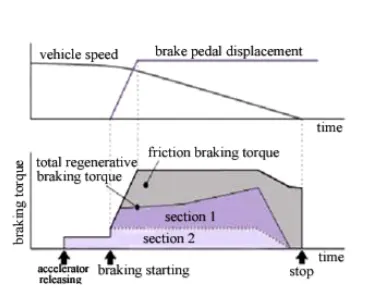
Fig 1.3: the curves of braking torque of regenerative braking system in HEV
section1: regenerative braking torque in harmonious;
section2: regenerative braking torque equivalent to
conventional fuel vehicle When releasing the accelerator pedal and the EV sliding, the braking intensity is relatively weak
(equivalent to the engine braking of conventional fuel vehicle), here, the regenerative braking (electric braking only) could sufficiently meet the demands of braking performance; The driver steps on the brake pedal while more braking intensity is
required. If the force added to the pedal is less, the braking force affecting on driving wheels is only the regenerative braking force which increases in direct proportion to pedal force; once the pedal force exceeds a certain value and the braking intensity could not be satisfied by regenerative braking only, the braking torque generated by mechanical friction on both front and rear wheels were needed. With the proceeding of braking, the vehicle slows down, and regenerative braking
torque gradually climbs up and reaches the maximum at the point which the vehicle speed has reduced to the zone of motor constant torque, while the friction braking torque declines correspondingly. When EV is to stop, the regenerative braking torque promptly falls to zero while the required friction braking torque rapidly rises.
The braking force of electro-mechanical braking system:
To ensure the braking stability of electric vehicles, it is not only to be properly distributed for the electric and friction braking torque but also to be reasonably controlled on the braking torque of the front and rear axle. Theoretically, there are three kinds of control strategies for the braking torque of the front and rear axle: ideal front and rear axle braking torque control strategy, optimal energy feedback control strategy, and
paralleled-hybridized braking control strategy. The paralleled-hybridized braking control strategy was adopted in this research, mainly because the braking controller for the whole vehicle is not needed under this control strategy. A motor controller only needs to be added to control the electric braking force under braking intensity and vehicle speed. Besides, the friction braking system is the same as that in traditional fuel vehicles.
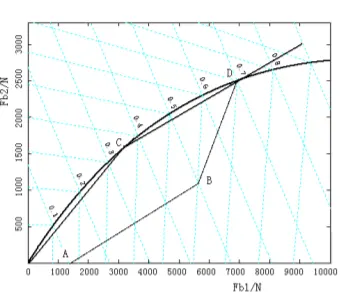
Fig 1.4 shows the braking force distribution curve
Fig.3 showed the braking force distribution curve of the front and rear axles, and the total braking force is borne both by electric braking force and friction braking force under a fixed proportion. There is only electric braking force acting on the
whole vehicle when the zd0.1; there are both electric braking force and friction braking force bring to bear at a fixed ratio while 0.1<zd0.7; the z> 0.7 is the state of emergency braking, and there is only friction braking force in this situation
***************************************************************************************************
- Mechanical losses. As their name suggests, mechanical losses are caused by the movement of the motor. ...
- Magnetic losses (aka core losses or iron losses) ...
- Copper losses (aka electrical losses or winding losses) ...
- Brush losses. ...
- Stray load losses
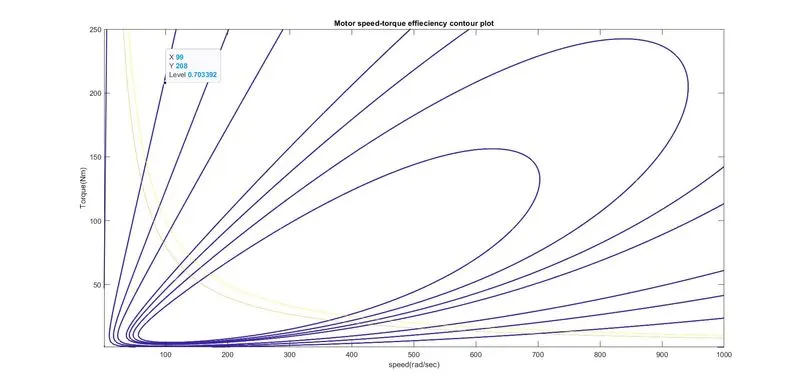
clear all
close all
clc

%plotting efficiency contour for electric motor
%inputs
Speed = linspace(1,1000,1000);
Torque = linspace(1,250,250);

%losses
kc=0.2; %for copper losses
ki=0.008; %for iron losses
kw=0.00001; %for windage losses
C=20; %for constant motor loss

%meshing
[S,T]=meshgrid(Speed,Torque);

%calculating power = speed * torque
Outputpower = (S.*T);

%calculating losses
Cu=(T.^2)*kc %copper losses
Fe=S*ki %iron losses
W=(S.^3)*kw   %windage losses

Inputpower = Outputpower+Cu+Fe+W+C;
Effieciency = Outputpower./Inputpower;

%now set the effieciency to plot contour
V=[0.70,0.80,0.85,0.90,0.91,0.92,0.0925,0.93];
box off
grid off
contour(S,T,Effieciency,V,'linewidth',1.5)
xlabel('speed(rad/sec)')
ylabel('Torque(Nm)')
title('Motor speed-torque effieciency contour plot')
hold on

%now plot a contour of power output
%additionally plotting contour of 8kw and 10 kw
V=[8000,10000];
contour(S,T,Outputpower,V)