Conceptual design of a building with columns and shear walls
Question 1:
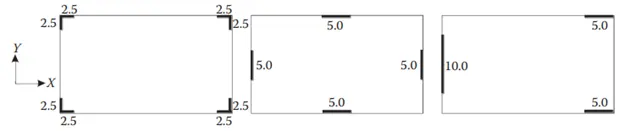
The building shown, 20 × 35 m in plan, has columns on a 5 × 5 m grid and shear walls (with dimensions shown in m, 250 mm in thickness) in three alternative arrangements, (a), (b), (c), all with the same total cross-sectional area of the shear walls. Compare the three alternatives, taking into account the restraint of floor shrinkage, the lateral stiffness and the torsional one with respect to the vertical axis, the vertical reinforcement required for the same total flexural capacity at the base, the static eccentricity, the system’s redundancy, foundation systems, architectural constraints etc.
Ans:
Restraint Of Floor Shrinkage:
- As per the shear wall arrengement in (a) shear wall are arranged at the corners therefore it will restraints at all the four corner.
- As per the shear wall arrengement in (b) shear wall are arranged at the centre of periphery, thus restraints occurs along the edges.
- As per the shear wall arrengement in (c) shear wall arrangement has non-symmetric therefore non uniform restraints occurs.
Lateral Stiffness:
- As per the shear wall arrengement in (a) The lateral stiffness becomes comparatively low along both the direction.
- As per the shear wall arrengement in (b) Uniform and comparatively higher lateral stiffness along x and y directions.
- As per the shear wall arrengement in (c) Non-uniformity in lateral stiffness.
Torsion:
- As per the shear wall arrengement in (a) Torsional resistance will be more at corner walls on the structure.
- As per the shear wall arrengement in (b) Torsion resists at the edge sides of the wall.
- As per the shear wall arrengement in (c) Less torsional resistance due to non uniform arrangement of walls.
Vertical Reinforcement:
- As per the shear wall arrengement in (a) Walls are subjected to nominal flexure moment with more twisting moment.
- As per the shear wall arrengement in (b) Walls are subjected to nominal twisting moment.
- As per the shear wall arrengement in (c) Walls are subjected to heavy flexural moment and twisting moment.
Eccentricity:
- As per the shear wall arrengement in a, b, c we can see that a & b are symmetrical and c is unsymmetrical.
System Redundancy:
- As per the shear wall arrengement in (a) the wall arrangement are symmetric uniform lateral load supports on both axis.
- As per the shear wall arrengement in (b) the wall arrangement are symmetric uniform lateral load supports on both axis.
- As per the shear wall arrengement in (c) the wall arrengement are unsymmetric oncentrated lateral load supports in both the axes.
Foundation System:
- As per the shear wall arrengement in (a) shear walls are arranged at corner in 'L' shape due to L shaped of shear wall the foundation design will be critical.
- As per the shear wall arrengement in (b) shear walls are arranged at certre of the walls due to the straight line of walls the foundation design will be easy.
- As per the shear wall arrengement in (c) shear walls are arranged at corner and in centre in straight line and concentrated due to this it is easy to fix but critical at design.
Question 2:
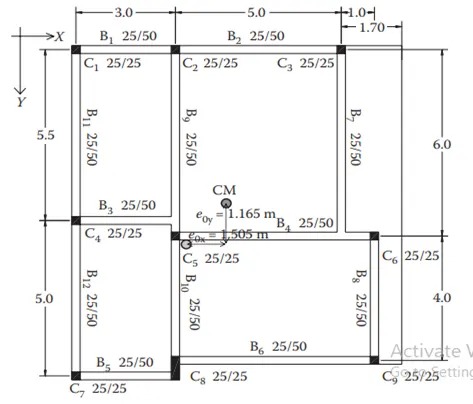
Discuss the suitability for earthquake resistance of the moment resisting framing plan of a three-storey building depicted here (cross-sectional dimensions in cm), the eccentricity of the centre of mass (as centroid of floor plan) to the centre of stiffness (from the moments of inertia of the columns) are shown. Suggest an alternative. Also, is there torsional flexibility? Are the two fundamental translational modes of vibration larger than the fundamental torsional mode of vibration. Discuss qualitatively.
Ans:
In this frame, there is a two-way eccentricity of the center of mass in accordance with the center of stiffness which is the eccentricity of the x-direction is larger than the y-direction.
And also only 2 numbers of frames continuous from one plain to another i.e. B1 and B2 at x-direction and B9 and B10 at y-direction. All other frames are broken at the midway.
Strong beam and Weak column Mechanism. The dimension of the beam is high than that of column size therefore the interia of beam is higher than that of column. As the design details beam and columns were unknown it is recommended to increase the size of columns.
Question 3:
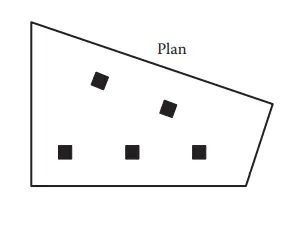
A multi-storey building with basement, with a quadrilateral (non symmetrical floor plan) plan as, has interior columns in an irregular (not in a grid) pattern in plan that serves architectural and functional considerations. Partition walls and interior beams supporting the slab have different layout in different stories. However, there is no constraint to the type, location and size of the lateral force resisting components and sub-systems on the perimeter. Proposals are to be made and justified for the choice of the lateral-load-resisting system and its foundation.
Ans:
As we go through the plan, plan is not symmetric an as well the columns provided through out the plans are not in grid. As the internal column arrangement are random it is unable to transfer lateral load properly and cannot achieve a desirable stability. During seismic action the lateral load wont influence in same direction.
There are two option which we can provide for the better stability.
- Option-1 :
It is suggested to provide shear walls at corners. Corner walls shall be preferably be supported over a box foundation.Shear wall shall be connected with linked beams to transfer shear from one to the other. The internal columns are supported with isolated footing and the footing were inter connected with tie beams.
- Option-2 :
In this plan a flat slab is more appropriate than a regular beam column junction as it provides support to the columns without any provision of the beam which reduces the weight of the building and also helps in the ductility which indirectly helps to maintain the structure in the the earthquake prone areas.