Week 9 - FVM Literature Review
Date: - 20-02-2021
FVM LITERATURE REVIEW
Finite Volume Method: -
- This is one of the numerical methods for discretization of governing differential equations which replicates the transport phenomenon of the physical system.
- While discretizing the domain we divide our domain into small control volumes.
- We use integral forms of the governing differential equations while discretizing the domain.
- Here we use interpolation schemes and gradient schemes to attain connection between neighbouring control volumes.
- This method is very helpful to replicate the exact physical form (without any assumptions) of governing differential equation.
- Gass divergence theorem (volume to surface (vis-versa)) is very helpful in this method.
- We can attain conservation of governing equations without any assumptions exactly like physical system so that’s why Most of the fluid interaction problems we deal with FVM method in CFD.
(Because we need more continuity in flow field variables in fluid interaction problems)
Difference between FVM and FDM:
- Main difference between FVM and FDM is forms of the equations that we use. In FVM we use integral forms of governing equations but in FDM we use partial differential equations.
- If we talk about 1D-heat steady state conductive heat transfer equation
For FDM we use differential form of governing equation
d/dx(k*dT/dx) + S = 0
where k is coefficient of thermal conductivity and ‘S’ is source term
For FVM we use integral form of governing equation
`intd/dx(k *d/dx(T))dv + int(S) dv = 0` ---------1
2 . In FVM we divide our domain into small control volumes but in FDM we divide our domain into nodes.
- Let’s consider a rod with 0.5 meters length and we finding temperature distribution for same 1D- conduction problem what we mention above.
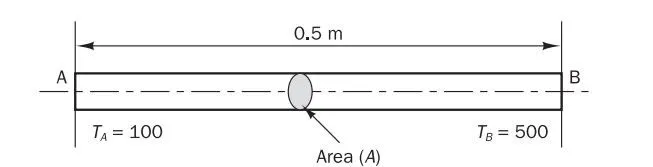
- For FDM we divide our above domain into points

- For FVM we divide our domain into control volumes

3. Compare to FDM in FVM we can more conservation of governing equations that means we are dealing more real physics without having any assumption so that we can achieve numerical solution of this system with less % of difference with exact solution of the same system.
4.If we talk about programming, FDM is so simple to programme but in FVM we do some complex and advance programming which consume both time and efforts.
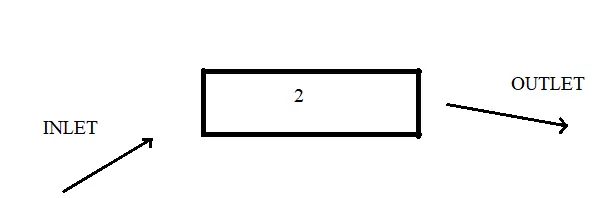
5.In FVM method there is proper inlet to the fluid and proper outlet for each control volume
Which is not there while applying FDM method because in-spite of control volumes we have nodal point in FDM method.
6.If we compare Final numerical solution’s accuracy FDM solutions are less accurate than FVM solutions.
Here in below picture, we can see while FVM we create control volumes and for each control volume we have inlet and outlet like I mention below picture.
7. If we see the difference between exact solution and numerical solutions of each method, we can say that less % o difference between FVM and exact solution whether it is 1D or 2D or 3D problem.
Need for interpolation schemes and flux limiters in FVM scheme: -
- Interpolation schemes are used to extract the connection between two neighbouring control volumes. With this we can obtain continuity of flow field variables between control volumes in domain.
- Specifically, this interpolation schemes are used for coefficient (or) non-gradient terms in discretized equation.
- Gradient schemes are used for gradient terms in discretized equation.
Form equation 1 we can write equation in terms of fluxes by applying at point ‘p’ as below
(KA*dT/dx)e – (KA *dT/dx)w + S (V) = 0 ------2
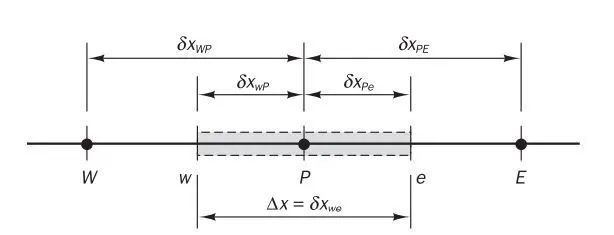
- So gradient terms in equation 2 and (dT/dx)e and (dT/dx)w are calculate at junction of two control volumes by gradient schemes.
- If coefficient of Thermal conductivity ‘K’ is function of ‘T’ then we use interpolation schemes to find out the ‘K’ profile along that control volume.
- If there is a discontinuity in physical problem like shock wave problem we may end up with large gradient values which leads to unstable solution so to eliminate this effect we introduce flux-limiters. This flux-limiters are used to bound the gradient values with some range .