Study about power semiconductor switches , BLDC motor, and Simulink model of H-bridge, and DC7 drive.
Aim: Study the different types of power semiconductor switches and study Simulink models of Speed control of a DC motor using BJT H-bridge and Four-Quadrant Chopper DC Drive (DC7) block and BLDV motor.
Objectives:
- Study about different power semiconductor switches.
- Study about speed control of a DC motor using BJT H-Bridge.
- Study about Four-Quadrant Chopper DC drive(DC7) block.
- Study the concept of the BLDC motor.
Theory:
Power semiconductor Switches: A power semiconductor device is a semiconductor device used as a switch or rectifier in power electronics (for example in a switch-mode power supply). Such a device is also called a power device or a power IC when used in an integrated circuit.
Type of Switches:
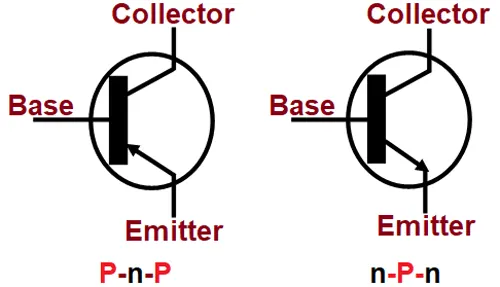
1.Power BJT(Bi-Polar junction transistor): The BJT consists of 3 terminals knows as base. emitter, collector. In which the control signal is provided to the base and emitter and power is collected across collector and emitter. The control signal is given in the form of current.
Symbol:
Advantages:
- It is a bipolar device.
- It is available with a high current rating which is about 800A.
- It also has low driving power.
Disadvantages:
- The switching speed i.e. the operating frequency is low which is around 10kHz.
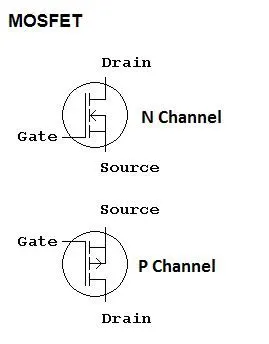
2.MOSFET(Metal oxide semiconductor field-effect transistor): MOSFET consists of three terminals known as gate, source, and drain. In this the control signal is applied across the gate and source terminals. The control signal is applied in the form of voltage.
symbol:
Advantages:
- The switching speed i.e. the operating frequency is high which is around 100kHz.
Disadvantages:
- The power carrying capacity is less compared to the BJT.
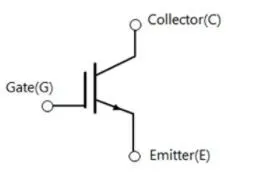
3.IGBT(Insulated Gate Bi-Polar transistor): This switch is the combination of the BJT and MOSFET switch. In this the control signal is applied across the gate and emitter terminal and power is collected across the collector and emitter terminal.
Symbol:
Advantages:
- As it is the combination of the BJT and MOSFET so its power carrying capacity is more and the switching speed is also more.
- They are designed to drive high-power applications with a low-power input.
Now we know the basic switch type so let's go to the given problem statements:
1. A. Explain a MATLAB demo model named ‘Speed control of a DC motor using BJT H-bridge’.
B. Comment on the armature current shoot-up from the scope results.
C. Refer to the help section of ‘The Four-Quadrant Chopper DC Drive (DC7) block’. Compare it with the H-bridge model.
A=>>
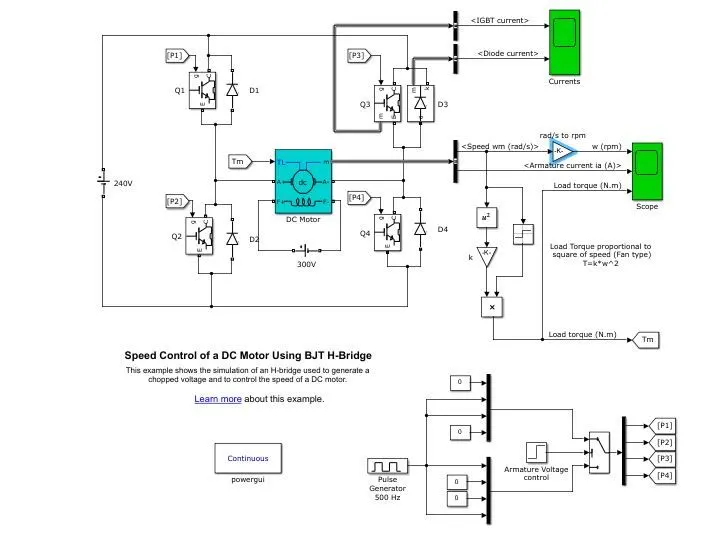
Simulink model of the Speed control of a DC motor using BJT H-bridge:
Main Block used and their input parameters:
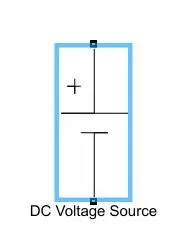
1.DC voltage source: In this Simulink model we are using the two blocks of the DC voltage source, In which the 240V is used for the rotor winding and 300V is used for the stator winding of the motor.
Symbol:
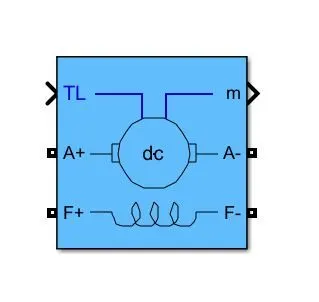
2.DC machine: This DC machine act as a DC motor which contains a total of 6 input terminals which are as follows,
symbol:
Ports Information:
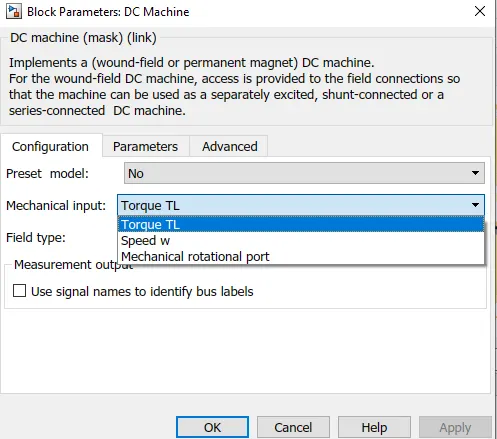
a.Mechanical Input: This port consists of three input parameters which are torque(TL), speed(W), and mechanical rotational port. This is selected according to our input parameter available.
b.Measure(m): This terminal is used to measure the output parameters of the DC motor.
c. Armature Current(Ia): It consists two-terminal one is the positive terminal and the other is the negative terminal of the Armature current. It is used to give the Armature current to the DC motor.
d. Field Current(If): This also consists of two terminals same as armature current terminals which give field current to the stator of the DC motor.
Input parameters:
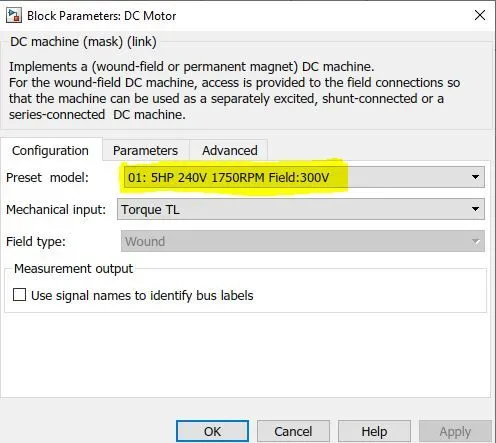
3.IGBT Block: It the insulated Gate Bi-Polar Transistor as we discussed in the types of switches. It consists of four ports
Symbol:
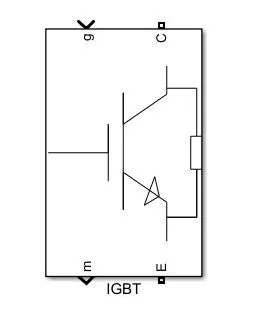
Ports Informations:
a.g_port: This is the gate port where we give the input control signal through the pulse generator.
b.C_port: This is the collector port where we can give the input voltage.
c.E_port: This is the emitter port across which we receive the output.
d.m_port: This is the measurement port to measure the current across IGBT.
Input Parameters:
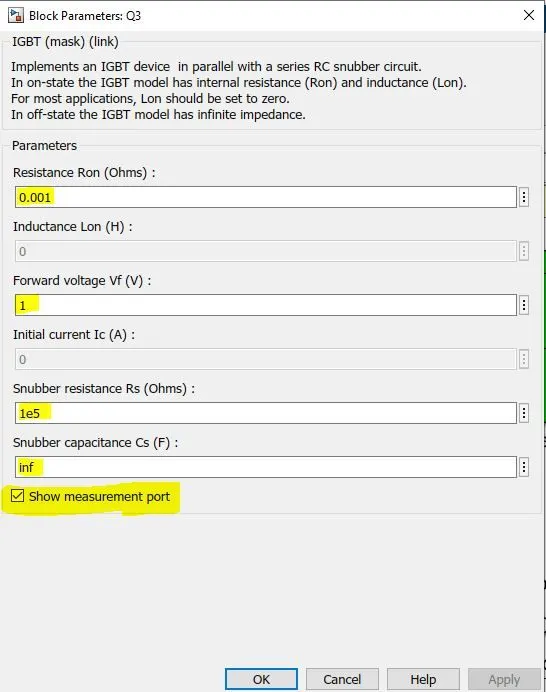
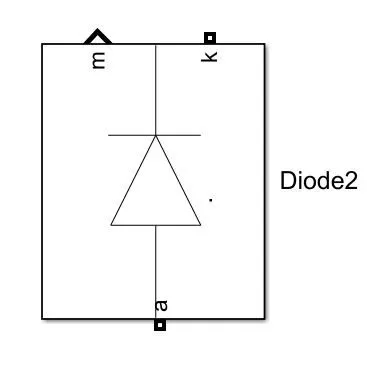
4.Diode: It consists of three-port which are anode(a), cathode(K), and measurement port(m),
Symbol:
Input parameters:
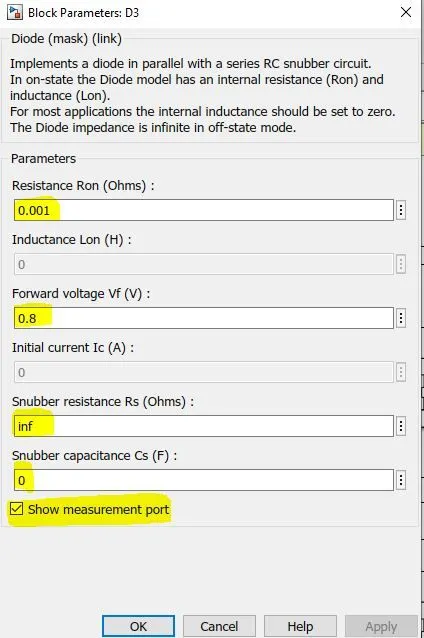
Explanation of the Simulink Model:
1.In this block we have used one DC machine block, four IGBT blocks, four Diode blocks, two DC voltage source blocks.
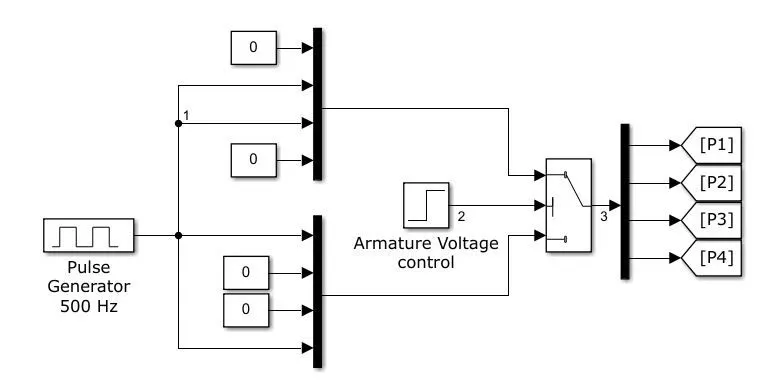
2. For giving input control signal to the four blocks of IGBT we are generating the pulse with the help of the pulse generator, Armature voltage control, and with the normal switch.
Input parameters in the pulse generator:
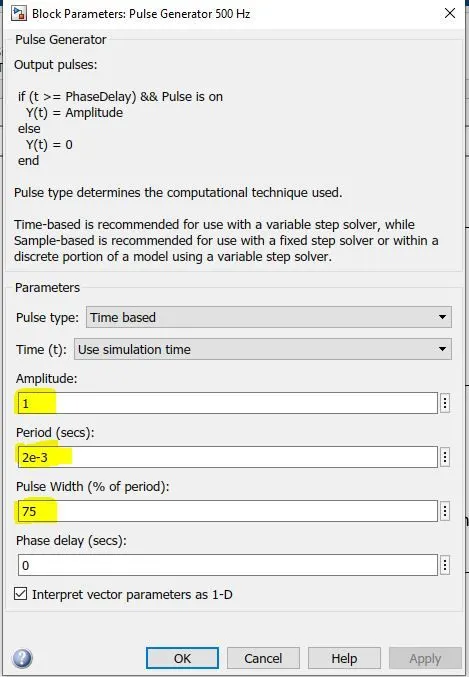
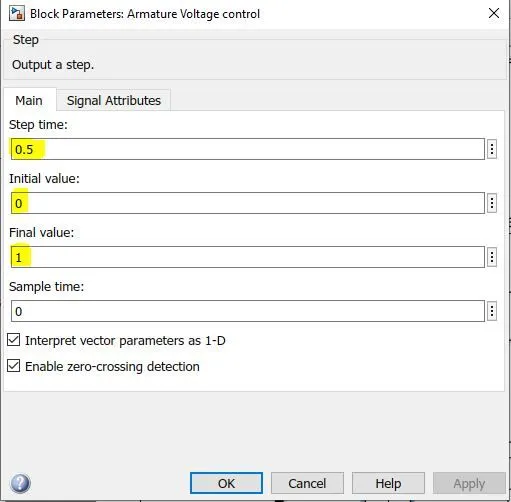
The duty cycle is 75% and the total time of the cycle is 1sec with a period of 2ms. We are connecting two terminals of the pulse generator to mux1, representing Q1 and Q4 signals and the other two represent Q2 and Q3 which are kept zero. In the mux2 block, the pulse generator connected to the mux represents Q2 and Q3, and the remaining two represent Q1 and Q4 signals which are kept zero. Now we connect the output of both the mux port to the switch block which works according to the armature voltage provided with the help of the step block with given parameters,
3.Now we have a total of four control inputs for the four IGBT gate ports to connect. The name of the IGBT switches is Q1, Q2, Q3, Q4. We have connected four diodes across each IGBT block. We have connected Q1 and Q2 IGBT blocks to the positive armature current port of the DC machine and Q3 and Q4 blocks are connected across the negative terminal of the DC machine
4.We are giving input to the DC motor in the form of Torque(TL) which is calculated with the help of the output speed of the motor with the given formula.
`T = Kxxw^2`
Where,
T = Torque of the motor
w = speed of the motor
5.Now we have four IGBT blocks and four Diode blocks so we have two conditions in which the first condition is Q1 and Q4 are turned on and the positive voltage is provided to the DC motor and the Q2 and Q3 are off. In the second condition, the Q2 and Q3 are turned on and a negative voltage is supplied to the DC motor and the Q1 and Q4 are off.
6.As we discussed we have two conditions let's discuss in brief,
a. When Q1 and Q4 are on and Q2 and Q3 are off. In this condition, the DC motor gets the positive voltage and after turning off Q1 and Q4 the diode D2 and D3 act as a freewheeling diode.
b, When Q2 and Q3 are ON and Q1 and Q4 are OFF. In this condition, the DC motor gets the negative voltage and after tuning OFF Q2 and Q3 the diode D1 and D4 act as a freewheeling diode.
7.Now we measure the current across the IGBT and Diode block with the help of the Scope block.
8.We are measuring the speed of the motor, Armature current, and Load torque across the motor with the help of a bus selector and scope block.
B=>>
The armature current graph from the DC motor is as follows:
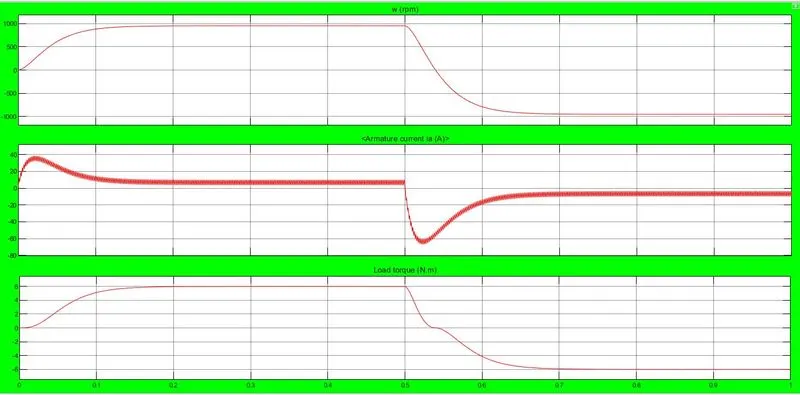
Conclusion: As we can see for the first half cycle the armature current increases rapidly and get to zero slowly at 0.5sec time this is because we are providing a positive voltage to the DC motor by using the Q1 and Q4 IGBT switch. In the second half cycle, we provide the negative voltage to the motor by using the Q2 and Q3 IGBT switch. so after we turn off this switch the current get to zero slowly due to the current and voltage losses.
C=>>
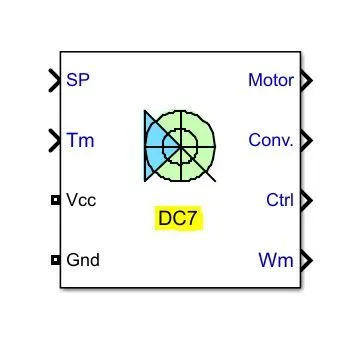
Four-Quadrant Chopper DC Drive (DC7) block:
Internal Circuit diagram:
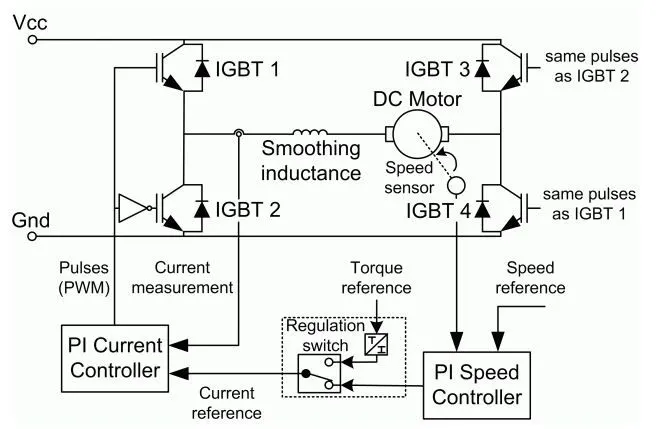
1.The DC7 block is a closed-loop block we don't have to give the control signals inputs like in the H-bridge instead of that we have two PI controllers to control speed across the motor and current signals across the IGBT block.
2.In the DC7 block the armature current oscillations are reduced by a smoothing inductance connected in series with the armature circuit. Whereas in the H-bridge we don't have any smoothing inductance connected.
3.The DC7 model is discrete, and a good simulation result is obtained with a 1-µs time step.
4.In the H-bridge we have only one output which is motor output, whereas in the DC7 block we have multiple bus output which consists of motor, converter, and controller variables.
5.The load torque equation for the H-bride type motor is `T= k*w^2`, whereas in the DC7 the load torque equation is `T e =J *d /dt ω_ r +F*ω_ r +T _m`
6. We have the option to control the DC7 drive regulation type either on speed or on torque regulation.
2.Develop a 2-quadrant chopper using Simulink & explain the working of the same with the
relevant results.
2-quadrant chopper Drive:
The two-quadrant DC chopper allows bidirectional current and power flow with a unidirectional voltage supply. for a smooth transition from motoring to braking and from braking and motoring we require this type of 2-quadrant chopper drive.
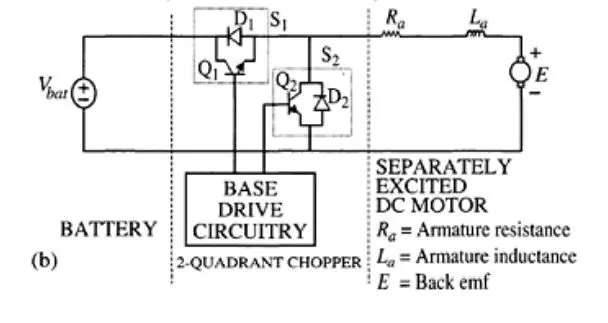
Circuit diagram:
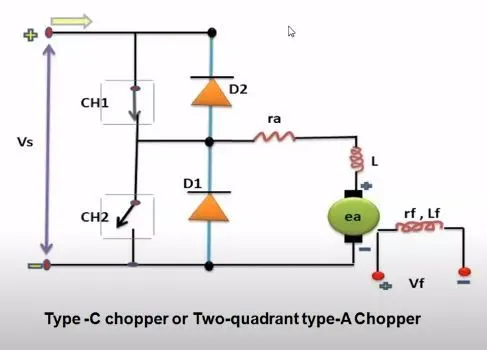
Working:
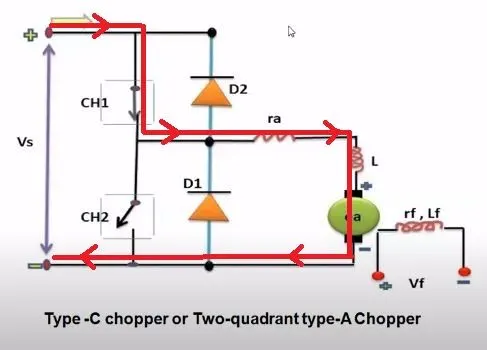
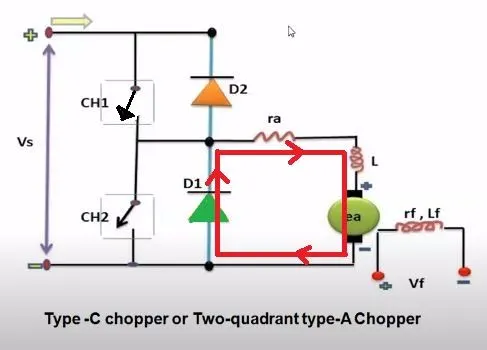
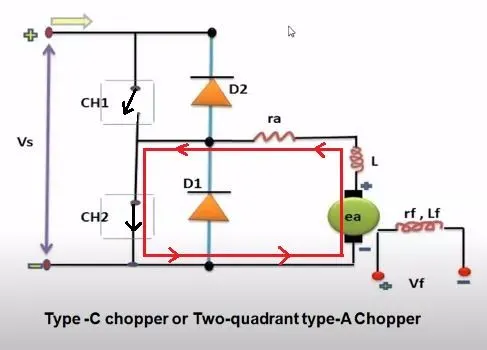
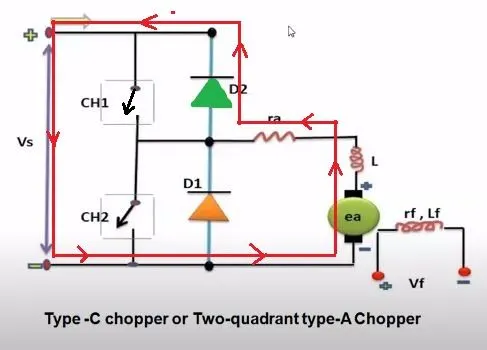
1.As we can see, in the circuit diagram we have two switches(CH1, CH2) and two diodes(D1, D2), as we know that 2-quadrant we have a total of four switch combinations possible but when we turn on both the switches then their is short circuit is going to happen. So that why we have only two conditions.
2.In the first condition the switch CH1 is ON so we get the forward motoring condition because the currents flow is from positive to negative directions and the voltage flow is from positive to negative direction. As follows,
2.When we turn off the switch CH1 then the diode D1 will act as a freewheeling diode because the energy is stored in the inductance now used when CH1.
3.When we turn ON the switch CH2 the load generates the current and the current flow is in the negative direction which is as follows :
4.Now we turn OFF the CH2 then the energy stored in the inductance flow through the diode D2 so the diode D2 act as a freewheeling diode so that it can charge the battery as follows,
Output graph of current w.r.t. time for the given switching condition:
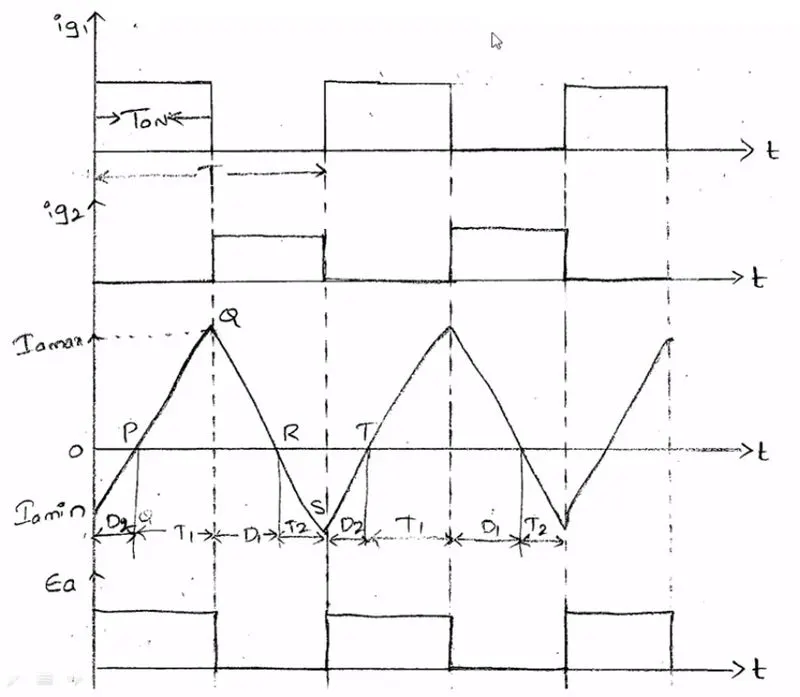
whereas,
T1=CH1, T2=CH2
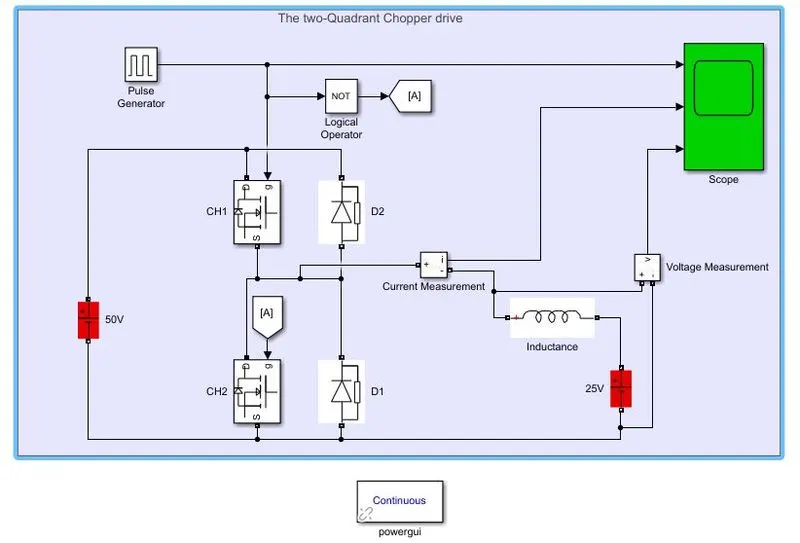
Simulink model of the 2-quadrant chopper drive:
Explanation:
1.As we know that when CH1 is on the CH2 should be off so for that we are using NOT gate at the pulse generator and connected to the CH2 and the pulse generator is connected to the CH1. The inputs for the pulse generator is as follows:
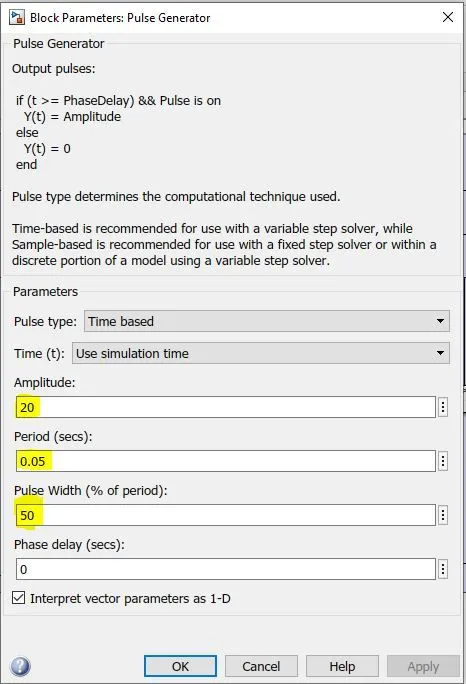
As we can see the time period for ON and OFF is 0.05 sec and the duty cycle is 50%.
2.We have connected the DC voltage source of 50V across both switches(CH1, CH2) and Diodes(D1, D2) and we have also connected 25V DC voltage source across the inductor and 50V battery.
3.To measure the current across both the switches and Diodes we have connected the current measurement block and to measure the voltage across the inductor and 24V battery we have connected the voltage measurement block. Now the output of these two measurement blocks is connected to the scope.
Results:
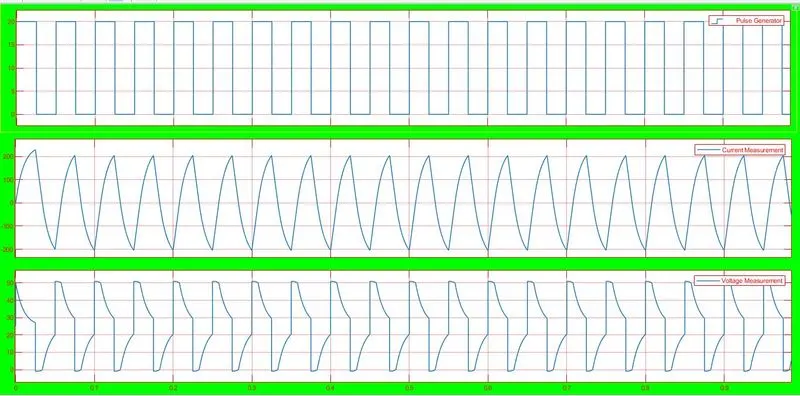
Conclusion:
As we can see in the above results that when we turn on CH1 then the current increases and it is positive and voltage decreases when we turn off the CH1 then the Diode D1 act as a freewheeling diode and the energy stored in the inductor passes through it D1. When all the energy across the inductor drains then the CH2 turns ON at this time the load generates the current which is negative as we can see in the results, now once turn off the CH2 then Diode D2 act as a freewheeling diode, and energy stored in the inductor is used to charge the battery so the negative current increase to the zero value, Now again the CH1 turns ON and the cycle continues.
So from this, we can conclude that the 2-Quadrant chopper works in the following quadrant,
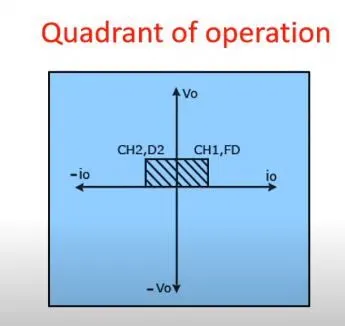
whereas FD=D1
3. Explain in a brief the operation of the BLDC motor.
Brushless DC electric motor(BLDC) OR Electronically commutated motor OR synchronous DC motor: This motor converts supplied electrical energy into mechanical energy. Various types of motors are in common use. Among these, brushless DC motors (BLDC) feature high efficiency and excellent controllability and are widely used in many applications. The BLDC motor has power-saving advantages relative to other motor types.
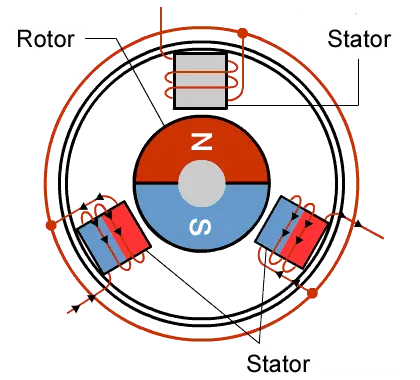
As we can the coils are not located on the rotor. Instead, the rotor is a permanent magnet; the coils do not rotate but are instead fixed in place on the stator. Because the coils do not move, there is no need for brushes and a commutator. With a BLDC motor, it is the permanent magnet that rotates; rotation is achieved by changing the direction of the magnetic fields generated by the surrounding stationary coils. To control the rotation, you adjust the magnitude and direction of the current into these coils.
Oprations of the BLDC motor:
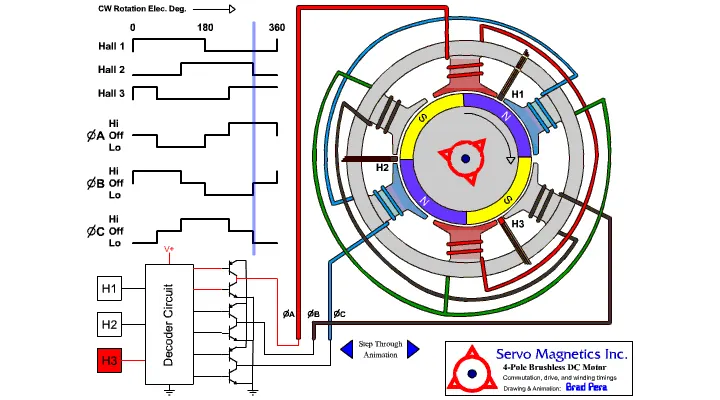
1.As we can in the above GIF we have three hall sensors placed at a `120^@` angle apart from each other.
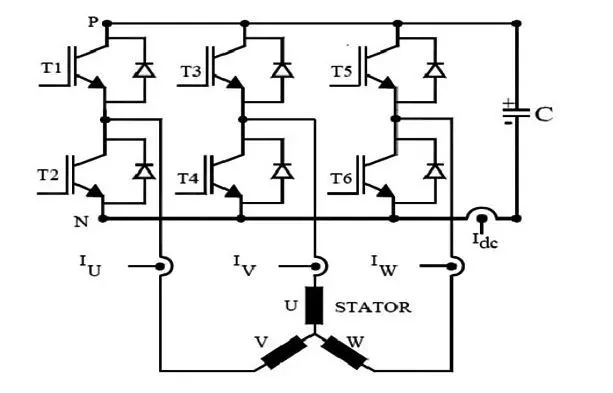
2.The BLDC operation depends on the position of the rotor magnetic field which is detected by the hall sensor and send to the feedback connector so that according to the feedback from the Hall sensor the magnetic field across the 3 stators changed by supplying the correct current phase(A, B, C)
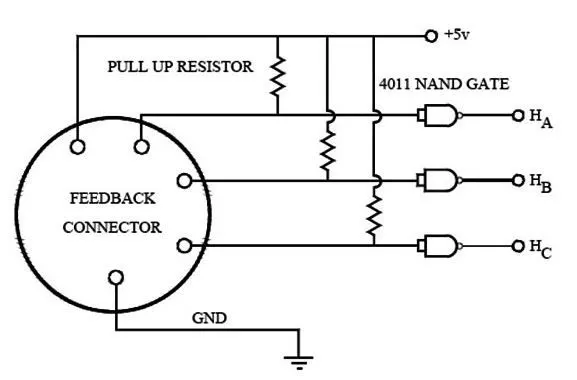
3. The phase currents are excited in synchronism with the constant part of the back emf, constant torque is generated.
4.The electromagnetic torque of the BLDC motor is related to the product of phase, back emf, and current. The back emf in each phase are trapezoidal in shape and are displaced by 120 electrical degrees w.r.t. each other in a 3 phase machine.
5.A rectangle current pulse is injected into each phase so that current coincides with the back emf waveform; hence the motor develops an almost constant torque.
6.The stator circuit for the voltage supply is as follows:
Types of BLDC motor:
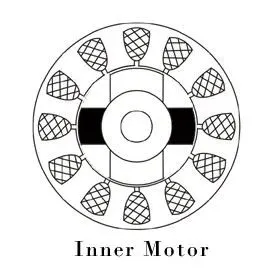
1.Inner Rotor Design
In an inner rotor design, the rotor is located in the center of the motor and the stator winding surrounds the rotor. As the rotor is located in the core, rotor magnets do not insulate heat inside and the heat gets dissipated easily. Due to this reason, the inner rotor-designed motor produces a large amount of torque and validly used.
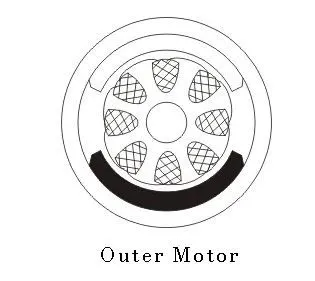
2.Outer Rotor Design:
In outer rotor design, the rotor surrounds the winding which is located in the core of the motor. The magnets in the rotor trap the heat of the motor inside and do not allow it to dissipate from the motor. Such type of designed motor operates at a lower-rated current and has low cogging torque.
Advantages:
- As brushes are absent, the mechanical energy loss due to friction is less which enhanced efficiency.
- BLDC motor can operate at high speed under any condition.
- BLDC motors accelerate and decelerate easily as they are having low rotor inertia.
- There are no ionizing sparks from the commutator, and electromagnetic interference is also get reduced.
- More electromagnets could be used on the stator for more precise control.
- There is no sparking and much less noise during operation.
Disadvantages :
- The cost of the BLDC motor is more compared to the brush motor.
- The limited high power could be supplied to the BLDC motor, otherwise, too much heat weakens the magnets and the insulation of winding may get damaged