Week-7 Challenge: DC Motor Control
Agenda:
- To modify the armature current of DC motor for Demo example "Speed control of a DC motor using BJT H-bridge’"
- To analyse the fourth quadrant Dc chopper block with H bridge block
- To utilize the Fourth quadrant DC chopper block for EV applications
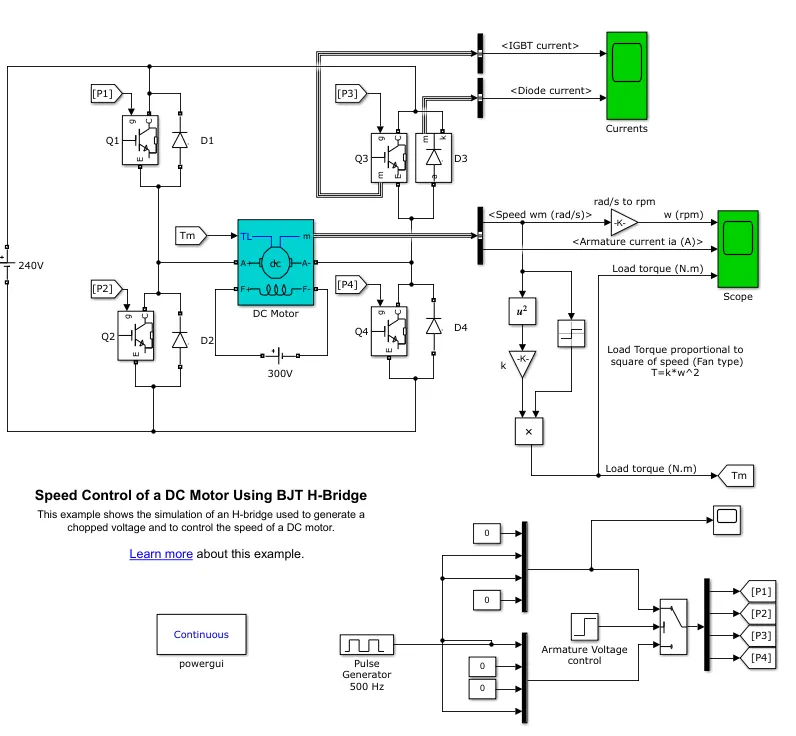
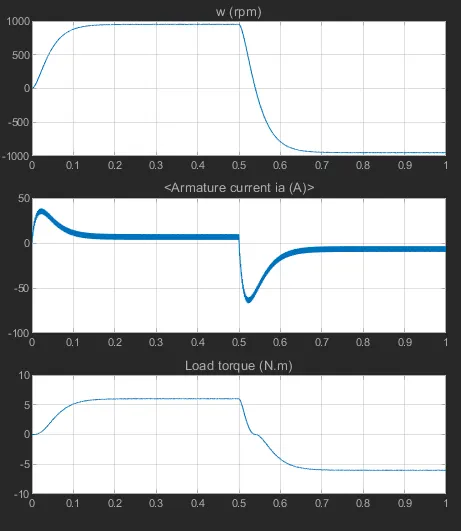
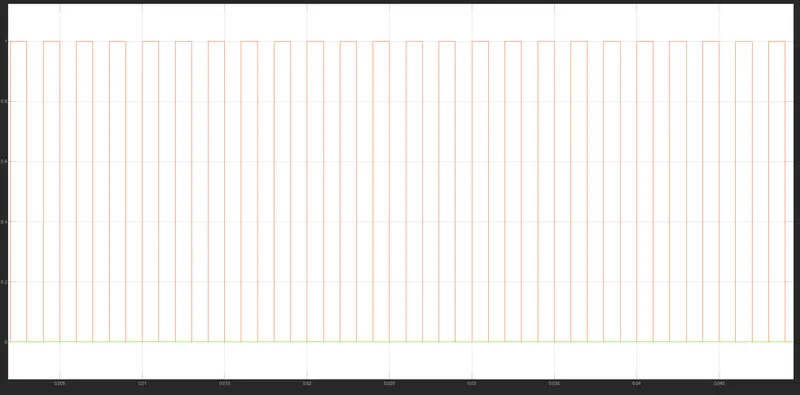
The default setting for the pulse generator is 75% which is shown the Fig
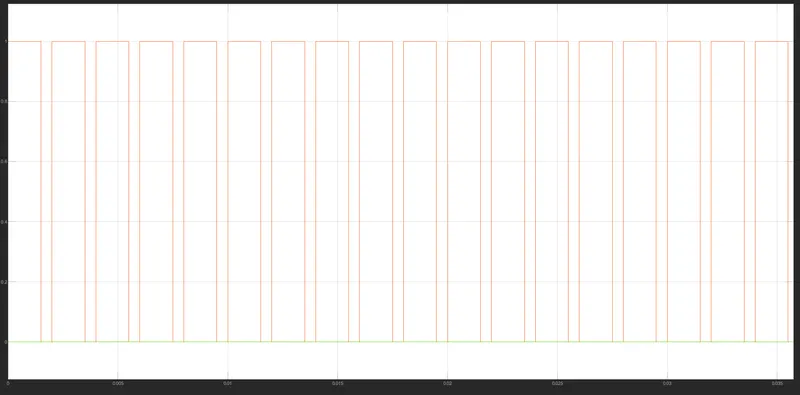
The default 75% duty cycle of the switches are shoot up the current both in forward and reverse motoring condition. The given circuit acs a inverter circuit which generates constant DC to alternate square pulse. So the armature current is also change according to the change of switching condition.
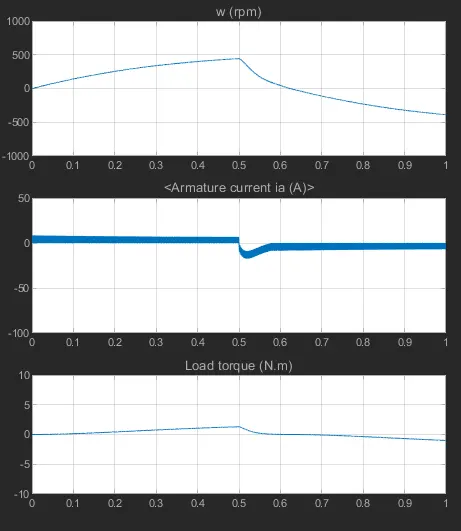
The change of duty cycle changes the armature current. At first the duty cycle is reduced from 75% to 50 %
The armature current is changes as follows.
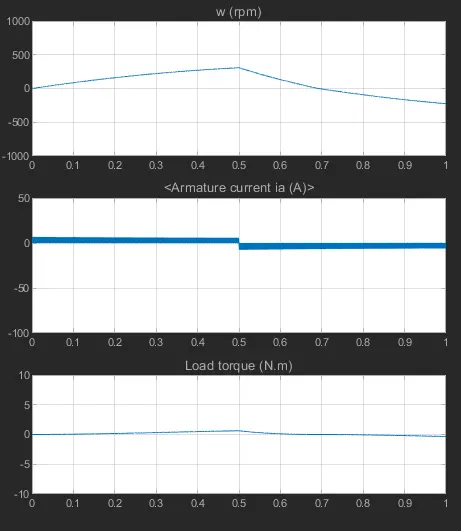
The duty cycle is further reduced to 40 % the negative current shoots is also reduced.
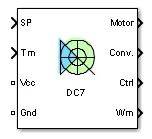
2. The Four-Quadrant Chopper DC Drive (DC7) block
This internal diagram of above block is shown as follows.
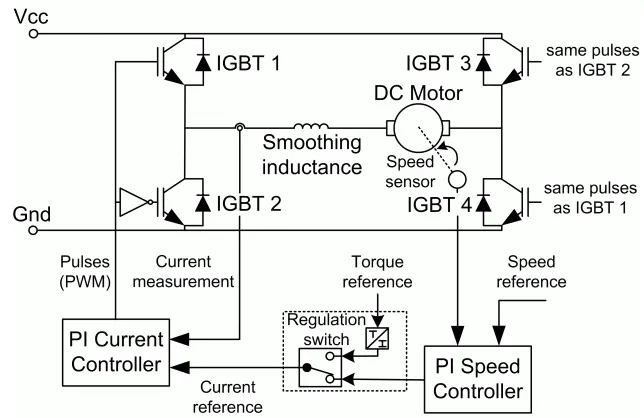
The internal block diagram has four IGBTs, which are working two IGBTs at a time. i,e IGBT1, IGBT4 and IGBT2, IGBT3. The load is a DC motor, which are controlled with PI controller.
This block has following blocks
Speed controller
Current controller
chopper circuit
and smoothing inductance.
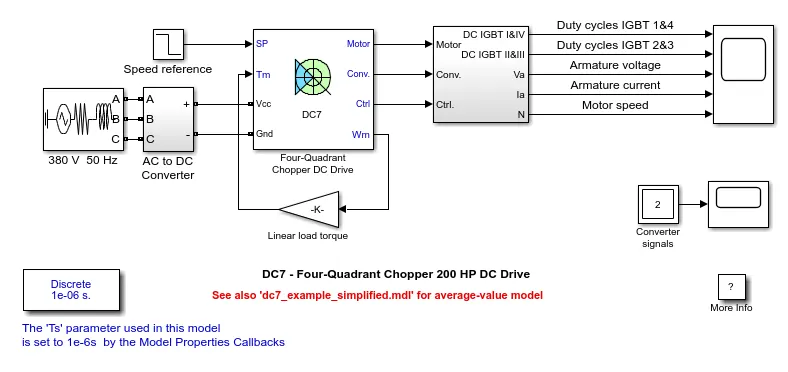
Comparison to H-Bridge
Both BJT H-bridges and 4 quadrant choppers have their advantages and disadvantages. H-Bridges like the 4 quadrant choppers are also capable of the braking
operation without using air resistance or friction or physical brakes to bring the motor to rest. 4 quadrant DC choppers are more commonly used in automobiles
whereas BJT H-bridges are commonly used in robotics and electro-mechanical devices.
Unlike 4 quadrant DC choppers, BJT H-bridges are not capable of performing regenerative braking but they can perform dynamic braking. It is this difference
that makes 4 quadrant DC choppers useful in hybrid and electric vehicles.
In 4 quadrant DC choppers, the current signals are interrupted with one another to change the direction of rotation of the motor. This is done by a speed
reference or a drive cycle from which the speed values are converted to current signals which interrupt one another to change the rotation of direction of the
motor. However in BJT H-bridges, the polarity of the current is reversed (depending on the duty cycle) to change the direction of rotation of the motor.
Also, the current signals in 4 quadrant DC choppers are chopped meaning that they are not continuous, they are discrete and so take less time for simulations.
But in BJT H-bridges, the current values are not chopped, meaning that they are continuous and so take more time for simulations.
Finally, in 4 quadrant DC choppers, a PI controller is used to control the speed and the current and in the H-bridge, this is not implemented.
3.
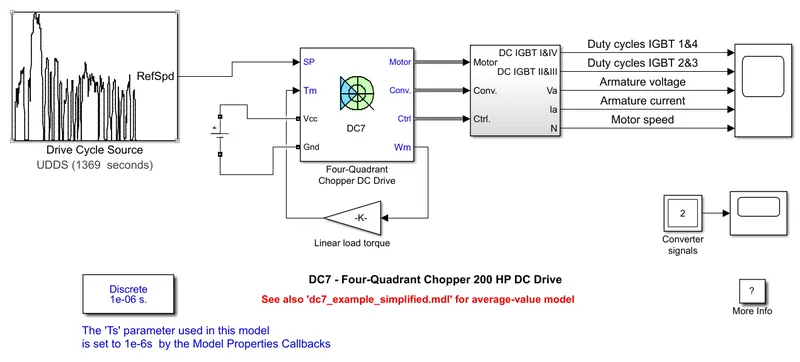
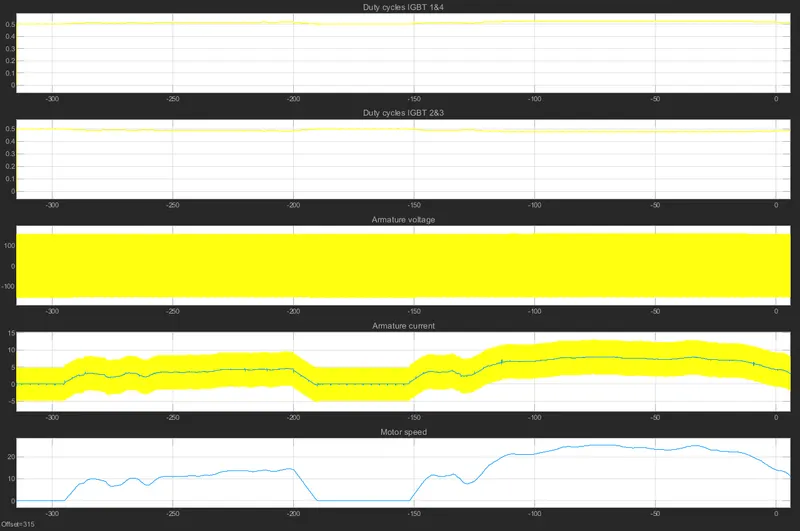
For EV, the drive cycle is given to dc7 block for all operations. The Dc source is given to the input. The results are shown in below figure. The load torqur is linear. The drive cycle is used from the library browser, UDDS.