Week 7- Base Unit Design Challenges 2
AIM:
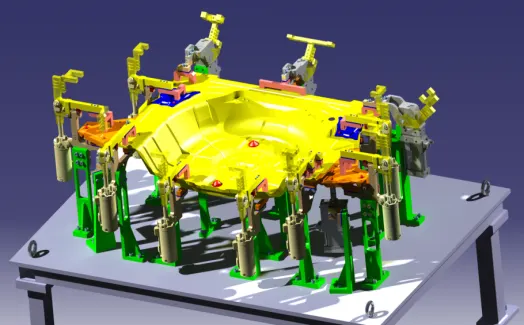
To Design a base unit for the Pin units,Clamp units,Swivel clamp units with all weldments for the given Car panel.
SOFTWARE USED:
CATIA-V5
INTRODUCTION:
Base Unit:
A base unit is the unit designed to mount all the other units of the tool,also other parts necessary for a tool like pneumatic valve box,trunking cable path will also be mounted on to a base unit.
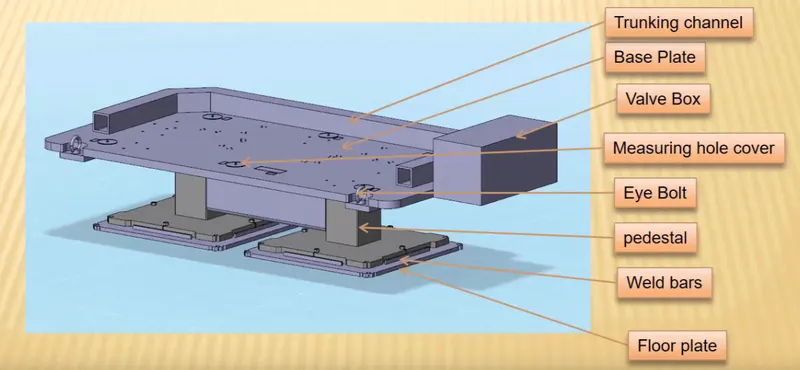
Below are the some parts of a base unit in general.
- Trunking channel
- Base plate
- Valve box
- Measuring hole cover
- Eye bolt.
- Pedestal.
- Weld bars.
- Floor plate.
Typical Parts of a base unit:
The typical Parts of a base unit are:
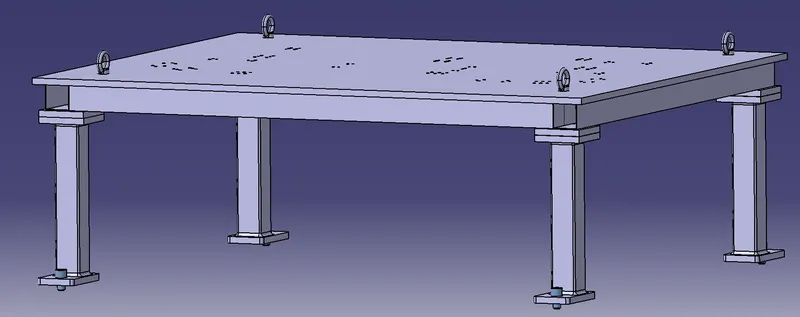
Base Unit:
Base Plate is a machined plate of 25 to 40mm thickness made of steel and aluminium on to which the holes are drilled to mount the individuals units like clamp units.pin units etc of a tool.
There are three key benefits to a Base plate:
- They can help to quickly and accurately tram in fixtures and vises.
- They can hold large, complicated, or odd-shaped parts.
- They protect the cast iron machine table.
Pedestal:
A pedestal is a part which connects the base plate to the floor plate.A pedestal is a standard part in general,and in some cases it can be a welded frame integrated with the base plate.
A standard pedestal can be of different heights and different sizes.
Depending on the size of the base plate,the number of pedestal varies for load distribution.
A pedestal are of different types with different inclinations.
Trunking Channel:
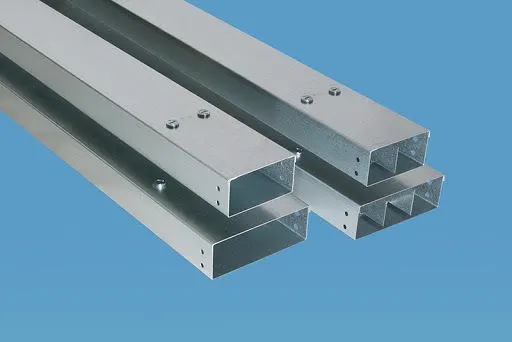
Trunking channel is a standard part which will accommodate all the pneumatic and electrical hoses and wires for the units.The trunking channel include all the pressure inlet cables going to the pneumatic parts of the fixture and protects them from damaging while operation is in process.
Valve Box:
Valve Box is a standard part which will contain all the valves for the pneumatic units.The valve box is the box which includes different solenoid valves.The pneumatic fixtures work on air pressure provided to it.So the arrangement of air pressure inlet and outlet is done within this valve box.The trunking channel includes all the pressure inlet cables going to the pneumatic parts of the fixture and protects them from damaging while operation is in process.
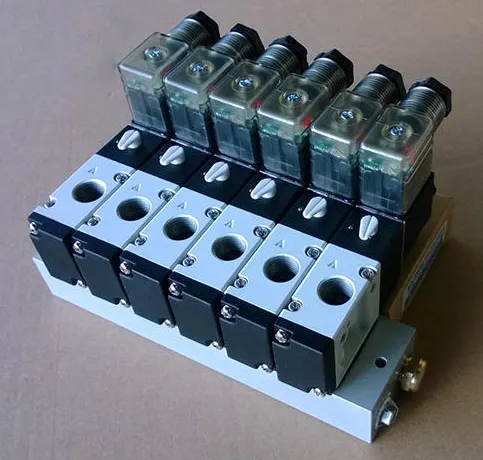
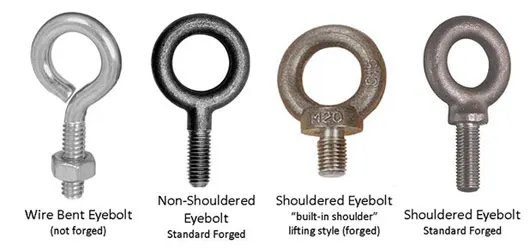
Eye Bolt:
An eye bolt is a bolt with a loop at one end. They are used to firmly attach a securing eye to a structure, so that ropes or cables may then be tied to it.
Machinery eye bolts are fully threaded and may have a collar, making them suitable for use with angular loads up to 450. Eye bolts without a shoulder should not be used for angular loads.Heavy forged eye bolts with a continuous eye may be forged with an integral shoulder, allowing their use for heavy off-axis loads.
These are used for the transporting of the tool by inserting hooks into them.Some, hooks or fork lift holes are also provided in some cases for transporting purposes.
Floor Plate:
Floor plate are grouted to the floor with fixed bolt on the ground.These are also called as foundation plates.
There will be a clearance of 10mm maintained between the pedestal base plate and the floor plate.
This clearance will be used by the leveling screws,for leveling the entire tool.
Weld bars are to be used to weld the positions permanently after leveling is done.
A weld bar is a plate along the sides of the base plate of the pedestal.
Fundamentals Of a Base Plate Design:
The fundamentals of a base plate design are:
- As designer it is important to know how big base plate or bigger base welded structure will be handled during the fabrication & handling process. Special care needs to take care of flatness if the base size is very long.
- A base plate size should cover all the units with its outer periphery including opening.
- A base plate is preferred to be designed with respect to BCS coordinates.
- A base plate should be drilled with datum holes / measuring holes in line with a pitch of 1000 mm in general.
- Number of datum holes is depends on the size of the base plate.
- Datum holes should be drilled at nominal values of coordinates, & in terms of 50 x 100. (In general) ex. X=100, Y 600, Z-250.
- Datum holes should be drilled with dia 100 mm away from other units.
- Datum holes should be covered with cover plates.
- Depending upon the weight, eye bolt size is selected for lifting holes on base plate Generally, 4 eye bolt provision is made You also need to select the location of eye bolt considering the rope/ belts used while shifting the structure or complete fixture are not damaging any units (rest, clamp or location units) nearby.
- Depending upon the component size & weight of the total units you can decide whether you need a fabricated base or just plate. Mostly fabricated bases are used made of square or rectangular tube with the plate.
- Most of the OEM makes 4 dowel holes at 4 corners & put small aluminum plate marking X Y&Z coordinates of dowel holes. If the base length is too long few OEM' s follow the methodology of having holes at 500 mm distance.
- The best unit of the fixture must be strong enough so that deflection of the fixture is as minimum as possible. This deflection of a fixture is called because of forces of welding, clamping of the work piece.
- The base unit of the fixture should have the mass to prevent vibration & chatter.
- The base unit may be built from simple sections so that other units may be fastened with screw or Welded necessary. Those parts of the fixture that remain permanently with the fixture may be welded. Those parts that need frequent changing may be held with screws .
- The base unit should be parallel to the floor to adjust this there should be provision of the height adjusting mechanism.
Points to be considered while designing a base plate:
1)Working height:
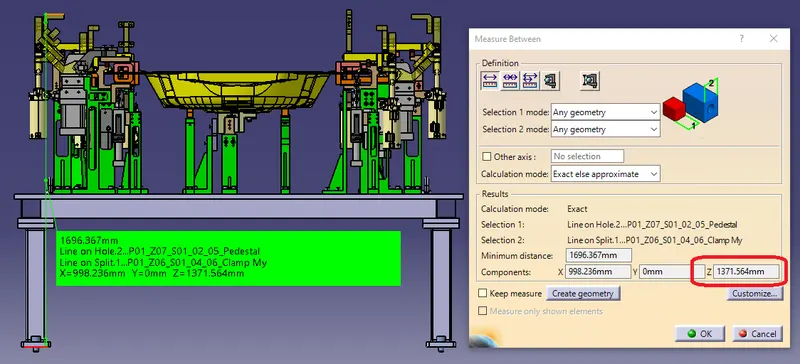
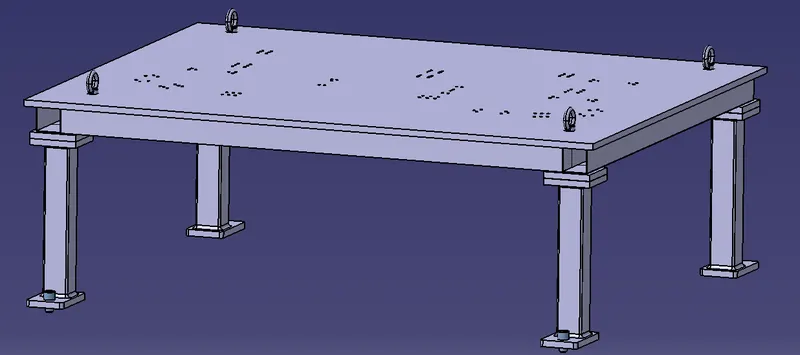
It depends on the nature of the manual or robotic welding fixture.For manual fixture we need to consider the working height 850-1100 mm, depending upon the working height of the worker standard of a specific country will apply (in few countries human height is higher or lower e.g. (US, Japan).If base structure is made with base plate having tubular structure welded below it we can reach to height 400 mm to 550 mm. In this case to reach the working welding height we need to provide additional some leg structure which may have top & plate welded to the tube.The total working height of this unit is 1370mm.The Dimensions of the Base Plate are obtained as 1850x1300x2mm.
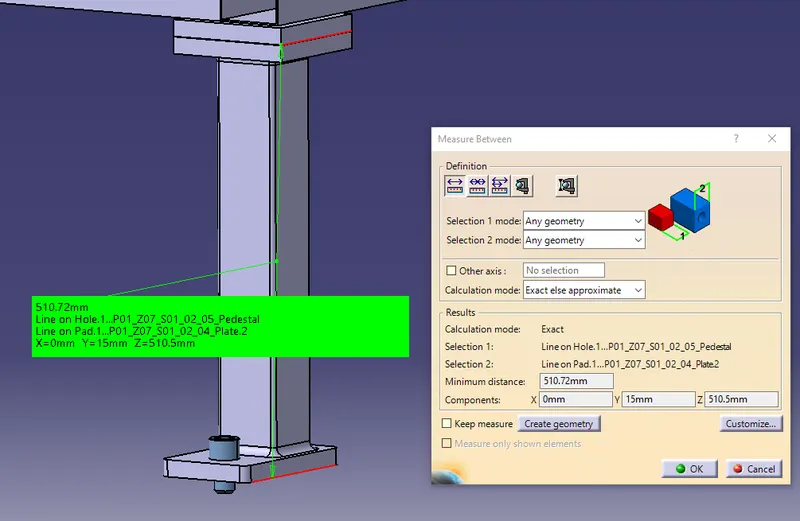
2)The base unit of fixture must be strong enough so that deflection of the fixture is as minimum as possible.This deflection of fixture is caused because of forces of welding clamping of the work piece.
The base plate is 20mm in thickness,which is machined to maintain the parallelism which can easily sustain the load of units without deflection.
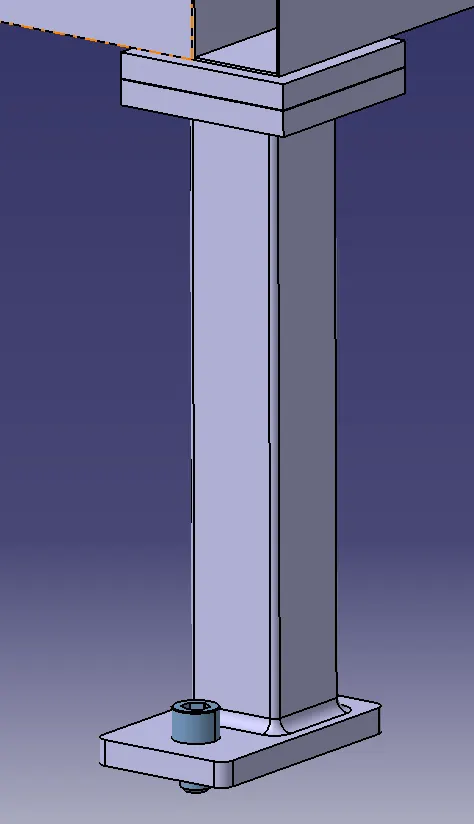
The weldment support and leg assembly part is made up by using 80x80x450mmx3mm thick seamless pipe which can withstand the forces caused by welding and clamping of the workpiece.
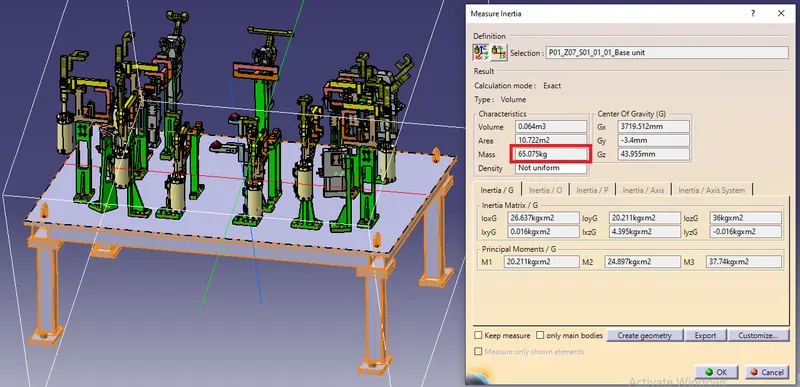
3)The Base unit of the fixture should have the mass to prevent vibration and chatter.The designed base unit weights 65 kg which is good enough to prevent vibration and chatter.
4)Base unit may be built from simple sections so that other units may be fastened with screws or welded whenever necessary.Those parts of the fixture that remain permanently with the fixture may be welded.Those parts that require frequent changing may be held with screws.The permanent parts of the base units are welded together and other parts have the facility to be fastened to the base unit.all the rough locators & the units can be fastened by using the threaded bolts.Base plate is designed to assemble these units without being failed to each other.
5)The base units should cover all the units within its outer periphery including opening.
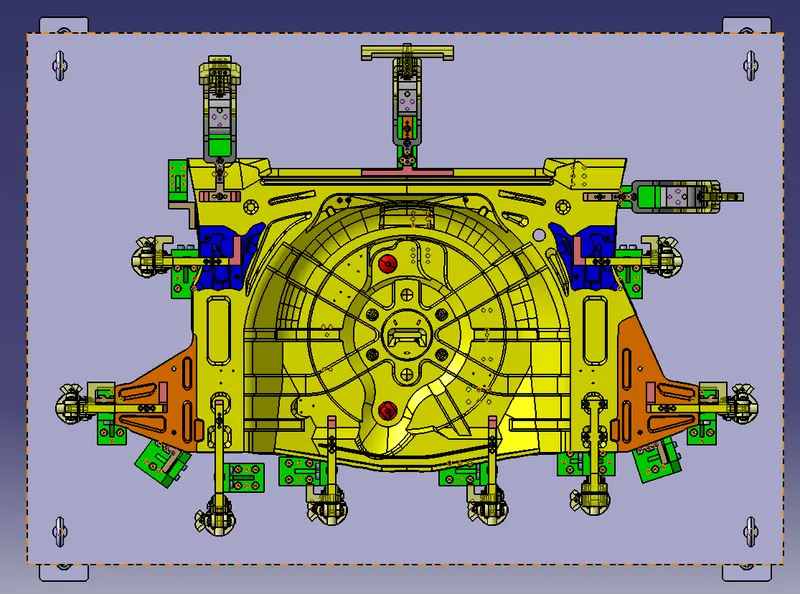
The above figure shows the base unit covers all other units within its outer periphery
6)The base unit should be parallel to the floor,to adjust this there should be provision of height adjusting mechanism.The height adjusting mechanism is provided to maintain the parllellity of the floor.at the time of adjustment we can provide spacers in order to maintain the parallelism with the floor.
3-2-1 Principle:
A work-piece free in space can move in an infinite number of direction. For analysis, this motion can be broken down into 12 directional movements or "degrees of freedom". All 12 degrees of freedom must be restricted to ensure proper referencing of a work-piece.
The 12 degrees of freedom all relate to the central axis of the work-piece. Notice the 6 axial degrees and 6 radial degrees of freedom. The axial degrees of freedom permit straight-line movement in both directions along the 3 principle axis shown as X, Y & Z.
The radial degrees of freedom permit rotational movement, in both clockwise & counterclockwise radial directions around the same three axis.
For a rigid body in plane has 6 degrees of freedom (i.e) The motion of a ship at sea has the 6 degrees of freedom .
- X+
- X-
- Y+
- Y-
- ZCW
- ZCCW
Now try to understand 3-2-1 principle of fixture. The purpose of Fixture is
- Resting
- Locating
- Orienting
- Clamping
Resting:
In a fixture the work piece should rest in such a way that it dosen’t move or vibrate on the resting blocks.
Locating:
The fixture should locate the work piece such that all the operations to be performed on it are performed without any problem and all of them are performed effectively.
Orienting:
The fixture should orient the work piece such that all the operations to be performed on it are within the reach of the work piece.
Clamping:
A clamp is a fastening device used to hold or secure objects tightly together to prevent movement or separation through the application of inward pressure.There are many types of clamps available for many different purposes. Some are temporary, as used to position components while fixing them together, others are intended to be permanent.
Achievement of 3-2-1 Principle:
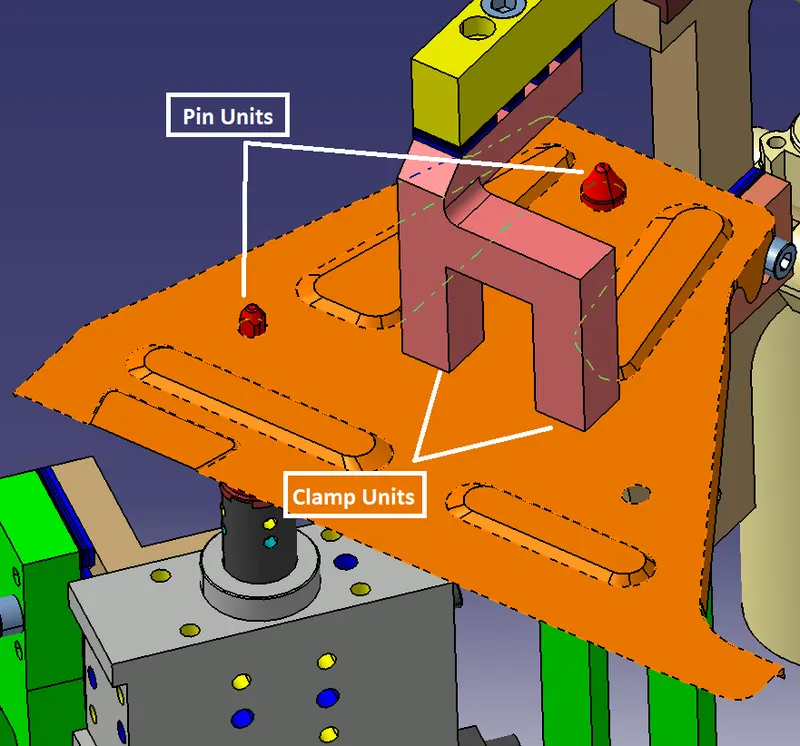
This requires minimum of three locator blocks to establish the part plane.Three locators or supports are placed under the work piece.Three locators are usually positioned at the primary locating surface.
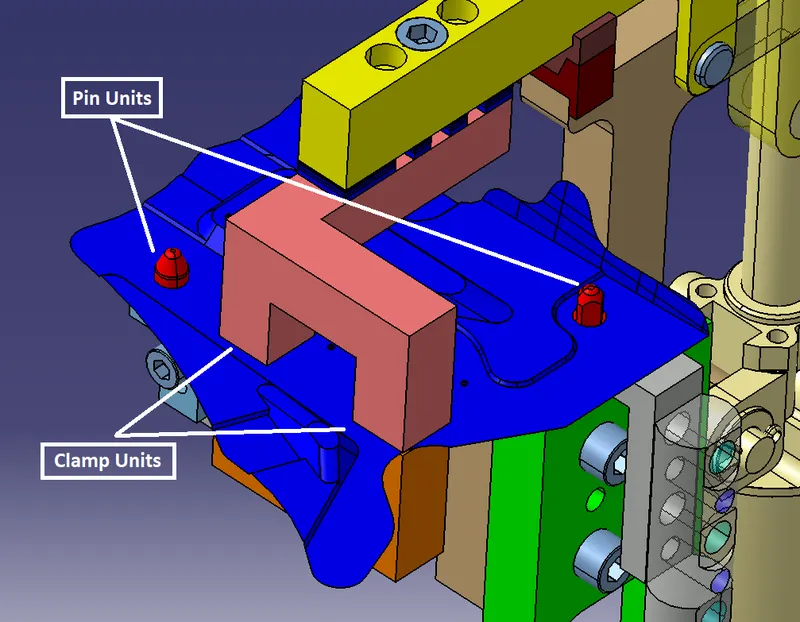
Clamp unit restricts 2 axial movements Upward and downward and other 2 pin units restricts radial movement.
As by 3-2-1 method,by introducing a minimum of 1 clamp and 2 pins will restrict 6 degrees of freedom(DOF).
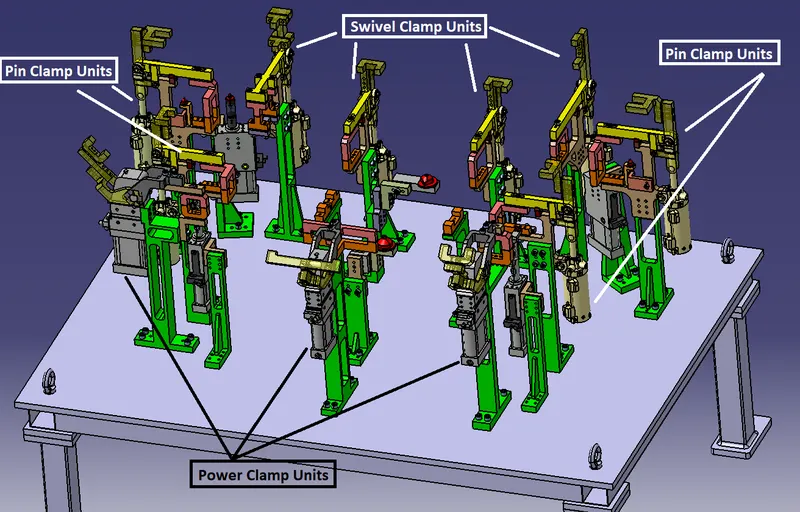
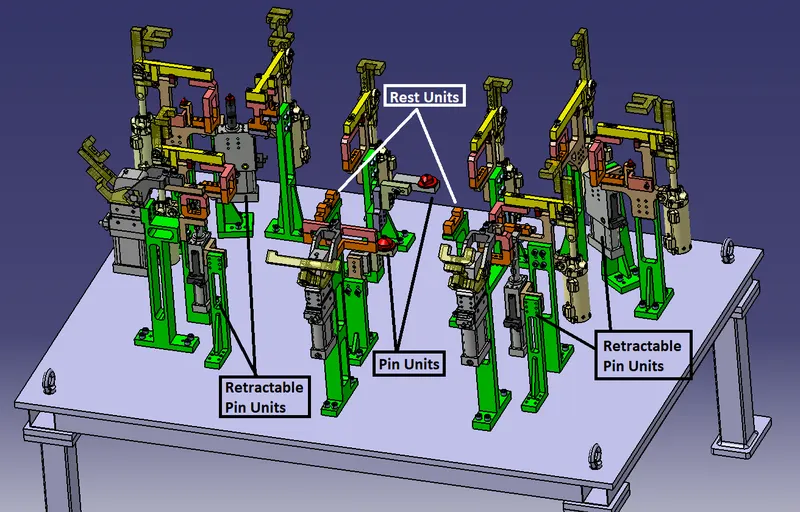
Clamp Plan:
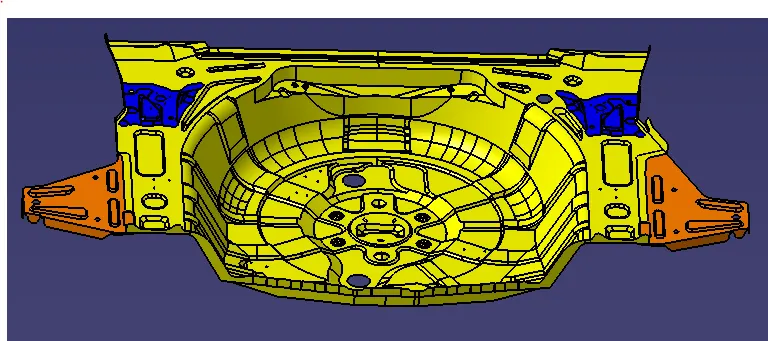
- In This assembly all the 5 panels are fixed by using 3-2-1 Principle.
- The Front Side panels are fixed by using a Pin clamp unit with a two way clamping Clamp mylar and a retractable pin unit with a diamond Pin.
- The back side panels are fixed by using a Pin clamp unit with a two way clamping Clamp mylar and a retractable pin unit with a diamond Pin.
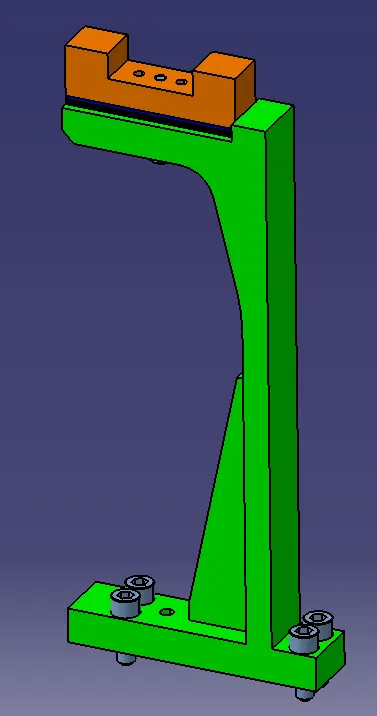
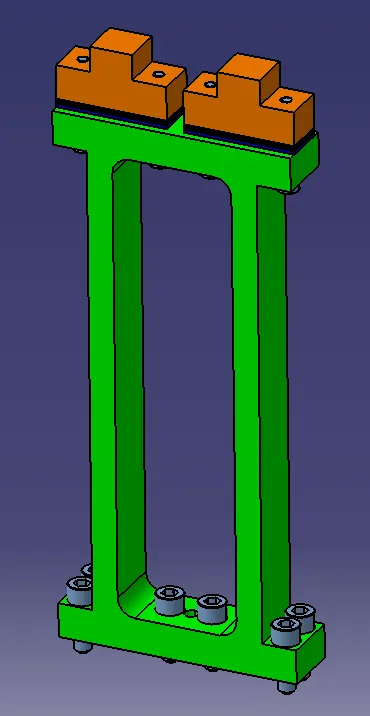
- The Centre Panel is locked by using two rest units at the bottom,two pin units into the holes to lock rotation movement and 4 swivel cylinders in the front and and three power clamp cylinders at the back.
- In this way by using all these units the panel is locked by using these units.
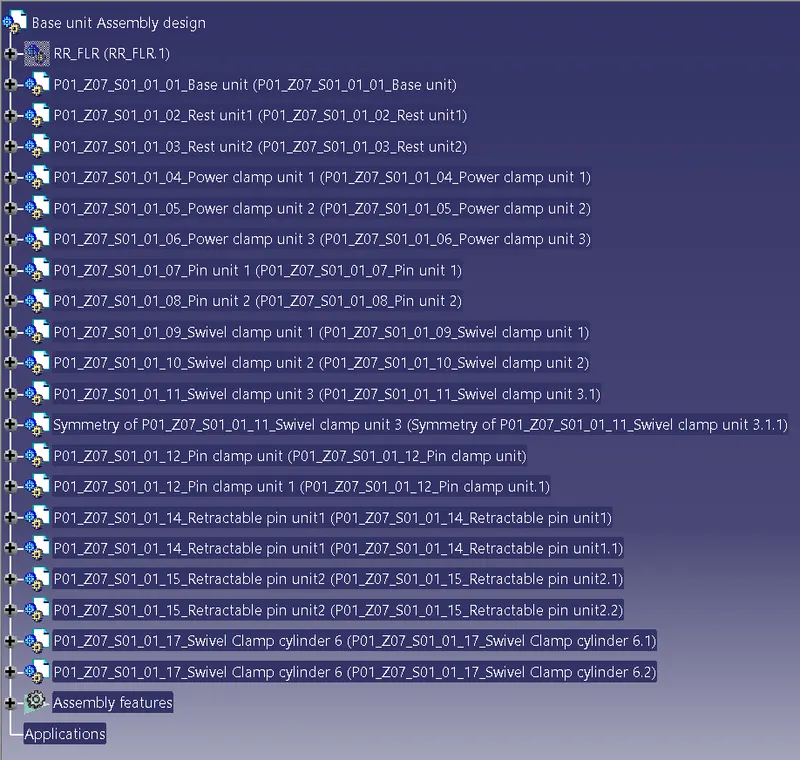
Structure of Design tree:
- A process where all the assemblies and parts are named in a specific standard Different customers have different set of standards and the structure of design tree.
- Every company,every customer has different standards of their own structural design tree.
- So they will be giving a template on how the structuring and detailing of the design is done. And you have to follow that particular designing or structuring of the tree.
- In the design tree itself if we mentioned that particular name, wherever that part is we can easily know that this part belongs to this one or this station or this assembly on particular unit. So this helps us to avoid errors during the design study, manufacturing assembly and inspections.
- It is an important process which helps us to identify a specific part or assembly as to which project ,tool, it belongs to.
- Structuring a design tree is actually to avoid the errors, which might come during manufacturing assembly, or either in house inspections as well.
- If the part, or assembly are not named properly, or design tree is not structured properly, it will create confusion to understand the design and may create major possibilities of making an error.
- Every part, every component should be named according to their procedures.
- If we did a mistake or renamed the entire standard parts from the customer as a design part .Now the customer is going to manufacture the entire part again from the scratch, but he already have that product in his itinerary.but extra cost extra time and is feasible. This is also known as an error which is actually going to increase the cost of the entire assembly as well
- Naming a fixture or a unit or a part gives the information as to which project zone or assembly do they belong.
- If we name the part properly or name the fixture properly ill actually tell which unit or which assembly or which zone or in which station it actually belongs
- It can help us to identify the quantity of items of same types or different types that are being used in an assembly.
- While starting of designing a fixture,The first unit will be the base unit.
- In a Design tree,all the manufacturing parts should be first and the standard parts should be at the last.
- Design tree helps to study or understand the parts in the assembly easily.
DESIGNS USED IN THE ASSEMBLY:
Design of the given Car Panel:
Design of the Base Unit:
Design of the Rest Units:
Design of the Power Clamp Units:
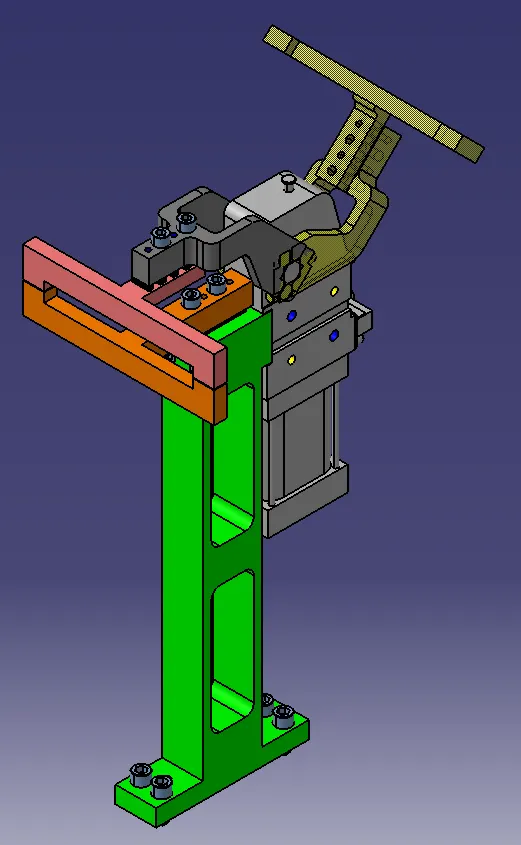
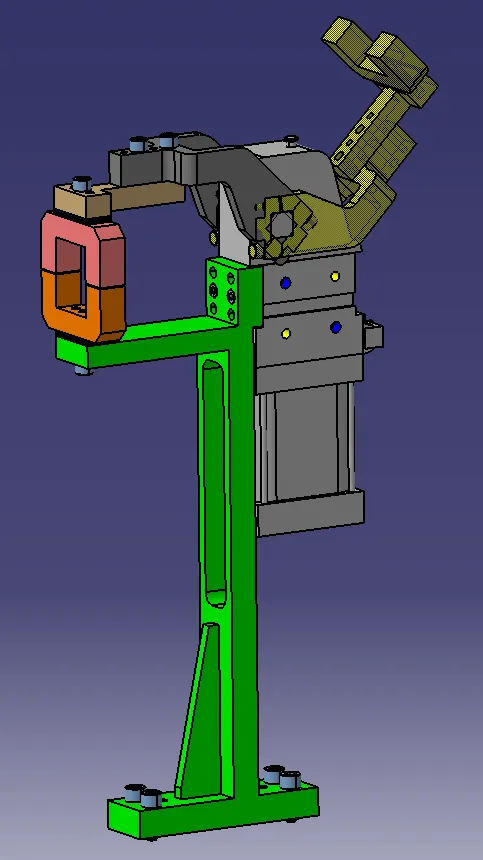
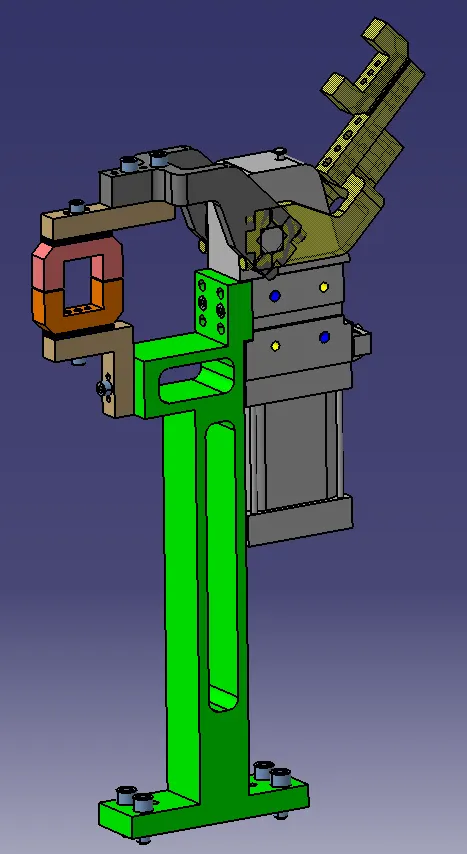
Design of the Pin Units:
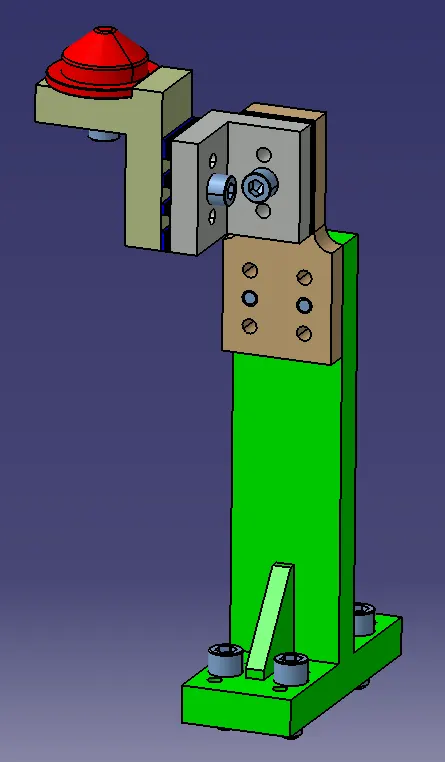
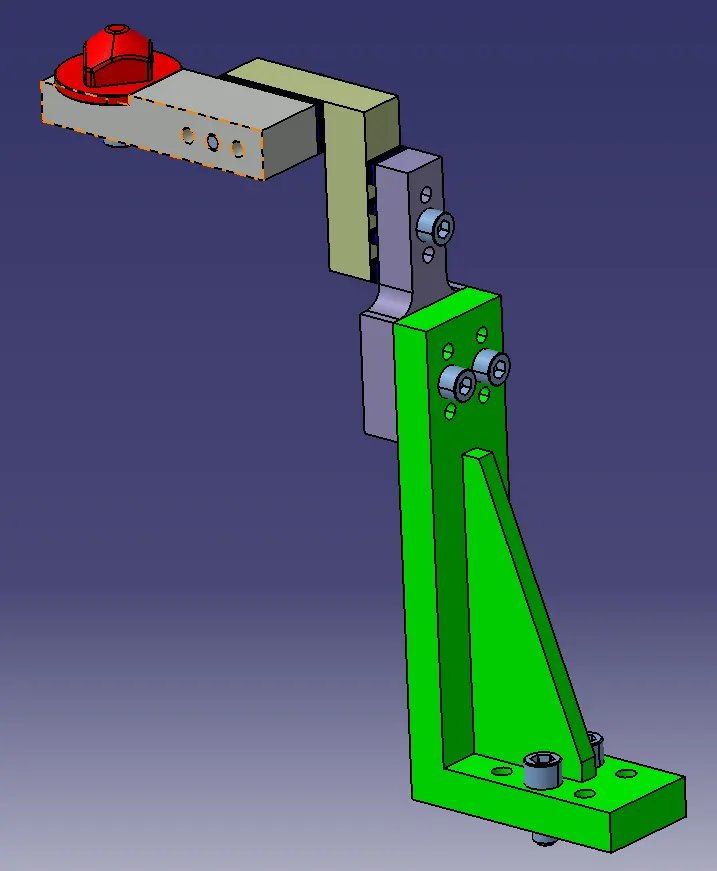
Design Of Swivel Clamp Units:
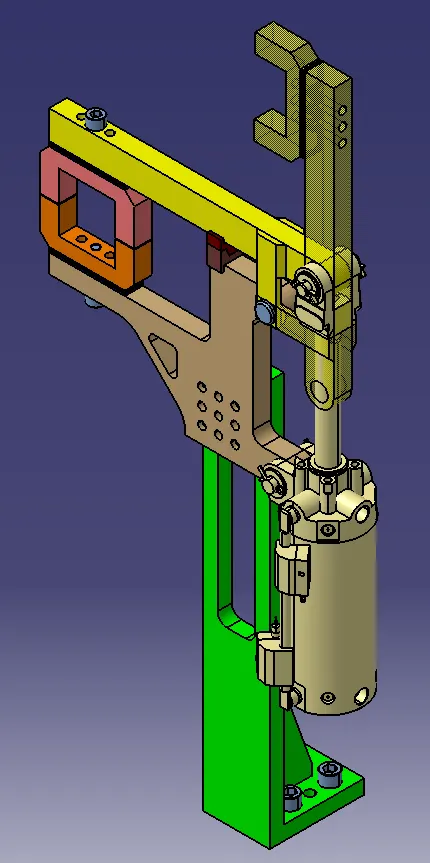
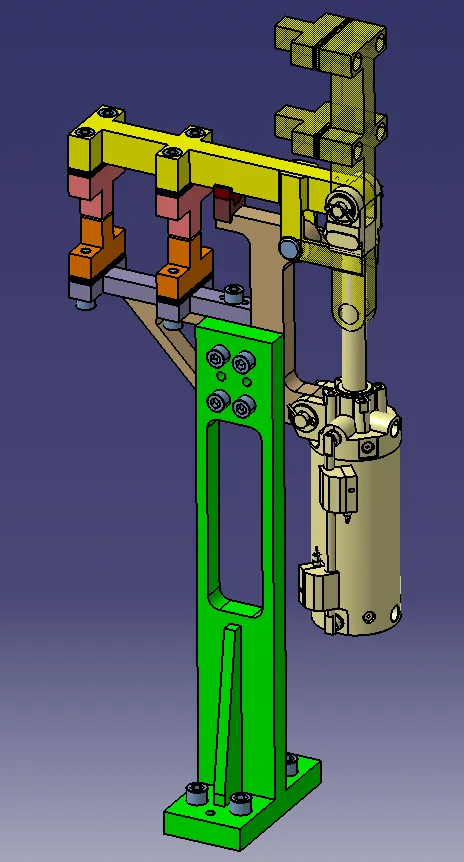
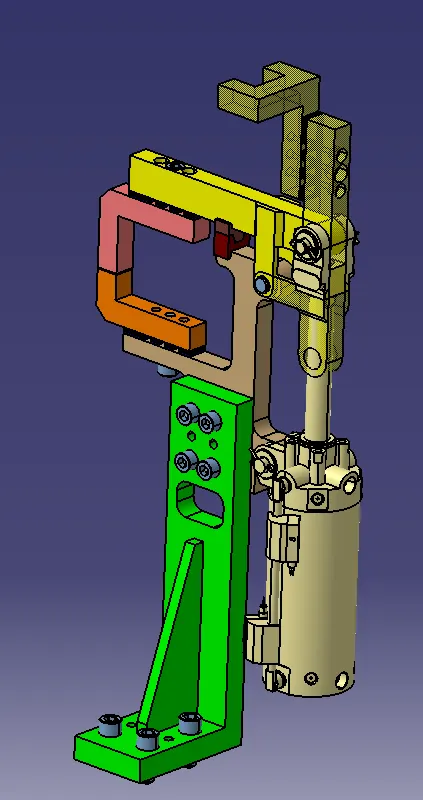
Design of Pin Clamp Units:
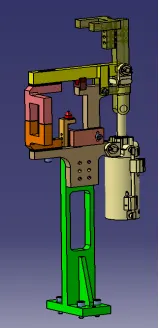
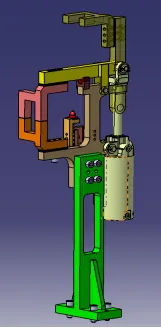
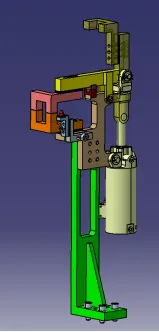
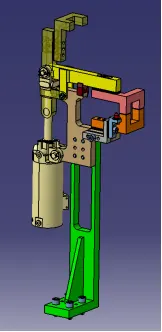
Design of Retractable Cylinders:
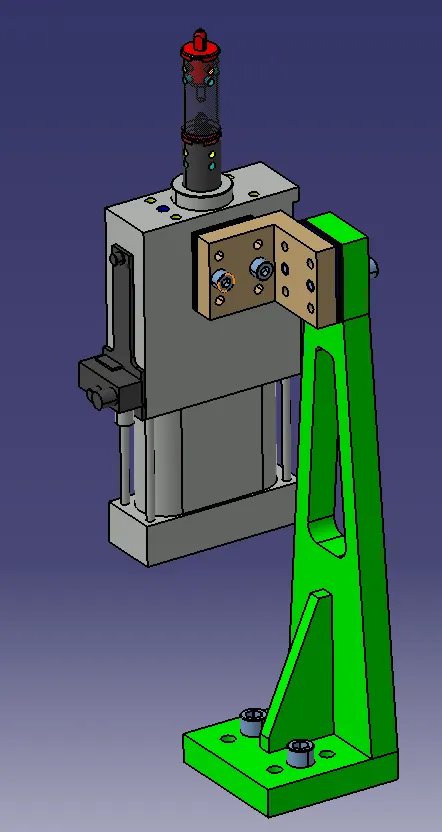
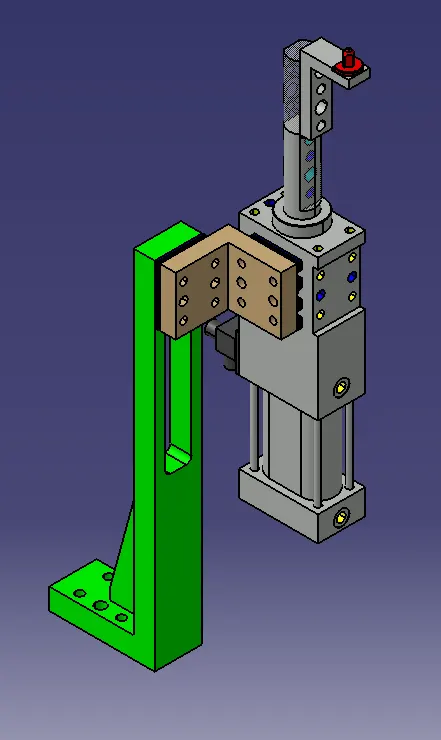
Assembly of the units on the Base unit:
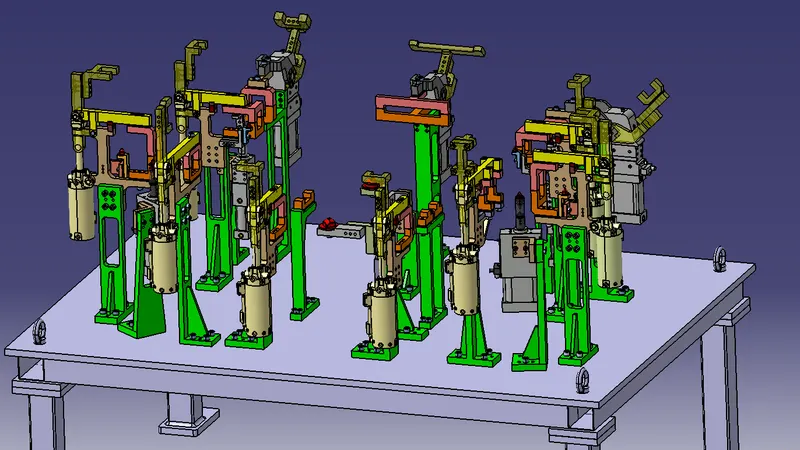
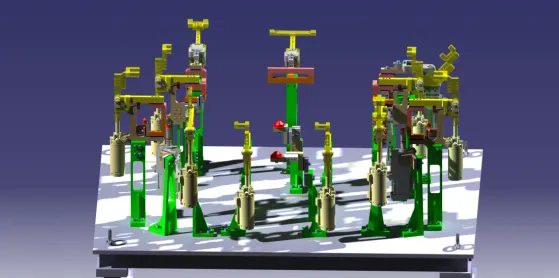
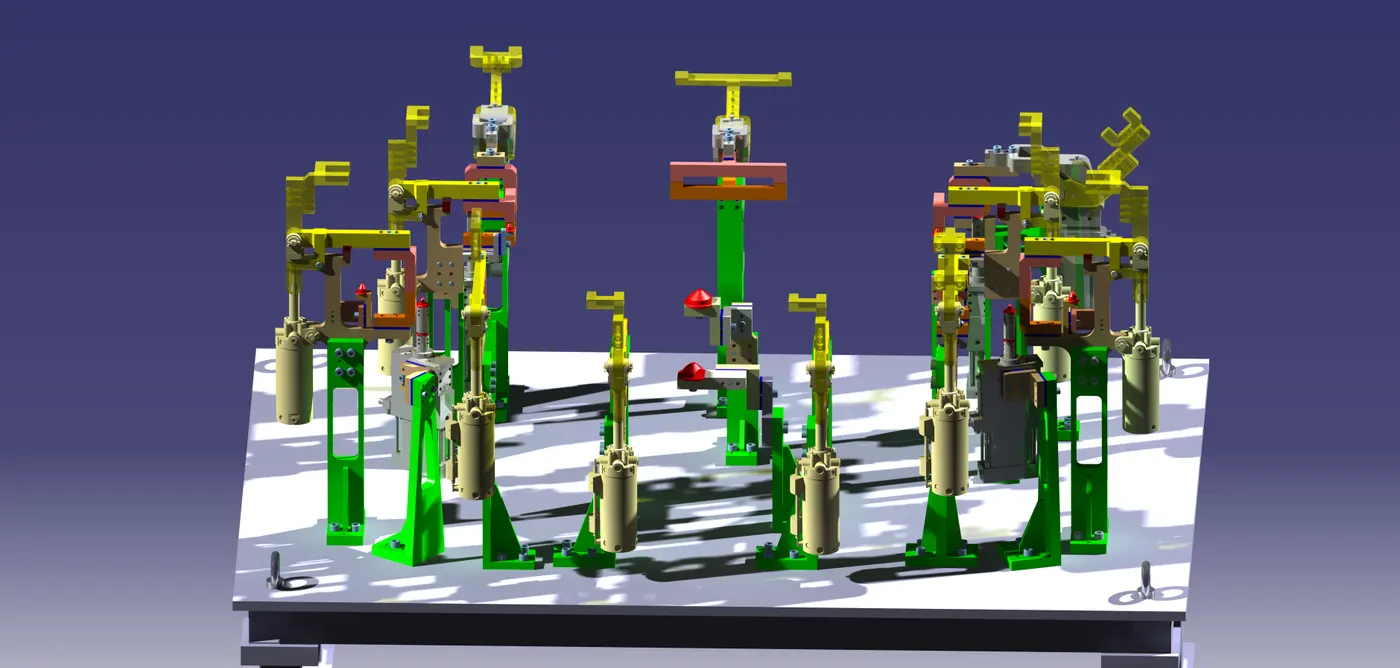
Total Assembly:
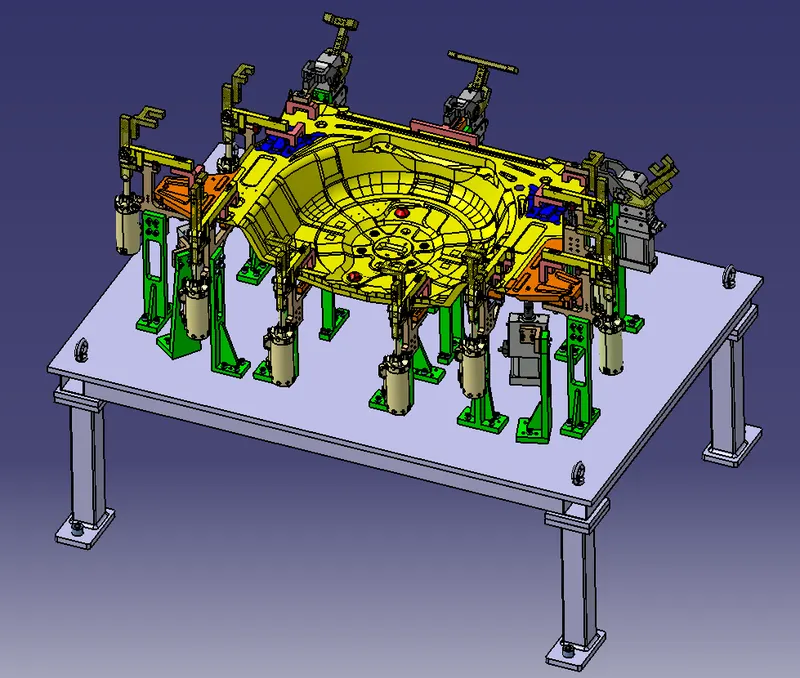
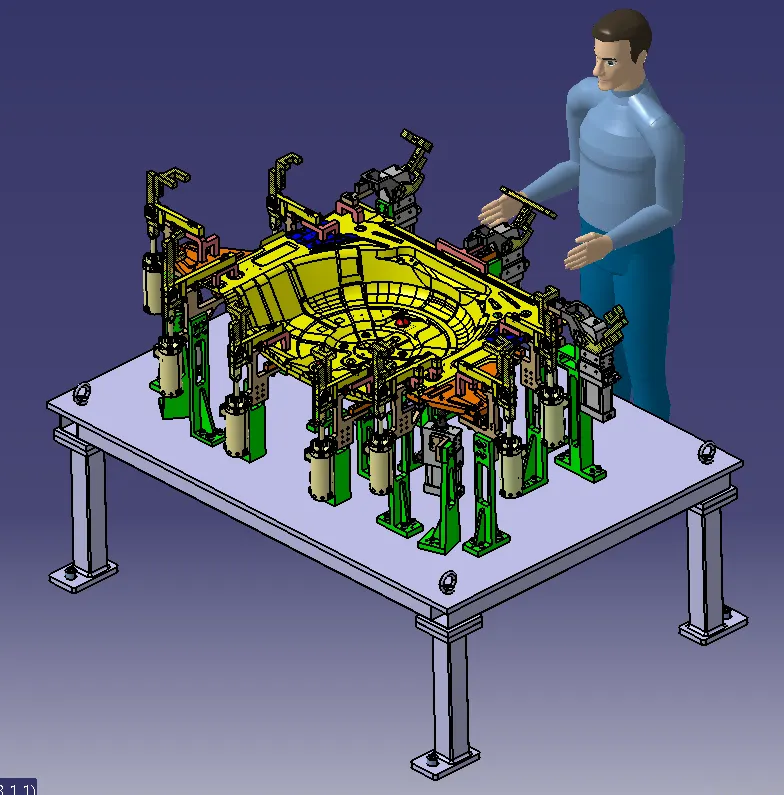
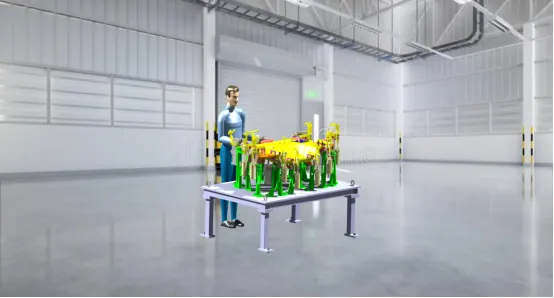
CONCLUSION:
Thus a base unit is designed with all the weld ments for a given car panel and all the other remaining units have been designed for the given car panel and fixed its movement using 3-2-1 Principle.