Benchmarking
BENCHMARKING
Benchmarking is a process of measuring the performance of a company's products, services, or processes against those of another business considered to be the best in the industry, aka “best in class.” The point of benchmarking is to identify internal opportunities for improvement.
In automobile industry benchmarking involves a structured comparison between similar products, services or processes on some dimensions of performance.
For example it can be used to compare the availability and delivery of features in a product and in this form often provides the basis of consumer tests and reviews. These look at products and services and provide recommendations based on which is best or some form of ranking amongst competitors.
There are two basic kinds of improvement opportunities: continuous and dramatic. Continuous improvement is incremental, involving only small adjustments to reap sizeable advances. Dramatic improvement can only come about through reengineering the whole internal work process.
Benchmarking is a simple, but detailed, five-step process:
-
Choose a product, service, or internal department to benchmark
-
Determine which best-in-class companies you should benchmark against which organizations you’ll compare your business to
-
Gather information on their internal performance, or metrics
-
Compare the data from both organizations to identify gaps in your company’s performance
-
Adopt the processes and policies in place within the best-in-class performers
In order to benchmark anything, you need to have quantitative data available to study. That means breaking down internal processes to calculate performance metrics. Quantify everything, because only quantifiable information can be accurately compared.
Types of Benchmarking:
- Internal benchmarking is a comparison of a business process to a similar process inside the organization.
- Competitive benchmarking is a direct competitor-to-competitor comparison of a product, service, process, or method.
- Functional benchmarkingis a comparison to similar or identical practices within the same or similar functions outside the immediate industry.
- Generic benchmarkingbroadly conceptualizes unrelated business processes or functions that can be practiced in the same or similar ways regardless of the industry.
But here we have to use Competitive benchmarking for selection of Car.
Now the parameters which we took to do benchmarking:
- Petrol/Diesel Engine
- Mileage
- Horsepower
- Torque
- Power to Wheel
- Weight
- Fuel Capacity
- Price
- Transmission Type
- Air Bags
- Safety Value by NCAP
- Maintenance Cost
- Boot Space
Benefits:
In addition to helping companies become more efficient and profitable, benchmarking has other benefits, too, such as:
-
Improving employee understanding of cost structures and internal processes
-
Encouraging team-building and cooperation in the interests of becoming more competitive
-
Enhancing familiarity with key performance metrics and opportunities for improvement company-wide
CASE STUDY
Problem Statement:
Mr. D.S. Pughazhyendhii is a married man who lives in Bangalore which is a highly crowded city.His Family comprises five members including his wife, five-year-old boy, his father, and his mother. He visits his native place Madurai which is 500kms away from Bangalore once in a month. Also, he will be using his car to commute to his office. His budget falls between 8 to 10 lakhs on road. Please suggest to him with options so that he will buy a good car for his family.
Note: Pughazhyendhii is fond of big cars
Points to be considered for Benchmarking:
- The car should be Five seater.
- He lives in a highly crowded city
- Once in a month trip of about 500kms.
- Uses a car to commute to the office(30Kms Up & down), total trip distance covered is 1200kms(Approx. for a month),
- The Budget is between 8-10 lakhs INR.
- The buyer is fond of Big Cars.
Approach:
Since Mr. D.S. Pughazhyendhii has a family of 5 members we will have to select a car where 5 people can sit comfortably in a car. And since he visits his native place once in a month he will need a car which is comfortable and has an decent amount of boot space to carry the luggages.
First we will have to decide which category of car he will buy. So considering all the above requirements he can go for a premium hatchback, compact SUV or a compact sedan. We will not cosider smaller hatchback because 5 people cannot sit comfortably and since he has a buget of upto 10 lakhs he can go for premium hatchback. Sedans and SUVs are above the budget.
List of cars:
Here are some list of cars and its specification which we shortlited considering all the requirements.
And all the specifications are according to the variants of the car which are under 10 lakh.
Petrol cars
- All new Hyundai i20 sportz
- Hyundai venue 1.2s
- Tata altroz xz+
- Tata nexon xm
- Vitara brezza vxi 1.5l
- Kia sonnet htk+
- Honda jazz vxmt
- Ford ecosport Ambiente
Diesel cars
- Tata altroz xt
- Nexon XE new
- All new Hyundai i20 1.5L U2 CRDI diesel Magna
- Kia Sonet HTE Tech line diesel 1.5
- Venue 1.5 DSL E
The production of Diesel cars have reduced and OEMs are targeting on Petrol versions only. According to National Green Tribunal's 2015 order, petrol cars have a lifecycle of 15 years while the same for diesel cars in 10 years. NGT passed this order in an effort to remove old, polluting diesel cars.
The exact impact of automobiles on the fragile environment is difficult to guess, however, hundreds of studies and researches in past 3 decades have highlighted the issues caused by the harmful CO2 and NOX emissions from automobiles. As demand on automobiles to become faster, safer and lighter it’s same for the fuel. The residual unburnt fuel in the engine not only reduces the mileage but also releases CO2 / NOX gas and harmful chemicals into the atmosphere. Particulate matter, hydrocarbons, carbon monoxide and other car pollutants harm human health. Diesel engines emit high levels of particulate matter, which are airborne particles of soot and metal. Carbon monoxide, another exhaust gas, is particularly dangerous to infants and people suffering from heart disease because it interferes with the blood's ability to transport oxygen.
Even though diesel cars have slightly better mileage than petrol cars, it is better to go with petrol versions rather than diesel cars as the maintenance cost of diesel cars is higher than petrol cars. This is because consumables like engine oil and spares used in diesel vehicles are more expensive. The resale value of a used diesel car is higher than that of a petrol car. However, the life of a petrol engine is more than a diesel engine. Also, the petrol price is around Rs 94/L and diesel is Rs 90/L.
Tata Altroz and Hyundai i20 comes under hatchback segment and since Pughazhyendhii is fond of big cars, these two cars will not be considered for benchmarking.
Rest of the cars mentioned above in the list comes under compact SUV segment. A compact sport utility vehicle or compact SUV is a class of small sport utility vehicles that is larger than mini SUVs, but smaller than mid-size SUVs.
Below we have Benchmark with some presently available cars in the market whose price ranges within 8 to 10 lakhs on-road (Bangalore, India).
1)FORD ECOSPORT AMBIENTE:
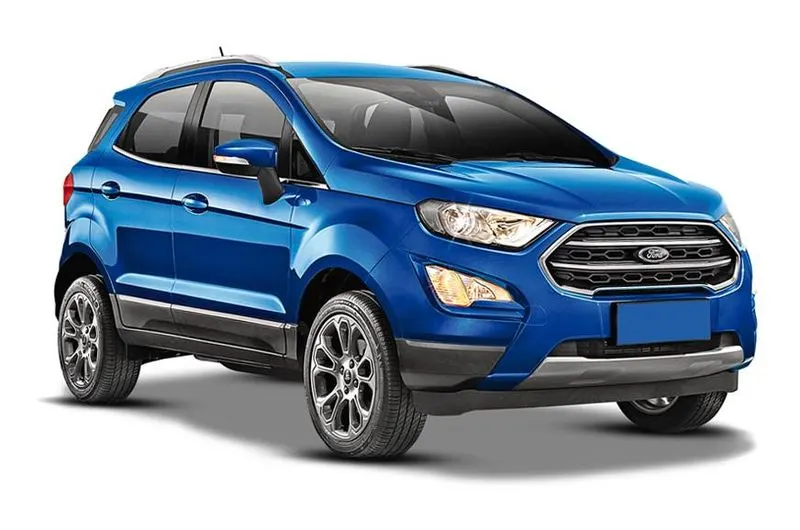
| Engine | 1496 cc, 3 Cylinders Inline, 4 Valves/Cylinder, DOHC |
| Max Power (bhp@rpm) | 121 bhp @ 6500 rpm |
| Max Torque (Nm@rpm) | 149 Nm @ 4500 rpm |
| Mileage (ARAI) (kmpl) | 15.9 |
| Transmission | Manual - 5 Gears |
| Turbocharger/Supercharger | - |
| Length (mm) | 3998 |
| Width (mm) | 1765 |
| Height (mm) | 1647 |
| Wheelbase (mm) | 2519 |
| Ground Clearance (mm) | 200 |
| Kerb Weight (kg) | 1188 |
| Bootspace (litres) | 352 |
| Fuel Tank Capacity (litres) | 52 |
| Airbags | 2 Airbags (Driver, Passenger) |
| Child Seat Anchor Points | |
| Anti-Lock Braking System (ABS) | yes |
| Electronic Brake-force Distribution (EBD) | yes |
2)KIA SONNET HTK+:
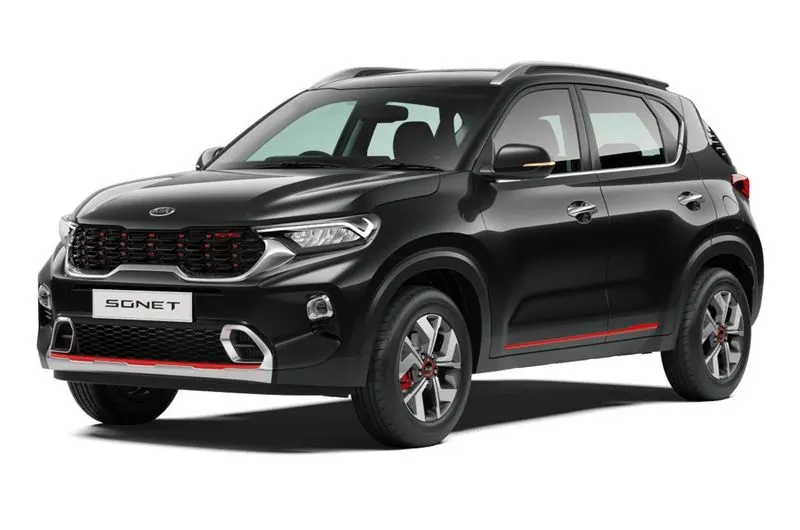
| Engine | 1197 cc, 4 Cylinders Inline, 4 Valves/Cylinder, DOHC |
| Max Power (bhp@rpm) | 82 bhp @ 6300 rpm |
| Max Torque (Nm@rpm) | 115 Nm @ 4200 rpm |
| Mileage (ARAI) (kmpl) | 18.4 |
| Transmission | Manual - 5 Gears |
| Turbocharger/Supercharger | - |
| Length (mm) | 3995 |
| Width (mm) | 1790 |
| Height (mm) | 1647 |
| Wheelbase (mm) | 2500 |
| Ground Clearance (mm) | 211 |
| Kerb Weight (kg) | -- |
| Bootspace (litres) | 392 |
| Fuel Tank Capacity (litres) | 45 |
| Airbags | 2 Airbags (Driver, Passenger) |
| Child Seat Anchor Points | - |
| Anti-Lock Braking System (ABS) | yes |
| Electronic Brake-force Distribution (EBD) | yes |
3)HYUNDAI VENUE 1.2S+:
| Engine | 1197 cc, 4 Cylinders Inline, 4 Valves/Cylinder, DOHC |
| Max Power (bhp@rpm) | 82 bhp @ 6000 rpm |
| Max Torque (Nm@rpm) | 114 Nm @ 4000 rpm |
| Mileage (ARAI) (kmpl) | 17.52 |
| Transmission | Manual - 5 Gears |
| Turbocharger/Supercharger | - |
| Length (mm) | 3995 |
| Width (mm) | 1770 |
| Height (mm) | 1605 |
| Wheelbase (mm) | 2500 |
| Ground Clearance (mm) | 195 |
| Kerb Weight (kg) | 1066 |
| Bootspace (litres) | 350 |
| Fuel Tank Capacity (litres) | 45 |
| Airbags | 2 Airbags (Driver, Passenger) |
| Child Seat Anchor Points | yes |
| Anti-Lock Braking System (ABS) | yes |
| Electronic Brake-force Distribution (EBD) | yes |
4)VITARA BREZZA VXI 1.5L:
| Engine | 1462 cc, 4 Cylinders Inline, 4 Valves/Cylinder, DOHC |
| Max Power (bhp@rpm) | 103 bhp @ 6000 rpm |
| Max Torque (Nm@rpm) | 138 Nm @ 4400 rpm |
| Mileage (ARAI) (kmpl) | 17.03 |
| Transmission | Manual - 5 Gears |
| Turbocharger/Supercharger | |
| Length (mm) | 3995 |
| Width (mm) | 1790 |
| Height (mm) | 1640 |
| Wheelbase (mm) | 2500 |
| Ground Clearance (mm) | 198 |
| Kerb Weight (kg) | 1115 |
| Bootspace (litres) | 328 |
| Fuel Tank Capacity (litres) | 48 |
| Airbags | 2 Airbags (Driver, Passenger) |
| Child Seat Anchor Points | yes |
| Anti-Lock Braking System (ABS) | yes |
| Electronic Brake-force Distribution (EBD) | yes |
5)HONDA JAZZ VX:
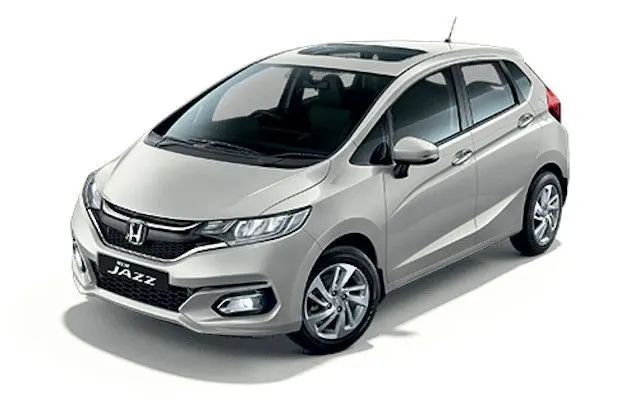
| Engine | 1199 cc, 4 Cylinders Inline, 4 Valves/Cylinder, SOHC |
| Max Power (bhp@rpm) | 89 bhp @ 6000 rpm |
| Max Torque (Nm@rpm) | 110 Nm @ 4800 rpm |
| Mileage (ARAI) (kmpl) | 16.6 |
| Transmission | Manual - 5 Gears |
| Turbocharger/Supercharger | |
| Length (mm) | 3989 |
| Width (mm) | 1694 |
| Height (mm) | 1544 |
| Wheelbase (mm) | 2530 |
| Ground Clearance (mm) | |
| Kerb Weight (kg) | 1044 |
| Bootspace (litres) | 354 |
| Fuel Tank Capacity (litres) | 40 |
| Airbags | 2 Airbags (Driver, Passenger) |
| Child Seat Anchor Points | |
| Anti-Lock Braking System (ABS) | yes |
| Electronic Brake-force Distribution (EBD) | yes |
6)TATA NEXON XM:
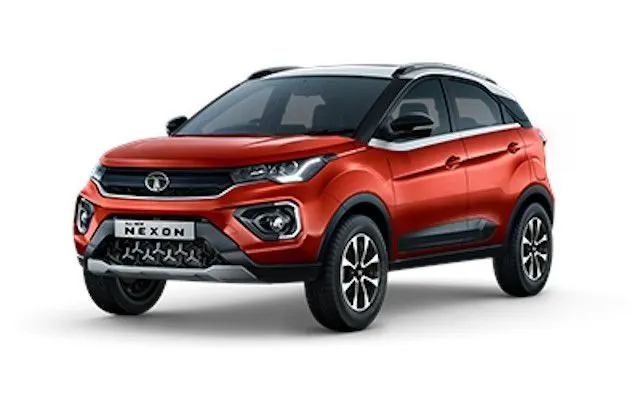
| Engine | 1199 cc, 3 Cylinders Inline, 2 Valves/Cylinder, SOHC |
| Max Power (bhp@rpm) | 118 bhp @ 5500 rpm |
| Max Torque (Nm@rpm) | 170 Nm @ 1750 rpm |
| Mileage (ARAI) (kmpl) | 17.4 |
| Transmission | Manual - 6 Gears, Sport Mode |
| Turbocharger/Supercharger | Turbocharged |
| Length (mm) | 3993 |
| Width (mm) | 1811 |
| Height (mm) | 1606 |
| Wheelbase (mm) | 2498 |
| Ground Clearance (mm) | 209 |
| Kerb Weight (kg) | 1188 |
| Bootspace (litres) | 350 |
| Fuel Tank Capacity (litres) | 44 |
| Airbags | 2 Airbags (Driver, Passenger) |
| Child Seat Anchor Points | yes |
| Anti-Lock Braking System (ABS) | yes |
| Electronic Brake-force Distribution (EBD) | yes |
Conclusion:
After comparing all the compact SUVs above, it is safe to say that the Tata Nexon provides better value for money with best in class features among all other compact SUVs. It also includes 5-star rating in the Global NCAP crash tests which is only one in its segment. Some of the advantages which help Tata Nexon to stand amongst all other compact SUVs are:
- Handsome design with great attention to detail
- Feature-loaded interior with a decent amount of space
- Powerful petrol and diesel engine options
- Fantastic ride quality and a feedback-rich steering
- It also has got decent mileage along with a turbocharger.
- As this is a 4 cylinder engine, inside cabin noise will be less.