Week 5 Sphere pressing on a plate
- Objective:-
To simulate the plastic deformation of a plate when pressed by a sphere.
- Model Details:-
A sphere is to be pressed against a plate, however we can take advantage of symmetry of geometry and loading to solve for only quarter model as shown in the figure below,
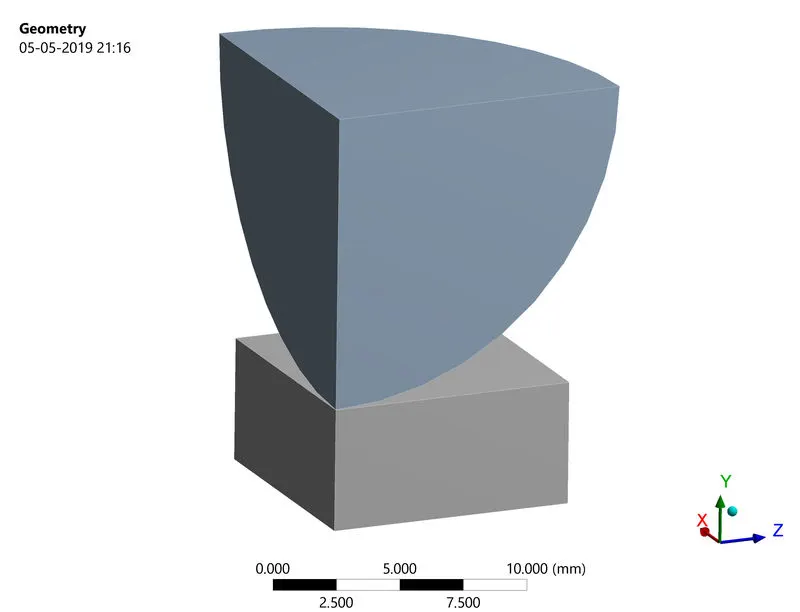
Since we want to capture the plastic deformation of the plate, we assign Structural Steel NL material to the plate. In the materials data, we can see that it has a bilinear isotropic hardening. Meaning, stress strain curve is defined by two linear curves, after the Yield stress value, later part of the stress strain curve is defined by the Tangent Modulus.
Properties of Structural Steel NL:-
Young's Modulus = 200 GPa
Poisson's Ratio = 0.3
Bilinear Isotropic Hardening:- Yield Strength = 250 MPa and Tangent Modulus = 1.45 GPa.
While for sphere, material assigned is structural steel only, since we don't want sphere to plastically deform.
Initially, two symmetry regions are created, one with symmetry normal as Z-axis, and other with X-axis. By doing this, we have reduced the number of elements to solve for and thereby reduced the calculation time. A frictional contact between sphere and flat surface is defined with friction coefficient as 0.74.
Mesh Details:-
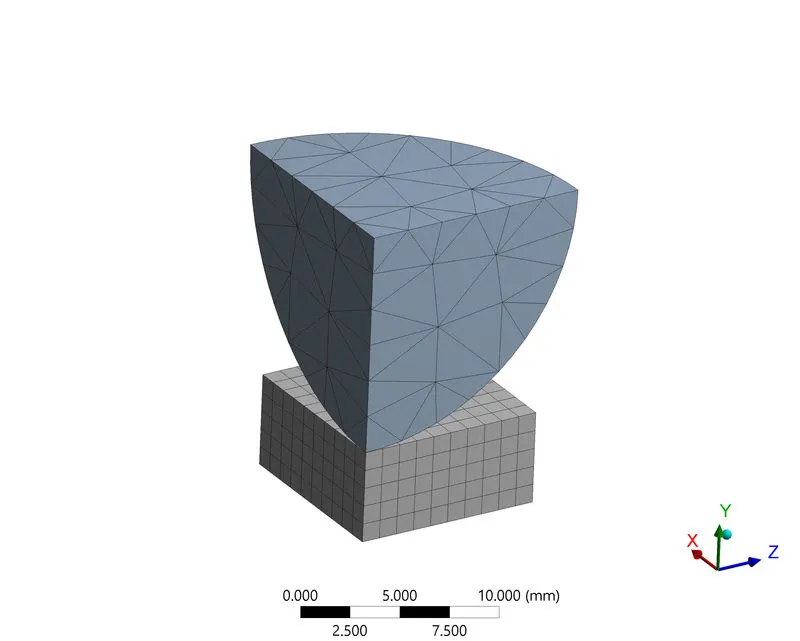
As we want to study the plastic deformation of the plate only, a Mesh Sizing is applied to plate with the element size of 1 mm. Although we can further reduce the element size, we have found this 1 mm element size to be sufficient and further reduction does not improve result much but adds significantly to the calculation time of simulation.
Element Type is Hex2O for Plate and Tet10 for the Sphere.
Number of elements:- 740
Number of nodes:- 3168
Avg. element quality:- 0.91884
- Loads and Constraints:-
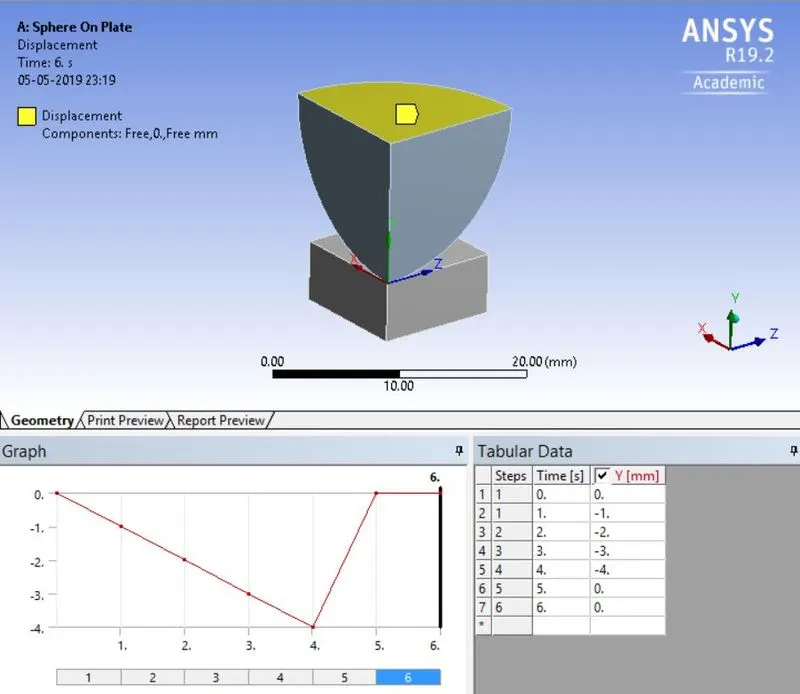
In this model, a fixed support is defined on the bottom surface of plate to fix the plate. A displacement is defined for the top flat surface of the sphere to simulate the pressing of sphere by 4 mm along negative Y-direction. In Analysis Settings, 6 time steps of 1 sec each is selected, and sphere is defined to move along negative Y-axis by 4 mm in first 4 seconds and then retracted back to original position in last 2 seconds, this can be seen from the images below,
- Results:-
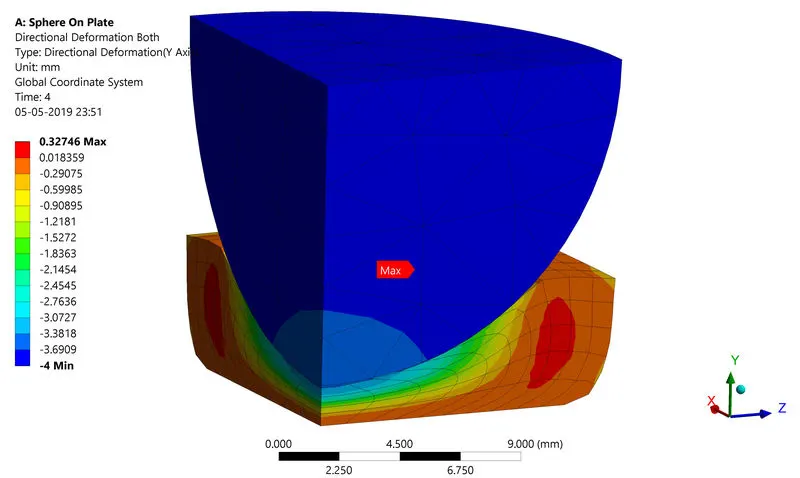
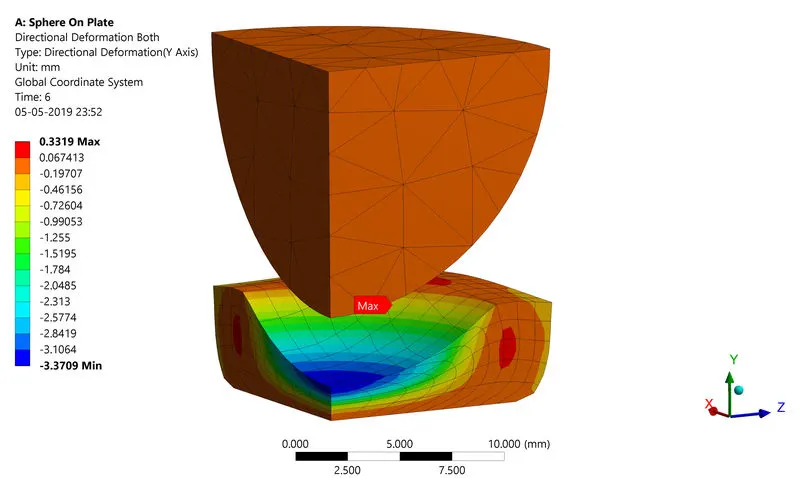
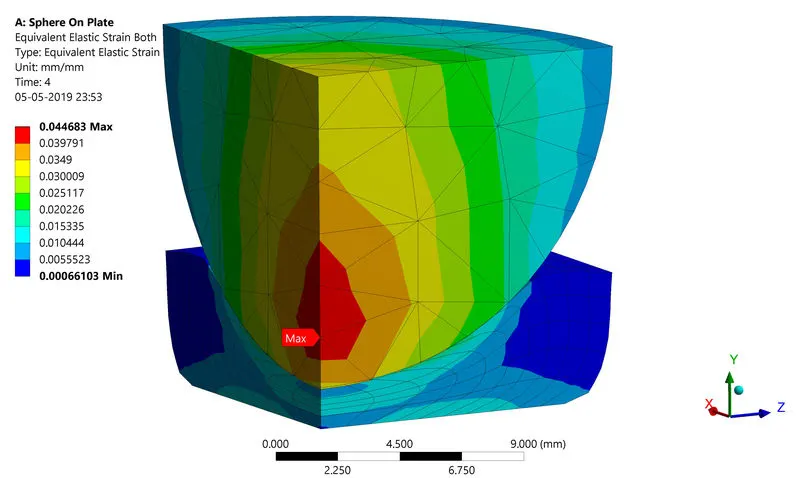
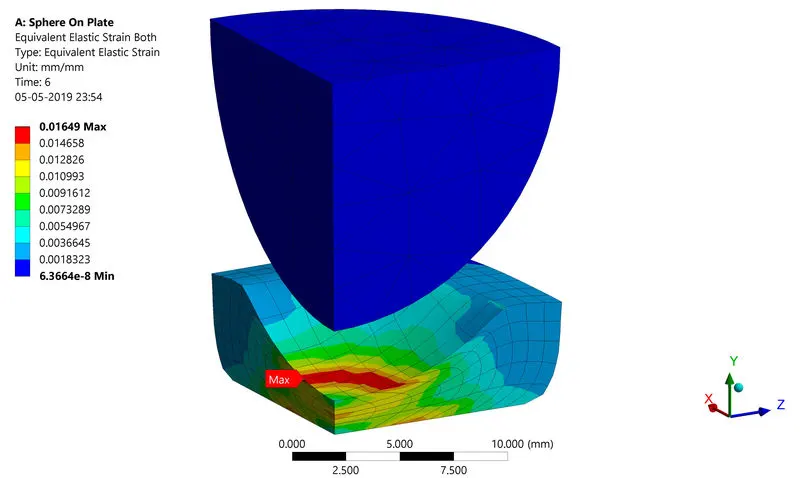
Directional Deformation, Equivalent Elastic Strain and Equivalent Stress fo the model are plotted in the results. The plastic deformation of the plate is captured from the Equivalent Elastic Strain animation. We can see that even after the sphere is retracted fully back there is some permanent plastic deformation on the plate.
Also, plastic deformation is evident from the images below, which are captured at time 4 sec and 6 sec, when sphere is at its lowest and at its original position respectively.
For Directional Deformation,
For Equivalent Elastic Strain,
Images below are only focussed on the plate, which clearly shows the centre point of the plate making some elastic recovery after sphere is retracted, and the remaining deformation is permanent plastic deformation,
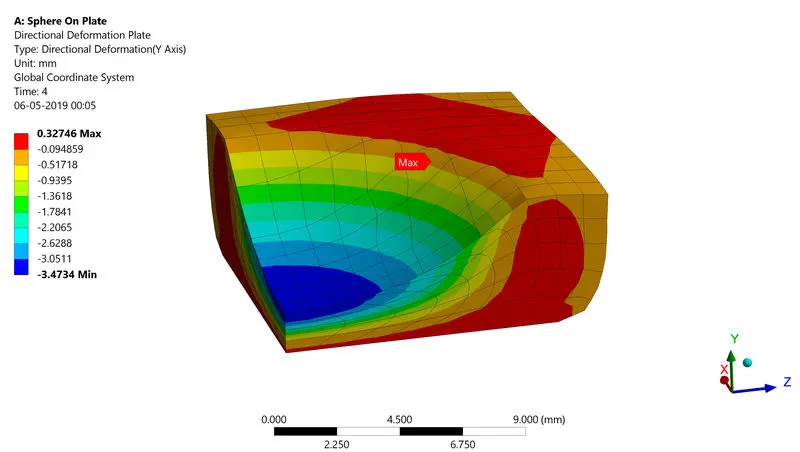
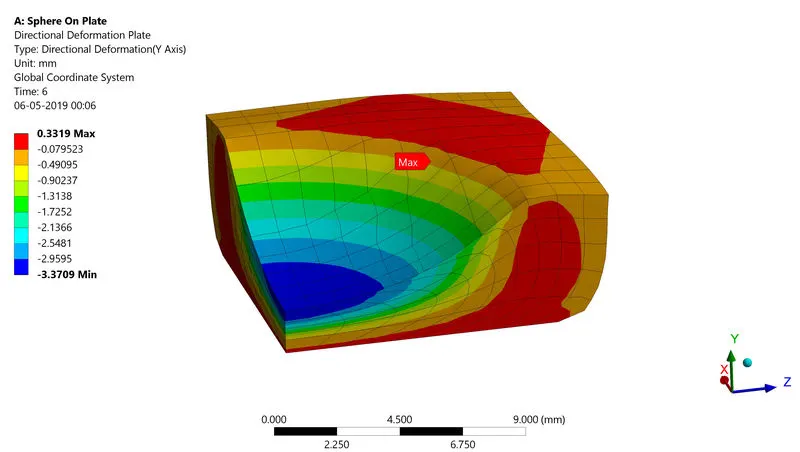
First image is at time 4 sec, where the centre of the plate shows to deformation of -3.4734 mm, when sphere is at its lowest. Second image is at time 6 sec when the sphere is retracted back completely, and centre shows deformation -3.3709 mm. Hence centre shows elastic recovery around 0.1025 mm, and remaining 3.3709 mm is the permanent plastic deformation.