Week 2 Railwheel and Track
- Objective:- To compare rail wheel and track under two given loading conditions and to implement a user defined result function to calculate 'Total Deformation'.
- Model Details:- A rail wheel mounted on a shaft along with a rail track is used for the study, as shown in the figure below. Face Sizing under Mesh Control is applied to surface of wheel and track that are in contact with element size of 15mm.While rest of ht emodel is meshed with 45mm element size.
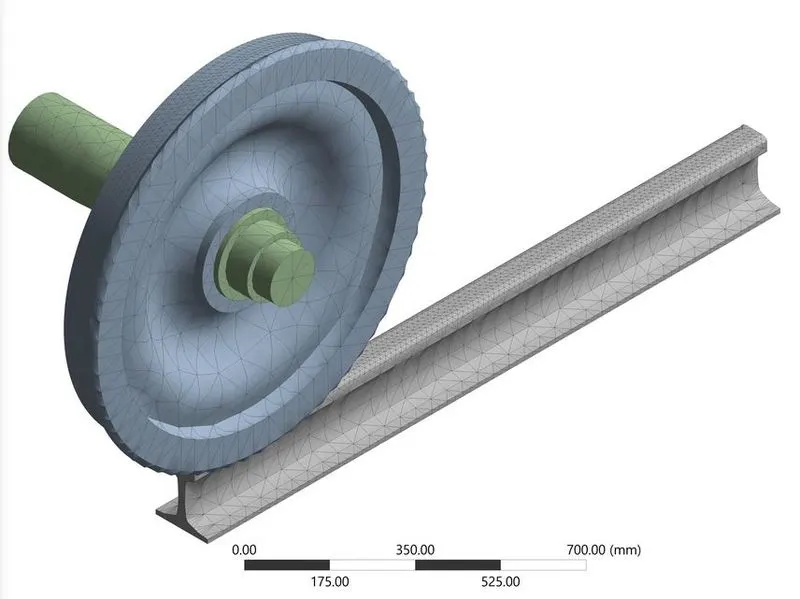
Mesh Details (Element Type - Tet10):-
Number of elements:- 16928
Number of nodes:- 31102
Average element quality:- 0.65305
Mesh generated is same for both loading conditions. Material assigned to all the parts is Structural Steel, which is also same for both the models.
Young's Modulus:- 200 GPa
Poissons's Ratio:- 0.3
Density:- 7850 Kg/m^3
- Loads and Constraints:- Under 'Joints', the rail is fixed while a translational joint is applied for shaft. The wheel is contrained to move only in YZ plane using a planar joint. These joints are shown in figure below. The boxes in the legend tells us the degree of freedom available for that part after implementing the respective joints. For eg., in fixed joint, no check box is coloured, which implies that there is no freedom for the track in any direction. While in Planar joint, 'X','Y' and 'RZ' boxes are coloured, which implies that the wheel is free to move in these respective directions.
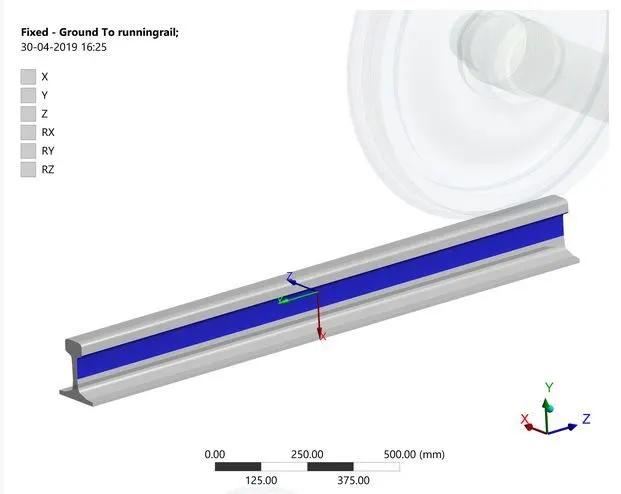
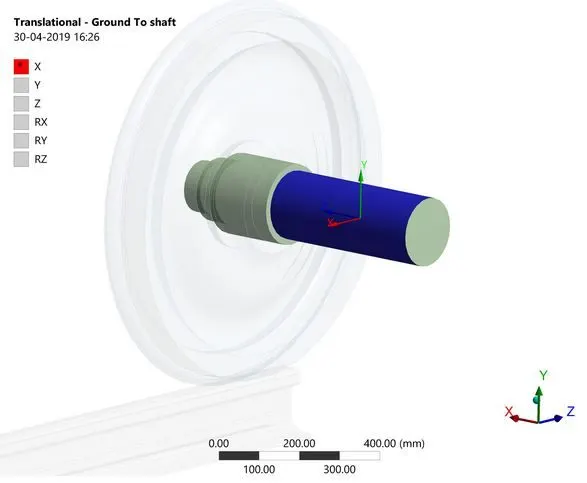
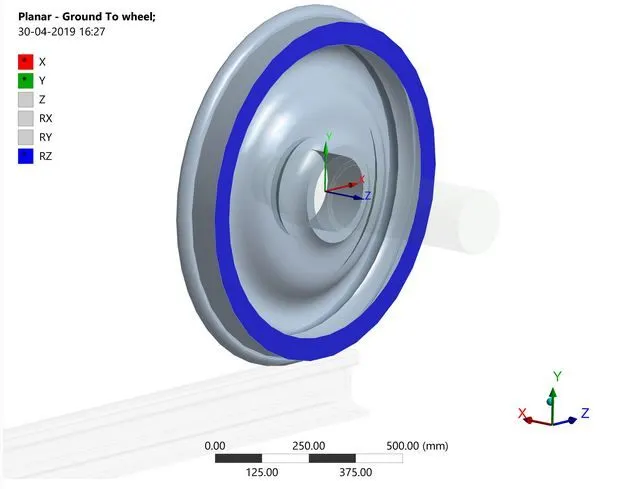
Surfaces on wheel and track which come in contact are defined as 'Frictional' with friction coefficient as 0.3. While the surface contact of wheel with shaft is defined as 'Frictionless'. After applying these constraints, following loadings are applied:-
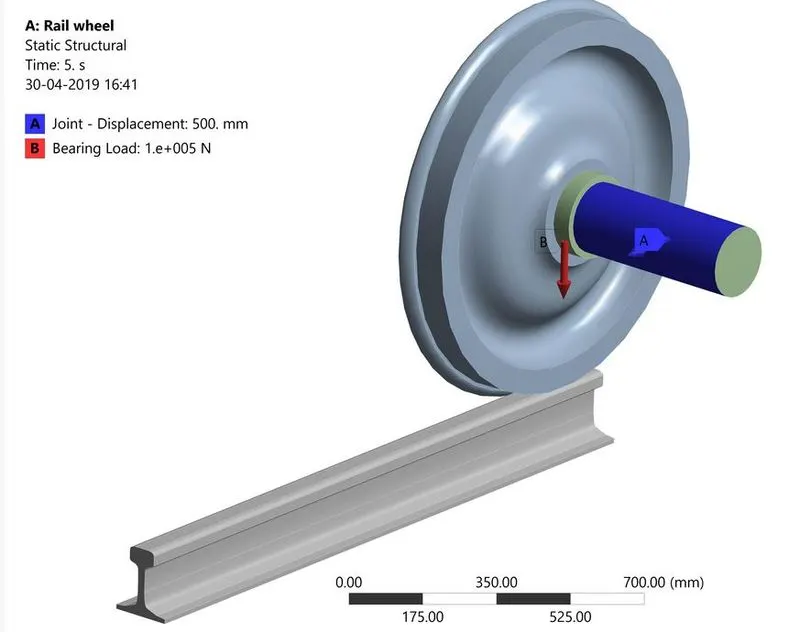
As shown in the figure above, bearing load is applied on the inner cylindrical surface of wheel, while joint displacement of 500mm is applied to the shaft. While the joint displacement is same for both loadings, the bearing load is kept as 100 kN for first model and it is kept as 500 kN or second model.
- Results:-
- First we will compare the results of User Defined Results, in which we intend to calculate the totaal deformation and compare it with inbuilt solution. Figure below shows the inbuilt 'Total Deformation' tool available with Ansys.
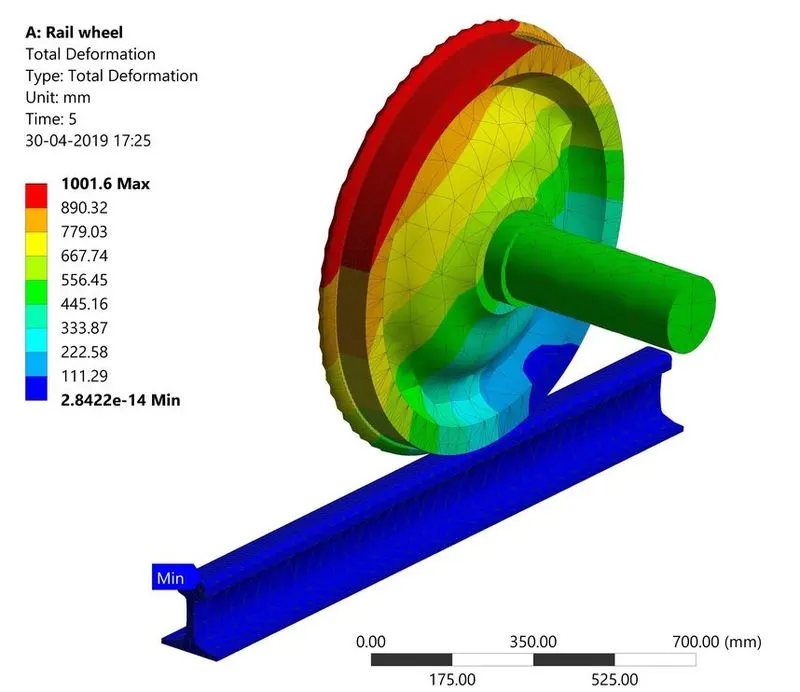
So the maximum total deformation obtained is 1001.6mm. 'Total Deformation' tool inbuilt in Ansys basically shown the displacement of every element from their respective initial positions. Due to translation of shaft along X axis causing rolling of wheel over the track, elemnts on the wheel will get displaced along X axis. So to obtain the same results from User Defined Functions, we will have to do the vector sum of displacements of all elements in X, Y and Z directions. So the functions to be used is [(UX)^2+(UY)^2+(UZ)^2]^0.5. Here UX, UY and UZ are the displacements if elements in X, Y and Z directions. The result of this User Defined Result is shown in figure below:-
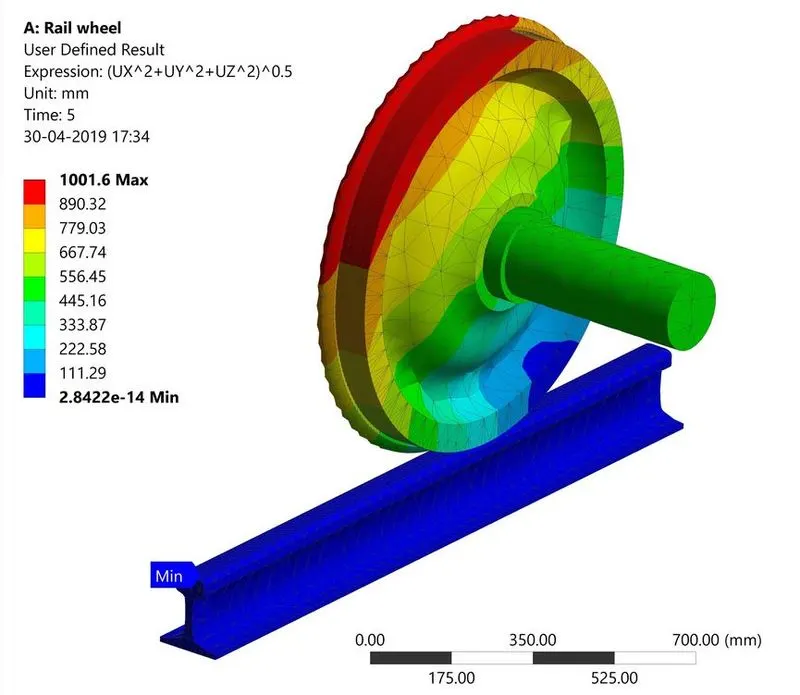
So we can see that, result from UDF matches perfectly with inbuilt 'Total Deformation' tool of Ansys, because of correct use of User Defned Function.
- Now we will compare the stresses, strains and life for the two different loading conditions:-
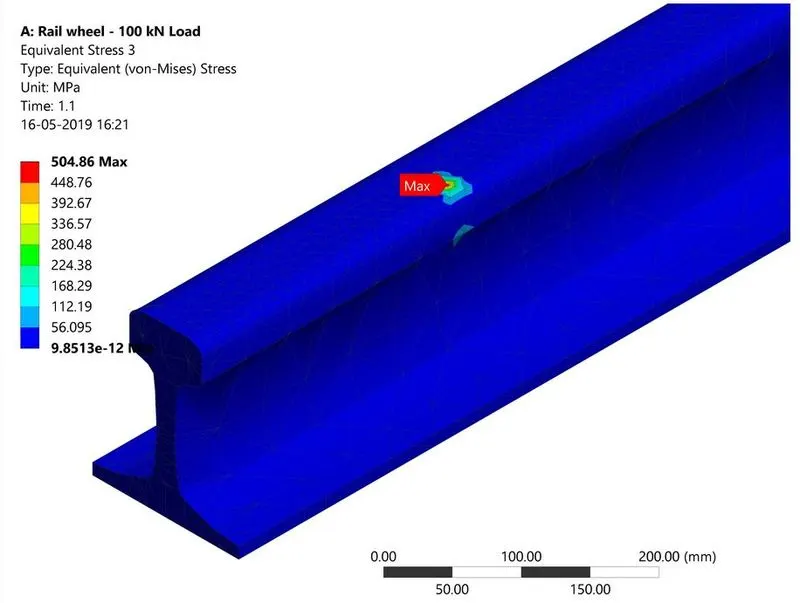
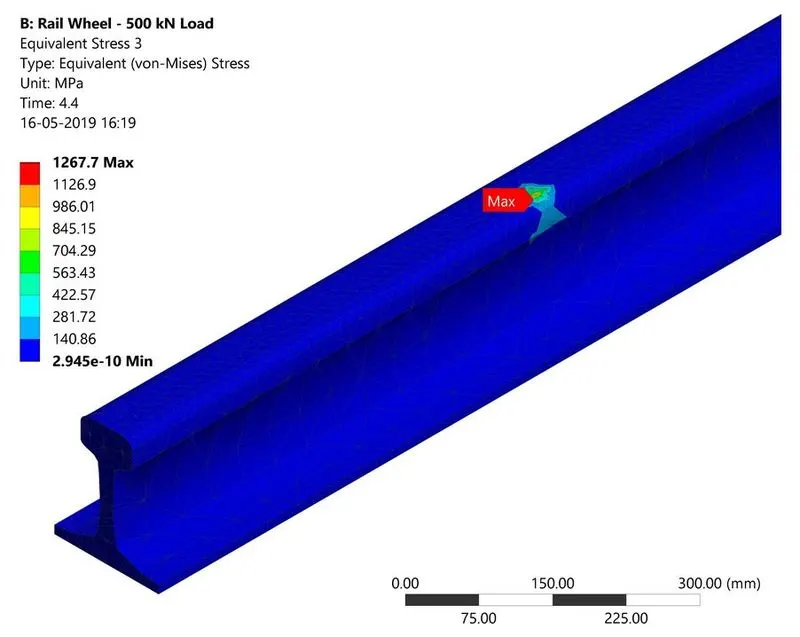
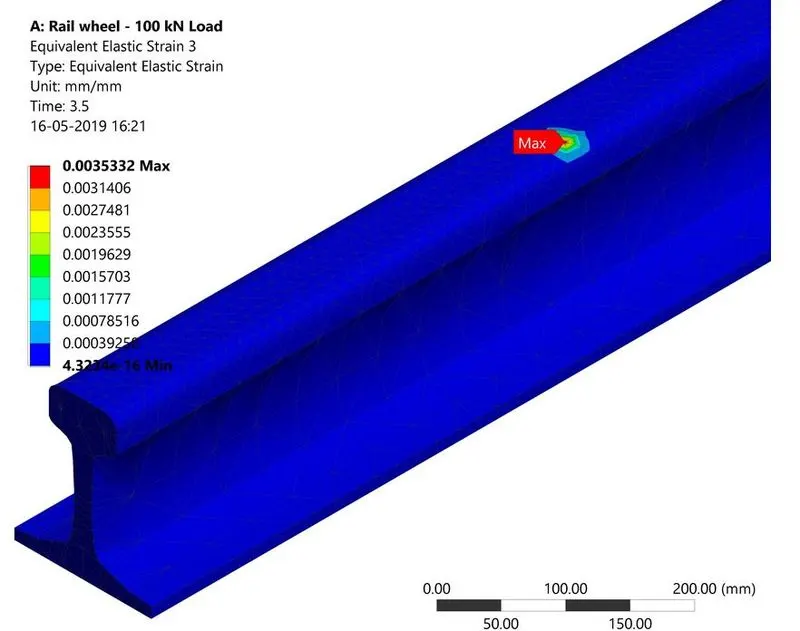
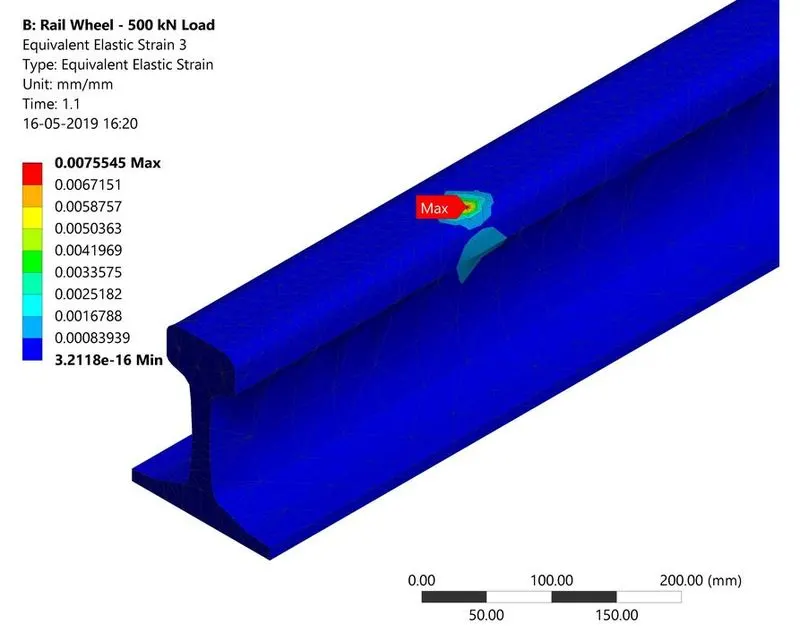
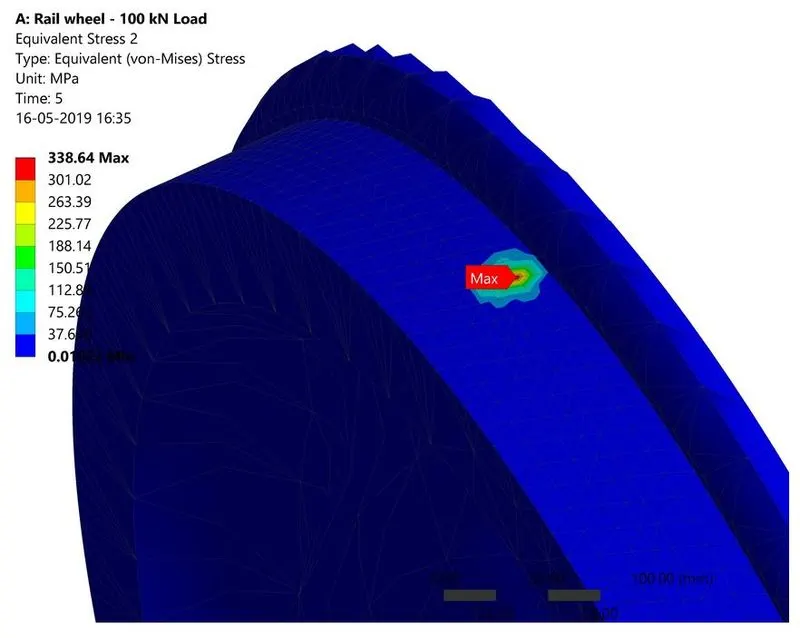
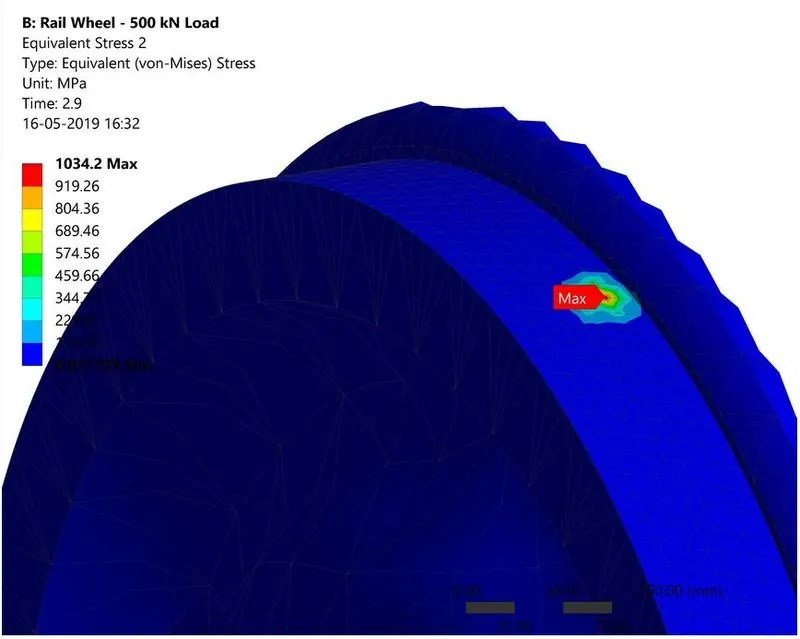
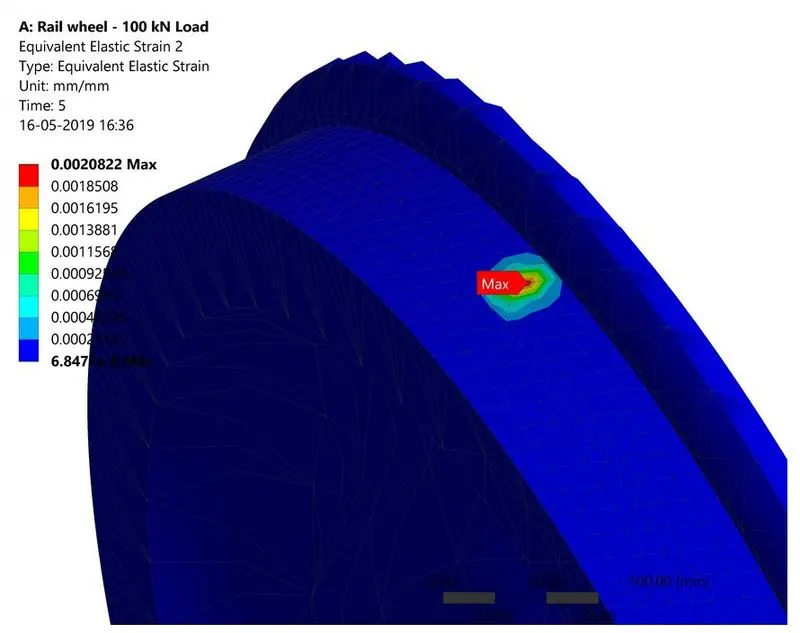
As the maximum stress and strain occur at the point of contact of rail wheel and track, we can only see one of the part at a time. For comparing Equivlent Stresses, we can see that maximum stres occurs in rail track, hence we will compare the stress value on rail track only.
- Equivalent Stress:-
Maximum Equivalent Stress for 100 kN Load:- 504.86 MPa
Maximum Equivalent Stress for 500 kN Load:- 1267.7 MPa
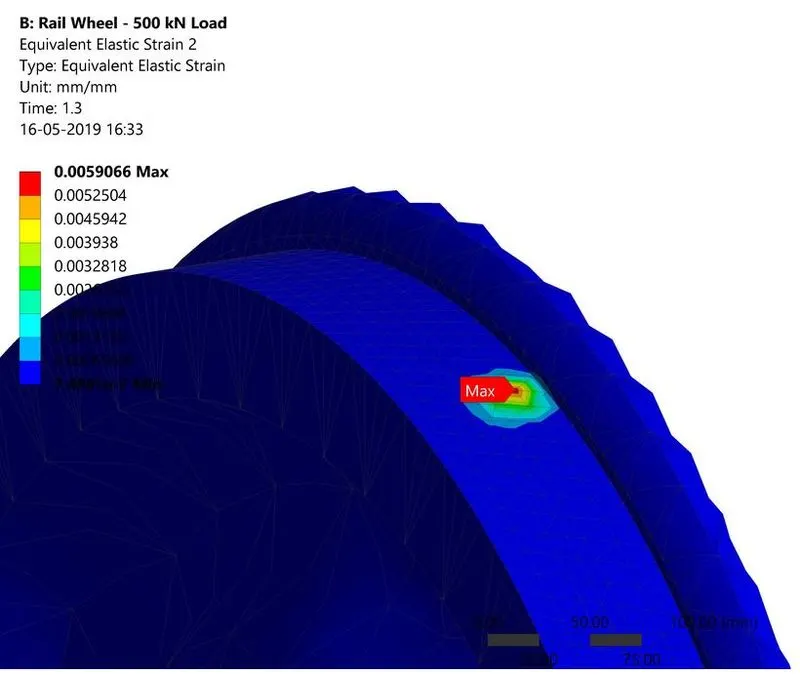
- Equivalent Elastic Strain:-
Maximum Equivalent Elastic Strain for 100 kN Load:- 0.0035332 mm/mm
Maximum Equivalent Elastic Strain for 500 kN Load:- 0.0075545 mm/mm
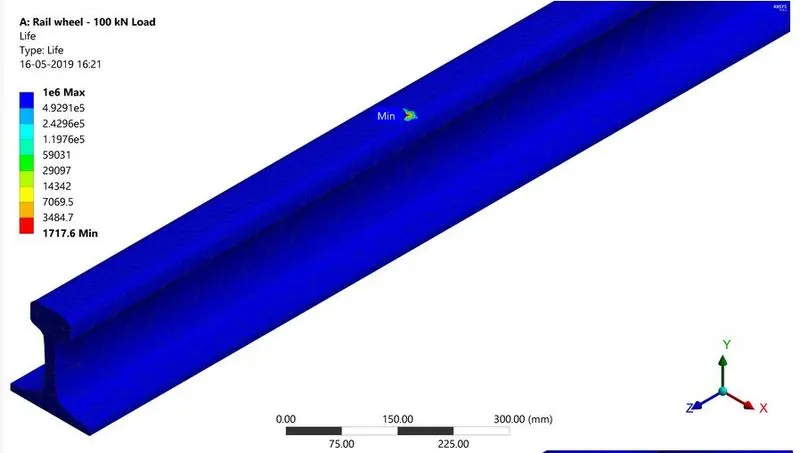
- Life:-
Minimum Life for 100 kN Load:- 1717.6 cycles
Minimum Life for 500 kN Load:- 165.63 cycles
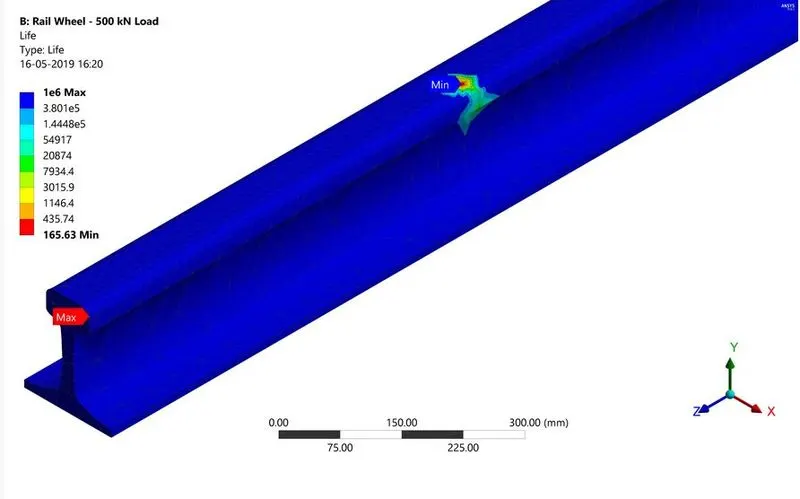
Also results for rail wheel are shown below:-
Animations of the simulation can be found in the links below,
Total Deformation using a User Defined Function:- https://youtu.be/YaG8BEaI1v4
Equivalent Stress in track for 100 kN load:- https://youtu.be/5kFXpNOopAE
Equivalent Stress in track for 500 kN load:- https://youtu.be/INYGoOAEUzc
Equivalent Elastic Strain in track for 100 kN load:- https://youtu.be/33ousJlk9aA
Equivalent Elastic Strain in track for 500 kN load:- https://youtu.be/sqdo_3BQ55U