Week 7-Long Piston With Cam
- Objective:-
To perform a transient structural analysis of a piston and cam mechanism model for comparison with different frictional coefficients.
- Model Details:-
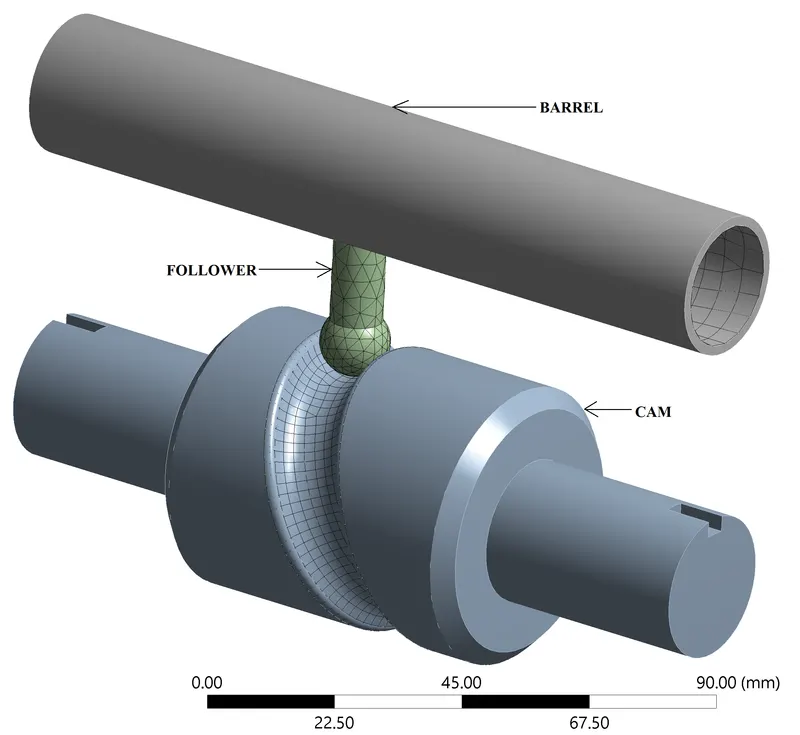
Piston-cam mechanism is modelled as shwon below. The barrel constraining the linear motion of the follower and the cam are treated as rigid objects in stiffness behaviour, as our focus is mainly on the follower. The model with mesh is as shown below,
Mesh Details:-
Face sizing is applied on the contacting surfaces for refining results at contacts, with element size as 2 mm. For the body mesh of cam follower, 4 mm element size is applied in the defaults.
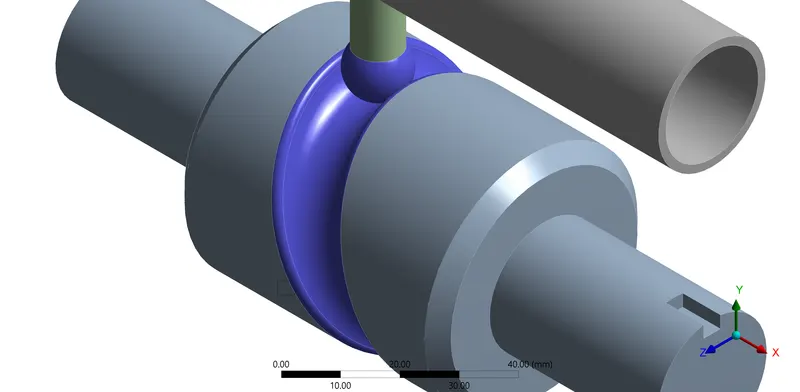
For the current purposes, refinenement is sufficient, further reduction in element size will increase the solver time.
Material assigned to all the three parts for all the three cases is Structural Steel.
- Loads and Constraints:-
Contacts:-
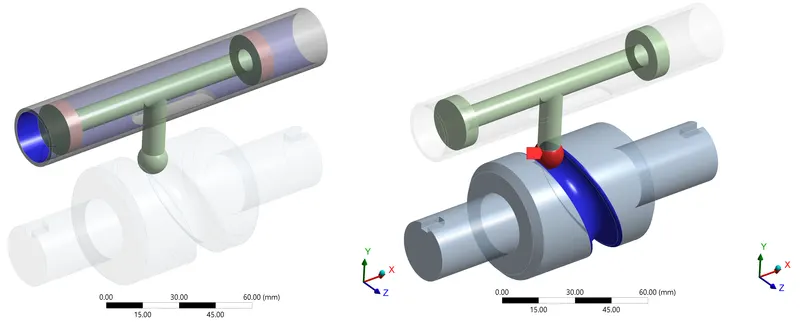
In all the three cases, the type of contact and joints is the same, only value of the frictional constant is changed from 0, 0.1 and 0.2.
Joints:-
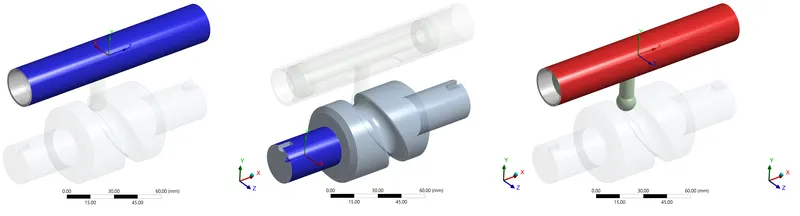
The barrel is applied with the fixed joint, cam with revolute joint, both joint being body to ground joint. The cam follower is applied with the body to body joint with the barrel, to constrain its motion aling the axs of the barrel.
Study is done in 9 time steps, the cam is rotated by 30 deg in each time stem. Corresponding to these time steps, directional deformation, directional velocity, equivalent stress and equivalent elastic strain is plotted.
- Results:-
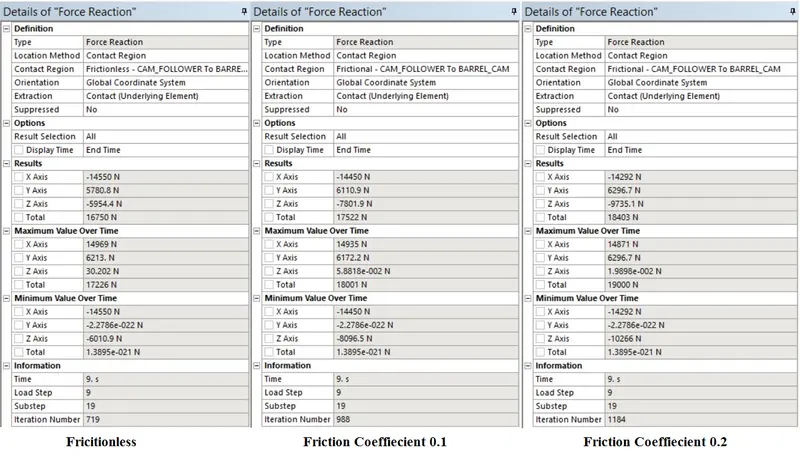
Follower motion is governed only by the cam profile, so frictional coefficient has no effect on its motion. However, different frictional coefficient will have different efforts to casuse the follower motion.
Friction increases the effort to cause follower motion. The maximum force reaction in the chart below shows that as expected, the effort required is highest for high frictional coefficient.
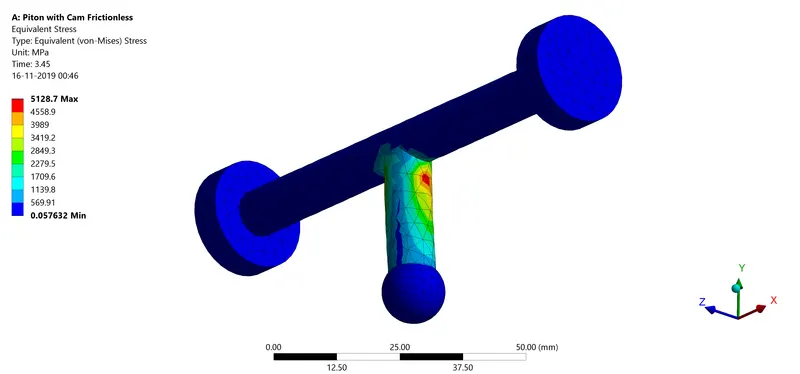
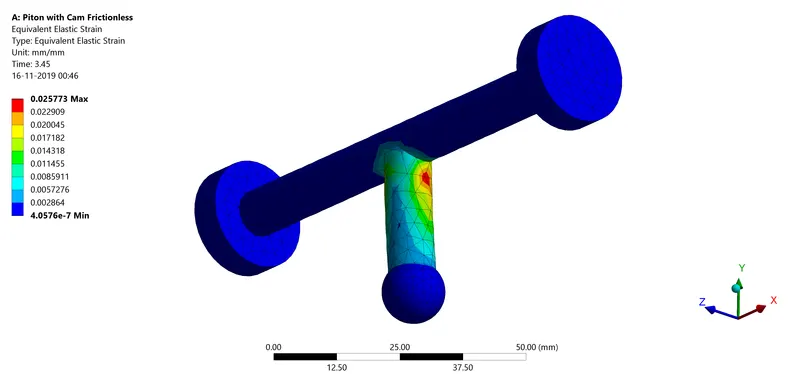
Equivalent stress, equivalent ealstic strain for all the three cases are compared below.
Frictionless:-
Max. equvalent stress = 5128.7 MPa
Max. equivalent elastic strain = 0.025773 mm/mm
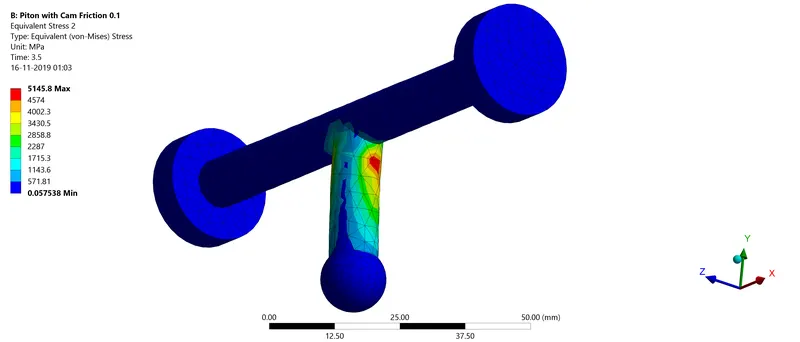
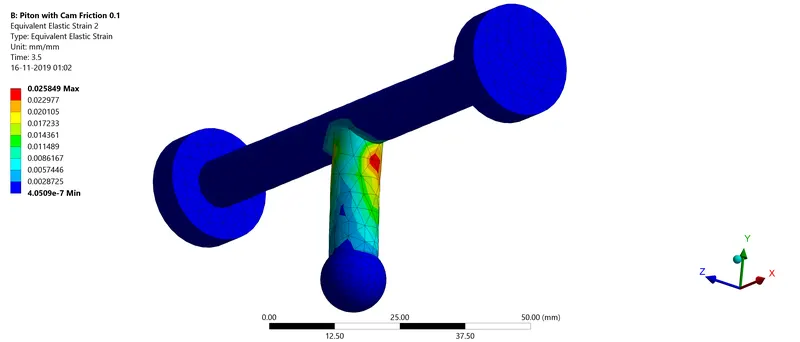
Frictional coefficient of 0.1 :-
Max. equvalent stress = 5145.8 MPa
Max. equivalent elastic strain = 0.025849 mm/mm
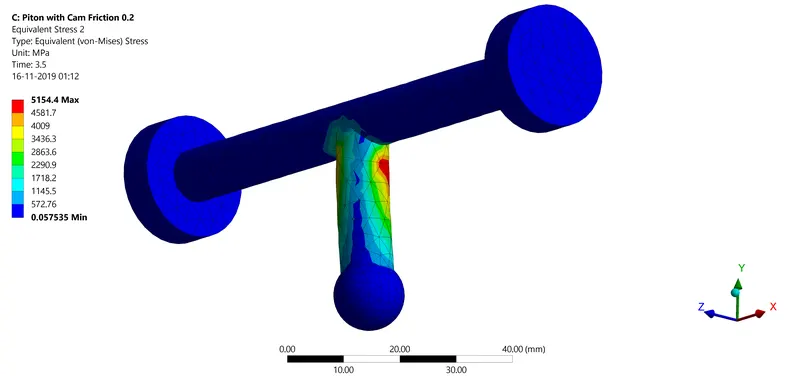
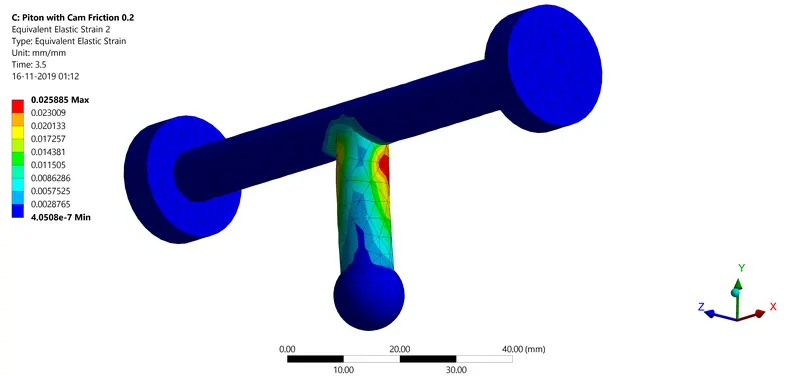
Frictional coefficient of 0.2 :-
Max. equvalent stress = 5154.4 MPa
Max. equivalent elastic strain = 0.025885 mm/mm
- Conclusion:-
From the force reactions table we can see that, due to frictional contact, additional extra force is spent on overcoming the frictional resistance. Hence the force reaction as well as equivalent stress and equivalent elastic strain is highest in the case of frictional coefficient 0.2.