Week 4 -Wire Bending Challenge
- Objective:-
To compare wire bending in ANSYS with different wire materials such as Copper alloy NL, Aluminium alloy NL and Magnesium alloy NL.
- Model Details:-
Wire bending model with mesh is as shown below,
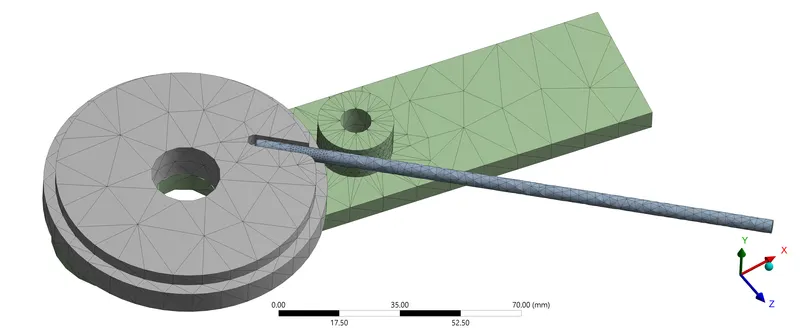
Mehs details (Element tpye - Tet10):
Number of elements = 3917
Number of node = 7894
Avg element quality = 0.69858
Tetrahedron mesh method is used for all three objects, with 2.2 mm mesh sizing for surfaces in contact. A 7 mm spherical region in the wheel at the curved bend on the wheel, where huge stress is expected, is meshed by using 0.8 m element size. Mesh smoothing is kept low.
Mesh is the same for all the three materials. Materials assigned to Wheel and Lever is Structural Steel. While Wire is assigned with Copper alloy NL, Aluminium alloy NL and Magnesium alloy NL in three different cases for comparison.
- Load and Constraints:-
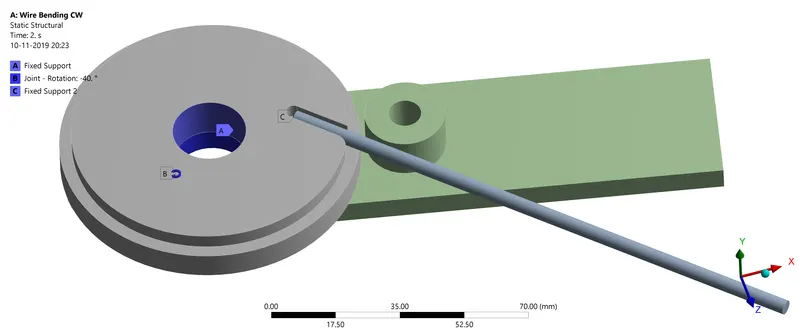
Firstly, Wire (contact) to Lever (target) contact is formed, and then WHeel (contact) to Wire (target) contact is made. Both contacts are frictional with coefficient as 0.2. The formulation is Augmented Lagrange with Normal Stiffness factor as 0.1.
A revolute joint at the cylindrical surface concentric to wheel centre is formed, for rotation of the lever.
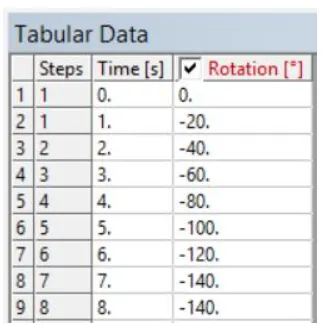
In the Analysis Settings, the bending is carried out in 8 time steps. For the first time step, it is performed with smaller maximum time step value.
The wheel and the inner flat surface of the wire are assigned with Fixed Support. Wire's one end is fixed, to stop it form slipping off of the wheel. The lever rotation per each time step is given in the table below.
- Results:-
Total deformation animation:- https://youtu.be/i4xK2jtAnxg
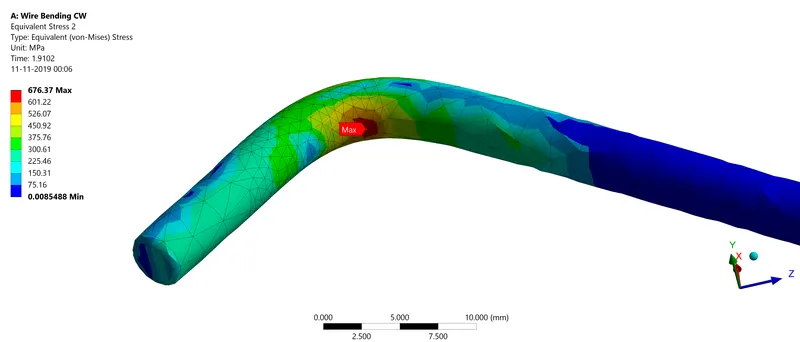
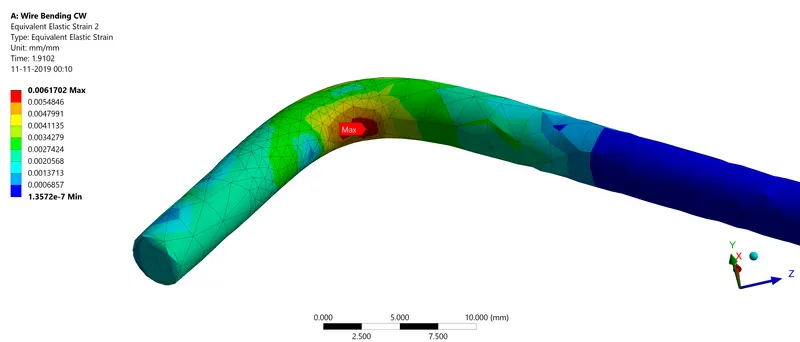
1. Copper Alloy NL:-
Max. Equivalent stress = 676.37 MPa
Max. Equivalent elastic strain = 0.0061702 mm/mm
Animation for equivalent stress:-https://youtu.be/8Gc6xnfN5Fk
Animation for equivalent elastic strain:-https://youtu.be/sKUMNdEBPhc
2. Aluminium Alloy NL:-
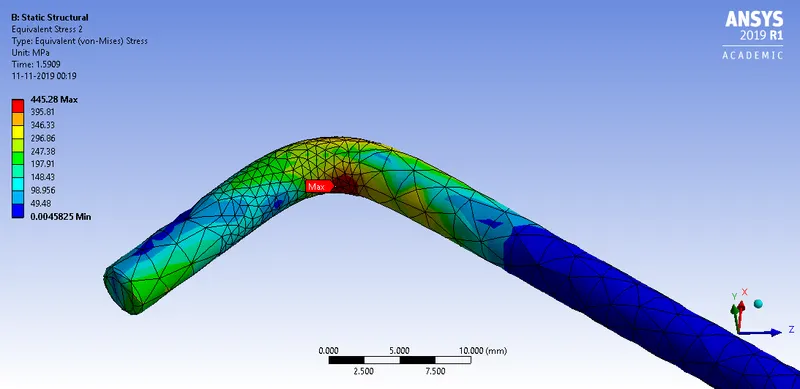
Max. Equivalent stress = 445.28 MPa
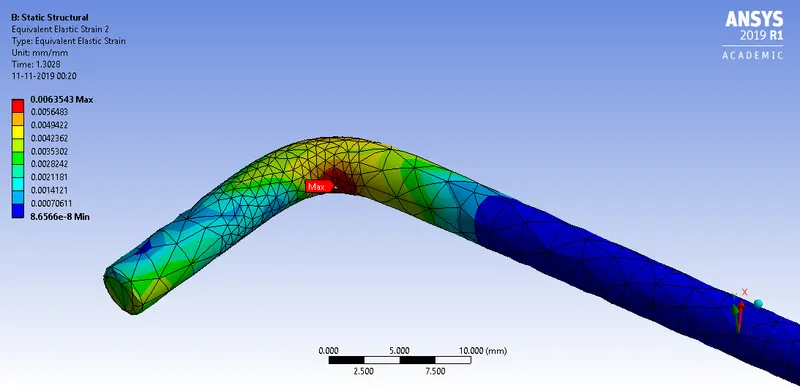
Max. Equivalent elastic strain = 0.0063543 mm/mm
Animation for equivalent stress:- https://youtu.be/V7juzOfneb4
Animation for equivalent elastic strain:- https://youtu.be/sy9SheGFshA
3. Magnesium Alloy NL:-
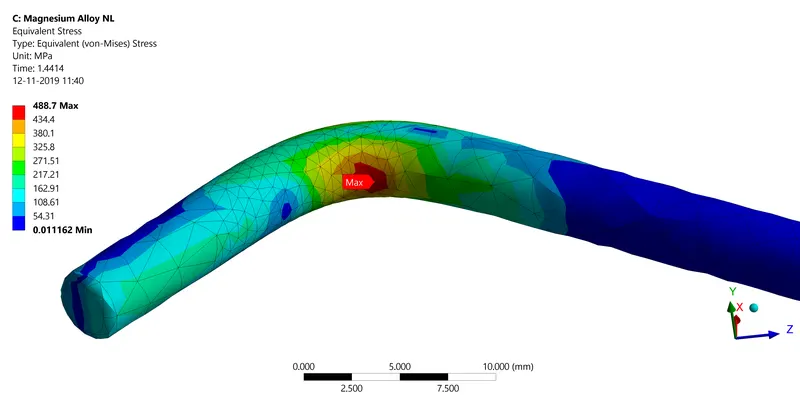
Max. Equivalent stress = 488.7MPa
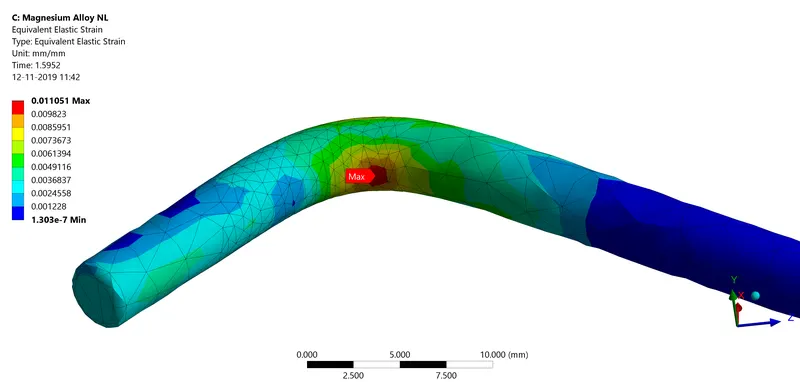
Max. Equivalent elastic strain = 0.011051 mm/mm
Animation for equivalent stress:- https://youtu.be/pVx2wKaM6zY
Animation for equivalent elastic strain:- https://youtu.be/aFmwX8cRA8Q
- Conclusion:-
We expect a greater resistance to bending for Copper alloy because of its higer Young's modulus compared to other two materials.
From the force reaction between Wheel and Wire table, we can see that the maximum force reaction of Copper alloy is the highest amongst the three given materials.
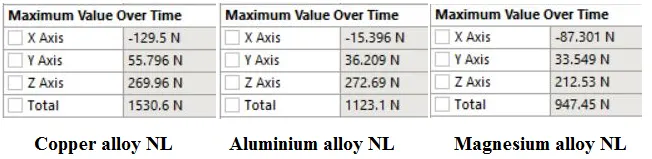
So we can conclude that Magnesium alloy wire will be easiest to bend compared to Copper and Aluminium alloy wire.
From the animation, we see that the maximum stress and strain is observed in the same region for all the three cases. This region is the first bending of the wire at the curved arc on the wheel. This result is also expected because the radium of curvature of the curved arc on the wheel (4-7 mm) is sharper compared to the radius of the wheel (40-50 mm) on which the wire subsequently bends. Hence this sharper curvature at the beginning induces higher strain and stress in the wire.