Week 3 Sheet metal Bending challenge
- Objective:-
To perform a metal sheet bending operation simulation with three materials such as Aluminium, Copper and Magnesium alloys. Also to study the effect of frictional coefficient and mesh size on the results.
- Model Details:-
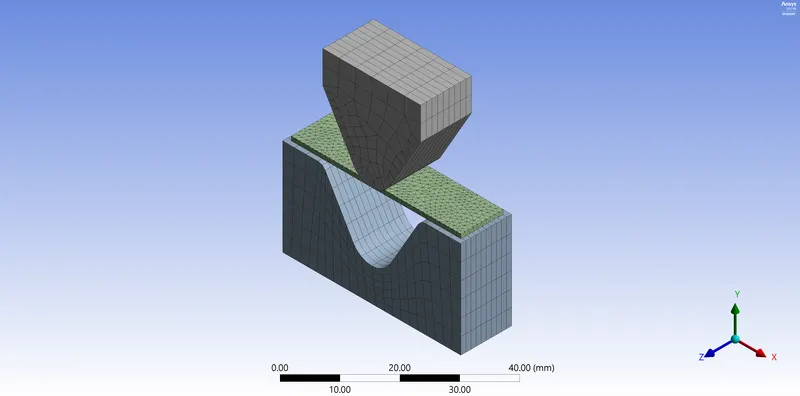
A model as shown above is used for the simulation. On top there is a punch which presses the sheet in the middle against the die at the bottom. For Case1 we have used three materials, Aluminium Alloy 1199, Copper Alloy NL and Magnesium Alloy NL.
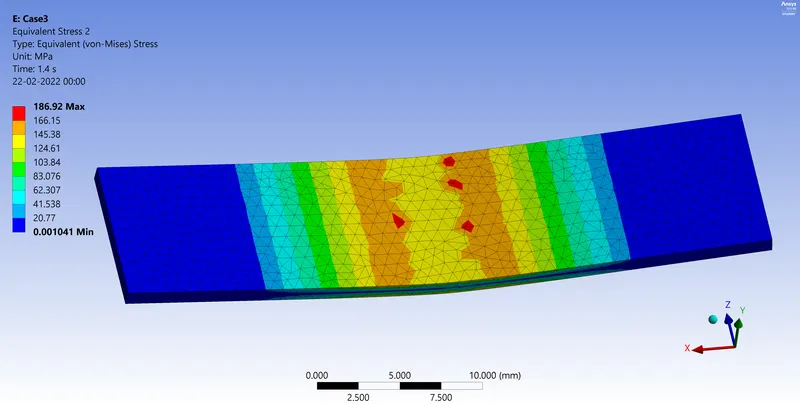
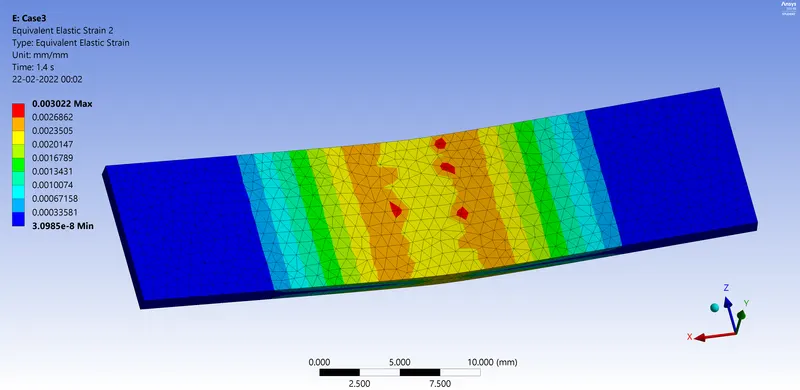
In Case3 we are improving the mesh of the sheet and comparing the results with Case1 with relatively coarser mesh. Number of elements in Case1 are 6255 with 17693 nodes while in Case3 we have 11223 elements and 26084 nodes.
For Case1 we will use 0.1 as the frictional coefficient for both the contacts of sheet (with the punch and the die), while for Case2 we will use 0.19 as the frictional coefficient.
- Loads and Constraints:-
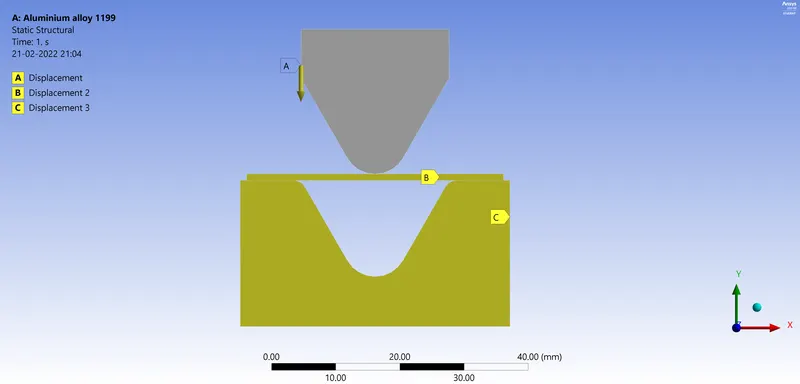
We are restricting the motion of sheet in Z axis, so that it dosen't slip off during bending operation. Then we are pressing the punch against the die, and their displacements are shown below,
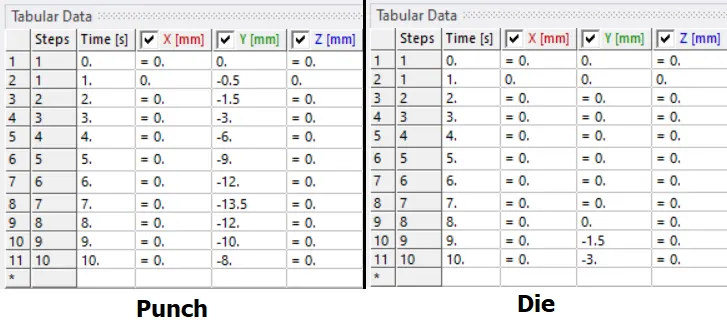
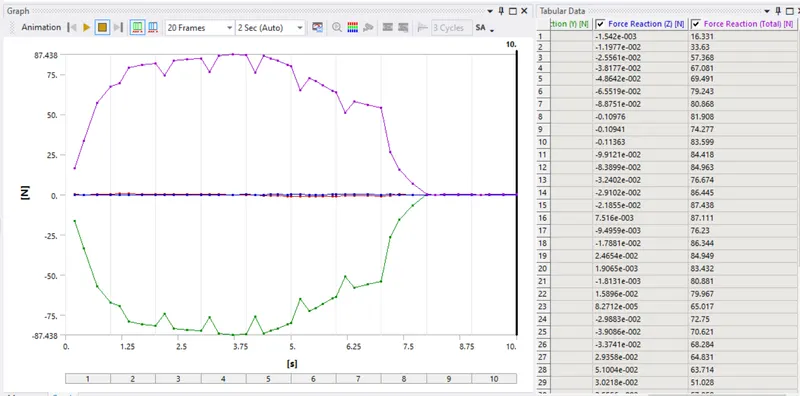
The analysis is carried out in 10 seconds, and the punch presses the sheet till 7 seconds and later both punch and die retracts. Till 7 seconds the die is held to its position.
- Results:-
Case1:-
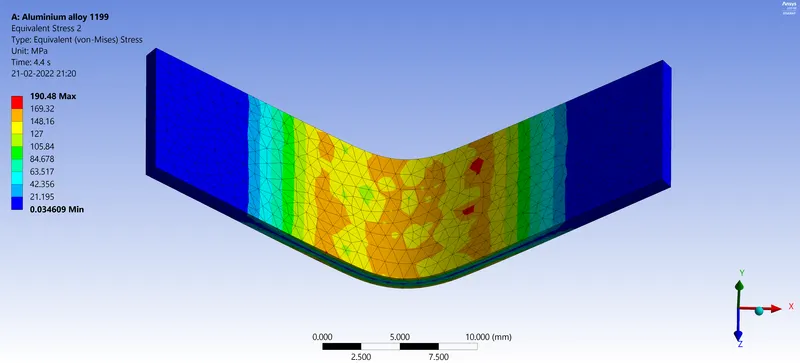
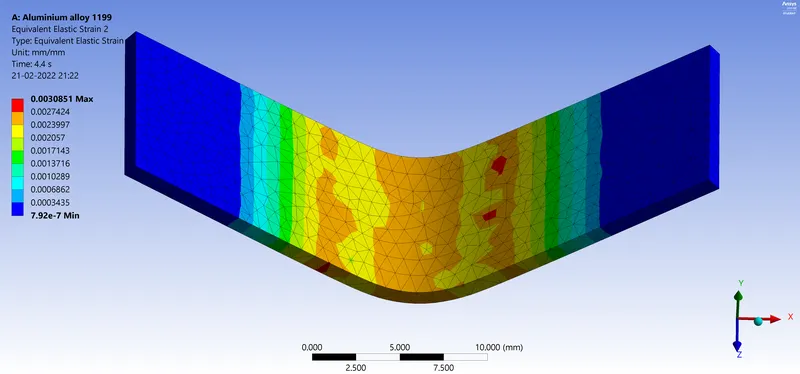
For Alumnium alloy 1199,
Animation link for equivalent stress = https://youtu.be/YANU5UME_Yk
Max. equivalent stress = 190.48 MPa
Max. equivalent elastic strain = 0.0030851 mm/mm
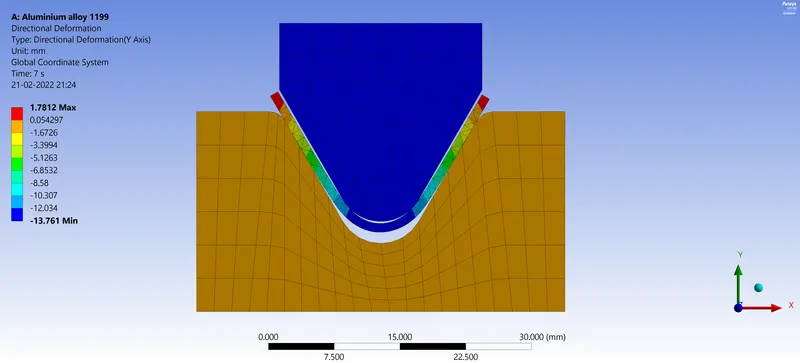
Directional deformation,
Max. force reaction = 87.438 N
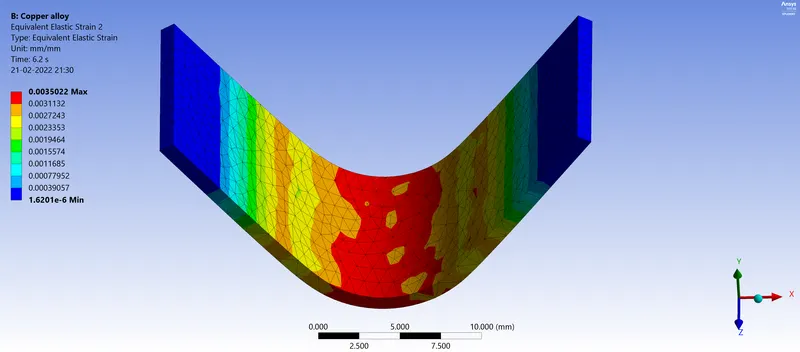
For Copper alloy,
Animation link for equivalent stress = https://youtu.be/H83sgQKA2Bw
Max. equivalent stress = 383.14 MPa
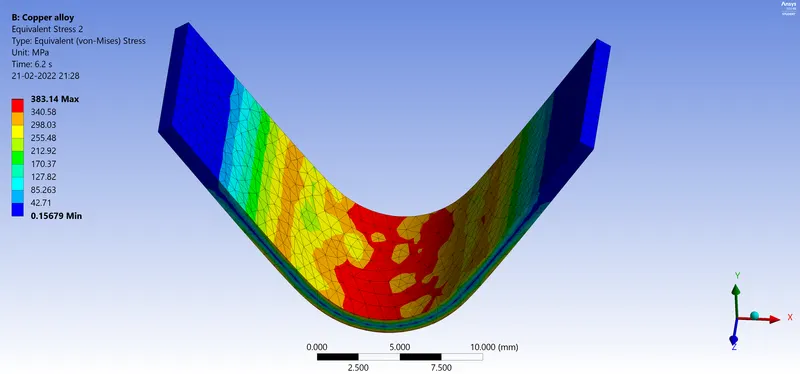
Max. equivalent elastic strain = 0.0035022 mm/mm
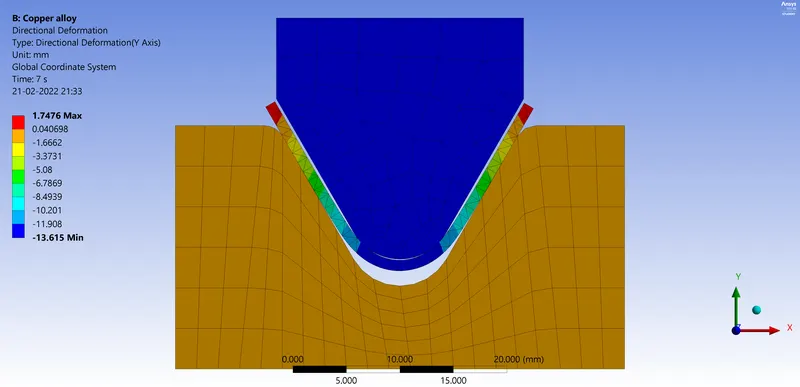
Directional deformation,
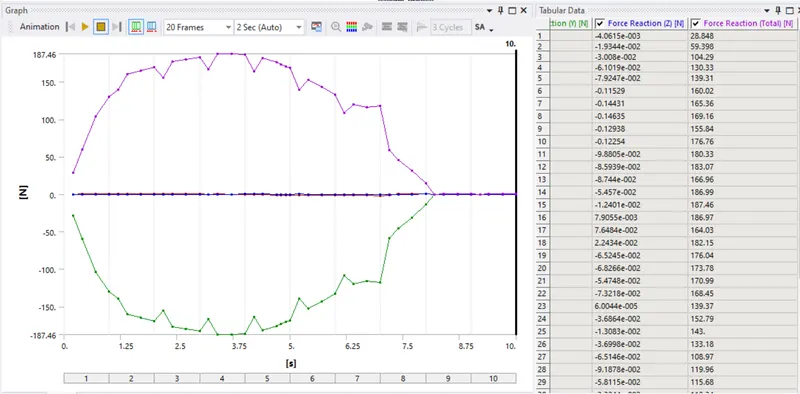
Max. force reaction = 187.46 N
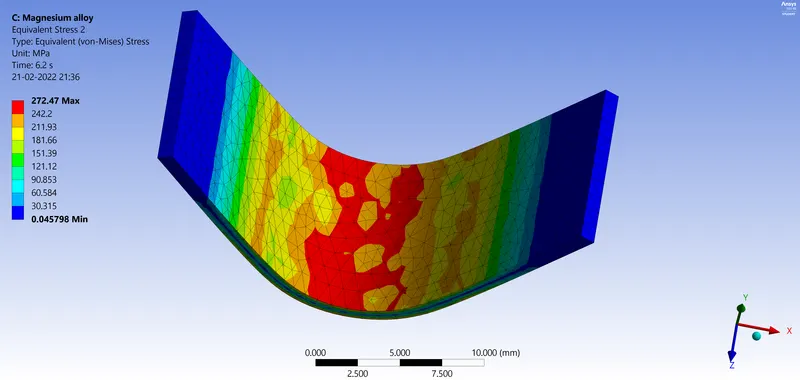
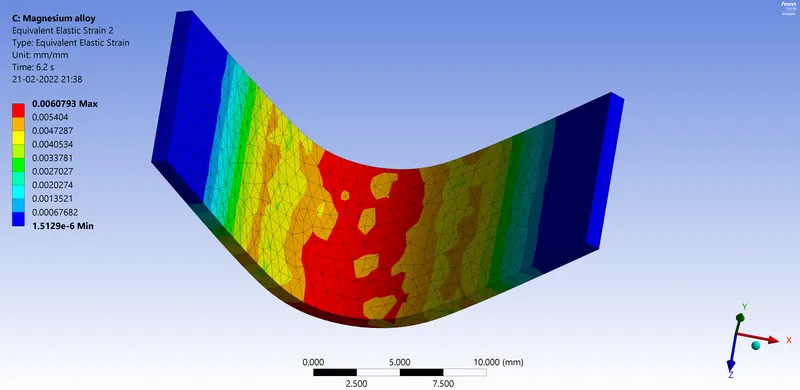
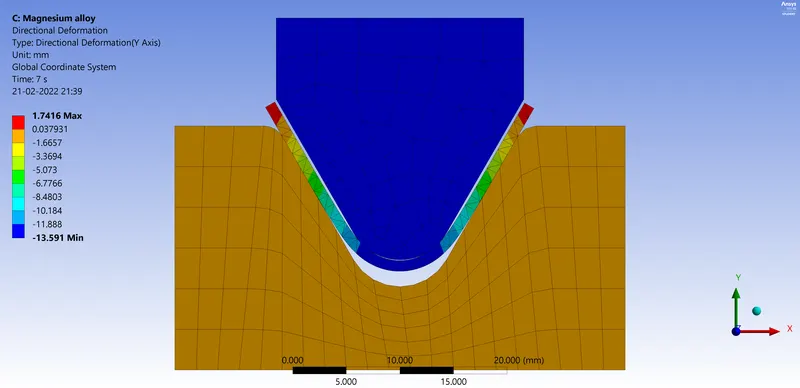
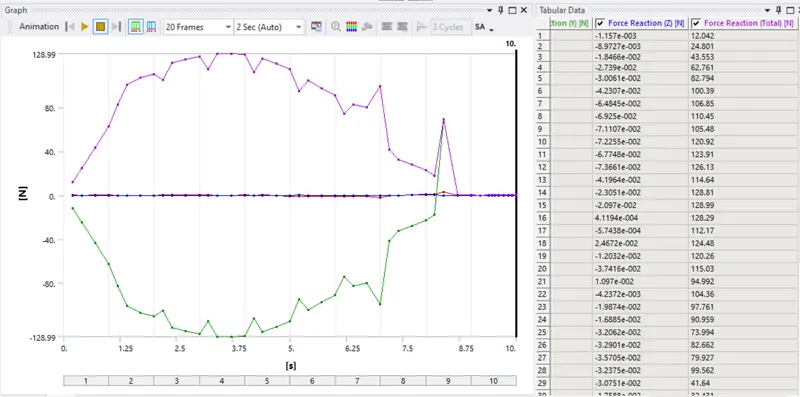
For Magnesium alloy,
Animation link for equivalent stress = https://youtu.be/I8I_M8X5EAU
Max. equivalent stress = 272.47 MPa
Max. equivalent elastic strain = 0.0060793 mm/mm
Directional deformation,
Max. force reaction = 128.99 N
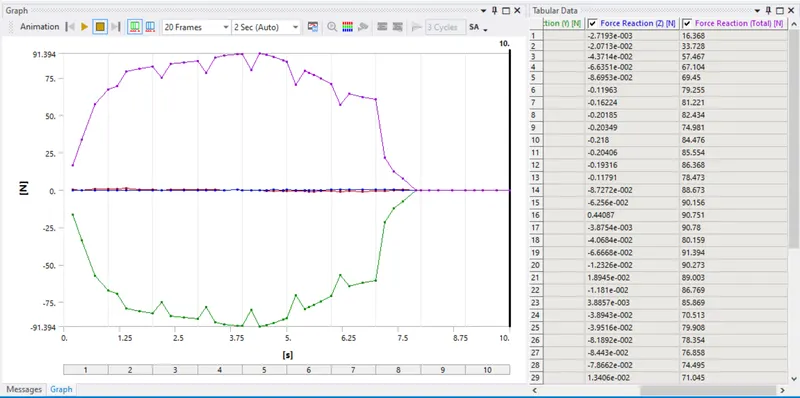
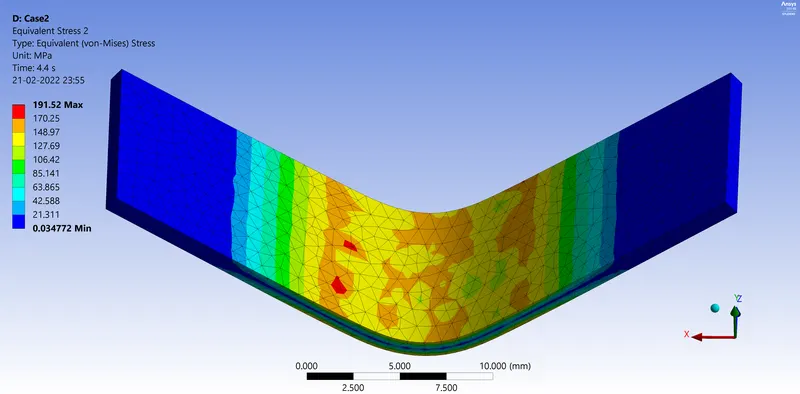
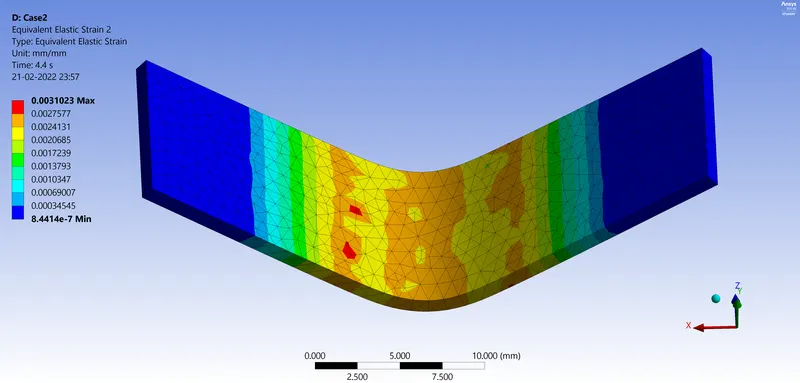
Case2:-
Max. force reaction = 91.394 N
Max. equivalent stress = 191.52 MPa
Max. equivalent elastic strain = 0.0031023 mm/mm
Case3:-
Max. equivalent stress = 186.92 MPa
Max. equivalent elastic strain = 0.003022 mm/mm
- Conclusion:-
In summary we can conclude that we have successfully simulated bending of a sheet, with different materials, contact features and mesh sizes.
In Case1, if we compare the results of three materials, we know that Copper alloy has the highest Young's Modulus (110 GPa). That means, it should show the highest resistance against the bending. So as expected we see that the force reaction for bending of the copper sheet is the higest among the materials (187.46 N).
Comparing Case1 and Case2, we can see that due to increase in frictional coefficient value the force reaction in Case2 (91.394 N) is higher than the force reaction in Case1 (87.438 N).
In Case3 we improved the mesh quality and that increased the number of elements from 6255 to 11223 and this increased the computation time from 446 seconds to 614 seconds (almost 30% increase). But the results for max. equivalent stress and max. equivalent elastic strain changed only by about 2%, so this refining of mesh cannot be justified. Hence we can conclude that the mesh in the Case1 is sufficient for getting relatively accurate results.