Week 9 Machining with Planer Challenge
- Objective:-
To perform an explicit dynamics simulation for planer machining of a workpiece, in two different cutting velocity (15000 mm/sec and 20000 mm/sec).
- Model Details:-
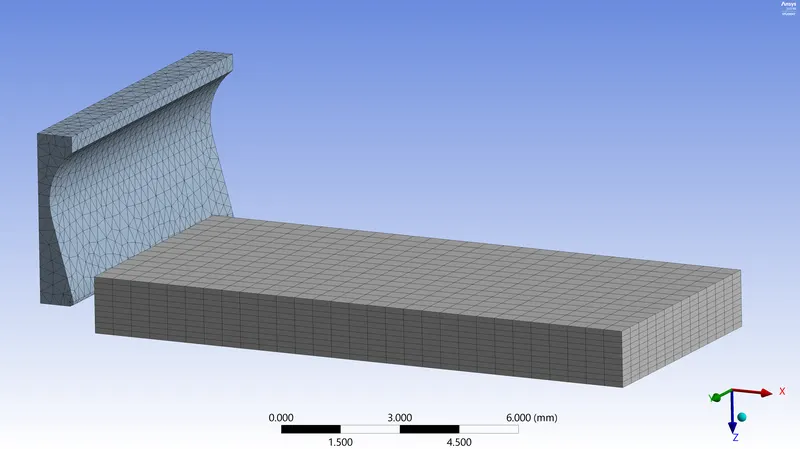
Above meshed model will be used for the simulations. A rectangular workpiece is machiend by the cutting tool on the left side. This type of machining being a large deformation in short time event, we will have to simulate using explicit dynamics tools.
The cutting tool is set to behave as 'rigid' as we are mainly interested into the study of the workpiece. The cutting tool is meshed using meshing method of 'tetrahedron'.
Workpiece has been assigned 'Steel 1106' material from the explicit materials library. The four depth edges of the rectangular workpiece are divided into 10 equal parts for meshing. The meshing of the model is as shwon in the image above.
- Loads and Constraints:-
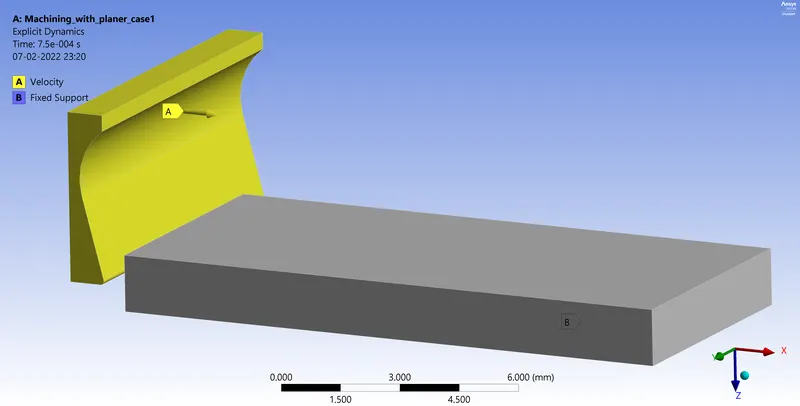
Simulation end time has been set to 7.5E-04 seconds. The workpiece is fixed in the analysis. Cutting tool has been assigned X direction velocity of 15000 mm/sec in Case1 an 20000 mm/sec in Case2.
- Results:-
Case1 (15000 mm/sec):-
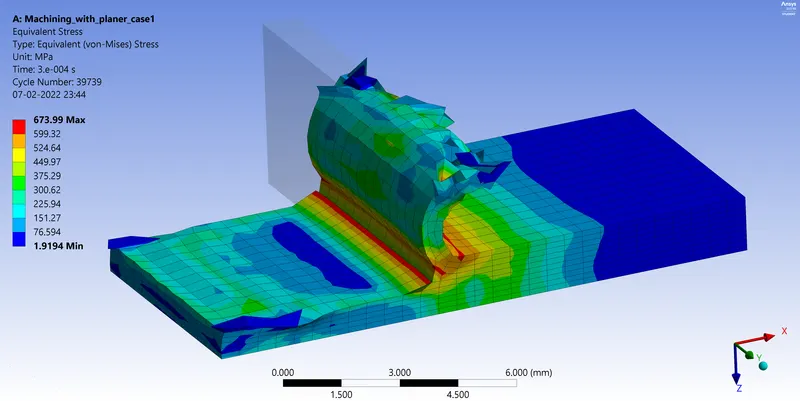
Max. equivalent stress = 673.99 MPa
Animation:- https://youtu.be/6mN9lGeLgAw
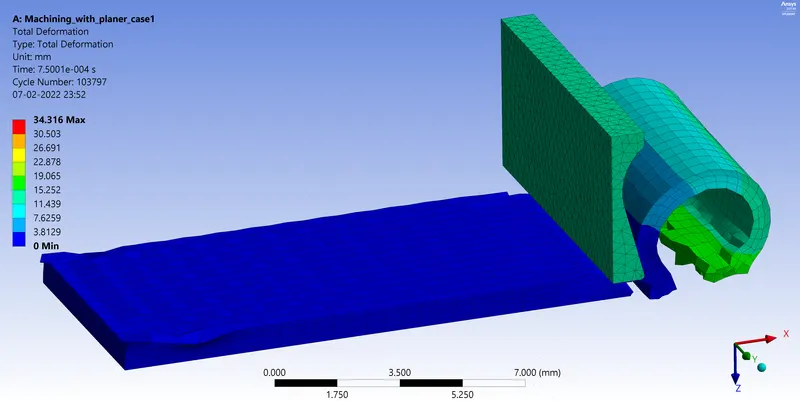
Total deformation =
Animation:- https://youtu.be/RZNmAMZnl5c
Max. Temperature of the body = 367.77 deg celsius
Animation:- https://youtu.be/bagMSCLRDtk
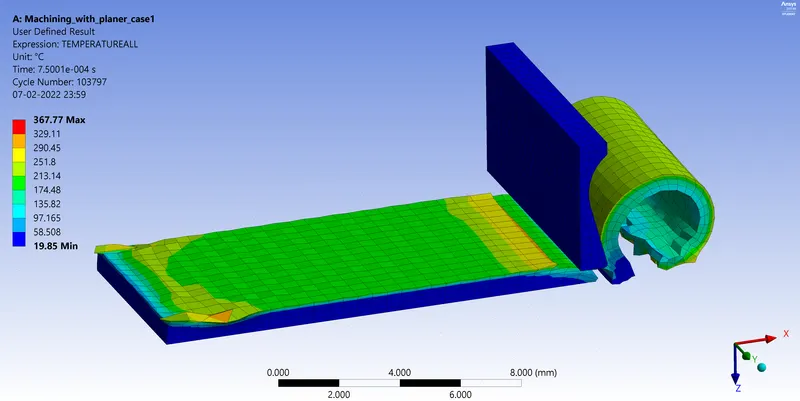
Case2 (20000 mm/sec):-
Max. equivalent stress = 674.52 MPa
Animation:- https://youtu.be/IPhMPZqCZww
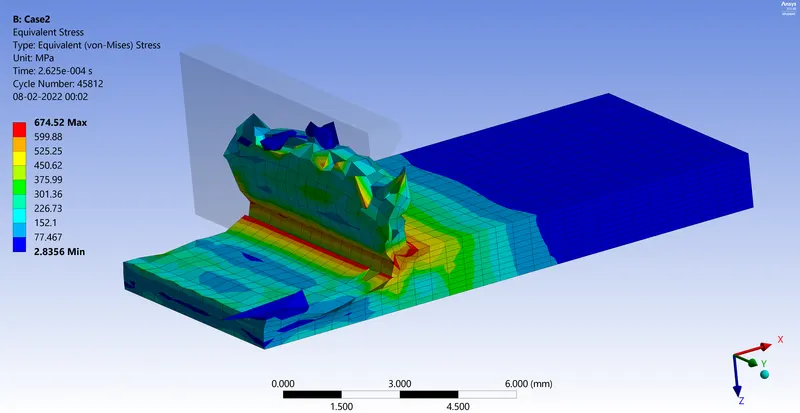
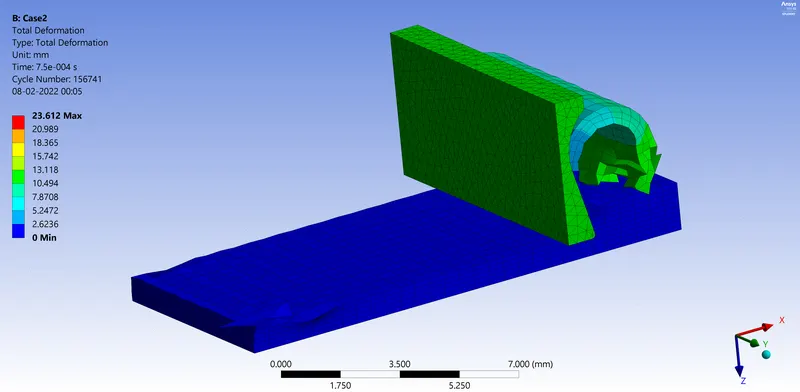
Total deformation =
Animation:- https://youtu.be/4uqYbNeter4
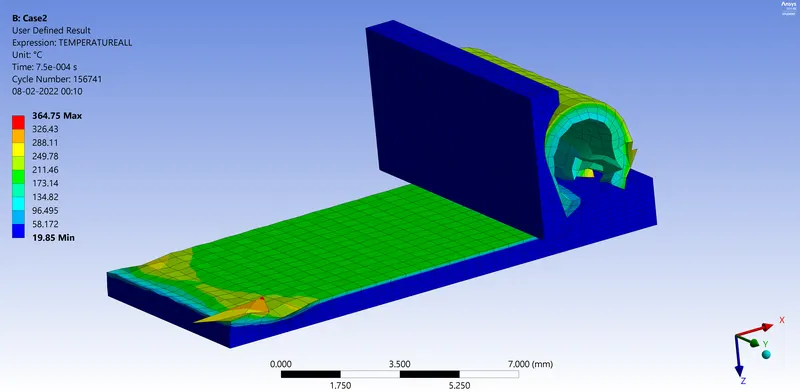
Max. temperature of the body = 364.75 deg celsius
Animation:- https://youtu.be/8BbFvVsMGWQ
- Conclusion:-
In summary we can conclude that we have successfully performed the explicit dynamics simulations of the machining operation using planer mechanism.
We simulated two cutting velocities of 15000 mm/sec and 20000 mm/sec, we can't see any appreciable difference in equivalent stress values. But we can see slightly smaller maximum temperature for lower cutting velocities.