Week 1 Spur Gear Challenge
- Objectives: -
To compare the pair of spur gear system for three given materials against a given load with static structural analysis.
Model Details: -
Geometry:
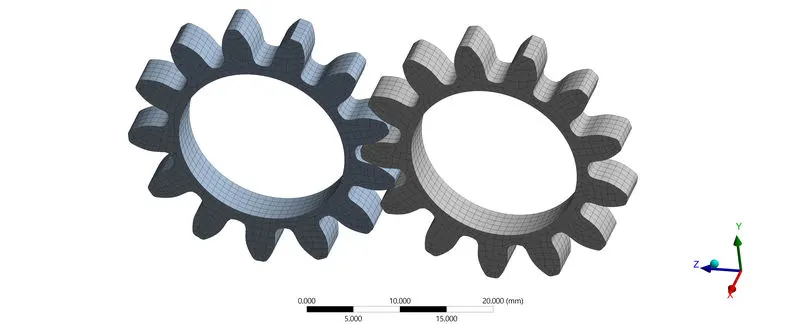
All the cases have two identical spur gear pairs with 13 teeth, the part drawings of which are directly given for study as shown in the Mesh figure.
Mesh:
As the default mesh size was very coarse, element size is changed for finer meshing. ‘No’ set for ‘Use of Adaptive Sizing’, and ‘Smoothening Quality’ is set to ‘Low’. Mesh details are as follow: -
Analysis type: - Static (Steady-state)
Element Method: - Hexahedral (20 Node)
No. of nodes: - 16586
No. of elements: - 2808 (Element size – 1.0 mm)
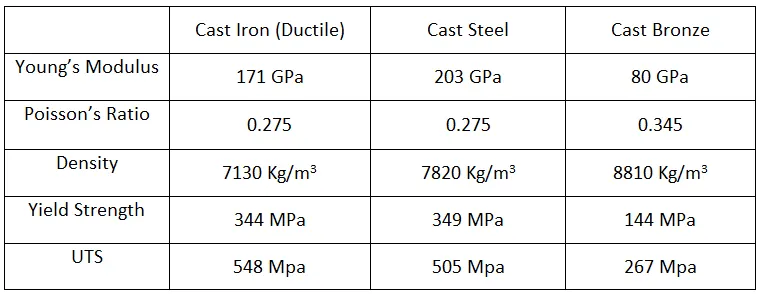
Materials:-
- Loads & Constraints: -
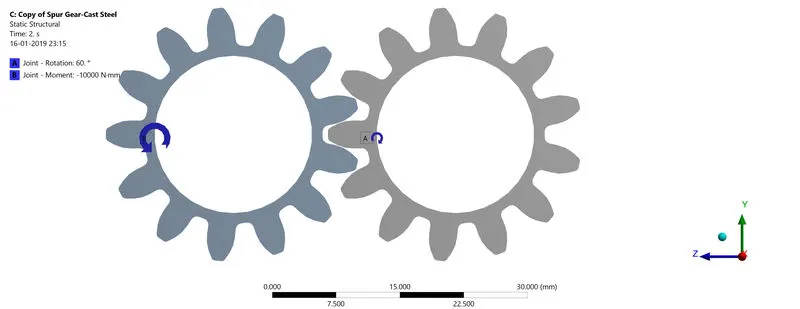
Both the gears are initially given revolute joint, to simulate the rotation, about their centres with respect to ground using ‘Body to Ground’ option. Subsequently, one of the gear is allowed to rotate through 180˚ in either clockwise or anti clockwise sense in 6 seconds. The other gear is applied with 10 N-m torque in opposite sense that of the first gear, as shown in figure below
- Results: -
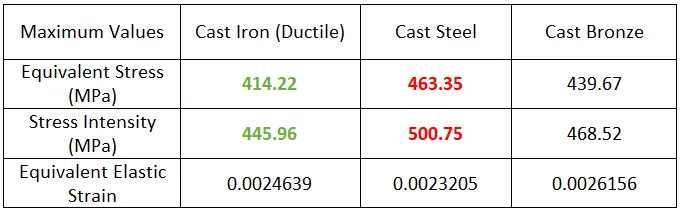
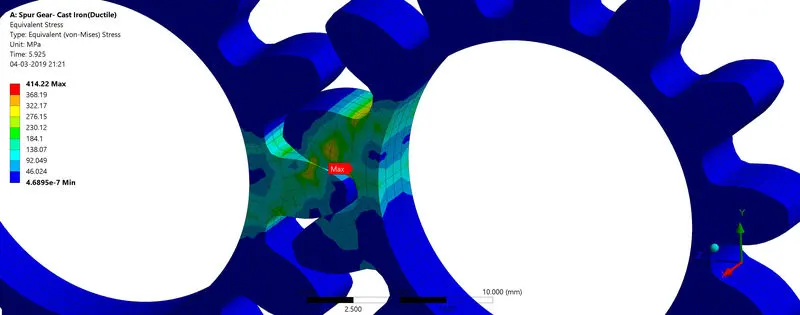
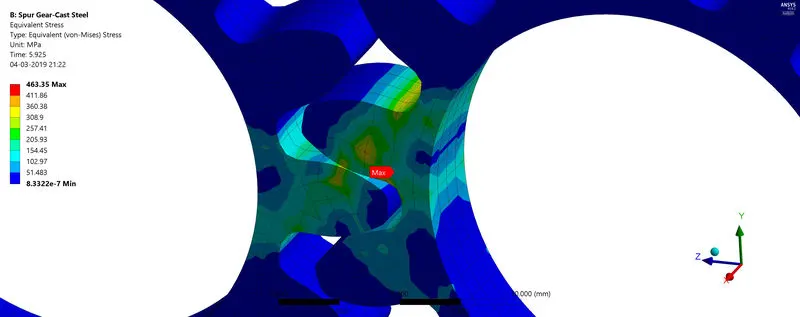
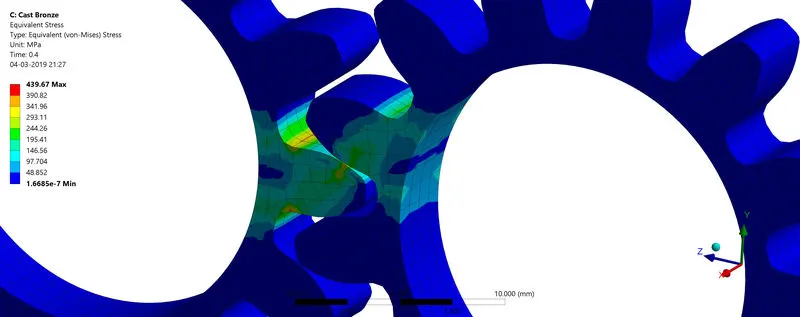
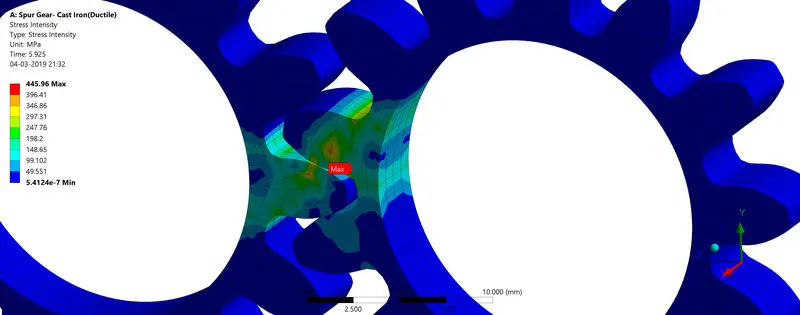
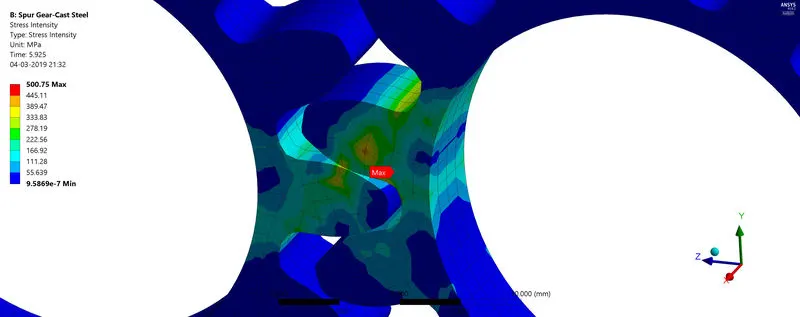
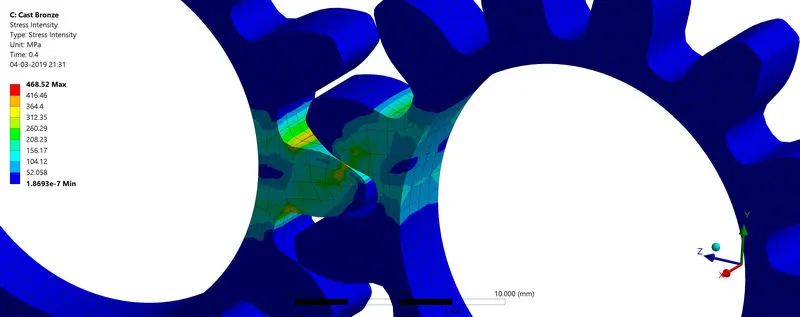
The Equivalent Stress, Total Deformation and Stress Intensity data have been tabulated below for the three materials given after performing the simulations, (Maximum Total Deformation values will yield us nothing important result, as in all the cases it will be 30 mm which is the displacement of outer point on teeth after 180˚ rotation.)
Equivalent Stress plots:-
Stress Intensity plots:-
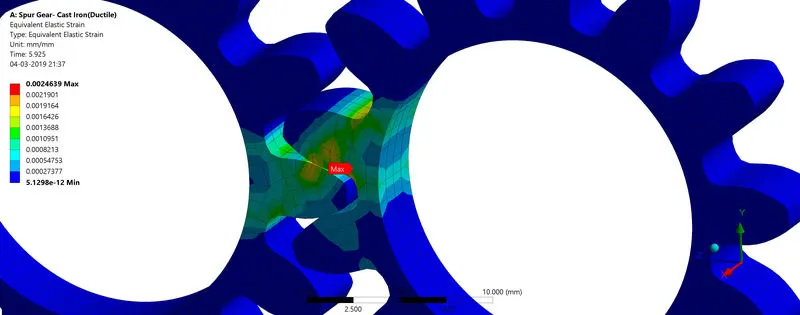
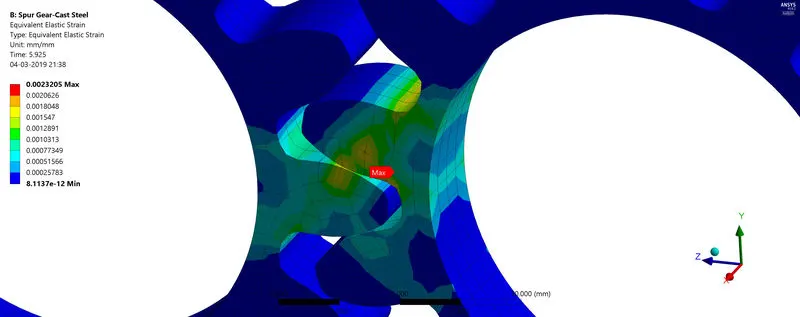
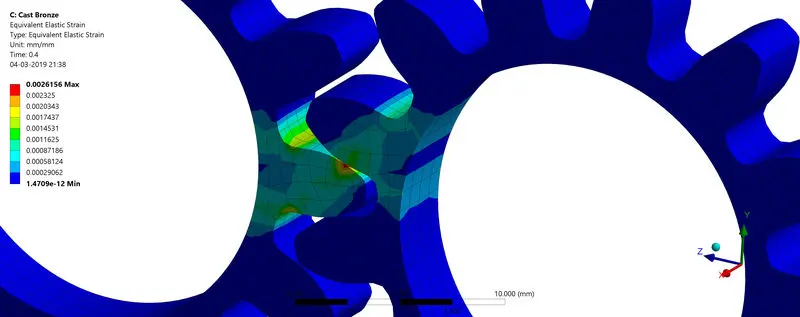
Equivalent Elastic Strain plots:-
- Conclusion:
From the observations we can see that the maximum Equivalent Stress and the Maximum Stress Intensity values are highest for the Cast Steel and lowest for the Cast Iron (Ductile) material. The Stress Intensity is the stress state near the crack tip which is calculated theoretically for providing the failure criterion (basically for brittle or materials exhibiting small scale yielding at tip of crack).
From the Table 2 we can see that due to high stiffness of cast steel, it shows the least Equivalent Elastic Strain, and has the highest Equivalent Stress and Stress Intensity, which suggest it to be vulnerable to fracture compared to other two materials, and therefore not a good option for gears. Cast Bronze has the lowest stiffness and hence the highest Equivalent Elastic Strain, but its Equivalent Stress and Stress Intensity values lie in between Cast Iron (ductile) and Cast Steel.
Cast Steel has the least magnitude of maximum Equivalent Stress and Stress Intensity, due to optimum stiffness and strain on loading, and hence should be the suitable choice for gear. Hence the recommended material is Cast Iron (Ductile).