Week 8 - Universal Joint
- Objective:-
To simulate a universal joint with a torsional load on one shaft and plot the equivalent stress, total deformation for different materials of the shaft namely, structural steel, stainless steel and titanium alloy.
- Model Details:-
Following model has been given with total 5 parts for the simulation, for the output shaft2, a spring is attached for the torsional load.
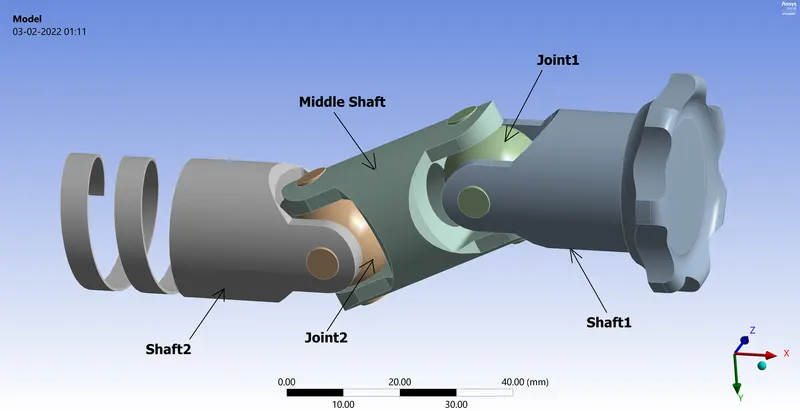
As we are interested in the stress and deformation of shaft2 only, I have assigned a body sizing mesh with element size of 2mm while the rest of the parts are meshed with element size of 4 mm.
No. of Nodes:- 24836 and No. of elements:- 14249
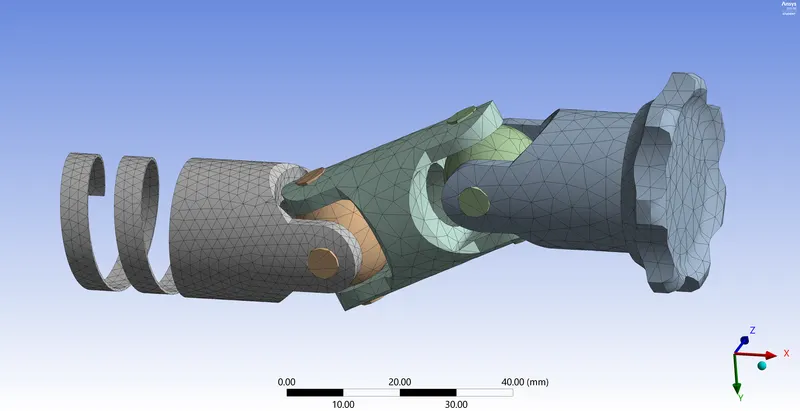
Only the shaft2 are assigned different materials for the three cases. The different assigned materials are structural steel, stainless steel and titanium alloy.
- Loads and Constraints:-
For the simulation, one end of the spring is fixed to the ground, so that when shaft2 rotates, it generated the torsional resistance. Also, the two shafts are fixed to revolve around their axis with respect to ground using revolute joints. And at last all the body-body hinged joints are defined for the shafts with respect to their corresponding joints.
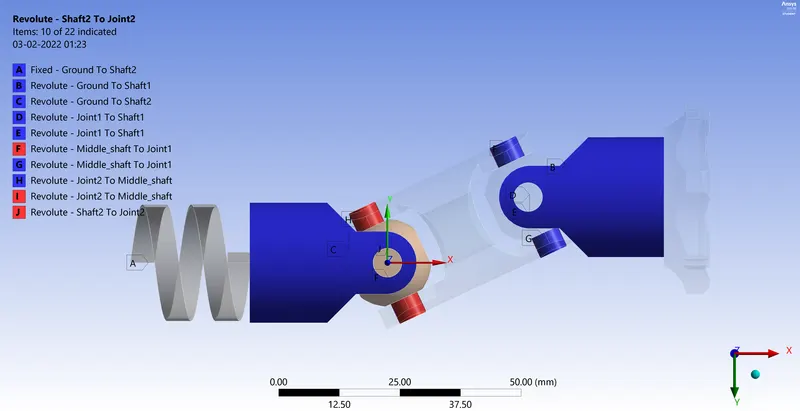
After the inertion of all joints for well defined assembly, the shaft1 is given a joint load of rotation. In 5 time steps of 1 sec, the shaft1 is rotated by 30deg each second. So after the end of joint load, shaft1 is rotated by 150 deg in total. Which means, shaft2 also rotates by 150deg and the torsion angle of the spring is also the same.
- Results:-
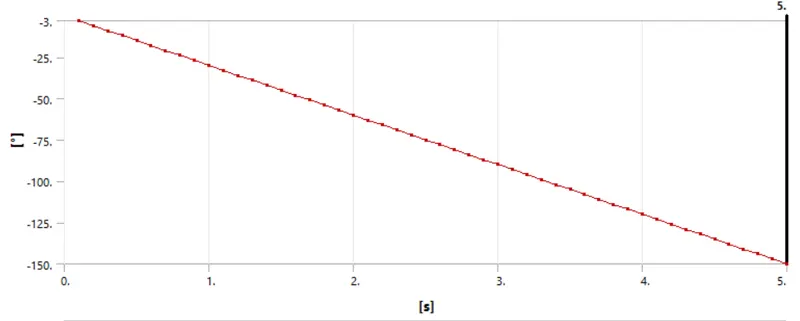
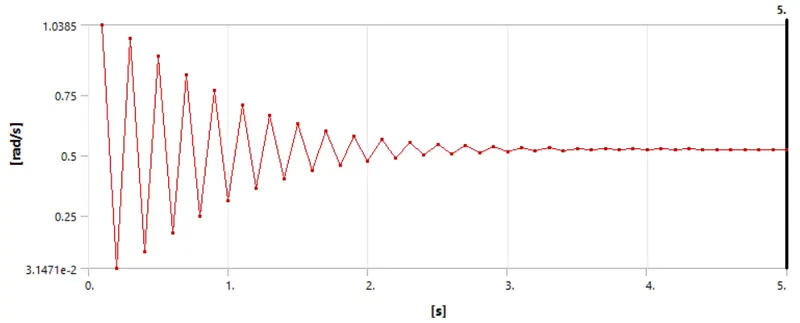
We will first see the results that are irrelevant to the assigned material, they are relative rotation and rotational velocity of the shaft2. As expected we see that shaft2 rotates 150deg in total and its angular velocity is 0.5233 rad/sec (30 deg/sec)
Animation for the general motion of the assembly:- https://youtu.be/vN2XoopuBqE
Graph of relative rotation and relative angular velocity of the shaft2:-
As Total deformation in the displacement of the element from its original position, it will be same for all the cases. Only the resistance to such motion (stress, force reaction and moment reaction) will be different in the three cases.
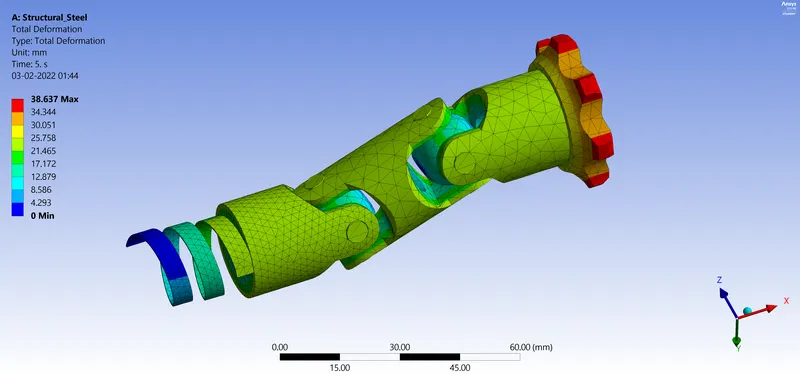
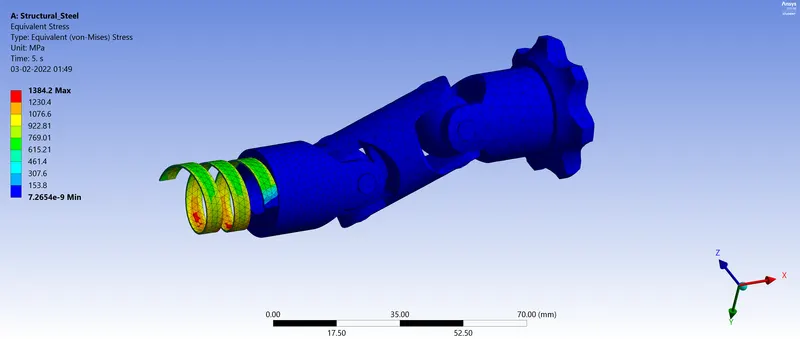
Case-1 (Structural Steel):-
Max. Equivalent stress = 1384.2 MPa
Max. Moment reaction at shaft2 = -1635.3 N-mm (along negative X-direction resisting the rotation of the shaft1)
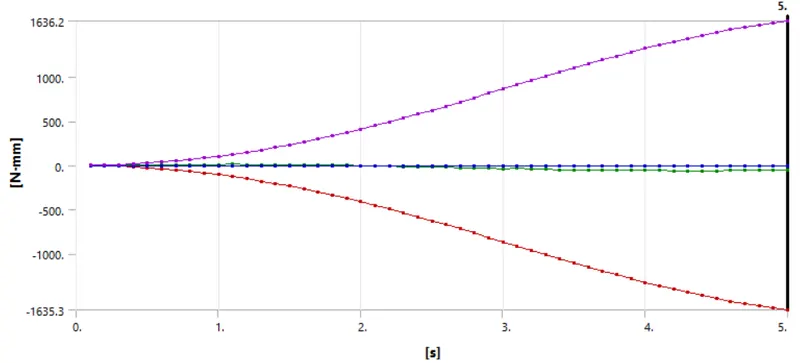
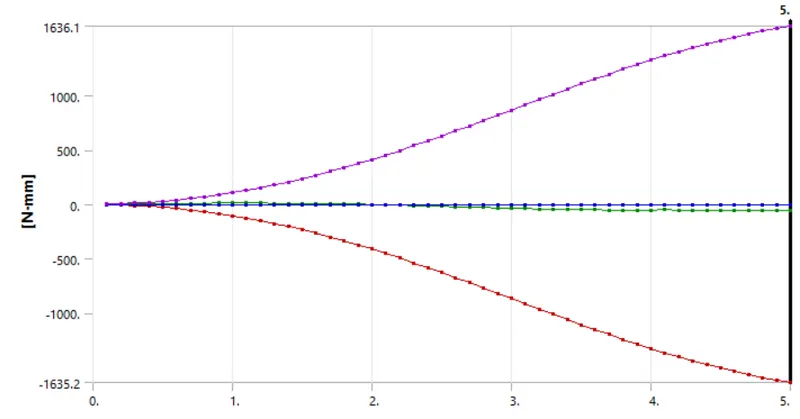
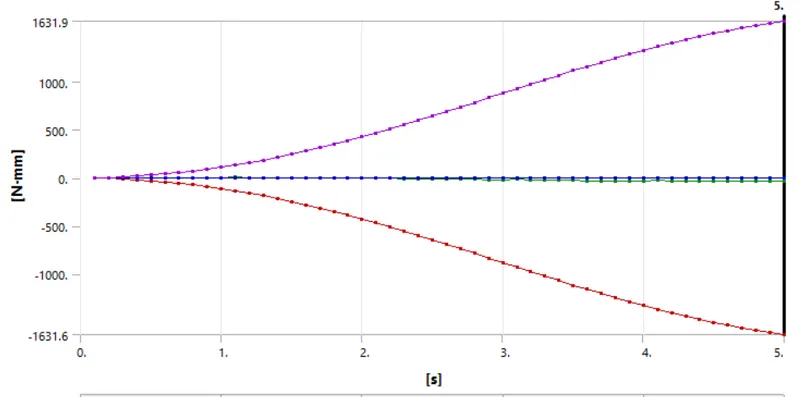
(red line is the X-axis component of the moment reaction, and purple line is just the magnitude of the net moment reaction)
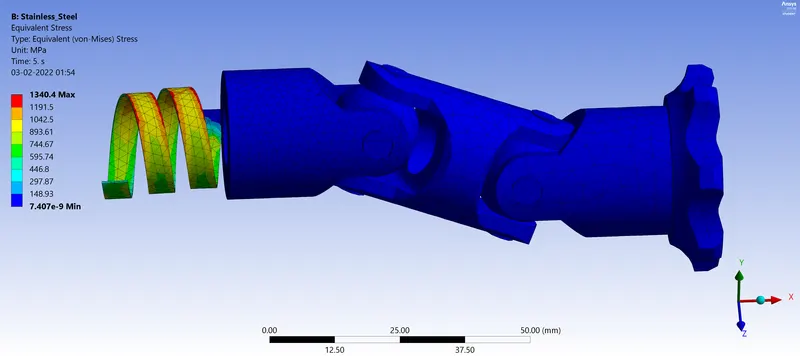
Case-2 (Stainless Steel):-
Max. Equivalent stress = 1340.4 MPa
Max. Moment reaction at shaft2 = -1635.2 N-mm (along negative X-direction resisting the rotation of the shaft1)
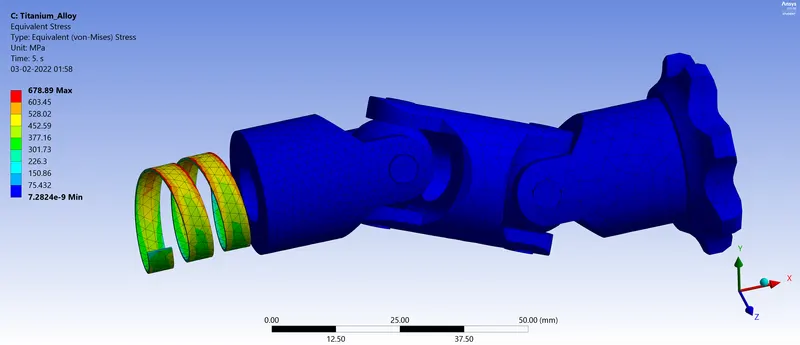
Case-3 (Titanium Alloy):-
Max. Equivalent stress = 678.89 MPa
Max. Moment reaction at shaft2 = -1631.6 N-mm (along negative X-direction resisting the rotation of the shaft1)
- Conclusion:-
Shear modulus of the three materials used in the simulation are:-
For Structural Steel = 76.923 GPa
For Stainless Steel = 73.664 GPa
and For Titanium Alloy = 35.294 GPa.
During torsion, this shear modulus decides the resistance by the material. For the equal angular rotation in the three cases (150 deg), the material with highest shear modulus should resist the highest. So from the results, as the shear modulus of structural steel and stainless steel is close their equivalent stress and moment reaction are also nearby. But as titanium alloys have around half the shear modulus compared to structural steel and stainless steel, its equivalent stress and moment reaction is much lower than them.
Also, we have successfully simulated the universal joint with a torsional load in this challenge.