Week 2 Bevel Gear Challenge
- Objective:- To perform parametric study in Ansys for checking the grid dependency of the model.
- Grid Dependency Test:- In FEM analysis, broadly, there are three sources of errors. Error due to element size, error due to order of interpolation function and error due to numerical error. As we increase the order of the interpolation function (p-method), error reduces exponentially and quadratic order is sufficient for most of the studies. The numerical error is due to the limit of storage of system in numbers of decimals and error during large number of calculations. Error due to element size can be reduced by decreasing the element size and thereby getting closer to the real geometry (like in case of curvatures which are approximated using finite smaller straight lines). However, smaller grid size increases the matrix size and require higher computation time. In Grid Dependency Test, we investigate how much does the solution depend on the grid size, by running simulation successively in finer mesh. After refining the grid sizes, there will come a time when further refinng of grid sizes will not show any appreciable improvement in the solution. So it is impractical to implement a finer mesh and to obtain marginal accuracy. Hence by doing a Grid Dependency Test, we can find some coarse mesh size which gives results within the acceptable range of error, with optimal use of computation time.
In current parametric study, we have used the mesh size of the gear as input parameter and some of the results (Equivalent Stress, Equivalent Elastic Strain and Total Deformation) as output parameters for comparison of different grid sizes.
- Model Details:- Two bevel gears with 16 and 24 teeth are used for the study. In parametric study, the mesh size is selected as the input parameter. Different meshes (Element type - Tet10) are generated using mesh size of 6,5 and 4 mm.
- Mesh generated using mesh size of 6 mm:-
Number of elements = 14,127
Number of nodes = 25,738
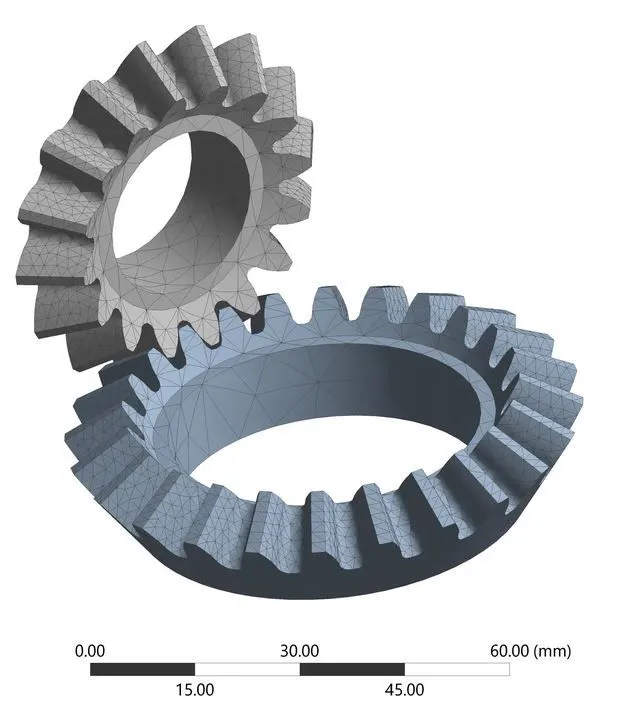
- Mesh generated using mesh size of 5 mm:-
Number of elements = 14,168
Number of nodes = 25,821
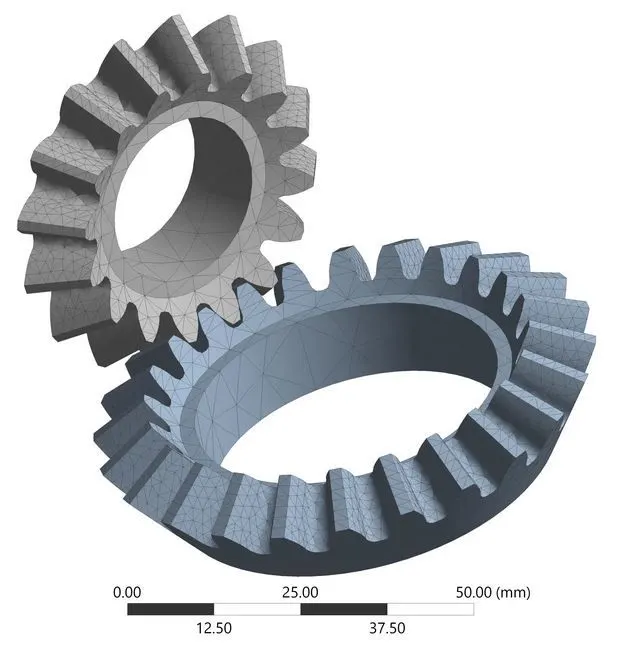
- Mesh generated using mesh size of 4 mm:-
Number of elements = 14,684
Number of nodes = 26,736
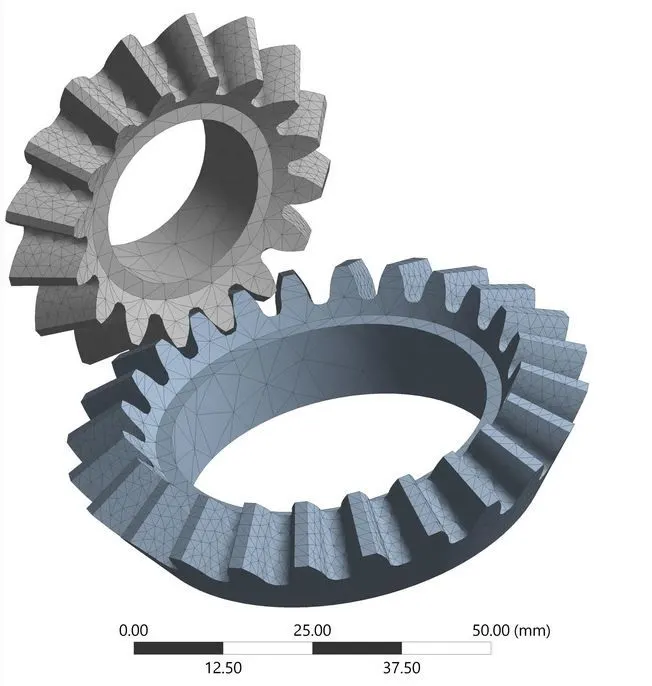
Material used is same for all mesh sizes and it is Structural Steel, as available in the Ansys Engineering Data.
Young's Modulus = 200 GPa
Poisson's Ratio = 0.3
Density = 7850 Kg/m^3
- Loads and Constraints:-
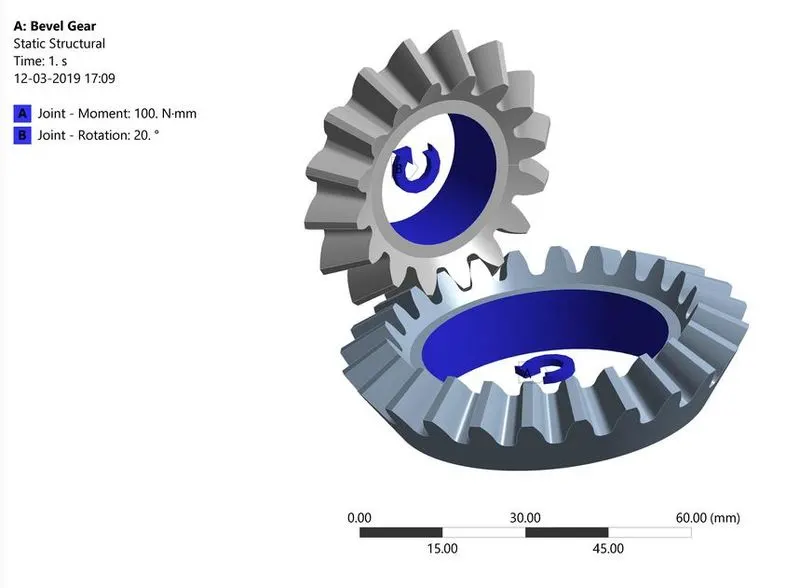
For grid dependency comparison, loads and constraints are kept same for all the cases. First, the revolute joints are inserted for both the gears for permitting rotational motion.
The simulation is carried out in 6 steps defined by time. In each time step, the small bevel gear is rotated by 20 deg, that is angular velocity is kept as 20 deg per second. While the big gear is applied with 100 N-mm torque in sense of rotation suitable with small gear, as shown in the figure below,
- Results:-
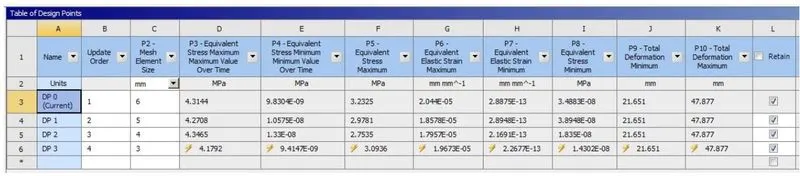
For the input mesh sizes, Equivalent Stress and Equivalent Elastic Strains are selected as output for comparison. Their values are summarized in tabular format as shown below,
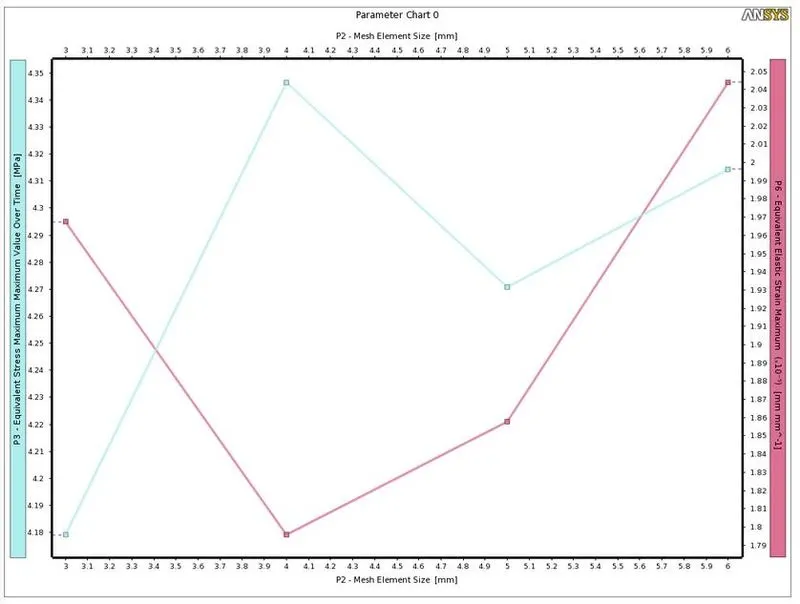
Here is the graph plotting the above values. On X-axis is the element size. On left Y-axis is the Equivalent Stress Maximum Value over time (Light Blue). While on right Y-axis is the Equivalent Elastic Strain Maximum (Pink).
Here the Total Deformation will obviously be the same for all the cases since the displacement of all the point (due to gear rotation) is same in every case.
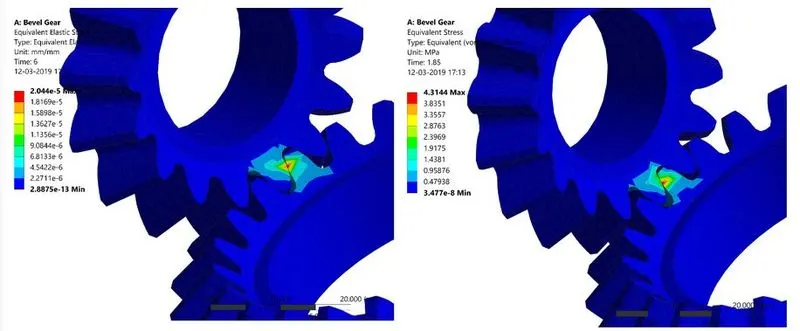
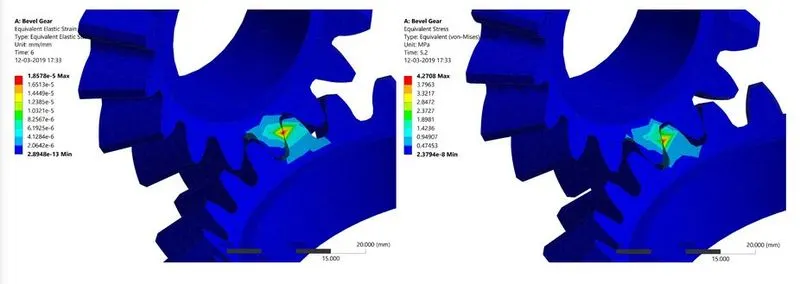
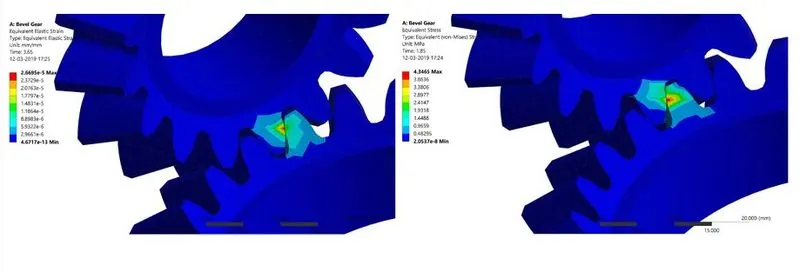
Below are the figures of the Equivalent Stresses and Equivalent Elastic Strains, captured at their respective maximum values over the entire time. The time at which they are maximum can be seen from the legend at the top left.
- Equivalent Elastic Strain and Equivalent Stress for 6 mm mesh size:-
- Equivalent Elastic Strain and Equivalent Stress for 5 mm mesh size:-
- Equivalent Elastic Strain and Equivalent Stress for 4 mm mesh size:-
- Conclusion:-
From the values of the Maximum Equivalent Stress and Equivalent Elastic Strains, we can see that even after refining mesh from the mesh size of 6 mm to 4 mm, there is no much appreciable change.
The maximum difference in Max. Equivalent Stress is 1.74% (Assuming finer mesh size value to be precise), while the maximum difference in Max. Equivalent Elastic strain is 13.82%.
But the number of nodes are increased from 25,738 for 6mm mesh size to 26,736 for 4mm mesh size, while also showing increase of 12 min 59 sec in computation time from 6mm (computation time = 1377 sec) to 4mm (computation time = 2156 sec).
While for such a study with limitations on number of elements and nodes, the increase in computation time might not be very significant, but the basic interpretation that can be drawn is:- a coarse mesh with mesh size of 6mm can be used for finding the safe stress with reasonable accuracy without going after finer mesh, thereby reducing the computation time.