Week 5.2 - Mid term project - Steady vs unsteady state analysis
Objective:
Compare your fastest steady-state simulation vs your fastest transient simulation and explain your result.
Solution:
The link for the original Steady and Unsteady 2-D Heat Conduction is given below:
In the above project, we have concluded that for all the given methods and approaches, the successive Over- Relaxation method has been the most efficient. The fastest steady-state simulation was corroborated by the Successive Over -Relaxation method and for the transient state simulation, it was the explicit SOR method.
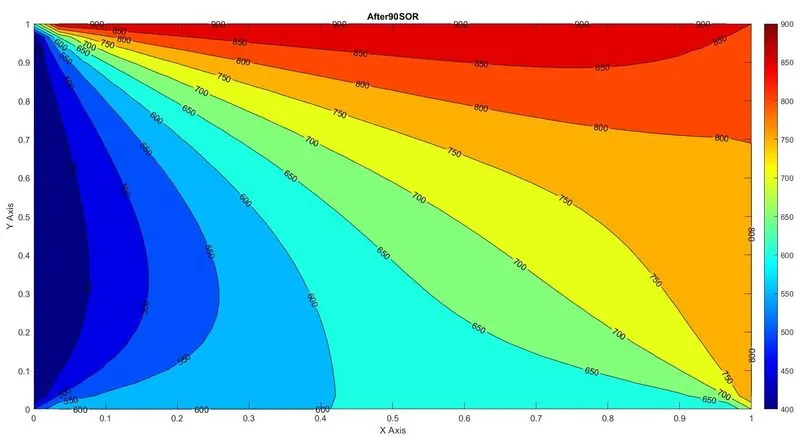
Fastest Steady-State Simulation: Successive Over -Relaxation Method.
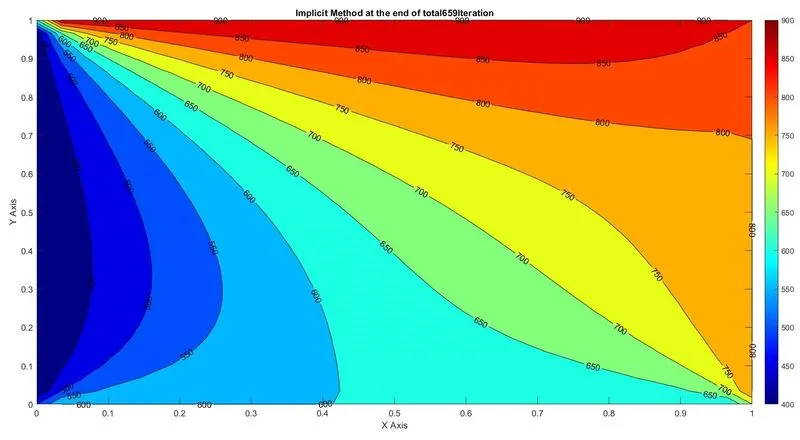
Fastest Transient State Simulation: Explicit Successive Over -Relaxation Method
Conclusions:
From the above stats, we can conclude that the Steady SOR method is the fastest of both the method. But it is also important to consider that the steady-state does not include the Thermal Diffusivity and the time derivative terms which result in a steady and a fast solution. Similarly, the transient state SOR method involves the aforementioned terms which result in higher simulation time and iterations when compared to the steady-state SOR method.
In the case of transient simulation, the implicit approach is generally more stable than the explicit. It is so because when time steps are considered, explicit approaches are very sensitive to them, and if a wrong time step is considered the solution may end up resulting in instability. On the contrary, implicit solution approaches are less sensitive to time steps. This tells us that when a solution is solved implicitly, we may end up with higher simulation time and iterations which may be very expensive or a wastage of valuable simulation time. In other words, we can also say that explicit solution approaches take less simulation time and iterations as the spatial nodes are solved separately as a system of linear equations and the time integration here is similar to the convergence loop in the steady-state simulation.
The Thermal Diffusivity (TD) also factors as an important consideration for our solvers. The right TD value leads to a more accurate solution. Considering we have the right value, other parameters like optimum grid size and time steps also take priority for an accurate and fast solution. On the same note, we have also concluded in previous challenges that having a smaller time step will give is more precise and accurate results but may end up having a larger simulation time. These are some of the factors and conditions which should be addressed when simulations of the above nature are conducted. An exact range of these factors cannot be given as they change with the given problem and its specifications.