Week 3.1 - Stoichiometric Combustion Calculator
AIM: To write the program in MATLAB to the stoichiometric coefficient for each fuel.
OBJECTIVE:
- To plot the comparison of the effect of the number of moles of carbon on the ‘stoichiometric coefficient ar’ using MATLAB.
- Also, observe this comparison with respect to different fuel types – Alkane, Alkene, Alkynes.
Alkane, Alkene, Alkyne:
These are simple Hydrocarbon chains with no other functional group attached. By functional group means, hydrocarbon chain doesn’t have a bond with Alcohol, Ester, Amine, Amide, Aldehyde, Ether, etc.
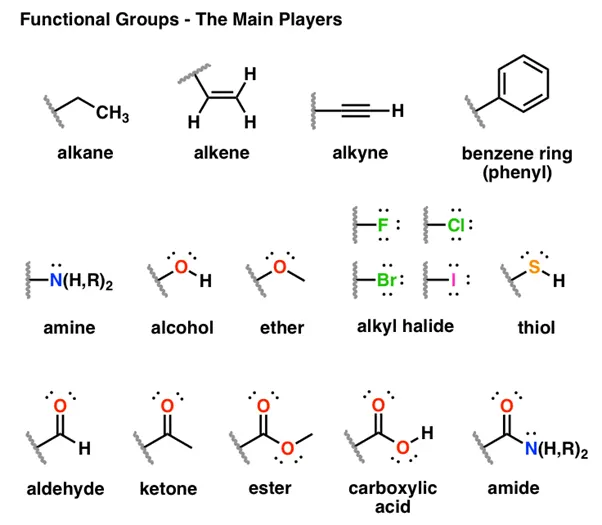
These simple hydrocarbon chains differ with respect to carbon bond:
Alkane, CnH2n+2:- Only single bond
Alkene, CnH2n:- At least one double bond
Alkyne, CnH2n-2:- At least one triple bond
Why Alkane preferred over Alkene and Alkynes:
- Alkanes are saturated organic compounds being unreactive irrespective of combustion of air. While Alkenes and Alkynes are unsaturated organic compounds and hence are widely used in chemical and medicine industries.
- To produce electricity for cooking (methane – natural gas)
- For cooking (propane and butane as LPG)
- For combustion in automobile (Octane as fuel)
Combustion of simple Hydrocarbons:
As we know simple hydrocarbons are used in the combustion process.
In presence of oxygen, hydrocarbon burns and produces by-products such as CO2, CO, NO, NO2, SO, SO2, N2O, H2O, etc.
Based on the amount of oxygen present in the air, the combustion can be complete or incomplete.
Stoichiometric combustion offers an easy way to understand combustion concepts. When fuel and air mix they produce products as co2, co, oh, h2o, no, n2o, and many more. In stoichiometric combustion, we make a simple assumption that the by-products are only co2, h2o, and n2.
For a generic alkane fuel the combustion process will following the below equation:

Here
n = Number of moles of C
ar = Stoichiometric co-efficient
a = Number of moles of Carbon-di-oxide
b = number of moles of water
c = number of moles of nitrogen
The Stoichiometric co-efficient ‘ar’ has a particular value for the specific fuel. It implies a mole of air required for combustion. If the available mole of air is less than ‘ar’ then it is said to be a rich mixture and if the available mole of air is greater than ‘ar’ it is said to be a lean mixture.
INPUTS:
[CODE]
clc
clear all
close all

% No. of moles of C
% for Alkane, Alkene, Alkyne
n = 1:12;

% No. of moles of carbon atom in carbon dioxide = moles of carbon in 1 mole
% of fuel
a=n;

[h_alkane,h_alkene,h_alkyne] = stoichi_con(n);

% No. of moles of H2O Molecules

b_alkane = 0.5*h_alkane;
b_alkene = 0.5*h_alkene;
b_alkyne = 0.5*h_alkyne;

% No. of moles of O2 molecules

ar_alkane = n+0.25*h_alkane;
ar_alkene = n+0.25*h_alkene;
ar_alkyne = n+0.25*h_alkyne;

% No. of moles of N2 molecules

c_alkane = 3.76*ar_alkane;
c_alkene = 3.76*ar_alkene;
c_alkyne = 3.76*ar_alkyne;


% plotting the graph between ar and no. of moles of C for alkane, alkene,
% alkyne

plot(n,ar_alkane,'r','Linewidth',2);
hold on
plot(n,ar_alkene,'b','Linewidth',2);
hold on
plot(n,ar_alkyne,'g','Linewidth',2);
axis([1 10 1 20])

xlabel('No. of Moles of Carbon');
ylabel('Stoichiometric Coefficient');
legend('Alkane','Alkene','Alkyne');
title('Coefficientg Chart');
[FUNCTION CODE]
function [h1,h2,h3] = stoichi_con(n)

    h1 = 2*n + 1;

    h2 = 2*n;

    h3 = 2*n-1;

end
RESULTS:
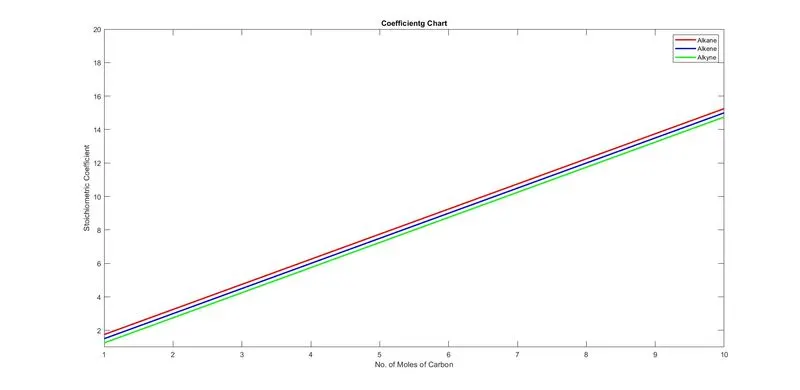
From the above Results:
Hence from the above result, the stoichiometric coefficient varies linearly (Positive slope) with respect to no. of moles of carbon for a specific fuel.
|
Number of moles of carbon ‘n’ |
stoichiometric coefficient ‘ar’ ALKANE |
ALKENE |
ALKYNES |
|
1 |
2.0 |
- |
- |
|
2 |
3.5 |
2.5 |
- |
|
3 |
4.3 |
4.5 |
4.0 |
|
4 |
6 |
6.0 |
5.4 |
|
5 |
8 |
7.5 |
7 |
RESULTS:
- Hence, the comparison of the effect of the number of moles of carbon on the ‘stoichiometric coefficient ar’ using MATLAB is been done.
- Also, we observe this comparison with respect to different fuel types – Alkane, Alkene, Alkynes.
- Preferred fuel priority: Alkane > Alkene > Alkyne