Week 9 - FVM Literature Review
QUESTION:
What is Finite Volume Method FVM), write down the major differences between FDM & FVM. Also, describe the need for interpolation schemes and flux limiters in FVM.
ANSWER:
The finite volume method is a discretization method that converts PDE to a linear algebraic system. The main advantage of the finite volume method is that it conserves the flux since the integral form of the governing equation are used and can incorporate the presence of discontinuities in the flow field.
The domain is divided into finite volumes and the governing equations are solved at the cell centroid. These cell centres are known as nodes and store the volume average values of the flow variables. The volume integral is converted to surface integral using the Gauss divergence theorem.
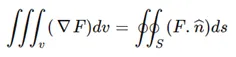
The major differences between the finite difference method and the finite volume method are, finite volume method uses the integral forms of the governing equation and computation is carried out at the centroids of each cell. The finite volume method can handle complex geometries and unstructured mesh since the flux through the face is a major concern. The finite volume method is inherently capable of handling discontinuities in the solution and the flow flux is conserved. One of the major drawbacks of the finite volume method is that discretization schemes higher than that of second-order are difficult to achieve because of the complexities.
Consider a 1D heat flow, the governing equation is given by,
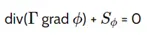
Where ‘Gamma’ is the diffusion coefficient and S is the source terms.
On integration along the control volume,
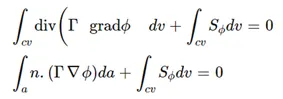
On discretizing the flux terms at the face are computed using the interpolation schemes. The gradients at the cell centroids are computed using the gradient schemes.
The most commonly used interpolations schemes are,
UPWIND INTERPOLATION SCHEMES:
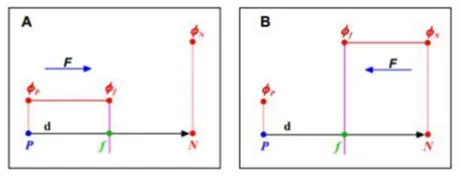
This is a first-order accurate interpolation scheme. It is bounded and has a diffusive character. The scheme is based on the direction of flow. The face value is considered as same as that of the neighbouring cell centroid.
CENTRAL DIFFERENCING SCHEME:
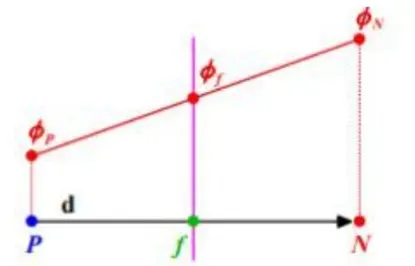
This is a second-order accurate interpolation scheme, which is unfounded and might generate oscillatory solutions. The face value is computed as a linear interpolation from the owner and neighbouring cells.
LINEAR UPWIND SCHEME:
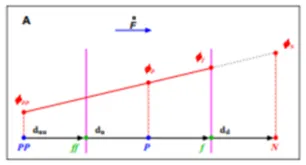
This is a second-order accurate interpolation scheme. It employed for highly convective flows. This scheme is unbounded and is prone to oscillations.
QUADRATIC UPWIND INTERPOLATION SCHEME:
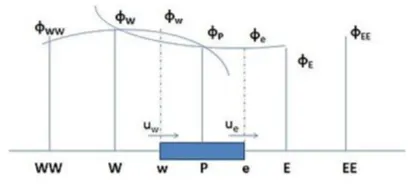
This is a third-order accurate interpolation scheme. The face values approximated using a three-point quadratic function with two surrounding nodes and one upstream node. This scheme is highly oscillatory.
FLUX LIMITERS:
For the second and higher-order interpolations, which predict the face values based on the gradients at the cell centroids, in the presence of strong gradients, due to overshooting, the face values might exceed the local maxima and minima. This will create new maxima and minima in the solution and might lead to the solution blowing -up. This issue can be overcome by using a Flux Limiter function.
The flux limiter function keeps monitoring the ratio of successive gradients and locally switches to the first-order scheme (low resolution) when it detects strong gradients. Adding flux limiter on higher-order schemes prevent the formation of new local minima and maxima. Such high resolution and bounded schemes are called Total Variation Diminishing (TVD)schemes. Commonly used Flux limiters are Super Bee, Mimed and Veneer.
Flux limiters limit the spatial derivatives to realistic values. Upwind and hybrid schemes have the problem of false diffusion in multidimensional flows whereas the QUICK scheme can minimise false diffusion but are less computationally stable. Flux limiters are used to finetune numerical schemes to physically reliable and meaningful results. It helps to maintain the stability of numerical schemes near a shock and sharp changes in the domain. They are used in high-resolution schemes when sharp wavefronts occur.
Following is the link for the Finite Volume Method theory and Reference.
Link - https://en.wikipedia.org/wiki/Finite_volume_method
CONCLUSION:
- Hence the Finite volume method is been explained.
- The need for interpolation schemes and flux limiter is explained.