Week 4 : Forward Model For a Conventional Vehicle (DHEV)
Q1) Using block diagrams, come up with a forward model for a conventional vehicle that includes the driver, controller and vehicle plant. The vehicle plant must at least contain an engine, fuel tank, transmission coupling unit, transmission, differential, wheels and the vehicle.
a. Each of the elements mentioned above can simply be represented by blocks. Connect the blocks appropriately with connections for each variable representing energy, material and information flow that would be required to analyze the energy flow through the system.
b. Classify the variables in terms of effort, flow and information/control variable.
c. For the vehicle plant model, write down the system equations for each block. System equation will simply be a power/energy balance equation, with an assumed system efficiency parameter.
d. Make a list of input variables and system parameters that would be required to calculate power requirement and energy consumption of the system.
Use Microsoft Word to document your work. Any generic software can be used to draw blocks diagrams (like Powerpoint or Word).
Your Answers
Forward Model for a Conventional Vehicle
Block Diagram
Conventional Model :
Conventional vehicles used are internal combustion engine fuelled by foil fuels to produce power to the wheels. Where as Electrical vehicle are the user of electric energy than conventional internal combustion engines.
Forward Model :

Driver Block :
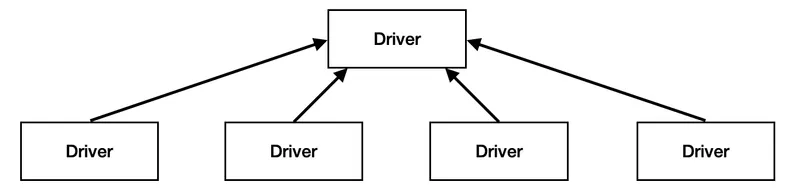
Operation :
In this case the driver operation is knows as user to given the instruction to control the vehicle, the first case is model selection to select the condition of driving i.e (auto pilot or self driving) which is selected by the user.Once the user select the first condition of the self driving option once he simultaneously change the gear (to provide the proper torque to the vehicle while driving.Then the user accelerate the pedal to increase the speed by the vehicle with respect passenger comfortable once the user press the acceleration pedal means the vehicle can increase its speed.Brake pedal is used to stop the vehicle whenever required and also is consider as safety measure to stop the vehicle, once the user press the brake pedal the vehicle suddenly try to stops the vehicle.
Controller Block :
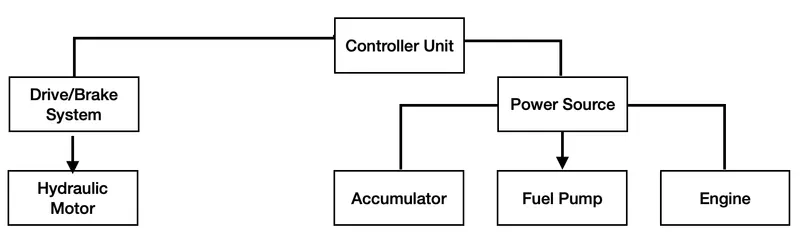
The aim of the Controller in vehicles is used to control the conventional vehicle's and give signals to the powertrain & accessories to the vehicle .It has been divided into two types one is drive / brake system controller & power source controller.Drive and break controller which is considers as accessories of the vehicle it is not used for vehicle dynamics but it is used to consider as improve the vehicle performance and safety measures of the vehicle.when the hydraulic/electric motor plays an vital role to improve the performance of the vehicle it is used to displace the coolant through the engine (radiator) and air conditioning the vehicle and also the motor is used to start the vehicle.
Power source controller:
The aim of power source controller is used to control pump displacement and the opening / closing of throttle. When the is used to improve the performance of the vehicle which is transmit the coolant to the engine and hydraulic accumulator is a energy storage device and also accumulator enables a hydraulic system to cope with extremes of demand using a less powerful pump, to respond more quickly to a temporary demand, and to smooth out pulsations for breaking the vehicles and also-it controls the powertrains to improve the vehicle dynamics.
Vehicle Plant Block :
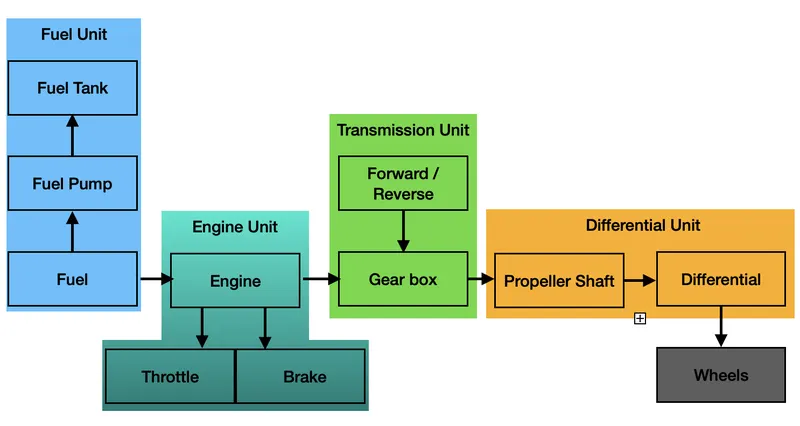
Fuel Unit :
A vehicle’s fuel system comprises components that deliver fuel from the tank to the engine, including a fuel pump, fuel lines, a fuel-pressure regulator, fuel filter and fuel injectors. Fuel system components are built to last, so the fuel filter is the only part that’s likely to require replacement on a schedule.
Engine Unit :
The engine consists of a fixed cylinder and a moving piston. The expanding combustion gases push the piston, which in turn rotates the crankshaft. Ultimately, through a system of gears in the powertrain, this motion drives the vehicle’s wheels.
Transmission Unit :
A car transmission, also known as the transmission system, is the mechanism by which power created by the engine is transferred to the driving wheels. This part of the vehicle is the most important in determining the power and functionality of your engine systems. The two types of transmissions include automatic transmission and manual transmission.
Differential Unit :
A differential is a gearbox that is found between the drive wheels of your vehicle. If your vehicle has a four-wheel drive system, then it more than likely has a front and rear differential. A differential works with the transmission to deliver power from the engine to the axle that turns the wheels. It also helps your vehicle turn properly. In order for your vehicle to turn, the outside wheels must turn faster than the inside wheels. A differential uses gears to enable the wheels to turn at different speeds.
To keep your differential in good condition, you need to have its fluid changed routinely. This is because normal wear can cause the fluid to break down, which could cause grinding and friction.
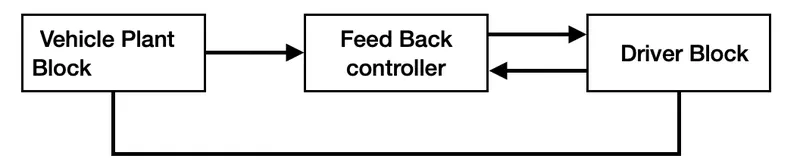
Feed Back Block :
Formulas Used :
- Force : F=Fr+Fω+Fg">F=Fr+Fω+FgF=Fr+Fω+Fg
- Rolling Force : Fr=Cr⋅M⋅g⋅cosθ">Fr=Cr⋅M⋅g⋅cosθFr=Cr⋅M⋅g⋅cosθ
- Acceleration Force : Fω=(12)⋅ρa⋅Af⋅Cd⋅(Vveh+Vw)2">Fω=(12)⋅ρa⋅Af⋅Cd⋅(Vveh+Vw)2Fω=(12)⋅ρa⋅Af⋅Cd⋅(Vveh+Vw)2
- Hill Climbing Force : Fg=M⋅g⋅sinθ">Fg=M⋅g⋅sinθFg=M⋅g⋅sinθ
- Power : P=F⋅VVeh">P=F⋅VVehP=F⋅VVeh
- Energy : E=P⋅t">E=P⋅tE=P⋅t
Where, t = Time
M = Mass or Weight of the Vehicle and Passenger Weight.
g = Gravity
Cr">CrCr = Rolling Resistance Coefficient
Pa">PaPa = Air Density
Af">AfAf = Frontal Area
Cd">CdCd = Drag Coefficient
Vveh">VvehVveh = Velocity of Vehicle
Vw">VwVw = Velocity of Wind
θ">θθ = Angle
P">PP = power
E">EE = Energy.
To Find Performance of the Vehicle :
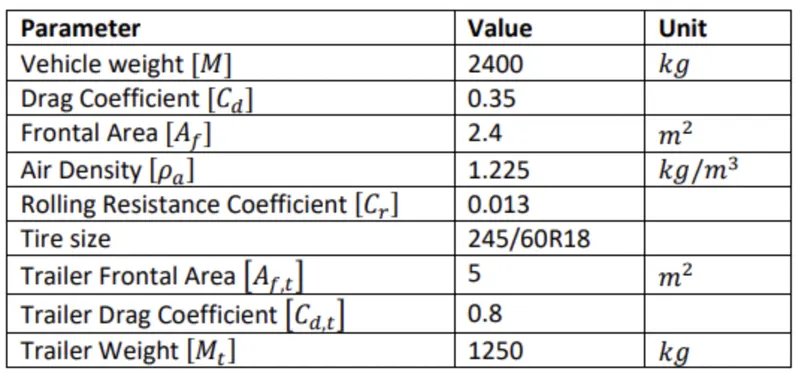
Vehicle Parameters :