Week 8 Challenge (DHEV)
Q1) Write in brief about axial flux motors and the differences, advantages and disadvantages between radial and axial flux motors.
A motor is a mechanism that transforms the motor’s energy into mechanical energy. Its operation is based on the electromagnetic interaction of the magnetic field created by the structure’s coil and magnet. It is classified into two categories based on the direction of the magnetic field: axial flux motors and radial flux motors. The focus of this blog post will be on axial flux motor and its differences with radial flux motor, but there will also be a brief explanation of applications.
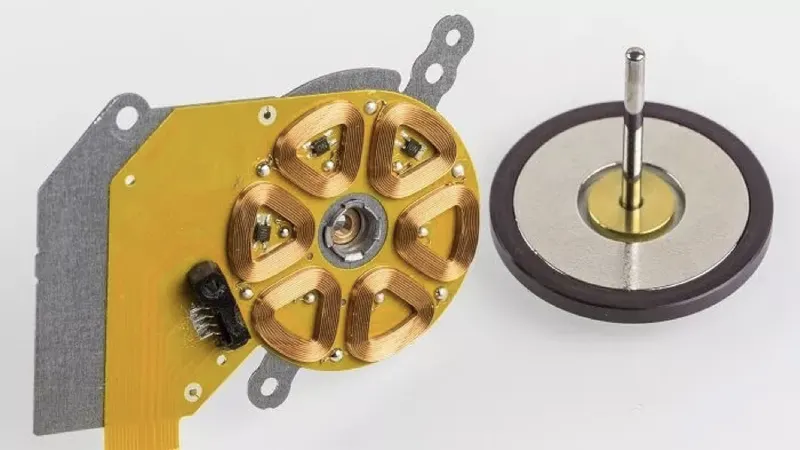
What is Axial Flux Motor
The world’s first motor is of the axial flux type. Even though axial flux motor is not new, its use has only risen in the last two decades. For many years, it was used in stationary applications such as elevators and agricultural machinery, but over the last decade, several developers have worked to improve the technology so that it can be used in applications such as electric motorcycles, airport pods, delivery trucks, electric cars, and even aircraft.
Let’s have a look at axial flux motor unique design choices:
- A rectangular copper wire is utilized to achieve the greatest feasible copper fill factor (90 percent).
- Dual permanent magnet rotors are employed to get the greatest torque-to-weight ratio feasible.
- Yoke less stator, which has the shortest flux pathways and lower total weight.
- The use of grain-oriented electrical steel reduces core losses by up to 85 percent.
- A unique technique for cooling the windings to achieve the lowest feasible stator temperatures.
- Concentrated windings for the lowest copper losses achievable (no coil overhangs).
Application(s) of Axial Flux Motor
Axial flux motor is ideal for high torque density and space-constrained applications. Most people assume that high power density is only determined by fast speed, and they ignore the impact of torque density. The quest for high speed alone will result in limited-service duration and noise. Indeed, the heart of a high-speed motor is the increase in torque density, and an axial flux motor is a common solution among them.
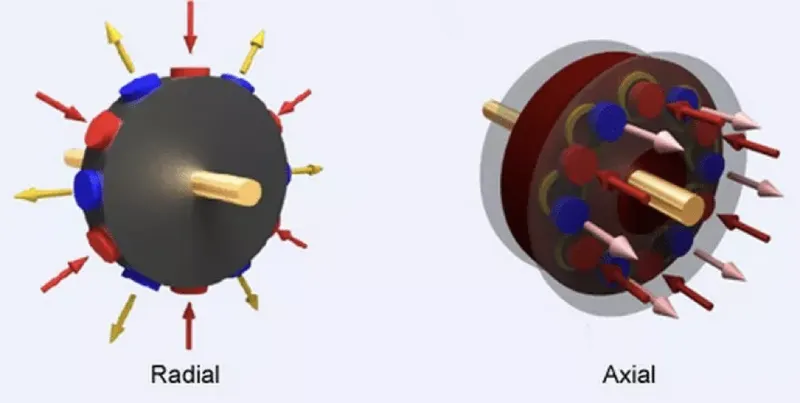
Axial flux vs Radial flux motor
The architecture of the motor is a variant of what is known as an axial flux, or axial gap, machine. Because of their very low axial length-to-diameter ratio, axial flux motors are frequently referred to as ‘flat’ or ‘pancake’ motors. They produce a lot of torque, but their speeds are limited due to the rotor’s design. This can be mentioned as one of the axial flux motor disadvantages.
The distinction, as their names suggest, is that the magnetic flux direction in axial flux machines is parallel to the motor rotation axis, whereas the magnetic flux direction in radial flux motors is radial.
The radial flux motor has the classic cylindrical design, whereas the axial flux motor is fashioned like a biscuit tin, and they lend themselves to alternative installations based only on shape. Because it is longer but smaller in diameter, the conventional radial flux is a natural match between two wheels on a single axle.
The magnets on the rotor of an axial flux motor, like all forms of AC synchronous electric motors, are attracted to the spinning field generated by a surrounding ring of independent electromagnets in the stator. Because the switching of the magnets that causes the field to revolve is not perfectly smooth, the rotor suffers from a tiny ‘torque ripple’ known as ‘cogging’ as it turns.
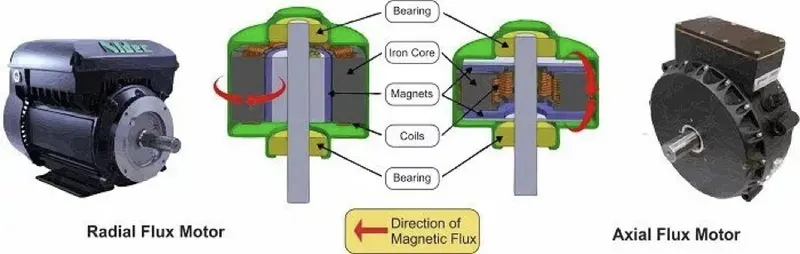
The majority of hybrid system motors are of the radial flux type, in which a rotor supplied with permanent magnets rotates within a wound stator. Because there is a tiny gap between the outer surface of the rotor and the inner diameter of the stator, these motors are known as a radial gap or radial flux machines, and they may generate a lot of power because they can run at high speeds.
Axial flux motor is considered superior to a radial flux motor. There are four reasons why Axial Flux motors provide substantially more power while having a lower weight density:
Lever
For axial flux motor, the magnets are placed farther away from the central axis. As a result, there is more “leverage” on the central axis.
Windings
In terms of winding, axial flux motor has a significant advantage over radial motor. It has a greater active winding copper and less overhang, which means it can increase the number of turns more easily and generates less heat due to the end effect. Furthermore, the winding might come into touch with metal, which is an excellent heat conductor. This translates into a simpler cooling system.
In radial flux motor, a substantial portion of the windings is inactive (the portion located on the outside of the stator teeth that is only utilized to form loops (coil overhang). The coil overhang adds to the electrical heat dissipation. Thus, it is referred to as “distributed winding,” and it results in a considerably lower total power/weight ratio, whereas axial flux machines have no coil overhang at all. The heat in a radial machine should be evacuated through the stator core, which should be constructed of low thermal conductivity steel.
Electromagnetic
Because axial flux motors contain a greater amount of electromagnetically active material, the percentage of winding mass that produces no torque but causes losses is smaller in axial flux machines. In radial flux motors, the magnetic flux passes through the first tooth and then through the stator to the magnets. Of contrast, the flux route in Axial Flux motors is shorter, i.e. from the first magnet, through one core, and directly on the second magnet.
Furthermore, in the case of radial flux machines, the flux must travel in two dimensions. The flux route in axial flux machines is one-dimensional. As a result, there are lower iron losses as the flux travels through the cores. Furthermore, the use of Oriented steel allows the flux to pass more easily, resulting in an extra efficiency benefit.
Cooling
Heat must be transferred via the stator to the exterior of the machine in the case of radial flux machines. However, steel is a poor heat conductor. The “coil overhang” is particularly difficult to cool since it is not in direct contact with the motor casing. Axial flux motors provide good cooling since the windings are in close contact with the outside aluminums shell. Because aluminium transmits the heat easily, the windings of axial flux motors remain cool while the resistance of the copper stays low. And, this leads to much-improved performance. These benefits typically enhance efficiency, which makes a significant effect on a worldwide scale.
Axial Flux motor disadvantages
Despite its technological benefits, axial flux motor offers significant design and manufacturing problems, making it much more expensive than its radial equivalent. Axial flux motor is versatile and the winding can be varied by geometric arrangement according to the design specific diameter, allowing for a significant reduction in the total volume occupied by the machine. Axial flux design has posed some serious design and production challenges as well:
Mechanical challenges: Because of the strong magnetic forces operating between the rotor and the stator, keeping a high-tolerance uniform air gap between these two components is a challenging engineering and material problem.
Thermal issues: Windings of an axial flux motor are situated deep within the stator and between the two rotor discs, posing a bigger cooling problem than in a radial flux direct drive system. Axial flux electric motors feature magnets that are positioned in planes parallel to the coils, allowing them to generate magnetic flux across a smaller rotational volume, resulting in a decrease in the moment of inertia and overall mass of the rotor.
Summary
Electrical motors are divided into two types: radial flux motor and axial flux motor. Radial flux motor is more prevalent and have been in use for a long time. Axial flux motor is an excellent alternative when rapid speed changes are required. Although the axial flux motor was invented earlier, its future development was hampered by the material and technology levels available at the time.In contrast, radial flux motor took the lead in development and became known as the simple motor.
Q2) Research on electric motors used in at least 3 electric vehicles of your choice. Describe in brief their type, construction, specifications (like torque, power, speed) etc. Also plot the ideal torque-speed and power-speed curve in both motoring (positive torque, 1st quadrant) and generating (negative torque, 4th quadrant) phase. Assume generating torque to be equal to motoring torque is not specified. If available, show the efficiency plot also.
Three Electrical Vehicle are
1. Tata Nexon EV
With a 3 Phase Permanent Magnet Synchronous Motor, the Nexon EV is one of the most impressive EV SUVs out there. Its Li-ion Polymer battery is equipped with liquid cooling to ensure that temperatures remain relatively low even after a long drive.
Even though it relies on electricity, this car can generate impressive peak powers of 127bhp. Moonlit Silver, Signature Teal Blue and Glacier White are the three colour options you can choose from.
- Battery Capacity – 30.2kWh
- Distance per Charge – 312 km/full charge
- Recharge Time – 0-80% charge in 60 minutes with a fast charger.
- Awards – Winner of Subcompact SUV of the Year Award at the 2018 edition of NDTV’s Car and Bike Awards.
- Price – Starting from Rs.13.99 lakh.
2. MG ZS EV
The British MG brand offers a premium EV, which counts as one of the top electric cars in India. It is powered by a similar motor like that in the Tata Nexon EV.
This impressively designed SUV boasts several brilliant features, including a 448-litre boot space, diamond-cut machined alloy wheels and power-assisted electric steering. It can also produce an immense torque of 353 Nm.
- Battery Capacity – 44.5kWh
- Distance per Charge– 340km/full charge
- Recharge Time – Fast charging in 50 minutes. The normal charge takes 6-8 hours.
- Price – Starting from Rs.20.88 lakh.
3. Tata Tigor EV
Powered by a three-phase AC induction motor, this electric sedan comes in Egyptian Blue and Pearlescent White colour options. The 310-litre boot space is an additional facility that can be very handy while storing luggage.
You can expect max powers of 40bhp from this vehicle, along with peak torque of 105 Nm. Under ideal driving conditions, this car can reach speeds of 80 kmph.
- Battery Capacity – 21.5kWh
- Distance per Charge – 142km/full charge
- Recharge Time – Fast charging in 90 minutes and normal charging in six hours.
- Price – Starting from Rs.9.54 lakh.
|
Tata Nexon EV |
Tata Tigor EV |
MG ZS EV |
|
|
Price |
Rs. 17,84,461 |
Rs. 14,05,803 |
Rs. 22,59,178 |
|
Electric Motors, Voltage Battery & Transmission |
|||
|
Motor Type |
Permanet Magnet Synchronous Motor |
||
|
Speed |
120 km/h |
80 km/h |
140 km/h |
|
Max.Power (PS@rpm) |
127 |
73.7 |
173.83 |
|
Max.Torque(Nm@rpm) |
245 |
170 |
280 |
|
Battery Capacity (kWh) |
30.2 |
26 |
50.3 |
|
Battery Type |
Lithium-ion Battery |
||
|
Normal Charging Time (0-80%) |
8h 30m |
11h 30m |
6 to 8 hrs |
|
Faster Charging Time (0-100%) |
1h |
2h |
50m |
|
Range |
312 km |
306 km |
461 km |
|
Transmission Type |
Automatic |
||
|
Thermal Management System |
Liquid Cooled |
Liquid Cooled |
Liquid Cooled |
|
Gradeability |
34% |
29% |
Nil |
|
Tyre, Brakes and Suspension Type |
|||
|
Fuel Type |
Electric |
||
|
Tyre |
Tubeless, Radial |
||
|
Wheel Type |
215/60 R16 |
175/65 R14 |
215/50 R17 |
|
Turning Radius |
5.1 M |
5.1 M |
5.6 M |
|
Steering Type |
Electric |
||
|
Steering Column |
Abjustable |
Tilt |
Tilt |
|
Front Brake |
Disc |
Disc |
Disc |
|
Rear Brake |
Drum |
Drum |
Disc |
|
Front Suspension |
Independent McPherson Strut With Coil Spring |
||
|
Rear Suspension |
Twist Beam with Dual path Strut |
Torsion Beam |
|
|
VehicleDimension and Capacity |
|||
|
Overall Length (mm) |
3993 |
3993 |
4314 |
|
Width excluding mirror (mm) |
1811 |
1677 |
1809 |
|
Height (mm) |
1606 |
1532 |
1620 |
|
Ground Clearance Unladen (mm) |
205 |
172 |
177 |
|
Wheel Base (mm) |
2498 |
2450 |
2581 |
|
Kerb Weight (kg) |
1400 |
1235 |
1610 |
|
Seating Capacity |
5 |
5 |
5 |
|
Boot Capacity (litres) |
350 |
316 |
448 |
|
No.of Doors |
5 |
4 |
5 |
|
Safety and Entertainment |
|||
|
No.of airbags |
2 |
2 |
6 |
|
Adv. Safety Features |
Smart Regenerative Braking, Panic Notification and etc. |
||
|
Media Touch Screen |
7 inch |
7 inch |
10.11 inch |
|
Connectivity |
Android auto, Apple CarPlay |
||
|
Parking Sensors |
Rear |
Rear |
Rear |
|
Drivring Mode |
2 |
2 |
3 |