Week 5 : Create a Block Diagram For Forward Model of a Hybrid Vehicle (DHEV)
Q1. To create a block diagram, develop a forward model for a hybrid vehicle that includes the driver, controller, and vehicle plant. The vehicle plant must contain an engine, fuel tank, transmission coupling unit, transmission, differential, wheels, and the vehicle.
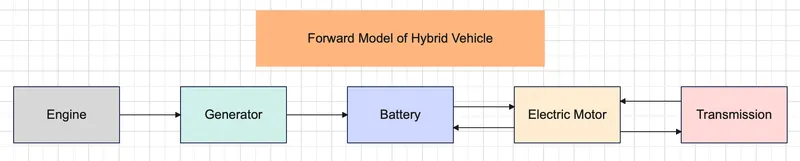
Working on the hybrid vehicle (simple definition):
Today's hybrid electric vehicles (HEVs) are powered by an internal combustion engine in combination with one or more electric motors that use energy stored in batteries. HEVs combine the benefits of high fuel economy and low tailpipe emissions with the power and range of conventional vehicles. A hybrid combines at least one electric motor with a gasoline engine to move the car, and its system recaptures energy via regenerative braking. Sometimes the electric motor does all the work, sometimes it's the gas engine, and sometimes they work together.
Fossil fuels: In the chemical tank when fuel is filled to power the engine in this case chemical energy can be used.
I.C engine: In this case, chemical energy is converted into mechanical energy because when the ic engine combustion happened inside the ic engine with the help of this energy fuel.
Generator: Due to this combustion process a reciprocating motion can be created, it will try to rotate the generator, so it can produce electricity and stored it in the battery.
Battery: It is used to store the power which is generated from the generator.
Electric motor: It is used to propel the vehicle it utilizes the power from the battery whenever required.
Transmission: It is used to create a tractive force if the vehicle and also it leads to the dynamic of the vehicle.
Forward model of Hybrid vehicle :
- Hybrid electric vehicles develop sufficient power to meet performance demands.
- Carry sufficient energy to support driving for a practical range.
- Should be efficient.
- Resulting in the least amount of environmental pollution.
- The vehicle can have one or more than one energy source and energy converters, like petrol and diesel engines vehicles, battery and electric motors, fuel cells and electric motors, etc.
The energy flow of Hybrid electric drive trains:
A hybrid vehicle will generally have multiple flows and two energy sources and converters. one will usually be a bi-directional energy source and converter & the other can be a bidirectional or uni-directional.
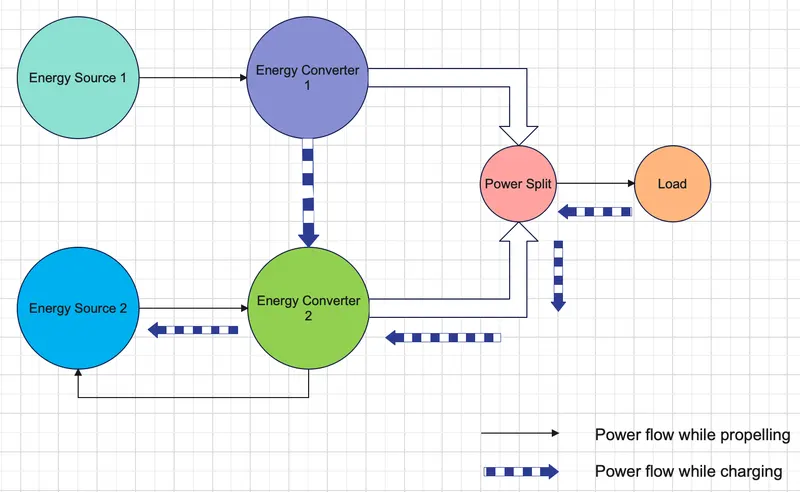
- The energy source 1 can be as an ic fossil fuel and energy converter is known as i.c engine it is used to charge the battery and also it's used to propel the vehicle
- The energy source (2) is a battery that stores the electric energy and the electric converter is known as the electric motor it is used to propel the vehicle.
- In this case, energy can be recovered from the wheel which can be explained in the model as also known as bi-directional energy which is multi-energy flow paths can be achieved.
To find the performance of the vehicle:
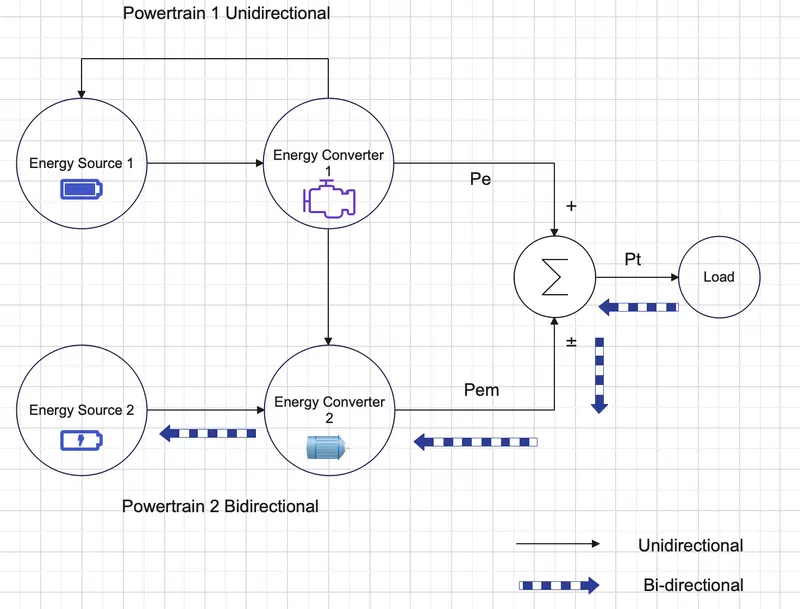
Pt=Pe=Pem=Pωηt">Pt=Pe=Pem=PωηtPt=Pe=Pem=Pωηt
Pt">PtPt = Power Produced by transmission
Pe">PePe = Power Produced by engine
Pω">PωPω = Power Produced by electrical motor
Efficiency of Power produced and discharged from battery and traction motor,
- The power of the electric motor comes from the electric energy stored in the battery. The direction of power flow depends on whether energy is being drawn from or supplied to the battery by the electric unit.
- When discharging the power is considered as positive (Pem(t)›0).
Pb(t)=Pem(t)ηb,d(t)ηb,d(t)">Pb(t)=Pem(t)ηb,d(t)ηb,d(t)Pb(t)=Pem(t)ηb,d(t)ηb,d(t)
- When charging the power is considered as negative (Pem(t)<0).
pb(t)=hem,c(t)ηb,c(t)Pem">pb(t)=hem,c(t)ηb,c(t)Pempb(t)=hem,c(t)ηb,c(t)Pem
Vehicle Parameters :
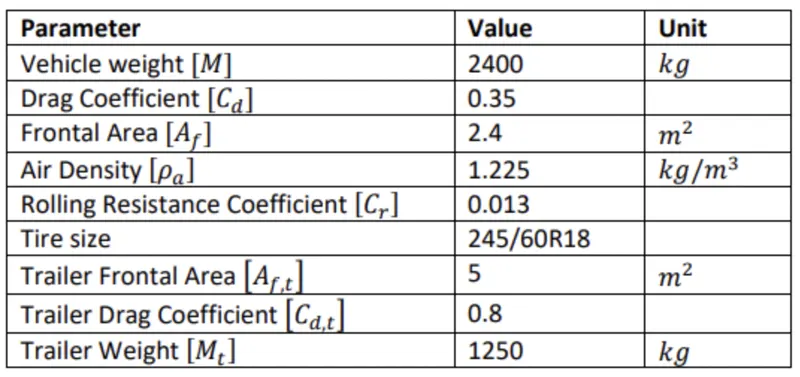
Formulas Used :
- Force : F=Fr+Fω+Fg">F=Fr+Fω+FgF=Fr+Fω+Fg
- Rolling Force : Fr=Cr⋅M⋅g⋅cosθ">Fr=Cr⋅M⋅g⋅cosθFr=Cr⋅M⋅g⋅cosθ
- Acceleration Force : Fω=(12)⋅ρa⋅Af⋅Cd⋅(Vveh+Vw)2">Fω=(12)⋅ρa⋅Af⋅Cd⋅(Vveh+Vw)2Fω=(12)⋅ρa⋅Af⋅Cd⋅(Vveh+Vw)2
- Hill Climbing Force : Fg=M⋅g⋅sinθ">Fg=M⋅g⋅sinθFg=M⋅g⋅sinθ
- Power : P=F⋅Vveh">P=F⋅VvehP=F⋅Vveh
- Energy : E=P⋅t">E=P⋅tE=P⋅t
Where, t = Time
M = Mass or Weight of the Vehicle and Passenger Weight.
g = Gravity
Cr">CrCr = Rolling Resistance Coefficient
Pa">PaPa = Air Density
Af">AfAf = Frontal Area
Cd">CdCd = Drag Coefficient
Vveh">VvehVveh = Velocity of Vehicle
Vw">VwVw = Velocity of Wind
θ">θθ = Angle
P">PP = power
E">EE = Energy.
Vehicle Architecture:
Based on the design and flexibility of the hybrid powertrain there are structurally different types of hybrid vehicles. The architecture is based on the mechanical and electrical connection between the power source, along with how power flow takes place.
Regenerate braking:
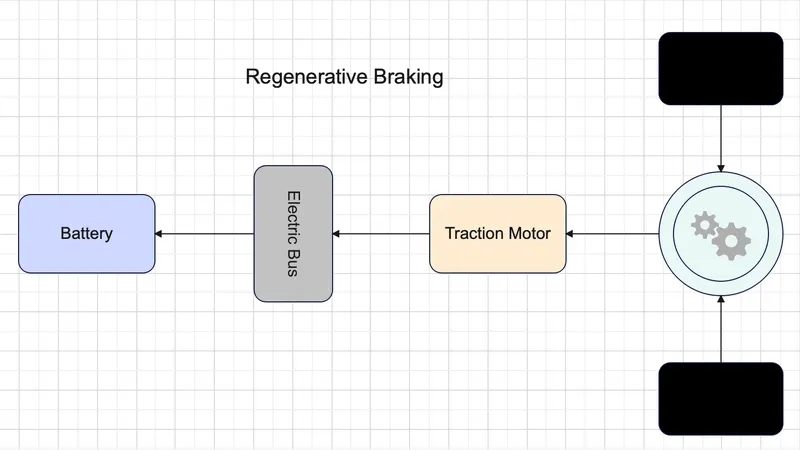
A hybrid electric vehicle cannot be plugged in for the battery to charge. The battery is charged with the help of regenerative braking and by the internal combustion engine. It helps to transform kinetic energy produced by the moving car into electrical energy stored back in the batteries.
The electric motor powers the vehicle as well as resists its motion. When you apply brakes to slow down, this resistance slows down the wheel and simultaneously recharges the batteries.
Types of Hybrid Vehicle :
- Series Hybrid Vehicle
- Paralle Hybrid Vehicle
- Fuel Cell Vehicle
Series Hybrid Vehicle :
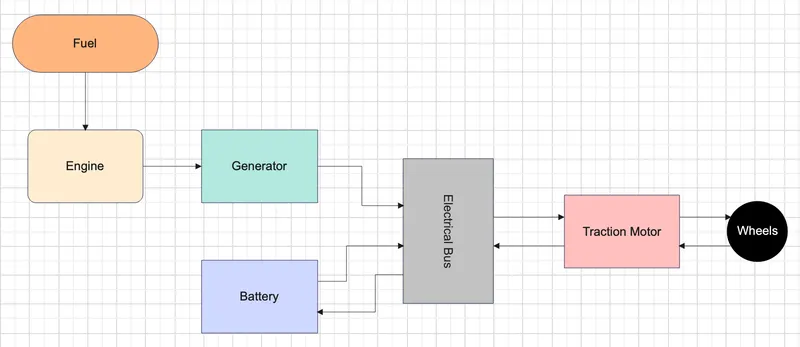
- Two power sources feed a single powerplant which is connected to the wheels.
- A unidirectional energy source is a fuel tank, unidirectional energy converter is an ic engine coupled with an electric generator.
- The bi-directional energy source is a battery, with a traction motor as the bi-directional energy converter, which is the powerplant that propulsion power to the wheel.
- The engine is mechanically decoupled with wheels and the traction motor is always coupled with wheels.
- With the help of regenerative braking, the battery gains some energy from the kinetic wheels of the vehicle.
Operating Modes of Series Hybrid Vechicle :
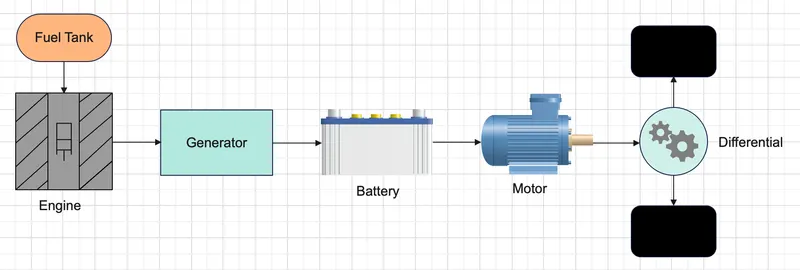
- In this case, a fuel is used as an energy source to propel the engine, when the ic engine creates a reciprocating motion to rotate the generator which is coupled with the ic engine.
- When the generator creates an electric current which is stored in the battery when the battery is act as a capacitor and powers the electric motor.
- When the traction motor is used to create the tractive effort to the wheel. in that case, propulsion can only be provided by the traction motor multiple energy flow are possible.
- The engine is used to only charge the battery.
- Regenerative breaking- vehicle kinetic energy is used to charge the battery through motor breaking.
Advantages Of Series Hybrid Powertrain :
- The need for a complicated multi-speed transmission and clutch is eliminated in series hybrids since only the electric motor directly drives the transmission, which may have one gear. Gasoline engines in series hybrids tend to be smaller and more efficient since they do not directly power the vehicle and are not subject to the highly variable power demands of stop-and-go driving.
- These design features make series hybrids the ideal car for urban and suburban driving conditions. The smaller, more efficient engine and greater use of electric power helps reduce harmful gas emissions in series hybrids.
- Hybrid cars are supported by many credits and incentives that help to make them affordable. Lower annual tax bills and exemption from congestion charges come in the form of less amount of money spent on the fuel.
- A Hybrid car is much cleaner and requires less fuel to run, which means fewer emissions and less dependence on fossil fuels. This, in turn, also helps to reduce the price of gasoline in the domestic market.
- The electric motor assists the internal combustion engine in case of accelerating, passing, or climbing a hill. The gasoline engines used in hybrid cars are usually small, light, and highly efficient as they don't have to power the car alone.
- Hybrid vehicles can be driven entirely with electricity. This usually happens while moving at low speeds, when the engine is idling at a stoplight, or when the engine starts up. Normally, the internal combustion engine starts operating only at higher speeds, where it has more efficiency. This helps increase the overall fuel efficiency of the vehicle.
Disadvantage of Series Hybrid Powertrain :
- The series hybrid requires a larger, more complicated battery and motor to meet its power needs. The larger battery and motor and the addition of a generator often makes the series hybrid more costly than a parallel hybrid.
- Series hybrids are also not as efficient as parallel hybrids for highway driving since the engine is not directly connected to the wheels. Plug-in hybrid models are available in both series and parallel that allow for electric-only operation and zero tailpipe emissions on shorter distance trips. The plug-in feature, however, also adds to the cost.
- Series Hybrid cars are twin-powered engines. The gasoline engine, which is the primary source of power, is much smaller as compared to what you get in single-engine powered cars while the electric motor is of low power. The combined power of both is often less than that of a gas-powered engine. It is therefore suited for city driving and not for speed and acceleration. The disadvantages are to owning a hybrid car are probably not what you think. Contrary to the popular myth, hybrid cars have just as much power as regular cars and have no issue with mountain driving or towing.
- Energy from the engine is converted twice, leading to extra losses due to the inefficiencies of the generator and traction motor.
- Requires a full-size engine if battery does not have high storage capacity.
Parallel hybrid vehicle:
- Multiple powerplants power the wheels together i.e in parallel.
- The engine and electric motor both can provide power to the wheels individually or together.
- Engine and electric motor output power are combined mechanically before going to the wheels.
- Generally, the engine is connected to the wheels using a conventional transmission.
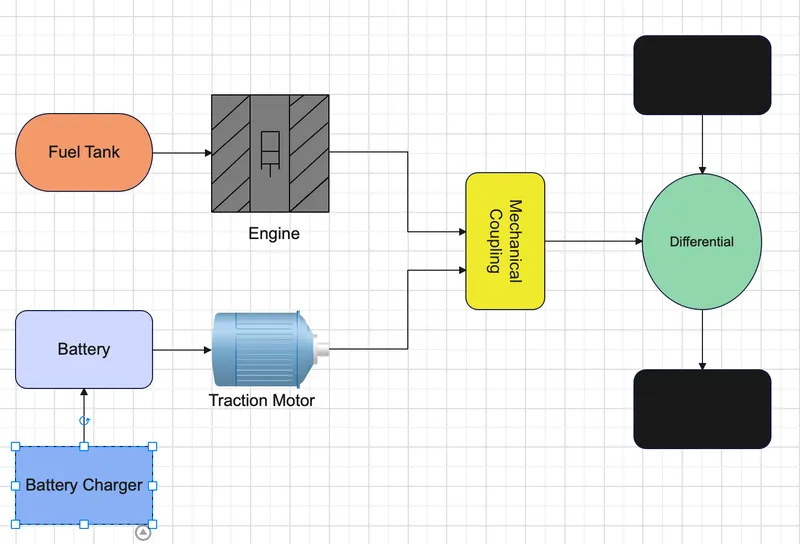
- The operation modes are subjected to the type of parallel hybrid architecture.
- Pure electric driving- Traction motor propels the vehicle using the energy stored in the battery. the engine is off.
- Pure engine driving-Engine powers the wheel, the electric motor is off.
- Hybrid driving-Energy from a fuel-engine and battery electric motor used to propel the vehicle.
- Regenerative braking-vehicle kinetic energy is used to charge the battery through electric motor braking.
Advantages :
- Depending on the connection, both the powerplants can be smaller and more efficient as no single powerplant is required to meet the maximum performance requirements.
- Gives a lot of flexibility in design, for custom design on the application.
Disadvantaes :
- Performance gains might be limited due to architecture, electric motor, and battery size/performance.
- Extra components engine, transmission,electric motor, battery, inverter.
Power Split Hybrid Vehicle :
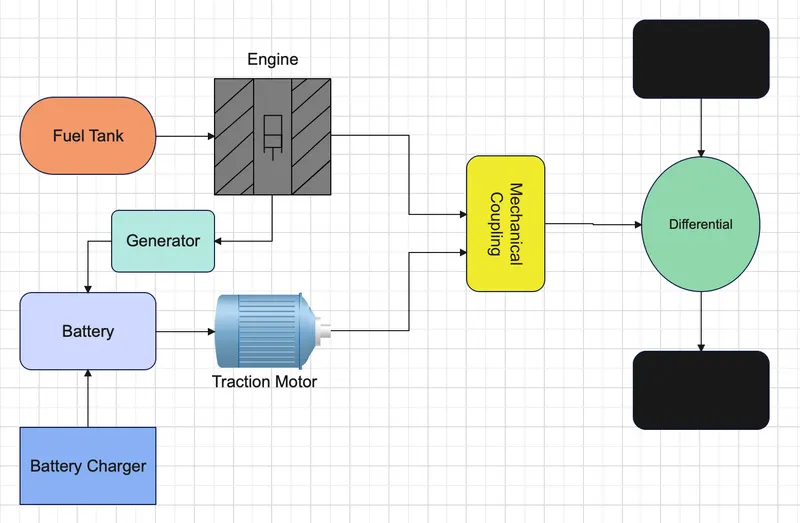
The vehicle can be powered by the gasoline engine working alone, the electric motor by itself, or by both energy
converters working together. Power distribution between the engine and motor is designed so that the engine can
run in its optimum operating range as much as possible.
- Since an electric motor can be used to provide high torque at a lower speed, a small efficient engine, tuned for cruising conditions can be used.
- For cruising, conditions can have a direct mechanical path between the engine and the wheels resulting in higher efficiencies.
- For the transient condition, one can use the traction motor for efficient operation.
- power split device provides the ability of CV(CVT) which enables the engine to operate at its most efficient points.
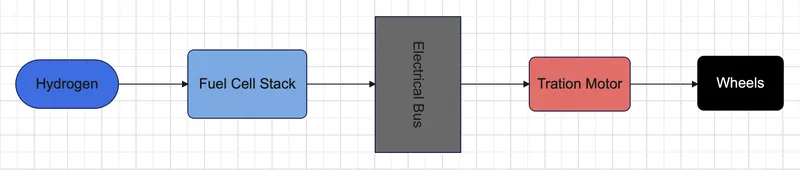
Fuel Cell Hybrid Vehicle :
FCEVs use a propulsion system similar to that of electric vehicles, where energy stored as hydrogen is converted to electricity by the fuel cell. Unlike conventional internal combustion engine vehicles, these vehicles produce no harmful emissions. Other benefits include increasing U.S. energy resiliency through diversity and strengthening the economy.
FCEVs are fueled with pure hydrogen gas stored in a tank on the vehicle. Similar to conventional internal combustion engine vehicles, they can fuel in less than four minutes and have a driving range of over 300 miles. FCEVs are equipped with other advanced technologies to increase efficiency, such as regenerative braking systems that capture the energy lost during braking and store it in a battery. Major automobile manufacturers are offering a limited but growing number of production fev to the public in certain markets, in sync with what the developing infrastructure can support.