Week 2 Railwheel and Track
Aim:-
To Perform a track simulation by applying and varying the bearing load on the wheel center, and analysis of various results such as Equivalent stress, Total deformation, and Equivalent Elastic strain in Rail wheel track, also include the comparison of cases of varying bearing load.
Case setup and Execution:-
1. Geometry:-
The given geometry was Imported and checked in space claim for discontinuity.
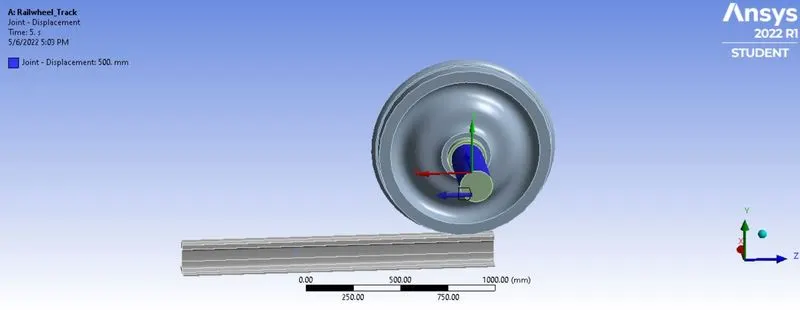
Fig 1. Given geometry
2. Material Assignment:-
Structural steel is assigned to the geometry.
3. Contacts:-
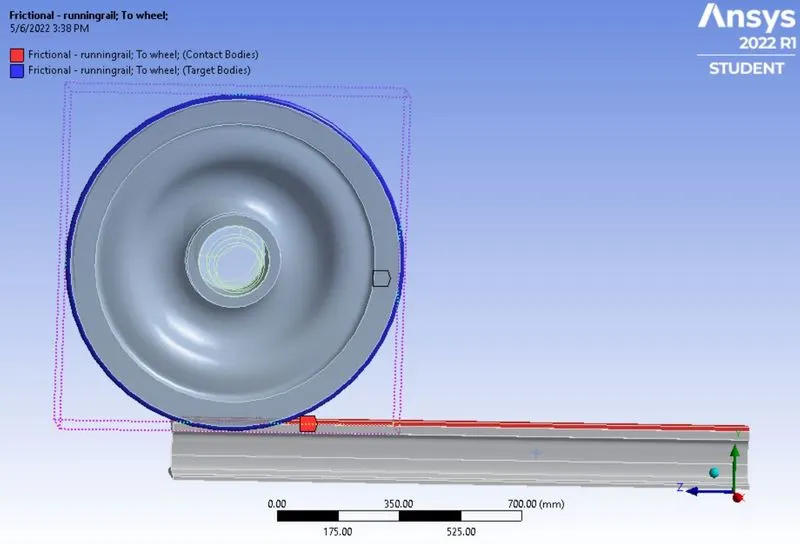
Fig 2. Frictional contact
1. Frictional contact is given between Track and wheel with a Coefficient of O.3
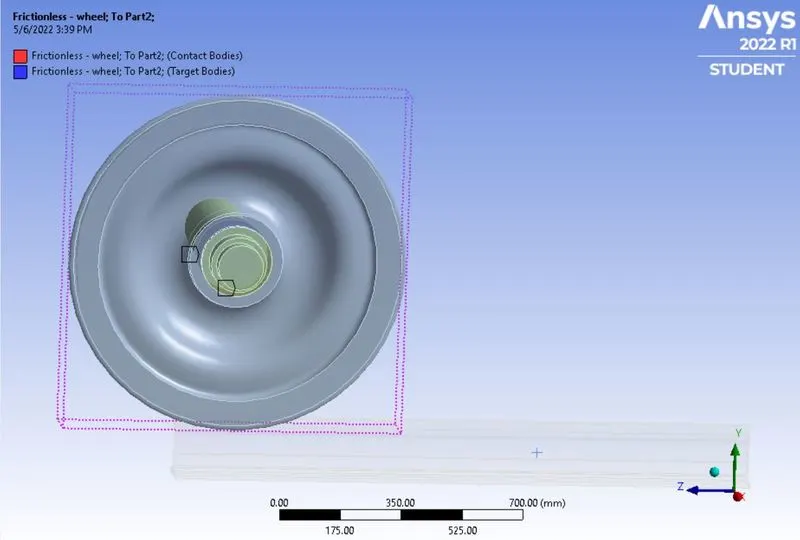
Fig 3. Frictionless Contact
2. Frictionless contact is given between shaft and wheel
4. Joints:-
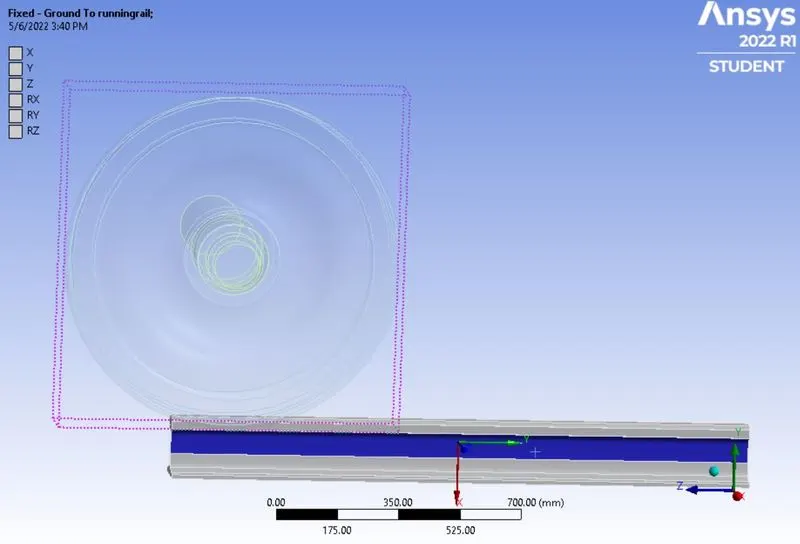
Fig 4. Fixed Joint
1. Fixed type of Joint is given to the track.
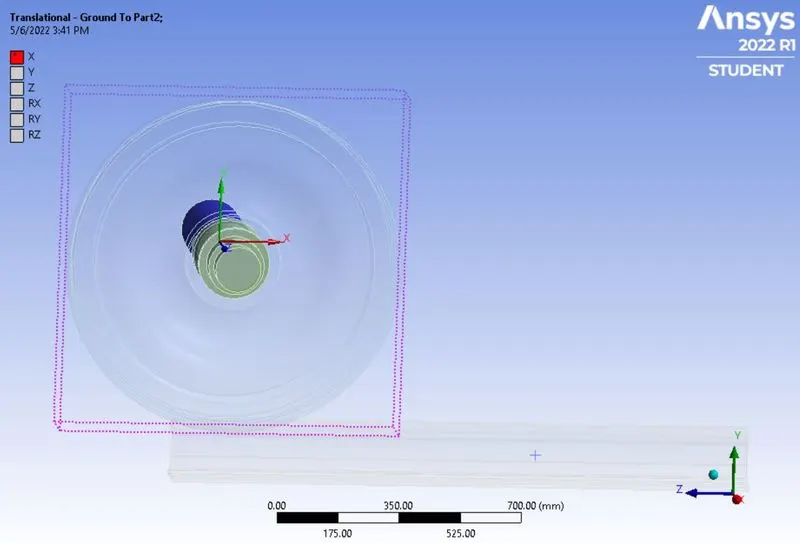
Fig 5. Translational Joint
2. Translational Joint is given to shaft
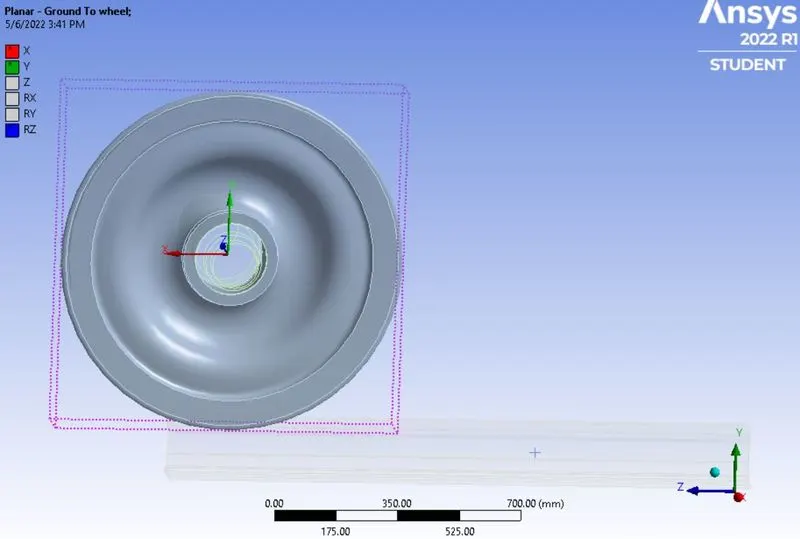
Fig6.Translational Joint
3.Planar Joint is given to Wheel
Fig 7. Planar Joint
Mesh:-
1.Face sizing is used to give mesh with element size of 35 mm and overall size of 50 mm
Analysis settings:-
1.In analysis settings, number of steps is given as 5 with auto time step as on where minimum time step is 1e^-3
and maximum time step is 0.1 seconds.
2.Bearing load is given as -100000N in 1st case and -500000N in 2nd case.
3.Translational Joint is given to shaft with x-displacement.
Results:-
Case1 Bearing load of -100000N
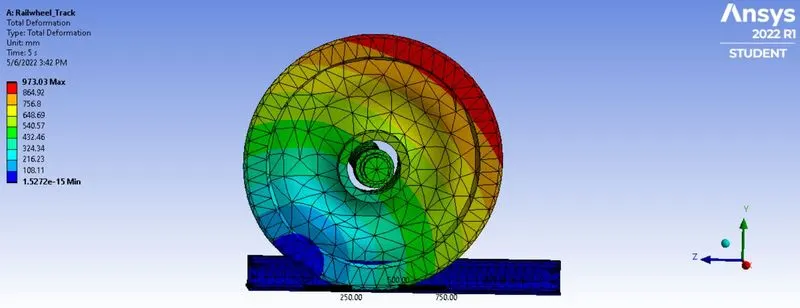
Fig1.Total Deformation ( -100000 N)
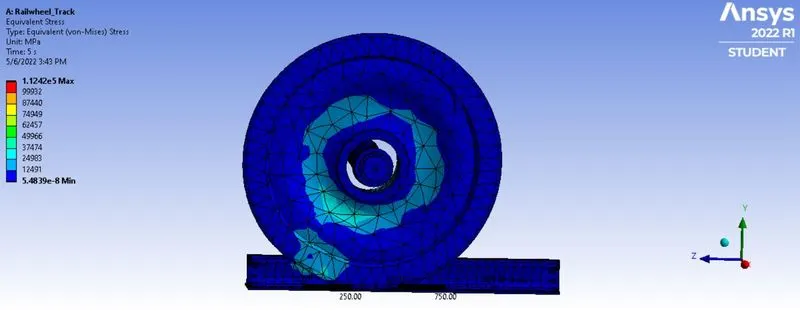
Fig 2. Equivalent stress ( -100000 N)
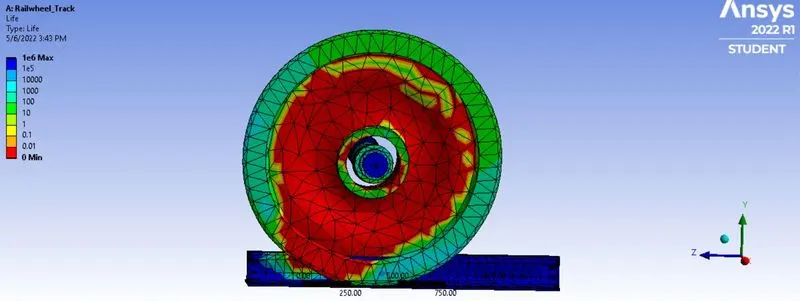
Fig 3. Life( -100000 N)
Case 2:-
Bearing load of -500000N
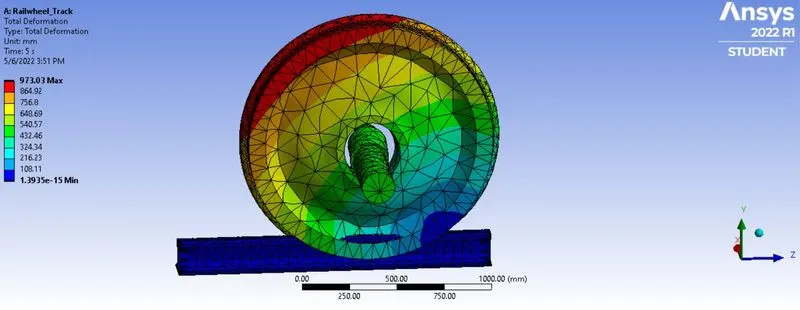
Fig 4. Total Deformation ( -500000N)
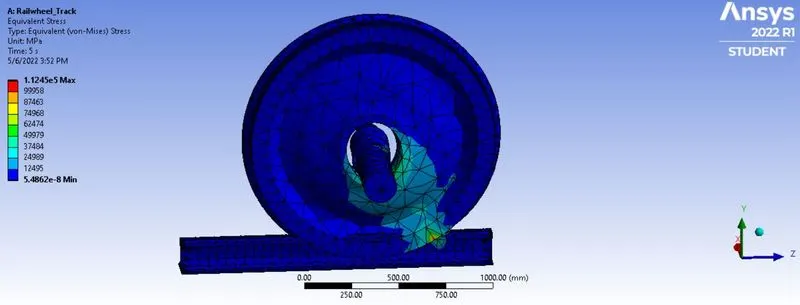
Fig 5. Equivalent stress ( -500000 N)
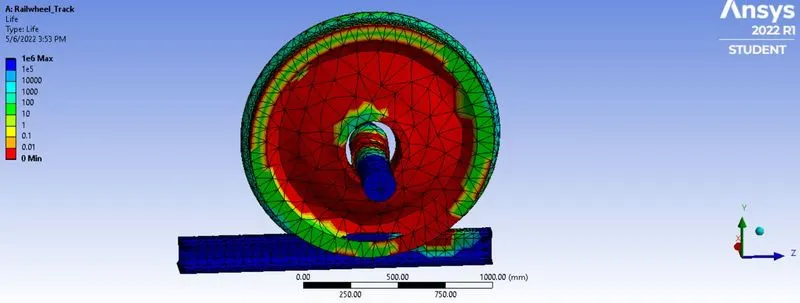
Fig 6. Life( -500000N)
Comparison:-
Bearing load Total Deformation Equivalent stress Life
Case 1 973.03 1.1242e5 1e^6
Case 2 973.03 1.1245e5 1e^6
Conclusion:-
The comparison is direct , as the load in the second case is higher maximum stress generation is appearing there,but the life of both the simulation is same, it means the model and the material assigned to the bodies are sustaining both the loads with the same fatigue occurence the behaviour is similar and the model is sustaining both the loading case (or) even higher the load will be carried out by the setup because the ultimate tensile strength of structural steel is way higher than the stress generated during simulation.Total deformation is same and equivalent stress has slight variation.Thus, conclusion of the analysis is the structural set up is having higher factor of safety to sustain even more load than the 500000 N