Project-1: Powertrain for aircraft in runways
- List out the total weight of various types of aircrafts.
| Aircraft | Empty Weight | Max Fuel Weight | Max Cargo Weight | Max Gross Takeoff Weight |
| Antanov AN-225 | 628,000 lbs | 661,400 lbs | 417,000 lbs | 1,411,000 lbs |
| 285,000 kg | 300,000 kg | 190,000 kg | 640,000 kg | |
| Airbus A380-800 | 611,000 lbs | 560,000 lbs | 185,000 lbs | 1,268,000 lbs |
| 277,000 kg | 254,000 kg | 84,000 kg | 575,000 kg | |
| Boeing 747-800 | 485,300 lbs | 427,400 lbs | 295,000 lbs | 987,000 lbs |
| 220,100 kg | 194,000 kg | 134,000 kg | 447,700 kg | |
| Airbus A340-500 | 370,000 lbs | 386,300 lbs | 119,000 lbs | 820,000 lbs |
| 168,000 kg | 175,000 kg | 54,000 kg | 372,000 kg | |
| Boeing 777-300ER | 370,000 lbs | 320,800 lbs | 148,000 lbs | 776,000 lbs |
| 168,600kg | 145,500 kg | 67,100 kg | 352,000 kg | |
| Boeing 787-10 | 299,000 lbs | 223,500 lbs | 126,300 lbs | 560,000 lbs |
| 135,500 kg | 101,500 kg | 57,300 kg | 254,000 kg | |
| Boeing 737-900 | 98,500 lbs | 53,100 lbs | 44,600 lbs | 187,000 lbs |
| 44,700 kg | 24,000 kg | 20,200 kg | 85,000 kg | |
| Airbus A320-100 | 93,900 lbs | 48,700 lbs | 44,000 lbs | 150,000 lbs |
| 42,600 kg | 22,100 kg | 20,000 kg | 68,000 kg | |
| Embraer 190 | 63,500 lbs | 28,600 lbs | 28,800 lbs | 106,000 lbs |
| 28,800 kg | 13,000 kg | 13,100 kg | 48,000 kg | |
| Gulfstream G650 | 54,000 lbs | 48,200 lbs | 6,500 lbs | 100,000 lbs |
| 24,500 kg | 21,900 kg | 3,000 kg | 45,200 kg | |
| Bombardier CRJ900 | 48,160 lbs | 19,600 lbs | 6,075 lbs | 80,500 lbs |
| 21,850 kg | 8,900 kg | 2,760 kg | 36,500 kg | |
| Bombardier Q400 | 39,300 lbs | 11,700 lbs | 18,700 lbs | 62,000 lbs |
| 17,800 kg | 5,300 kg | 8,500 kg | 28,000 kg | |
| Learjet 75 | 13,900 lbs | 6,060 lbs | 2,900 lbs | 21,500 lbs |
| 6,300 kg | 2,750 kg | 1,300 kg | 9,700 kg | |
| Cessna Citation CJ4 | 10,300 lbs | 5,800 lbs | 2,200 lbs | 17,200 lbs |
| 4,700 kg | 2,650 kg | 1,000 kg | 7,800 kg | |
| Beechcraft King Air B100 | 7,100 lbs | 3,200 lbs | 4,150 lbs | 12,000 lbs |
| 3,200 kg | 1,450 kg | 1,900 kg | 5,400 kg | |
| Diamond DA50 RG | 3,200 lbs | 340 lbs | 1,250 lbs | 4,400 lbs |
| 1,450 kg | 155 lbs | 560 kg | 2,000 kg | |
| Beechcraft Bonanza G36 | 2,500 lbs | 450 lbs | 850 lbs | 3,660 lbs |
| 1,150 kg | 200 kg | 385 kg | 1,660 kg | |
| Cessna 206H | 2,200 lbs | 520 lbs | 1,150 lbs | 3,600 lbs |
| 990 kg | 235 kg | 520 kg | 1,630 kg | |
| Sirrus SR22 | 2,250 lbs | 485 lbs | 950 lbs | 3,600 lbs |
| 1,000 kg | 220 kg | 430 kg | 1,630 kg | |
| Cessna 172R | 1,700 lbs | 380 lbs | 560 lbs | 2,425 lbs |
| 770 kg | 170 kg | 255 kg | 1,100 kg |
- The Maximum Zero Fuel Weight:
The maximum zero fuel weight (MZFW) is the maximum weight allowed before usable fuel and other specified usable agents (engine injection fluid, and other consumable propulsion agents) are loaded in defined sections of the aircraft as limited by strength and airworthiness requirements.
- Max Gross Takeoff Weight:
The maximum takeoff weight (MTOW) or maximum gross takeoff weight (MGTOW) or maximum takeoff mass (MTOM) of an aircraft is the maximum weight at which the pilot is allowed to attempt to take off, due to structural or other limits.
- Difference between ground speed and air speed
Air speed:
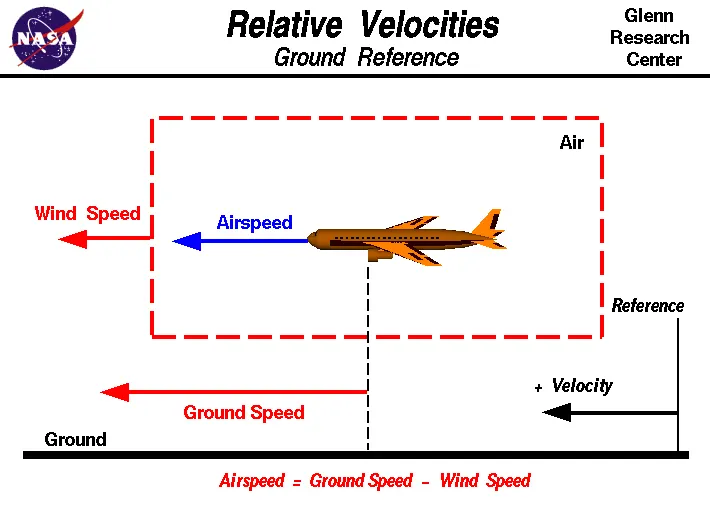
The important quantity in the generation of lift is the relative velocity between the object and the air, which is called the airspeed. Airspeed cannot be directly measured from a ground position, but must be computed from the ground speed and the wind speed. Airspeed is the vector difference between the ground speed and the wind speed.
Airspeed = Ground Speed - Wind Speed
On a perfectly still day, the airspeed is equal to the ground speed. But if the wind is blowing in the same direction that the aircraft is moving, the airspeed will be less than the ground speed.
Ground speed:
Ground speed is the horizontal speed of an aircraft relative to the Earth’s surface. It is vital for accurate navigation that the pilot has an estimate of the ground speed that will be achieved during each leg of a flight.
Ground speed can be determined by the vector sum of the aircraft's true airspeed and the current wind speed and direction; a headwind subtracts from the ground speed, while a tailwind adds to it. Winds at other angles to the heading will have components of either headwind or tailwind as well as a crosswind component.
Air speed vs Ground speed:
As mentioned above, true airspeed is simply the speed at which an aircraft is moving relative to the air it is flying in. As such, it’s also the speed at which the air is flowing around the aircraft’s wings.
Ground speed, on the other hand, is the aircraft’s speed relative to the ground. One thing that should be noted here is that it’s its horizontal rather than vertical speed – an aircraft climbing completely vertically would have a ground speed of zero.
In other words, while airspeed is what determines whether there is enough airflow around an aircraft to make it fly, ground speed is what determines how fast an aircraft will get to its destination.
- Why is it not recommended to use aircraft engine power to move it on the ground at Airport?
Reverse thrust technology allows the majority of aeroplanes to move themselves in reverse. However, in most cases, it is not viable because using reverse propulsion by aeroplanes would result in significant fuel consumption, noise, and safety risks for nearby workers.
Reverse thrust should not be used since the jet explosion may harm terminal buildings or their equipment. The engine will blow off the sand and debris ahead, sucking it to the engine and damaging it because of how near it is to the ground.
We employ a towing vehicle to help handle this kind of problem. The towing vehicle will be pulled until it reaches a safe location, at which point the aeroplane will proceed independently to continue the takeoff. The jet-blast of the aircraft engines or the propwash from their propellers won't cause any harm or hazard to neighbouring structures, ground personnel, other aircraft, or ground handling equipment when aeroplanes are moved via towing.
- How an aircraft is pushed to runway when its ready to take off?
An aircraft can be pushed to runway using two techniques:
- Use the engines to provide reverse thrust:
Reverse thrust technology allows the majority of aeroplanes to move themselves in reverse.
- Use a tow vehicle:
The engines are used to generate reverse thrust by employing deflector scoops on each engine to direct the thrust airflow slightly forward and sideways. This has consequences but is primarily used to help slow down the aircraft after landing. It can also allow the aircraft to reverse.
Reverse thrust could be used to back out of a gate on older aircraft with their engines situated high up on the back, but most modern aircraft have their engines mounted beneath the wing, placing them near to the ground.
Reverse thrust requires a high power setting to initiate beginning motion in an aircraft. This creates a high-speed wind that can easily damage the airport terminal, jetway, surrounding ground vehicles, baggage, and ground personnel and cause debris to be ingested by the engine which is not good.
By far the most common option is to use a tow vehicle to hook up to that airplane and propel it backward without the airplane’s engines running.
- Learn about take off power, tyre design, rolling resistance, tyre pressure, brake forces when landing.
Take off Power:
Takeoff is the phase of flight in which an aerospace vehicle leaves the ground and becomes airborne. For aircraft traveling vertically, this is known as liftoff. For aircraft that take off horizontally, this usually involves starting with a transition from moving along the ground on a runway.
The takeoff speed required varies with aircraft weight and aircraft configuration (flap or slat position, as applicable), and is provided to the flight crew as indicated airspeed.
For light aircraft, usually full power is used during takeoff. Large transport category (airliner) aircraft may use a reduced power for takeoff, where less than full power is applied in order to prolong engine life, reduce maintenance costs and reduce noise emissions. In some emergency cases, the power used can then be increased to increase the aircraft's performance. Before takeoff, the engines, particularly piston engines, are routinely run up at high power to check for engine-related problems. The aircraft is permitted to accelerate to rotation speed (often referred to as Vr). The term rotation is used because the aircraft pivots around the axis of its main landing gear while still on the ground, usually because of gentle manipulation of the flight controls to make or facilitate this change in aircraft attitude
Tyre Design:
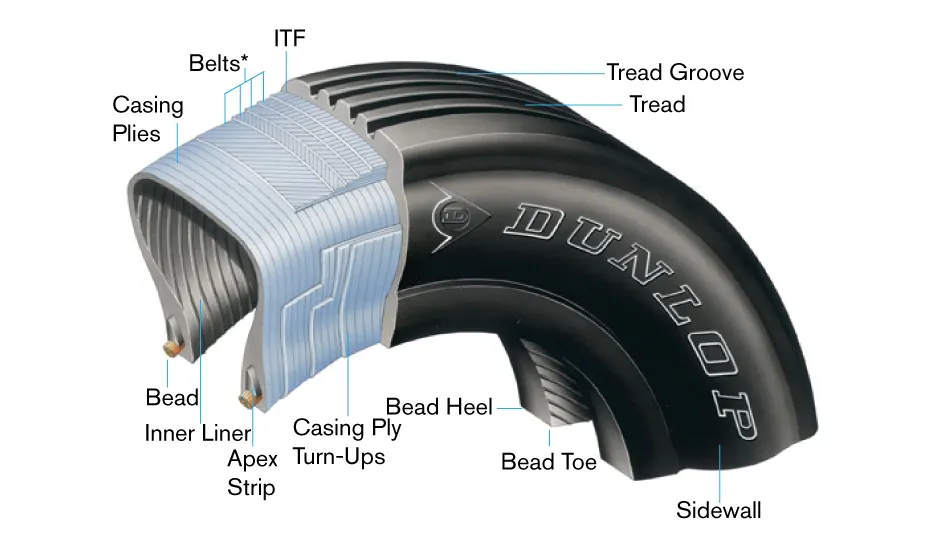
An aircraft tire or tyre is designed to withstand extremely heavy loads for short durations. The number of tires required for aircraft increases with the weight of the aircraft, as the weight of the airplane needs to be distributed more evenly. Aircraft tire tread patterns are designed to facilitate stability in high crosswind conditions, to channel water away to prevent hydroplaning, and for braking effect.
Aircraft tires also include fusible plugs (which are assembled on the inside of the wheels), designed to melt at a certain temperature. Tires often overheat if maximum braking is applied during an aborted takeoff or an emergency landing. The fuses provide a safer failure mode that prevents tire explosions by deflating in a controlled manner, thus minimizing damage to aircraft and objects in the surrounding environment.
Rolling Resistance:
Rolling resistance, sometimes called rolling friction or rolling drag, is the force resisting the motion when a body (such as a ball, tire, or wheel) rolls on a surface. It is mainly caused by non-elastic effects; that is, not all the energy needed for deformation (or movement) of the wheel, roadbed, etc., is recovered when the pressure is removed.
Any coasting wheeled vehicle will gradually slow down due to rolling resistance including that of the bearings. Additional contributing factors include wheel diameter, load on wheel, surface adhesion, sliding, and relative micro-sliding between the surfaces of contact. The losses due to hysteresis also depend strongly on the material properties of the wheel or tire and the surface.
Brake Forces when landing:
Aircraft brakes stop a moving aircraft by converting its kinetic energy to heat energy by means of friction between rotating and stationary discs located in brake assemblies in the wheels.
- Calculate the force and power required to push/pull an aircraft by a towing vehicle
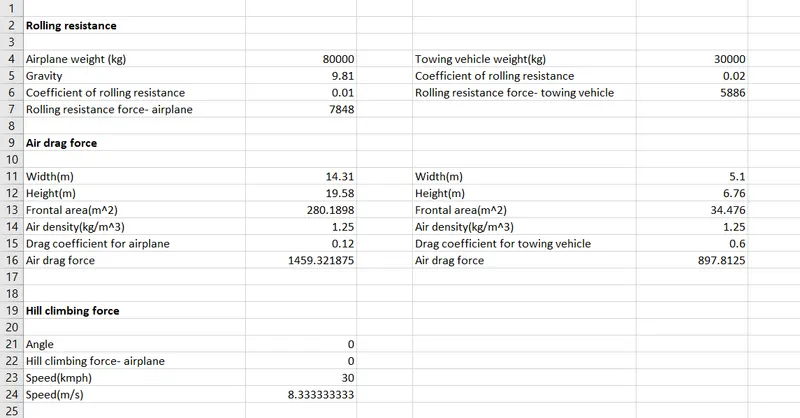
Calculation for the force and power required to push/pull an aircraft by a towing vehicle is calculated using excel sheet.
We know that,
- Rolling resistance force,Frr = urr*m*g
where, m= mass of vehicle(kg)
g= gravity(N/m^2)
urr= rolling resistance coefficient
- Air drag force, Fad= 0.5*rho*A*Cd*(V^2)
where, rho= air density(kg/m^3)
A= frontal area(m^2)
Cd= air drag coefficent
V= velocity(kmph)
- Hill climbing force, Fhc= m*g*sin(theta)
where, theta= angle of elevation
- Acceleration force, Fa= m*a
where, a= acceleration of vehicle(m/s62)
Calculation:
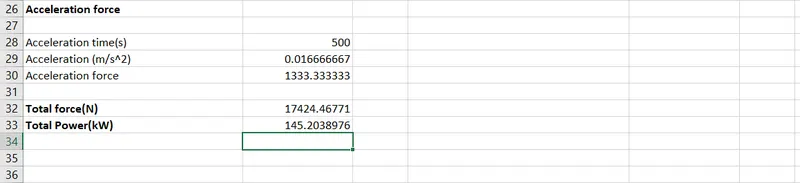
- Simulink model for the calculated force and power
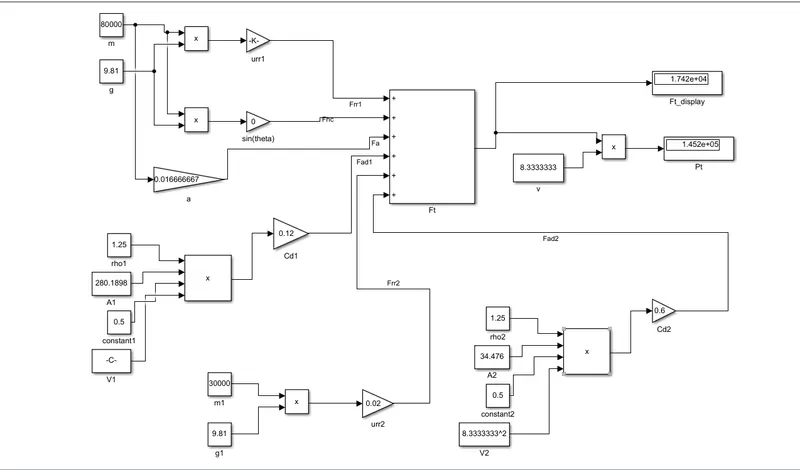
- The simulink model values can be compared to the excel sheets values.
- It can be observed that both have obtained identical output values.
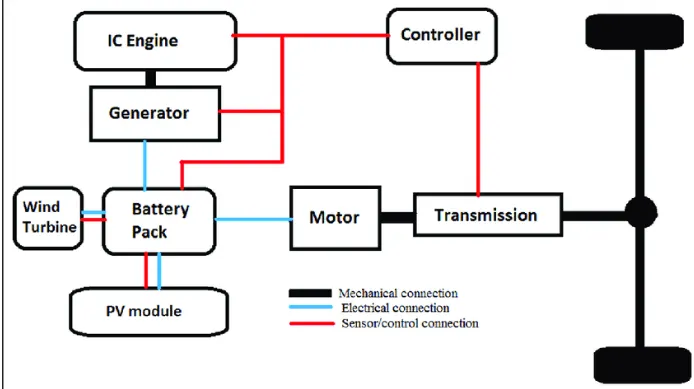
- Design an electric powertrain with type of motor, it’s power rating, and energy requirement to fulfill aircraft towing application in Simulink. Estimate the duty cycle range to control the aircraft speed from zero to highest. Make all required assumptions. Prepare a table of assumed parameters. Draw a block diagram of powertrain.
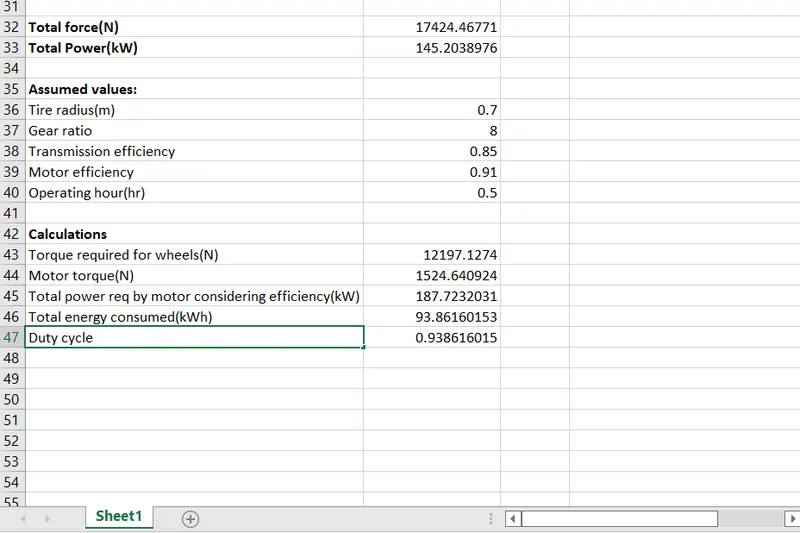
From the previous calculation, we have,
Total traction force, Ft= 17424.46 N
Total traction power, Pt= 145.203kW
Assuming,
Tire radius= 0.7m
Gear ratio=8
Transmission Effeciency (nt) =85%
Motor Efficiency (nm)=91%
Torque required for the wheels, Tw= Ft* tire radius
Tw= 17424.46*0.7 = 12.197 kN
Motor torque= Tw/ gear ratio
= 12.197 kN/8 =1.524kN
Total power required by the motor considering efficiencies, Pt= total power/(nm*nt)
= 145.203kW/(0.91*0.85)= 187.722 kW
Total Energy consumed = Pt*Operating hr
consider operating hour =0.5 hr
E= 187.722 kW*0.5= 93.861 kWh
If the battery capacity is 200 kW
Then the duty ratio = 187.722/200 = 0.93
Therefore, duty cycle range will be 0 to 93%
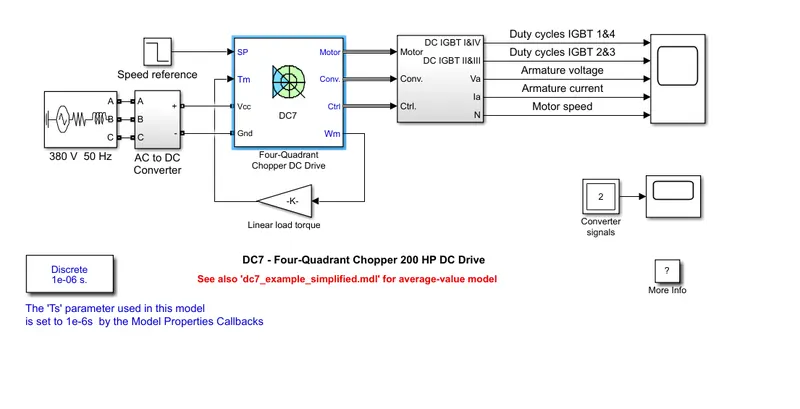
Simulink Model of Aircraft Towing Application Using DC7 Block:
Plot:
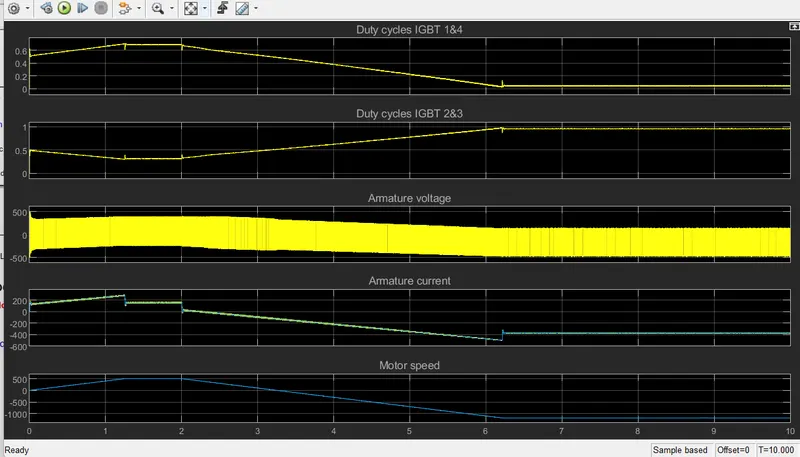
- It can be observed that motor attains high speed and later it slows down and it becomes zero & reverse the speed afterward.
lock diagram of powertrain:
Parameters in excel sheet: