Week 2 Challenge
Compare four different types of fuel cells and state their applications.
Fuel cells are devices that convert chemical energy into electrical energy through electrochemical reactions. There are various types of fuel cells, each with its own advantages and disadvantages, and they are used in a range of applications. Here are four different types of fuel cells and their applications:
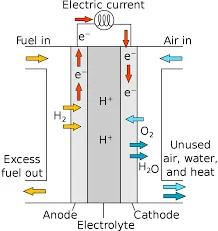
- Proton Exchange Membrane (PEM) Fuel Cells:
PEM fuel cells use a polymer electrolyte membrane to transport protons from the anode to the cathode. They are efficient and operate at low temperatures (typically below 100°C), making them suitable for portable power applications such as laptops, mobile phones, and other small electronics. PEM fuel cells are also used in fuel cell vehicles, where they provide clean, efficient power to propel the vehicle.
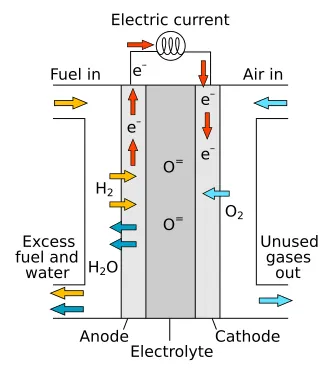
- Solid Oxide Fuel Cells (SOFCs):
SOFCs use a solid ceramic electrolyte to transport ions from the cathode to the anode. They operate at high temperatures (typically between 600°C and 1000°C), which allows them to use a variety of fuels, including natural gas and biogas. SOFCs are suitable for stationary power applications such as combined heat and power (CHP) systems, where they can generate both electricity and heat for buildings and industrial processes.
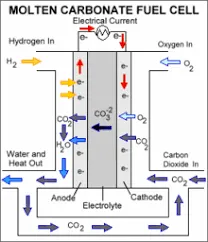
- Molten Carbonate Fuel Cells (MCFCs):
MCFCs use a molten carbonate electrolyte to transport ions from the cathode to the anode. They operate at high temperatures (typically between 650°C and 750°C) and are typically fueled by natural gas. MCFCs are suitable for large-scale stationary power applications such as grid-scale power plants and industrial processes.
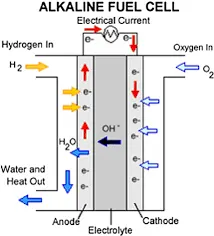
- Alkaline Fuel Cells (AFCs):
AFCs use an alkaline electrolyte to transport ions from the anode to the cathode. They are efficient and operate at low temperatures (typically between 60°C and 80°C), making them suitable for small-scale applications such as backup power for telecommunications systems and off-grid power for remote locations
 .
.
In summary, different types of fuel cells have different applications depending on their operating temperature, efficiency, and fuel requirements. PEM fuel cells are suitable for portable power applications, SOFCs and MCFCs are suitable for stationary power applications, and AFCs are suitable for small-scale backup power applications.
Using a plot with energy density and power density on the X and Y axis, arrange various battery types like lithium ion, lead acid, Nickel Cadmium, Ultracapacitor, fuel cell.
Sure, here is a plot showing the energy density and power density of various battery types, including lithium-ion, lead-acid, nickel-cadmium, ultracapacitors, and fuel cells:
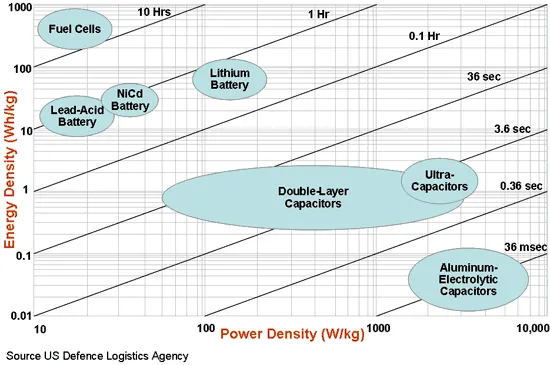
As you can see from the plot, lithium-ion batteries have high energy density and moderate power density, making them well-suited for portable electronic devices and electric vehicles. Lead-acid batteries have lower energy density and power density compared to lithium-ion batteries, but they are still commonly used in automotive and stationary applications due to their low cost and long lifespan.
Nickel-cadmium batteries have higher power density than lead-acid batteries but lower energy density than lithium-ion batteries. They are less commonly used today due to their lower efficiency and environmental concerns regarding the use of cadmium.
Ultracapacitors have very high power density but lower energy density compared to batteries. They are used in applications that require high power bursts, such as regenerative braking in hybrid electric vehicles and smoothing out power fluctuations in renewable energy systems.
Fuel cells have moderate power density and energy density, but their main advantage is their ability to generate electricity continuously as long as fuel is supplied. They are commonly used in stationary power applications, such as backup power systems and grid-scale power generation.