Week 5 Challenge
Consider a scenario where an aggressive driver is accelerating very rapidly and braking harshly in a city driving. Is battery better a choice to supply power than UC in this scenario?
- True
- False
Why?
This statement is False.
- In a scenario where an aggressive driver is accelerating very rapidly and braking harshly in a city driving, ultracapacitors may be a better choice to supply power than batteries.
- Ultracapacitors, also known as supercapacitors, have a higher power density than batteries, which means they can supply and receive electrical energy more quickly.
- This makes them well-suited for applications that require high power bursts, such as acceleration or regenerative braking.
- Ultracapacitors can also handle more charge/discharge cycles than batteries without losing their capacity or performance, which makes them more durable in applications that involve frequent cycling.
- Overall, in a scenario where an aggressive driver is accelerating very rapidly and braking harshly in a city driving, ultracapacitors may be a better choice to supply power than batteries, due to their ability to provide high power bursts and their durability in frequent cycling.
Consider the following components.
1) Lead acid battery 2) Nickel cadmium battery 3) Nickel Metal hydride battery 4) Lithium ion (specify chemistry) battery 5) Ultra Capacitor
Note: In case of a range of energy density, take the average value for the plot.
Create a plot with energy density on the X Axis and cell voltage on the Y axis.
Comment on the capabilities of these batteries based on the plot created.
-
Lead acid battery - Lead acid batteries have a relatively low energy density, typically ranging from 30-50 Wh/kg. They are commonly used in automotive starter batteries, backup power supplies, and other applications where high energy density is not a primary concern.
-
Nickel cadmium battery - Nickel cadmium batteries have a slightly higher energy density than lead acid batteries, typically ranging from 40-60 Wh/kg. They are commonly used in portable electronics, power tools, and other applications where a moderate energy density and long cycle life are important.
-
Nickel Metal Hydride battery - Nickel metal hydride batteries have a higher energy density than nickel cadmium batteries, typically ranging from 60-100 Wh/kg. They are commonly used in hybrid electric vehicles, portable electronics, and other applications where a higher energy density and long cycle life are important.
-
Lithium-ion battery - Lithium-ion batteries have a much higher energy density than the above three battery chemistries, typically ranging from 100-265 Wh/kg, depending on the specific chemistry and design. They are commonly used in electric vehicles, portable electronics, and other applications where a high energy density, low weight, and long cycle life are important. Different lithium-ion battery chemistries have different energy densities, with some of the highest energy densities being found in lithium-polymer batteries.
-
Ultra Capacitor - Ultracapacitors have a very high power density but a relatively low energy density compared to batteries, typically ranging from 1-10 Wh/kg. They are commonly used in applications that require high power bursts, such as regenerative braking, energy storage in power grids, and other applications where a high power density and fast charging/discharging are important.
Plot for energy density vs cell voltage:
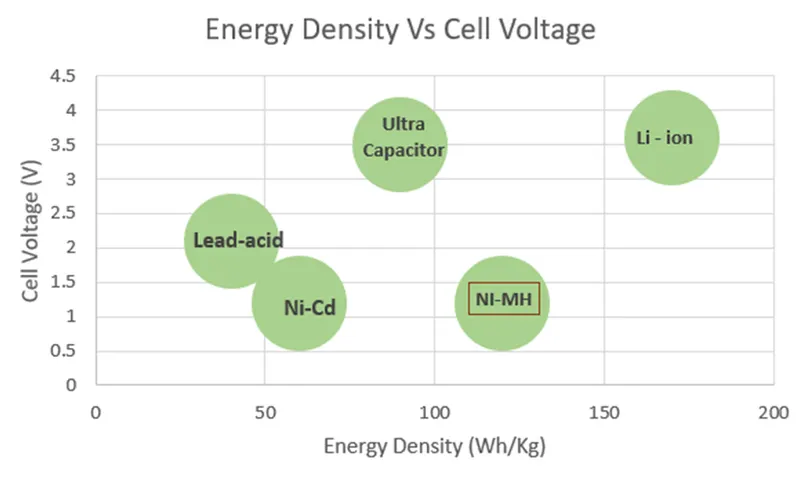
For the above-mentioned components on the same plot (retain the previous plot) created in the previous
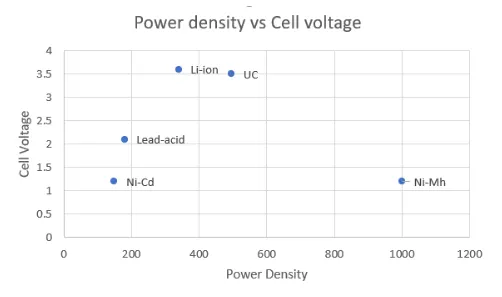
Create a plot with power density on the X axis and cell voltage on the Y axis.
-
Lead acid battery - Lead acid batteries have a relatively low power density, typically ranging from 100-500 W/kg. They also have a low cell voltage, typically around 2 volts per cell.
-
Nickel cadmium battery - Nickel cadmium batteries have a slightly higher power density than lead acid batteries, typically ranging from 500-1000 W/kg. They also have a relatively low cell voltage, typically around 1.2 volts per cell.
-
Nickel Metal Hydride battery - Nickel metal hydride batteries have a higher power density than nickel cadmium batteries, typically ranging from 1000-2000 W/kg. They also have a higher cell voltage than nickel cadmium batteries, typically around 1.2-1.4 volts per cell.
-
Lithium-ion battery - Lithium-ion batteries have a much higher power density than the above three battery chemistries, typically ranging from 2000-5000 W/kg, depending on the specific chemistry and design. They also have a higher cell voltage than the above three battery chemistries, typically ranging from 3-4 volts per cell. Different lithium-ion battery chemistries have different power densities and cell voltages.
-
Ultra Capacitor - Ultracapacitors have a very high power density, typically ranging from 10,000-50,000 W/kg. They also have a relatively low cell voltage, typically around 2-3 volts per cell.
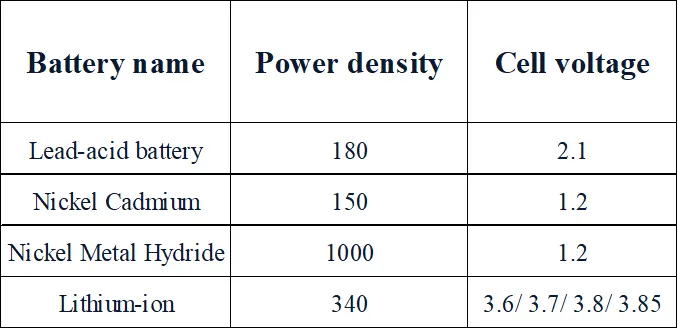
Plot for power density vs cell voltage
Consider the following scenario:
A battery has just been manufactured in the industry and has been connected to a charger for the first time. The electrode marked as (1) in the picture below is the negative electrode.
- True
- False
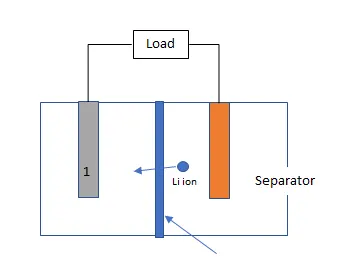
The statement is True.
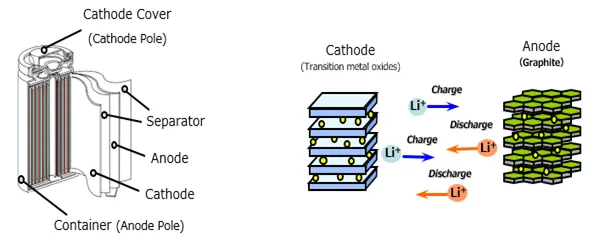
A seperator, which is an ionic conductor, is used to transfer Li ions from the cathode to the anode during charging. Li+ ions and e - ions are intercalated in the graphite when the DC source is connected during charging such that a positive potential is formed between the cathode and source. This attracts the e- from the cathode and causes the lithium metal oxide to split into metal oxide. As a result, the Li cell progresses in an unstable condition as the potential difference between the cathode and anode grows.
When the external load is connected, it establishes a channel so that the e- flows via external and Li + ions through seperator and interact with metal oxide to produce lithium metal oxide. During discharge, Li+ ions migrate from Anode to Cathode because the potential difference is significant.