Week 2 Session 7
Compare the different architectures of HEV. Discuss the pro's and con's.
Series Hybrid:
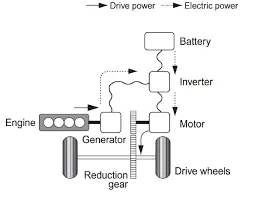
HEV series consists of the ICE, generator, power converter, motor, and battery. There is no mechanical connection between the ICE and the transmission, so the ICE will work at the maximum efficient point by controlling the output power of the battery to fulfill the vehicle's required power. However, the power from the ICE is transferred via the generator and the engine, so much more energy is lost. Because the engine is the final and sole drive unit, the engine must be sufficiently large to meet the vehicle's output, so the regenerative braking power can almost be stored by the engine in the battery.
In the HEV series, when it has to be recharged, an electric motor, coupled to an ICE, supplies electricity to the electric machine to drive the vehicle and to the energy storage system. One of the main benefits of the series is that the speeds of
the engine and car are decoupled. As a result, the engine will run at its peak, substantially reducing the consumption of fuel.
However, because the electrical machine is the only one connected to the wheels and the engine/generator set is sized for
sustained grade power, this design includes a large pack of energy storage device, electrical machine and engine, adding
inefficiencies and weight.
Ex: BMW- i3, Karma Fisker
Pro's:
- The need for a complicated multi-speed transmission and clutch is eliminated in series hybrids since only the electric motor directly drives the transmission, which may have one gear.
- Gasoline engines in series hybrids tend to be smaller and more efficient since they do not directly power the vehicle and are not subject to the highly variable power demands of stop-and-go driving.
- These design features make series hybrids the ideal car for urban and suburban driving conditions.
- The smaller, more efficient engine and greater use of electric power helps reduce harmful gas emissions in series hybrids.
Con's:
- The series hybrid requires a larger, more complicated battery and motor to meet its power needs.
- The larger battery and motor and the addition of a generator often makes the series hybrid more costly than a parallel hybrid.
- Series hybrids are also not as efficient as parallel hybrids for highway driving since the engine is not directly connected to the wheels.
Parallel Hybrid:
Parallel HEV allows both the electric motor and ICE to deliver power to drive the vehicle in parallel, i.e. the ICE and motor can drive, respectively, or together. There is a mechanical relation between the ICE and the transmission, unlike the HEV series, and therefore the rotational speed of the ICE depends on the driving cycle, so that the ICE can run on the optimum running line by controlling the battery output power.
Both the electric vehicle and the engine have mechanical connections to the wheels of parallel hybrids. Since both the electric machine and the engine are directly connected to the wheels, the power can be shared during accelerations. Compared to series hybrids, it is also possible to downsize both the engine and the electric motor. Since the ICE speed is linked to the vehicle speed, the ICE can operate close to its best efficiency curve only under certain conditions. However, since both mechanical and electrical energies can be used to directly propel the vehicle, the powertrain efficiency is increased compared to series configuration during most operating conditions.
Ex: Honda Civic IMA
Pro's:
- Overall efficiency is high over long distances.
- More flexibility.
- Economical gain.
Con's:
- It has a complex design.
- I.C.E is not decoupled with the wheels; so it cannot be charged at standstill.
- It doesn’t operate in a narrow range of RPM and so the efficiency is low at low rotation speed.
Series/Parallel:
HEV combination combines the features of both series and parallel HEV, adding an additional mechanical link between ICE and transmission compared to the hybrid series, and also adding an additional generator compared to the parallel hybrid between ICE and power converter. Although structural complexity contributes to more costly production.
To build an incredibly successful method, the HEV mix blends the best elements of both series and parallel hybrids. This
system splits the power of the engine into two routes: one goes to the generator to generate electricity and one goes to drive
the wheels via a mechanical gear system. In general, the series path is avoided as it is less efficient. The key additional
characteristic is that the speeds of the engine, generator and motor are decoupled, allowing additional power independence.
Ex: Toyota Prius, or Chevrolet Volt
Pro's:
- By combining the two designs, the engine can both drive the wheels directly (as in the parallel drivetrain), and be effectively disconnected, with only the electric motor providing power (as in the series drivetrain).
- With gas-only and electric-only options, the engine operates at near optimum efficiency more often. At lower speeds it operates more as a series vehicle, while at high speeds, where the series drivetrain is less efficient, the engine takes over and energy loss is minimized.
Con's:
-
This system incurs higher costs than a pure parallel hybrid since it requires a generator, a larger battery pack, and more computing power to control the dual system.
- Control complexity.