Week-6 Challenge: EV Drivetrain
1.
- DC-DC Converter
- DC-DC converter is an electronic circuit that converts DC voltage from one voltage level to another. It can be step up or step down of voltage.
- This type of converter is also known as chopper.
- The electric components inside the vehicle vary in their voltage requirements, with most running on much lower voltage. This includes radio, dashboard readouts, air conditioning, and in-built computers and displays.
- It can be unidirectional or bidirectional.
- Most of the components are bidirectional, allowing power to go from the battery to the inverter, which rotates the motor.
- When decelerating, the vehicle's momentum turns the motor, which is now acting as a generator, drives power back through the inverter and charges the battery.
- DC-DC converter converts higher voltage DC power from the traction battery pack to the lower-voltage DC power needed to run vehicle accessories and recharge the auxiliary battery.
- DC-AC Convetrer
- DC-AC converter change a dc input voltage to a symmetric ac output voltage of desired magnitude and frequency.
- This type of converter is also known as inverter.
- The inverter can change the speed at which the motor rotates by adjusting the frequency of the alternating current.
- When the vehicle has to be accelerated, the accelerator pedal sends a signal to the controller which adjusts the vehicle's speed by changing the frequency of the AC power from the inverter to the motor.
- AC-DC Converter
- AC-DC converter takes a harmonic AC input and converts it to a DC output.
- These concerters are also known as rectifiers.
- Inverters are used in Ev/Hev mainly for the on-board charging purpose. Since the charging stations use AC power to charge the vehicle and the battery stores DC power, rectifiers are used to convert AC-DC.
2.
Given,
Rated Armature voltage,Va= 72 V
Rated armature current, Ia= 400 A
Ra= 0.5Ω
KΦ= 0.7 Volt second
Chopper Switching frequency= 400 Hz
Duty cycle= 70%(0.7)
Speed- Torque characteristics is given by:
 ............................(1)
To find voltage, V:
V= Va* duty cycle
V=72*0.7
V= 50.4V
To find Torque,Tv:
Tv= (V*KΦ- ((KΦ)^2*w))/Ra
=(50.4*0.7)-((0.7)^2*w))/0.5
Tv= 70.56-0.98w .........................................(2)
Comparing equation (1) & (2), we get,
(0.0051)w^2+0.98w-45.86=0
By solving the quadratic equation, we get,
w= -231.07 ,w=38.91
Neglecting negative value,
the steady state speed, w= 38.91 rad/s ~ 371.75rpm
By substituting the value of w in equation (2), we get
Tv= 32.4N-m
3. Mathematical model of a DC motor for the given equation:
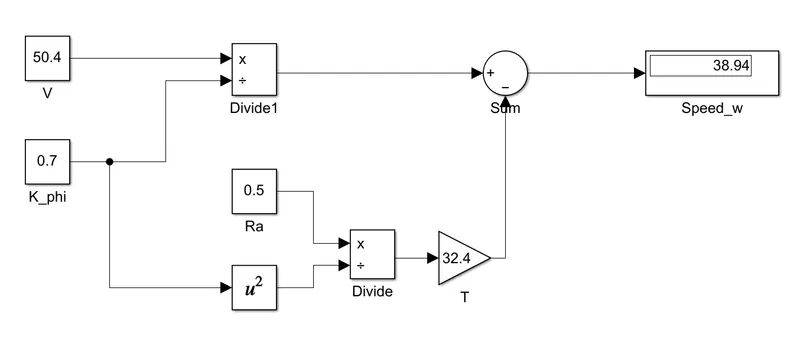
- The speed(w) has been calculated using the given equation for a DC motor.
4.
- The author thinks both BLDC and induction motors will rule over automotives in Ev and Hev segments since PMSM is expensive and come with complex control of rotors.
- He also thinks that the hybrid and upcoming plug-in hybrid markets are anticipated to continue to be dominated by BLDCs, while the high-performance pure electrics market is likely to continue to be dominated by Induction motors.
- He's keen to know what will occur as hybrids' electrical requirements increase and their performance levels rise.