Week 6 Session 13
Discuss two new trends in battery system field.
i. Cloud-Bsed BMS
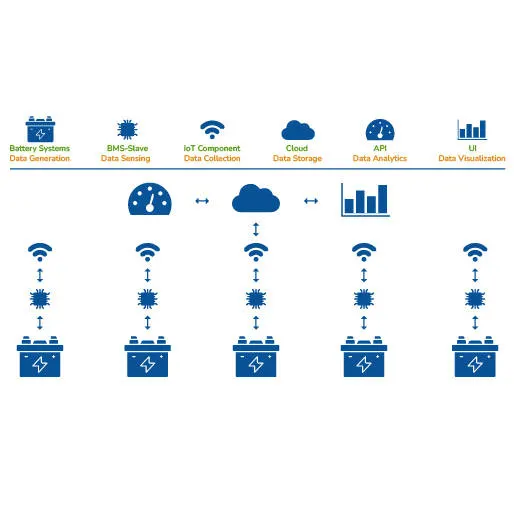
The BMS keeps track of the battery's SoC (State of Charge), voltage, current, and temperature. By keeping the temperature steady, it is essential for the battery's charging and discharging processes. When the battery temperature rises, the BMS manages the heat by regulating the flow of coolants through the system.
But at any given moment, the BMS only has one to four sensors linked to the battery. limiting the number of data points the battery can gather. Multiple anomalies placing stress on the battery can create a weakness that can cause the system to crash.
Through IoTs, cloud-based technologies have begun to pervade most facets of daily life. The processing capability of battery management systems may be exponentially increased by utilizing cloud-based technologies' processing power. Inferences can be made by cloud-based BMS using BMS data collected from other vehicles in the network. Cloud-based BMS will be able to identify locations where the battery temperatures are greater than usual using a high-fidelity mathematical model of the battery pack.
ii. Lithium-Sulphur Battery
Metal oxides from Lithium, Nickel, Manganese, and Cobalt make up the cathode in lithium-ion batteries. Cobalt makes up up to 20% of the total weight of the cathode among the three metal oxides. But it comes from the Democratic Republic of the Congo, which is thought to employ unethical social practices. The worldwide supply chain for cobalt has been badly impacted as EV manufacturing rises throughout the world.
Significant work has been achieved over the past ten years to lessen reliance on a metal that is susceptible to supply shocks. The Sulfur-Lithium battery is winning the race to displace Lithium-ion batteries as the primary source of energy storage in the future out of all the technologies that are now under study.
Metallic lithium serves as the cathode while sulfur acts as the anode in a lithium-sulfur battery. When the battery is discharged, lithium ions are created and flow through the electrolyte. At the cathode end, these ions combine with sulfur, turning it into lithium polysulphides. While charging, this procedure is reversed.
Lithium-Sulfur batteries are one of the battery trends to look out for in the future primarily because of their high specific energy, which is in the range of 450W/kg. Since lithium-sulfur has a higher energy density, it may be utilized to store electricity from renewable sources.
However, because to its poor conductivity, sulfur needs more carbon to aid in the formation of polysulphides during the discharging phases. The amount of sulfur and the frequency of recharges eventually decline as a result of the repeated formation of polysulphides in the cathode end.