Week-11 Challenge: Braking
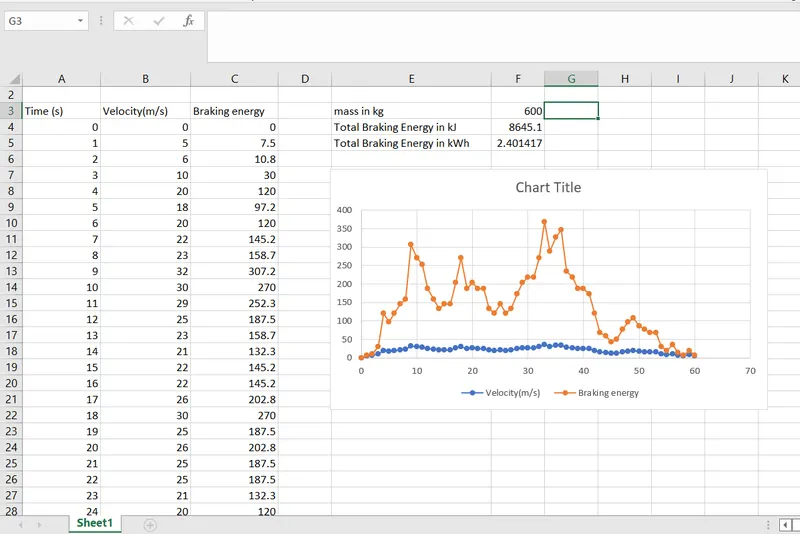
1. For a defined driving cycle, calculate the energy required for braking.
Deceleration is decrease in speed with respect to time. Since deceleration is similar to acceleration, the braking power calculation is also same as of acceleration power.
If m= Mass of the vehicle in kg
Vi= Initial velocity in m/s
Vf= Final velocity in m/s
Velocity= Vf-Vi in m/s
Then, Energy,`E = 1/2**m**(Vf-Vi)^2` in joules
2. Why electric motor can’t develop braking torque at high speed similar to starting? How electric and mechanical brakes are coordinated?
Regenerative braking (electrical) force and mechanical braking force make up two halves of the overall brake force distribution. The usual method of braking is a combination of mechanical and regenerative. Regenerative Braking is a form of braking in which the kinetic energy of the motor is returned to the power supply system.
When the motor's speed surpasses the synchronous speed, regenerative braking occurs. Because the motor acts as a generator in this baking technique and receives power from the load, which are the motors, it is known as regenerative baking. The rotor must revolve faster than synchronous speed in order for regenerative braking to occur; only then will the motor function as a generator, reversing the direction of current flow and torque as they travel through the circuit.
The motor works in the constant torque area when operating at low speed because the torque it produces is almost constant. Higher acceleration power is therefore feasible. The motor begins to operate in the constant power area as the vehicle speed rises. Therefore, using this strategy makes it simpler for the vehicle to reach high speeds. But at the same high speed, the engine will create less torque while braking than it did during acceleration. The motor will generate a significant amount of torque during acceleration, but a low amount of torque above base speed during deceleration. As a result, the electric car motor's peak accelerating torque and peak deceleration torque are not identical. Hence, regenerative braking cannot occur with a level of efficiency that allows us to fully recharge the battery.
Coordination of Electric and Mechanical Brake :
The total brake distribution in an electric motor consists of two components: an electrical brake, also known as a regenerative brake, and a mechanical brake, also known as a classic brake with a hydraulic cylindrical system. If the required amount of regenerative braking power exceeds the battery's capacity to be charged or the machine's capacity to generate braking force, mechanical brakes must also be used. In real-world situations, a mixture of these two is used. In most cases, mechanical brake and regenerative brake responses are coupled.
Brake Control Startegy:
The phenomena where mechanical brake and regenerative brake forces are combined is called Brake Control Strategies. There are two Brake Control Strategies-
- Series brake control strategy
- Parallel brake control strategy
1.Series brake control strategy:
In a series, we sequentially apply the mechanical brake and the regenerative electric brake. Only one brake approach, either mechanical or regenerative, may be used at once.
2. Parallel brake control strategy:
The use of both mechanical and regenerative braking is combined. Both friction and regenerative braking are used at greater speeds. The motor's high torque output and enhanced percentage contribution to regenerative braking occur whenever the vehicle's speed decreases. Because of this, regenerative braking contributes more at low speeds while mechanical and friction brakes are both used at high speeds.
3. Make a MATLAB program which plots contour of given motor speed, torque and efficiency values. Attach the code as a .m file attach a screenshot of all the plots.
Matlab script for contour of given motor speed, torque and efficiency values:
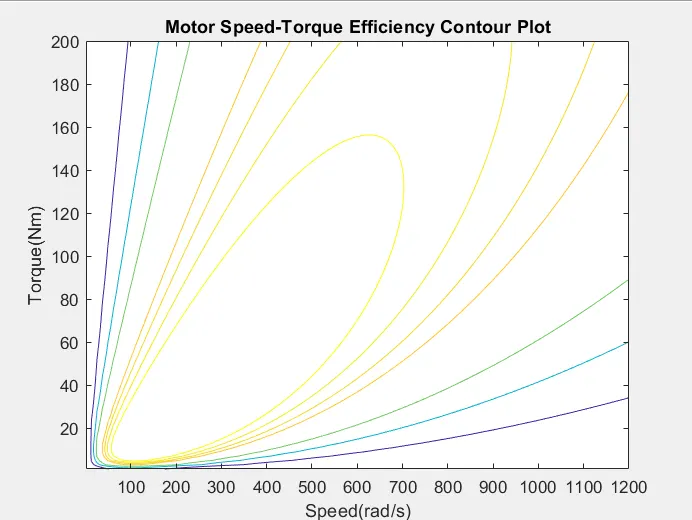
- The above Plot shows the Motor Speed-Torque Efficiency Contour Plot.
- It can be observed that efficiency is higher in inner contours and lower in out contours.