Project-1: Powertrain for aircraft in runways
Part A
1 Answer
- Manufactured Empty weight (MEW)
It is the weight of the aircraft "as-built" and includes the weight of the structure, power plant, furnishings, installations, systems and other equipment that are considered an integral part of an aircraft. This excludes any baggage, passengers, or usable fuel2.
- Zero fuel weight (ZFW)
This is the total weight of the aeroplane and all its contents (including unusable fuel), but excluding the total weight of the usable fuel on board.
As a flight progresses and fuel is consumed, the total weight of the aeroplane reduces, but the ZFW remains constant.
Maximum zero fuel weight (MZFW) is the maximum weight allowed before usable fuel and other specified usable agents (engine injection fluid, and other consumable propulsion agents) are loaded.
- Operating Empty Weight (OEW)
It is the basic weight of an aircraft including the crew, all fluids necessary for operation such as engine oil, engine coolant, water, unusable fuel and all operator items and equipment required for flight but excluding usable fuel and the payload.
- Payload
It is the carrying capacity of an aircraft. It includes cargo, people, extra fuel. In the case of a commercial airliner, it may refer only to revenue-generating cargo or paying passengers.
- Maximum Takeoff Weight (MTOW)
This is the maximum weight at which the pilot of the aircraft is allowed to attempt to take off.
- Regulated Takeoff load (RTOW)
Depending on different factors (e.g. flap setting, altitude, air temperature, length of runway), RTOW or maximum permissible takeoff weight varies for each takeoff. It can never be higher than MTOW.
- Maximum load to Land (MLW)
This maximum weight at which an aircraft is permitted to land.
The following image depicts takeoff weight components.
- Minimum taxi Weight (MRW)
also called maximum taxi weight (MTW)
It is the maximum weight authorized for manoeuvring (taxiing or towing) an aircraft on the ground.
- Aircraft Gross weight
It is the total aircraft weight at any moment during the flight or ground operation. This decreases during the flight due to fuel and oil consumption.
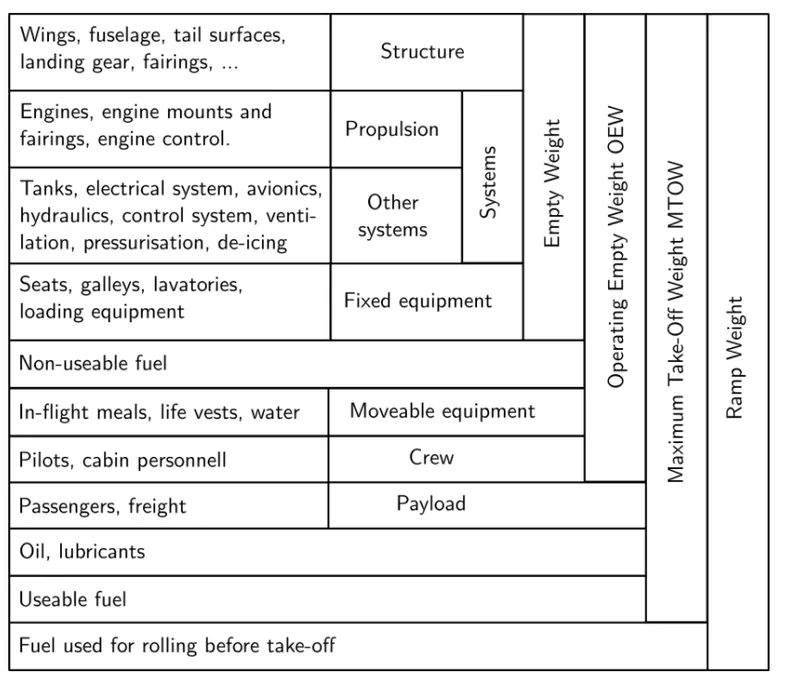
Fig 1:-Various loads Aircraft's loads.
2.
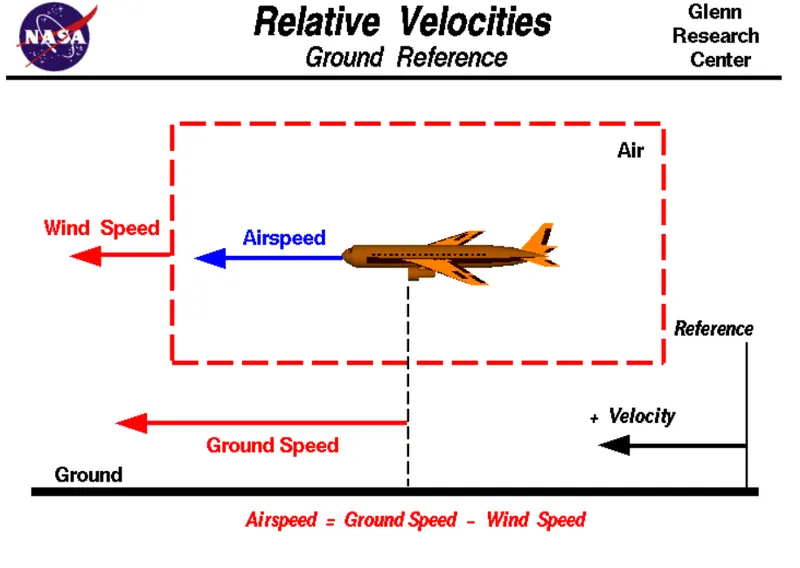
Fig 2:-Difference between air speed and Ground Speed[Credit:-NASA]
Ground Speed:-For a reference point picked on the ground, the Airplane moves relative to the reference point at the ground speed. Ground speed is also a Vector quantity so a comparison of the ground speed to the wind speed must be done according to rules for Vector Quantity.
Airspeed
The important quantity in the generation of lift is the relative velocity between the object and the air, which is called the airspeed. Airspeed cannot be directly measured from a ground position but must be computed from the ground speed and the wind speed. Airspeed is the vector difference between the ground speed and the wind speed.
Airspeed = Ground Speed - Wind Speed
On a perfectly still day, the airspeed is equal to the ground speed. But if the wind is blowing in the same direction that the aircraft is moving, the airspeed will be less than the ground speed.
3 .Answer
Taxiing is the movement of an aircraft on the ground, under its own power, in contrast to towing or pushback where the aircraft is moved by a tug. The aircraft usually moves on wheels, but the term also includes aircraft with skis or floats .why it is not Advisable to move the aircraft on the runway is that the Engine will be close to the ground and damage the Reverse thrust and Damage the terminal. And it will take up any debris will be there on runway
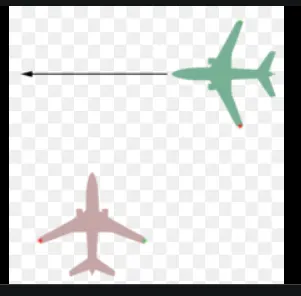
Fig 3:-Taxing of aircraft
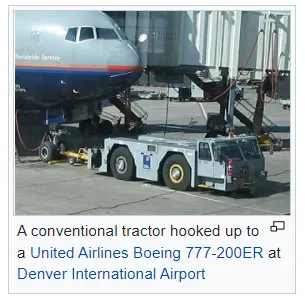
Fig 4:-Pushback of an Air craft[credits:-Wikipedia]
4
In aviation, pushback is an airport procedure during which an aircraft is pushed backwards away from its parking position, usually at an airport gate by an external power. Pushbacks are carried out by special, low-profile vehicles called pushback tractors or tugs.
Although many aircraft are capable of moving themselves backwards on the ground using reverse thrust (a procedure referred to as a powerback, the resulting jet blast or prop wash would cause increased noise, damage to the terminal building or equipment, and hurt airport staff due to high-speed debris. This debris would also be sucked into the engine, as it is in normal use, and cause excessive wear - a major cause of wear on aircraft engines is during ground use. A pushback is therefore the preferred method when ground-handling aircraft.
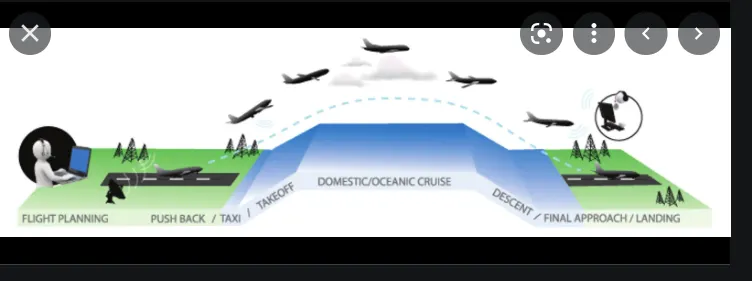
Fig 5:-How aeroplane will take off
5
An aeroplane, by definition, is a fixed-wing aircraft. Its wings can produce lift only when there is a relative velocity between the aeroplane and the air. In order to be airborne, the lift produced by the aeroplane must be at least equal to the weight
of the aeroplane. This can happen when the velocity of the aeroplane is equal to or greater than its stalling speed. To achieve this velocity called ‘Take-off velocity(VTO)’ the aeroplane accelerates along the runway. Thus, an aeroplane covers a certain distance before it can take off. Similarly, when an aeroplane comes into land, the lift produced must be nearly equal to the landing weight. Hence, the aeroplane has a velocity, called ‘Touch down speed (VTD)’, when it touches the ground. It then covers a certain distance before coming to halt.
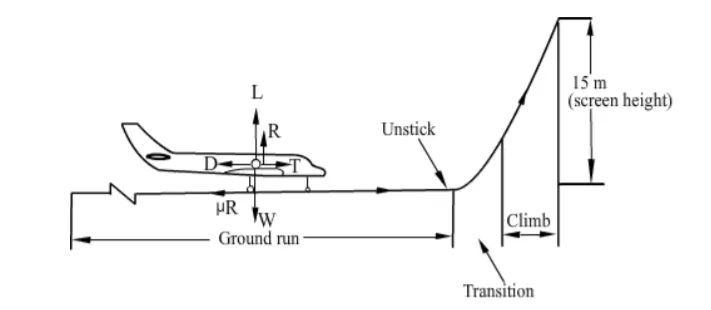
Fig 6:-Takeoff power of an aeroplane.
and here we had got the ground run and climb than it will Screen height.
it is power by which plane leaves the ground and it will be air bound.
Credits:-IIT madras Notes
Aircraft tyres
An aircraft tyre is designed to withstand extremely heavy loads while landing, take off, taxing, and parking. The number of wheels required for aircraft increases with the weight of the aircraft, as the weight of the aeroplane needs to be distributed more evenly.
Design and construction of the tyre
- They support the weight of an aircraft while it is on the ground.
- It also provides the necessary traction for the braking and stopping of an aeroplane.
- Tyre also helps to absorb the shock of landing and provide cushioning for the roughness of takeoff, roll-out, and taxi operations.
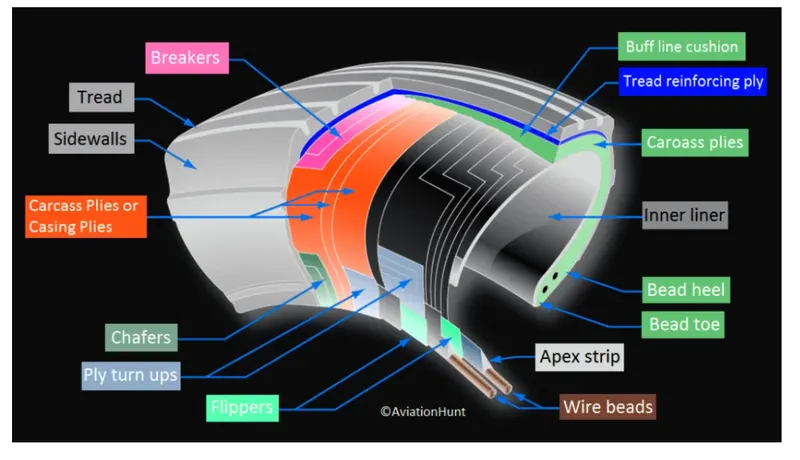
Fig 7:-cross-section of the tyre in aviation
Retreading – Retreading is a method of restoring a worn tyre by renewing the tread area or by renewing the tread area plus one or both sidewalls. Repairs are included in the tyre retreading process.
Load Rating – Load rating is the maximum permissible load at a specified inflation pressure.
Ply Rating – Ply Rating is used to identify the maximum recommended load rating and inflation pressure for a specified tyre. It is an index of tyre strength.
Speed Rating – The speed rating is the maximum takeoff speed to which the tyre has been tested.
Skid Depth – Skid depth is the distance between the tread surface and the deepest groove as measured in the mould.
Aircraft tyres must have an approved speed and load rating and have sufficient clearance when retracted through landing gear to allow for tyre growth. Tyre growth is the increase in the size of the tyre due to centrifugal forces at high speed.
Rolling Resistance :
Rolling resistance sometimes called rolling friction or rolling drag is the force resisting the motion when a body (such as a ball, tire, or wheel) rolls on a surface. It is mainly caused by non-elastic effects; that is, not all the energy needed for deformation (or movement) of the wheel, roadbed, etc., is recovered when the pressure is removed. Two forms of this are hysteresis losses and permanent Note that the slippage between the wheel and the surface also results in energy dissipation. Although some researchers have included this term in rolling resistance, some suggest that this dissipation term should be treated separately from rolling resistance because it is due to the applied torque to the wheel and the resultant slip between the wheel and ground, which is called slip loss or slip resistance. In addition, only the so-called slip resistance involves friction, therefore the name "rolling friction" is to an extent a misnomer.
this could be expressed in the below equation
`F=Crr*N`
F=Force of rolling Resistance
Crr=Co efficient of rolling Resistance
N=Normal Force
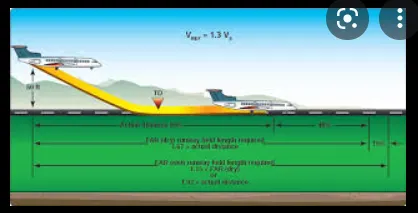
Fig 8:-Rolling resistance of airplane
tyre pressure
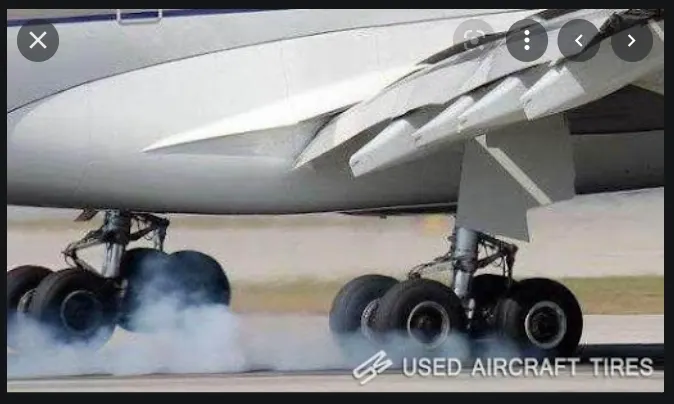
Fig 9:-Tyre at landing
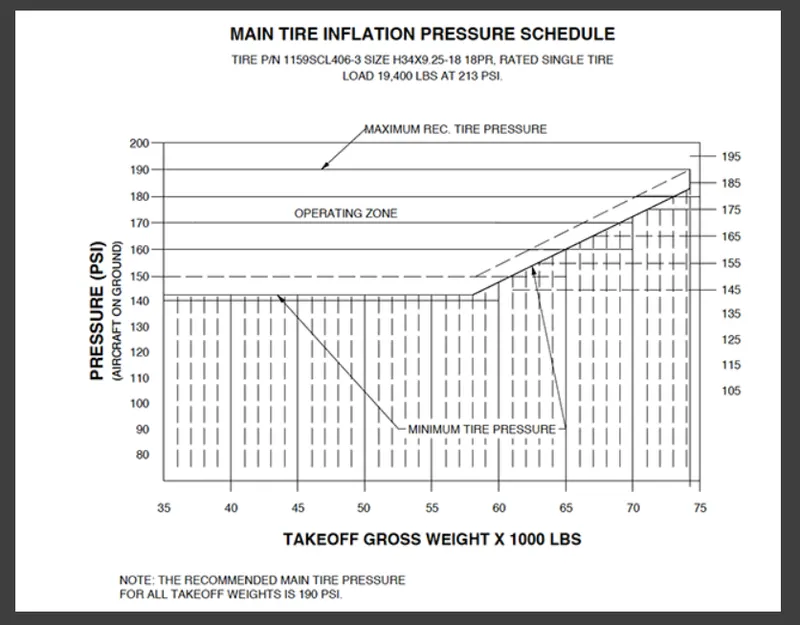
Fig 10:-Inflation of tyre [Credits:-aircraft tires]
So it cannot be determined how much pressure that the type should be there. So it is independent of all these matters.
while landing hat there is a lot of pressure acting on the aeroplane.
And it's not a contact value and it varies with the maximum weight of aircraft and how many passengers and will be there. and we cannot tell from which pressure to which that the pressure required. And the tyres will be conductive to overcome electric static fore and all.
6 Answer
here these forces will matter are :
- Rolling Resistance
- Aerodynamic Resistance
- Gradient Resistance
So Rolling Resistance is resistance which will have when it will rotate and it can be written as write down
Frr=U*M*G
where Frr= Force of rolling resistance
U=magnitude of coefficient of rolling resistance
M=mass of vehicle
G=accelation due to gravity ---------------1
Aerodynamic Resistance will be in acting when because of aerodynamic force acting on it,it can be explained as
`Fad=Co*Drag*F*sigma *v^2`-----------------2
Fad=Aerodymanic DragCo=Cosentant
Drag=Drag
F=Front Area
V=Velocity of Aircraft
Gradient Resistance
`F ag=M*sin theta*g`-------------3
F ag=Gradient Reistance
M=Mass of vehicle
Sin theta=Sin of angle
g=Accleration due to gravity
now we need to sum this thing to get the overall force acting at it
so 1+2+3=value od sum of forces
Fta=(0.002*9.8*4300)+(0.0025*0.5*1.125*150*4*4)+(4000*sin 0*9.85)
Fta=843+33.75+0
`ta=877.....................4 `in newton
model can be shown below
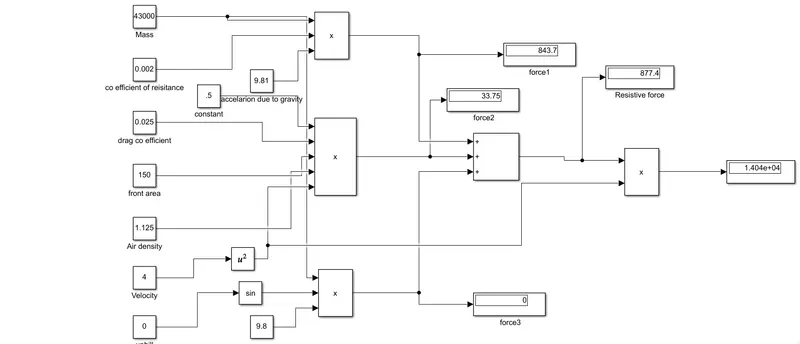
Fig 11:-Entire model in Simulink
7A :
Here we are going to use the tugger for pulling and pushing of aircraft.
if you want to look into its working then
it has a battery for power that will be either a Li-ion battery pack or a Lead Acid battery pack. With BMS. And it has an inboard charger in it.
Then the power will go to the DC-DC converter which will be used to move the aircraft.
And voltage is will depend upon the weight of aircraft and all.
then it has connected to PMDC motor and it will drive Differbtial motor and it will move the Wells of the motor.
Then it will work as powering the motor.
Energy for towing =power required for Taxing *time in which it is used [it has taken from a towing tuck energy=84.6kW]
Enegry =84.6*900
E=64.64Kw-h
Battery pack will have Voltage=200V;Current =400A
P=V*I
P=200*400
P=80kW
Duty cycle=Enegy required/Power
Duty Cycle=64.64/80
Duty cycle=0.0789
Duty cycle=79%
and the scheme is explained below
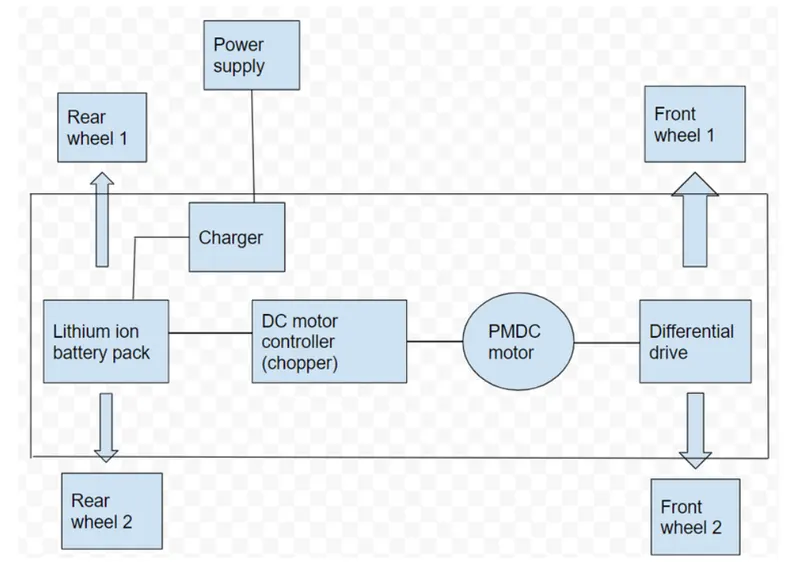
Fig 12:-Tugger which i developed
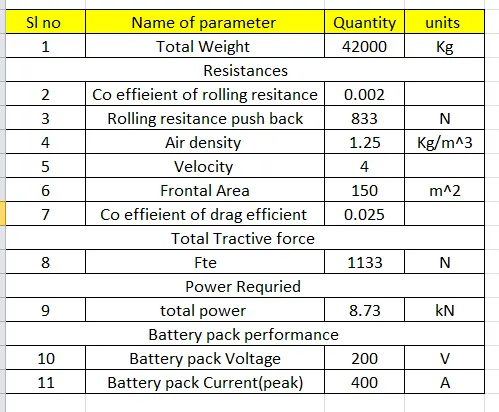
Fig 13:-Performance sheet
Conclusion
- A lot of different weights were discussed
- the difference between ground speed and airspeed is known
- Why aircraft won't be used in ground movement.
- aircraft can be pushed is known.
- a lot of terminologies will be known.
- with necessary design parameter, a system is developed and both answered is verified.
- an tuger plane is simulated with a lot of assumptions.