Week 1 Understanding Different Battery Chemistry
| Sl No | LCO | LMO | NCA | NMC | LFP | LTO |
| Full Form | Lithium Cobalt Oxide | Lithium ion manganese oxide battery | Lithium Nickel Cobalt Aluminum Oxide | Lithium Nickel Manganese Oxide | Lithium Iron Phosphate | Lithium Titanate Oxide |
| Short form | Li-cobalt | NMC | LFP | Li-Tritante | ||
| Cathode | LiCoO2 | LiMn2O4 | LiNiCoAlO2 | LiNiMnCoO2 | LiFePO4 | Li2TiO3 |
| Anode | Graphite | Graphite | Graphite | Graphite | Graphite | Graphite |
| Reaction | The cathode has a layered structure and during discharge, lithium ions move from the anode to the cathode. The flow reverses on charge | The architecture forms a three-dimensional spinel structure that improves ion flow on the electrode, which results in lower internal resistance and improved current handling. A further advantage of spinel is high thermal stability and enhanced safety, but the cycle and calendar life are limited | Shares similarities with NMC by offering high specific energy, reasonably good specific power and a long life span. Less flattering are safety and cost. Summarizes the six key characteristics. NCA is a further development of lithium nickel oxide; adding aluminum gives the chemistry greater stability. | One of the most successful Li-ion systems is a cathode combination of nickel-manganese-cobalt (NMC). Similar to Li-manganese, these systems can be tailored to serve as Energy Cells or Power Cells. For example, NMC in an 18650 cell for moderate load condition has a capacity of about 2,800mAh and can deliver 4A to 5A | This is made possible with nano-scale phosphate cathode material. The key benefits are high current rating and long cycle life, besides good thermal stability, enhanced safety and tolerance if abused. | Batteries with lithium titanate anodes have been known since the 1980s. Li-titanate replaces the graphite in the anode of a typical lithium-ion battery and the material forms into a spinel structure. The cathode can be lithium manganese oxide or NMC. |
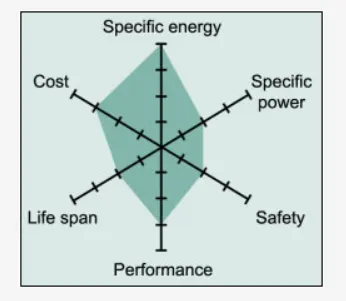 |
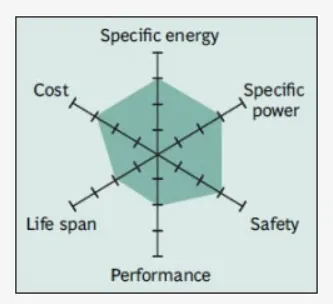 |
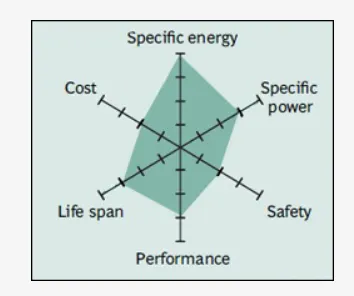 |
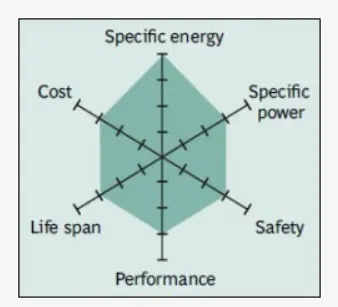 |
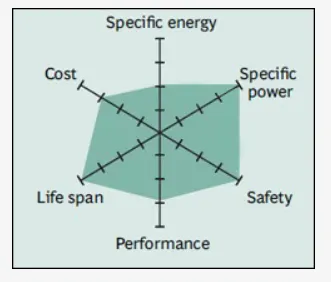 |
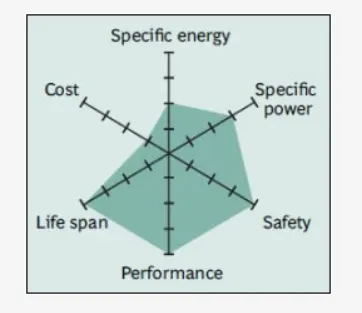 |
And the graph will be as shown in below graph
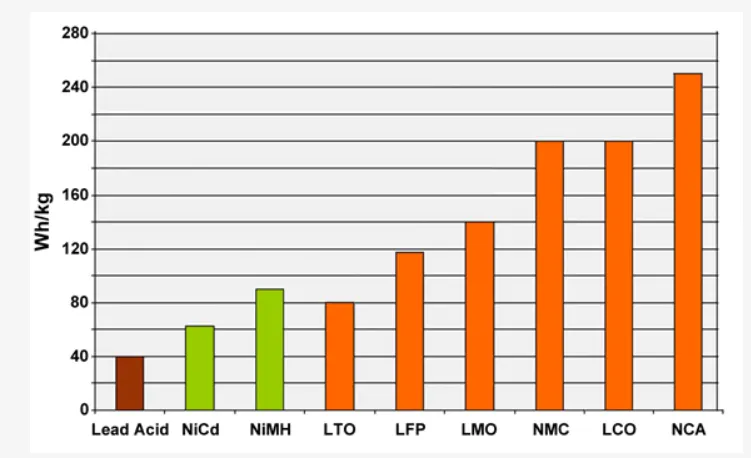
By the graph will show the difference of Wh/kg and maximum will be of NCA and mimium of Lead Acid.
2 )
PFA different type of Lithium ion chemistry
| Sl No | Parameter | Lithium Cobalt Oxide | Lithium ion manganese oxide battery | Lithium Nickel Cobalt Aluminum Oxide | Lithium Nickel Cobalt Aluminium Oxide | Lithium Titanate Oxide | Lithium Iron phosphate |
| 1 | Nominal voltage | 3.60V | 3.70V (3.80V) | 3.60V (3.70V) | 3.20, 3.30V | 2.40V | 3.20,3.30 |
| 2 | Full charge in v | 4.20 | 4.20 | 4.20 or higher | 4.20 | 2.85 | 3.65 |
| 3 | Full Dischagre in V | 3.00 | 3.0 | 3.0 | 3.0 | 1.80 | 2.50 |
| 4 | Minimal Voltage in V | 2.50 | 2.50 | 2.50 | 2.50 | 1.50 | 2.0 |
| 5 | Specific Energy in Wh/kg | 150-200 | 100-150 | 150-220 | 200-260 | 70-80 | 90-120 |
| 6 | Charge Rate | 0.7-1C(3h) | 0.7-1C(3h) | 0.7-1C(3h) | 1C | 1C(5Cmax) | 1C(3h) |
| 7 | Dischagre Rate | 1C(1h) | 1C,10C possible | 1-2C | 1C | 10C possible | 1C(25C pulse) |
| 8 | Cycle Life | 500-1000 | 300-700 | 1000-2000 | 50 | 3000-7000 | 1000-2000 |
| 9 | Thermal RunAway | 150 C | 250 C | 210 C | 270 C | 500 C | 210 C |
| 10 | Application | Mobile Phones ,Tablets. | Power Train,Power Tools. | E-Bike ,Medical Devies. | Medical ,EV(Tesla). | UPS,EV,Solar Street . | Stationary with high Currents and Endurance . |
| 11 | Comments | High energy,limited market. | Higher Power ,Less Capacity. | High Capacity & HighPower. | Higest capacity with Moderate Power. | Long Life,Wide Temperature.Low capacity .Very Expensive. | Flat Discharge ,High power ,safe. |
Sources
1 battery university
2 From internet
3 From DIY battery from john.