INDUCTION MOTOR-2
INDUCTION MOTOR-2:
OBJECTIVE:
- To discuss the equivalent circuit network of induction motor MATLAB model.
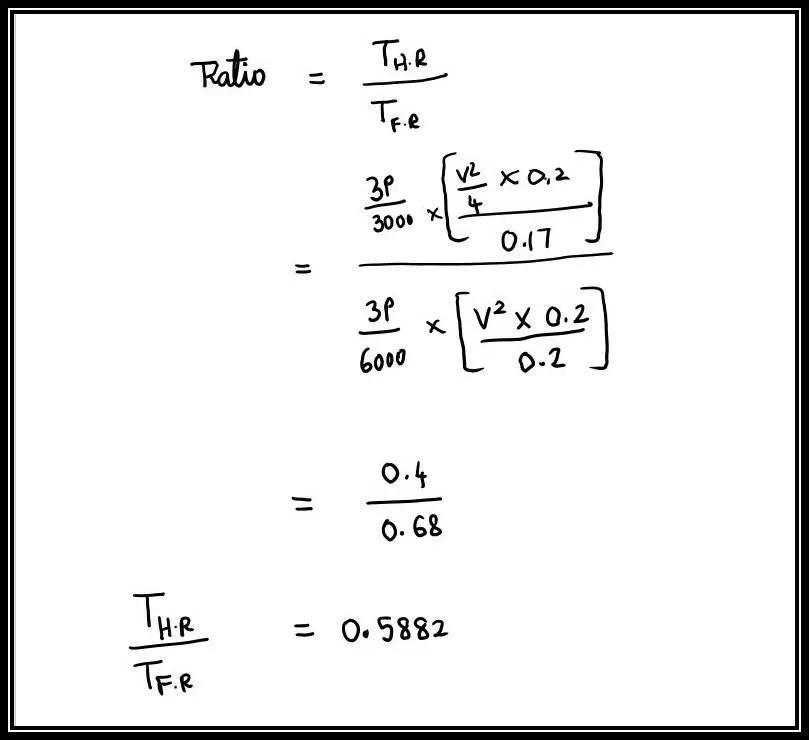
- To Calculate the ratio of starting torque at half voltage & frequency to rated values for the given parameters 3 phase, 50 Hz induction motor, represented by equivalent circuit constants X1 = X2 = 0.1 ohm and R1 = R2 = 0.2 ohm is operated at half of rated voltage and frequency.
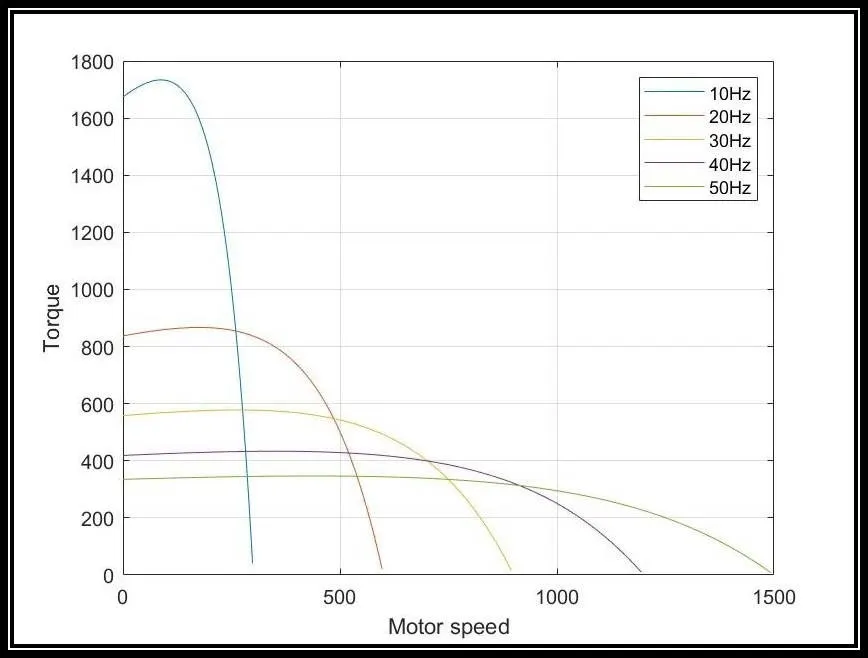
- To Make a MATLAB script file that will plot speed-torque characteristics for the frequency control method.
- To explain the operation of the BLDC motor.
PROCEDURE:
1)Equivalent Circuit network of induction motor:
- Steady-state analysis of induction motors is often carried out using the per-phase equivalent circuit.
- A single-phase equivalent circuit is used for the three-phase induction machine, assuming a balanced set as shown in fig.
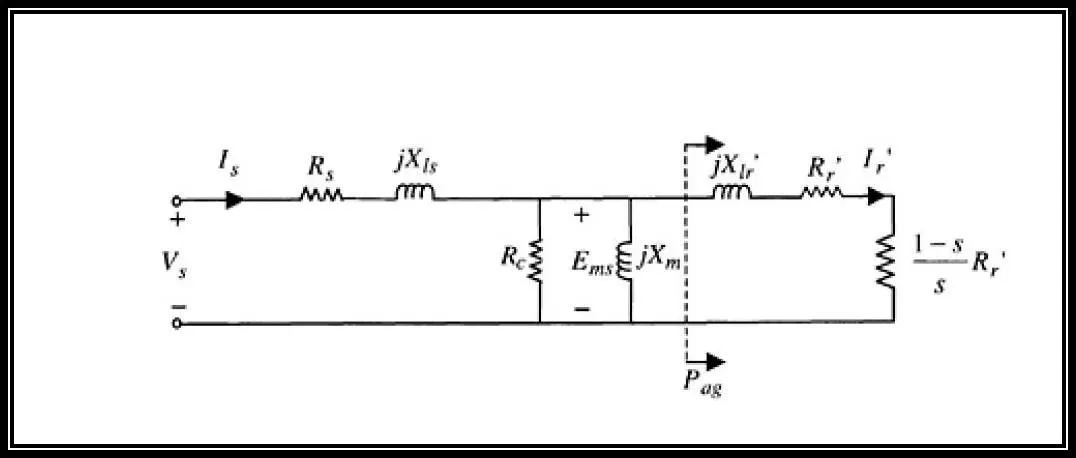
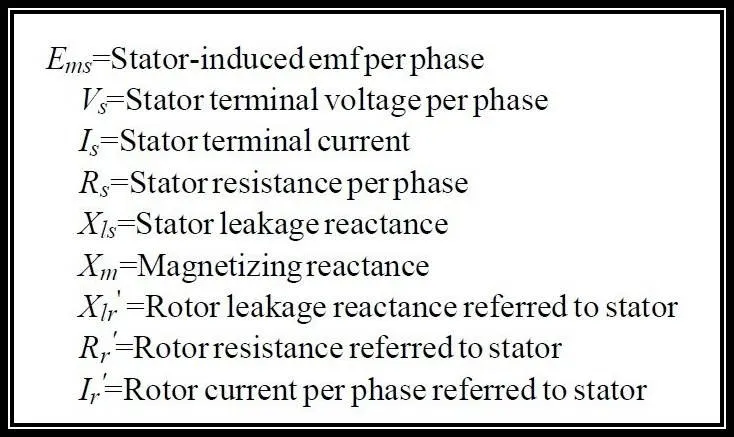
- The per-phase equivalent circuit consists of the stator loop and the rotor loop, with the magnetic circuit parameters in the middle.
- The inductance representing the magnetization current path is in the middle of the circuit, along with an equivalent core loss resistance.
- For the stator and rotor electrical parameters, the circuit includes the stator winding resistance and leakage reactance and the rotor winding resistance and the leakage reactance.
- A slip-dependent equivalent resistance represents the mechanical power delivered at the shaft due to the energy conversion in the air gap coupled electromagnetic circuit.
- The electrical input power supplied at the stator terminals converts to magnetic power and crosses the air gap.
- The air gap power Pag is converted to mechanical power delivered at the shaft after overcoming losses in the rotor circuit.
- Although the per-phase equivalent circuit is not enough to develop controllers that demand good dynamic performance like in an EV or HEV, the circuit provides a basic understanding of induction machines.
- The vast majority of applications of induction motor are for adjustable speed drives, where controllers designed for good steady-state performance are adequate.
- The circuit allows the analysis of a number of steady-state performance features.
- The electromagnetic torque is given by :
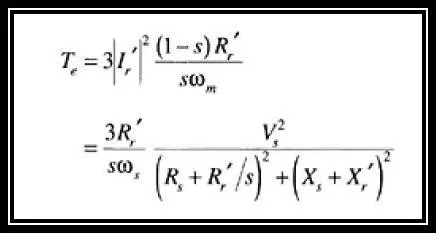
- The torque produced by the motor depends on the slip and the stator currents, among other variables.
- The induction motor starting torque, while depending on the design, is lower than the peak torque achievable from the motor.
- The motor is always operated in the linear region of the torque-speed curve to avoid the higher losses associated with high slip operation.
- In other words, operating the machine at small slip values maximizes the efficiency.
- The value of the rotor circuit resistance determines the speed at which the maximum torque will occur.
- In general, the starting torque is low, and the maximum torque occurs close to the synchronous speed when the slip is small.
- The motor draws a large current during line starting from a fixed AC source, which gradually subsides as the motor reaches the steady-state speed.
- If the load requires a high starting torque, the motor will accelerate slowly.
- This will make a large current flow for a longer time, thereby creating a heating problem.
- Nonlinearity at speeds below the rated condition is due to the effects of leakage reactances.
- At higher slip values, the frequencies of the rotor variables are large, resulting in dominating impedance effects from the rotor leakage inductance.
- The air gap flux cannot be maintained at the rated level under this condition.
- Also, large values of rotor current(which flows at high slip values)cause a significant voltage drop across the stator winding leakage impedance(Rs+jLls), which reduces the induced voltage and in turn, the stator mmf flux density.
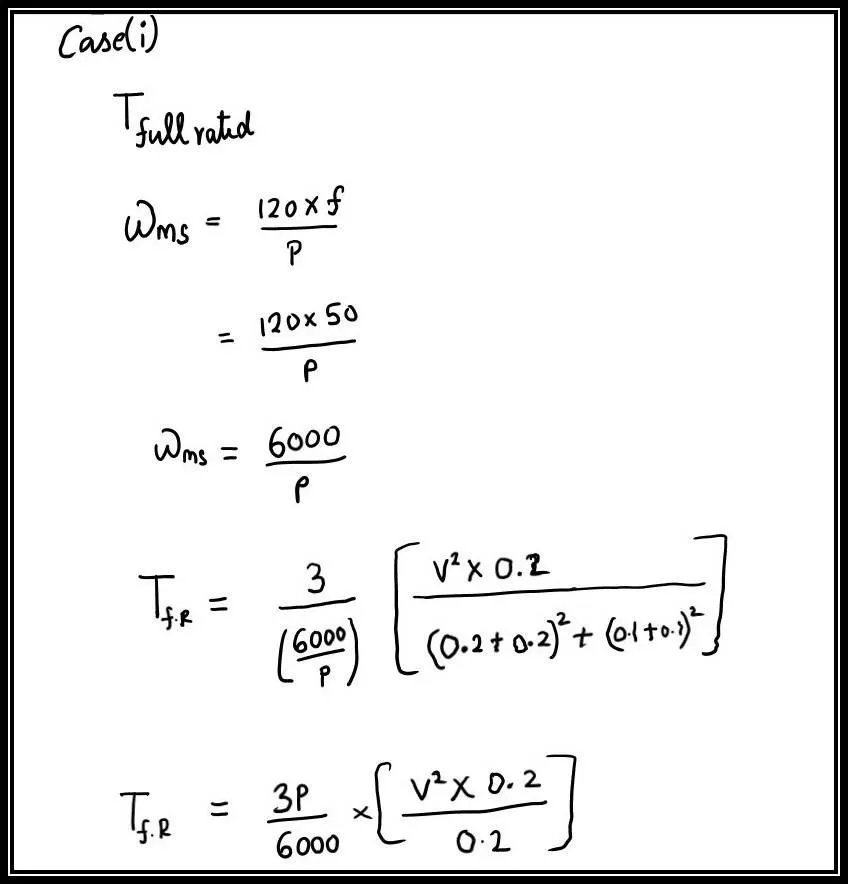
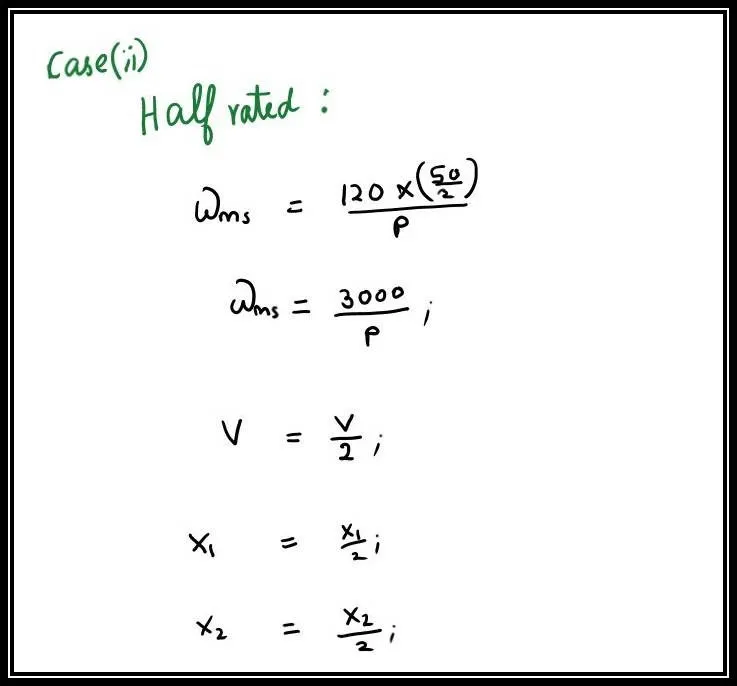
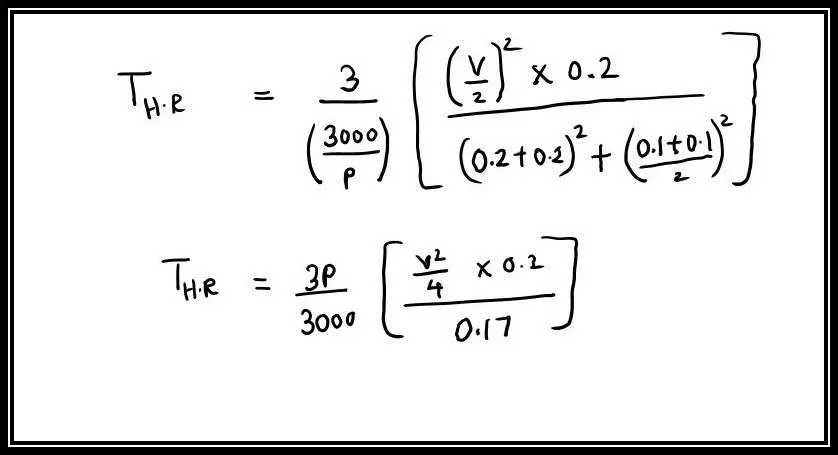
2)Ratio of Starting torque at half voltage and frequency to rated values:
Given:
Phase=3;
Frequency=50Hz;
X1 = X2 = 0.1 ohm;
R1 = R2 = 0.2 ohm;
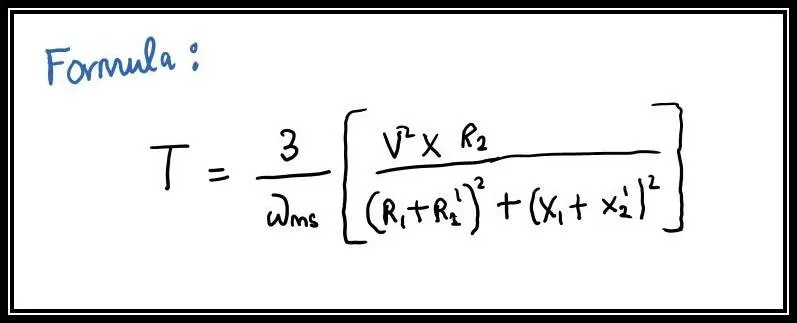
Sol:
3)Matlab code:
clear all
close all
clc

phase=3;
poles=4;
frequency=linspace(10,50,5);
v=230/sqrt(3);
r1=0.2;
r2=0.2;
x1=0.1;
x2=0.1;
xm=18;

zeq=1i*xm*(r1+1i*x1)/(r1+1i*(x1+xm));
req=real(zeq);
xeq=imag(zeq);
veq=abs(v*1i*xm/(r1+1i*(x1+xm)));

for k=1:length(frequency)
    omega(k)=4*pi*frequency(k)/poles;
    ns(k)=120*frequency(k)/poles;

    for g=1:200
        s(g)=g/200;
        rpm(g)=ns(k).*(1-s(g));
        I(g)=abs((veq)/(zeq+1i*x2+r2./s(g)));
        T(g)=phase.*(I(g).^2)*r2/(s(g).*omega(k));
    end

plot(rpm,T)
hold on
grid on
legend('10Hz','20Hz','30Hz','40Hz','50Hz')
xlabel('Motor speed')
ylabel('Torque')

end
Step-wise explanation:
- Initially, the parameters are assumed which includes phase,poles,r1(stator resistance),r2(rotor resistance),x1(stator reactance),x2(rotor reactance),voltage per phase,xm(magnetic reactance).
- The frequency value is assigned from 10 to 50 HZ with an increment of 10Hz.
- In the next step, the equivalent impedance is calculated using the formula.
- The 1i indicates the imaginary part.
- In the next step, the equivalent voltage is calculated by using the formula.
- Then in the next step, the for loop is created for the length of frequency.
- Then angular speed and the synchronous speed are calculated for the length of the frequency.
- Then slip value is assumed randomly and for each value of slip the speed, torque, and the equivalent current are calculated using the formula.
- Then the plot is created for the motor speed and the torque.
- Then the label for the x and y-axis is given and a legend is provided for indicating the different values of frequencies.
Result:
4)BLDC Motor:
- In Brushless DC(BLDC) motor the alternating current must be variable frequency and so derived from a DC supply, and because its speed/torque characteristics are very similar to the ordinary 'with brushes' DC motor.
- As a result of 'BLDC' being not an entirely satisfactory name, it is also known as 'Self-synchronous AC motor', a 'Variable frequency synchronous motor', a 'permanent magnet synchronous motor' and an 'electronically commutated motor'(ECM).
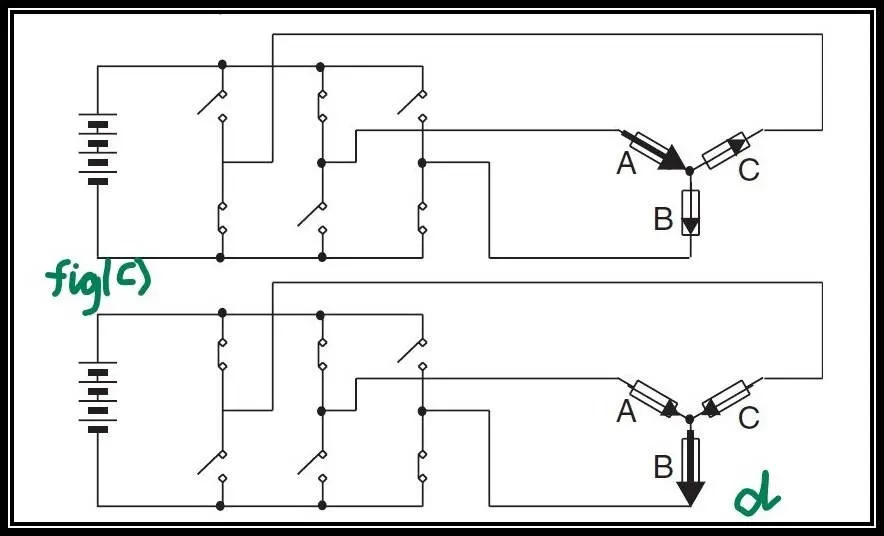
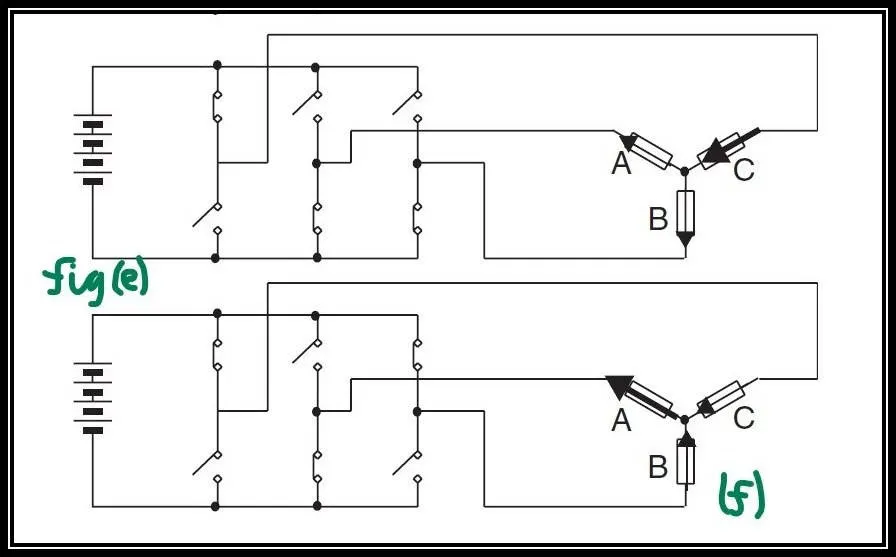
- The basics of operation of the BLDC motor is shown in fig.
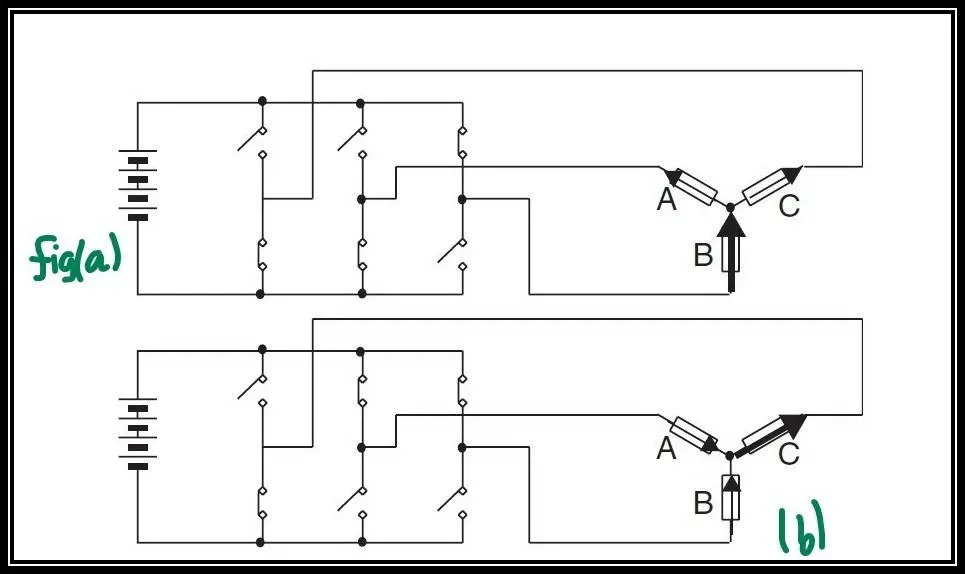
- The rotor consists of a permanent magnet.
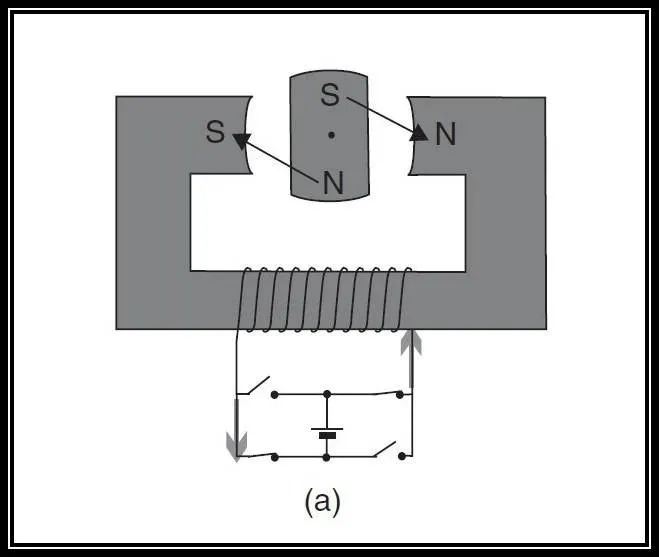
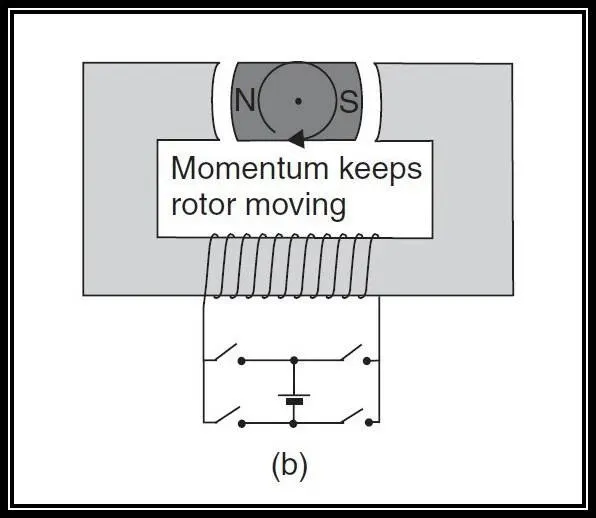
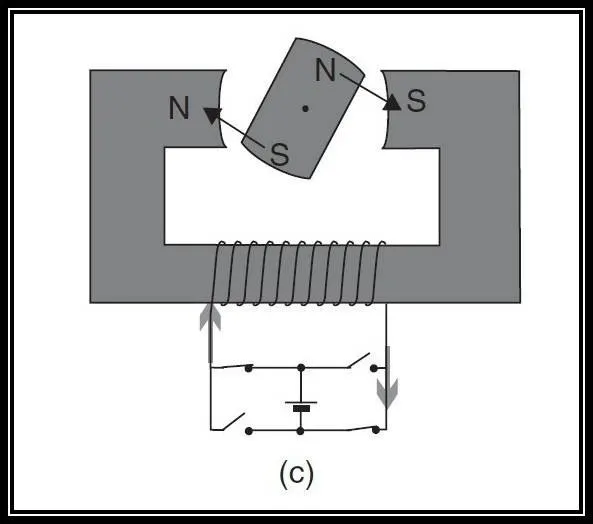
- In the above fig(a), the current flows in the direction that magnetizes the stator so that the rotor is turned clockwise.
- In the above fig(b), the rotor passes between the poles of the stator, and the stator current is switched off.
- Momentum carries the rotor on, and in the above fig(c), the stator is re-energized, but the current and hence the magnetic field are reversed.
- So the rotor is pulled on the round in a clockwise direction.
- This process continues, with the current in the stator coil alternating.
- Obviously, the switching of the current must be synchronized with the position of the rotor.
- This is done by using the sensors.
- These are often Hall effect sensors that use the magnetism of the rotor to sense its position, but optical sensors are also used.
- A problem with the simple single-coil system of fig4.2 is that the torque is very unsteady.
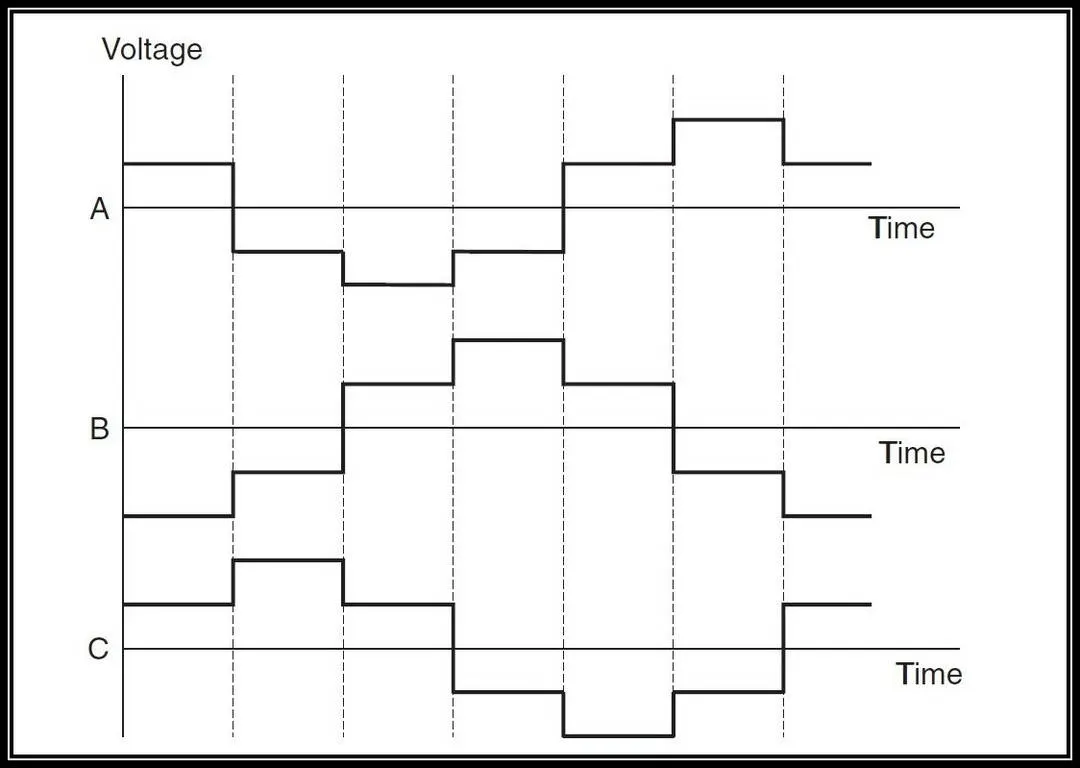
- This is improved by having three(or more) coils, as shown in fig4.3.
- In this diagram, coil B is energized to turn the motor clockwise.
- Once the rotor is between the poles of coil B, coil C will be energized, and so on.
- The electronic circuit used to drive and control the coil currents is usually called an inverter and it will be the same as or very similar to, our 'universal inverter'.
- The main control inputs to the microprocessor will be the position sensor signals.
- A feature of these BLDC motors is that the torque will reduce as the speed increases.
- The rotating magnet will generate a back EMF in the coil which it is approaching.
- This back EMF will be proportional to the speed of rotation and will reduce the current flowing in the coil.
- The reduced current will reduce the magnetic field strength, and hence the torque.
- Eventually, the size of the induced back EMF will equal the supply voltage, and at this point, the maximum speed has been reached.
- This type of motor can very simply be used as a generator of electricity, and for regenerative or dynamic braking.
- Although, the current through the motor coil alternates, there must be a DC supply, which is why these motors are generally classified as 'DC'.
- They are very widely used in computer equipment to drive the moving parts of disc storage systems and fans.
- In these small motors switching circuit is incorporated into the motor with the sensor switches.
- However, they are also used in higher power applications, with more sophisticated controllers that can vary the coil current (and hence torque) and thus produce a very flexible drive system.
- Some of the most sophisticated electric vehicle drive motors are of this type, and one is shown in the below fig.
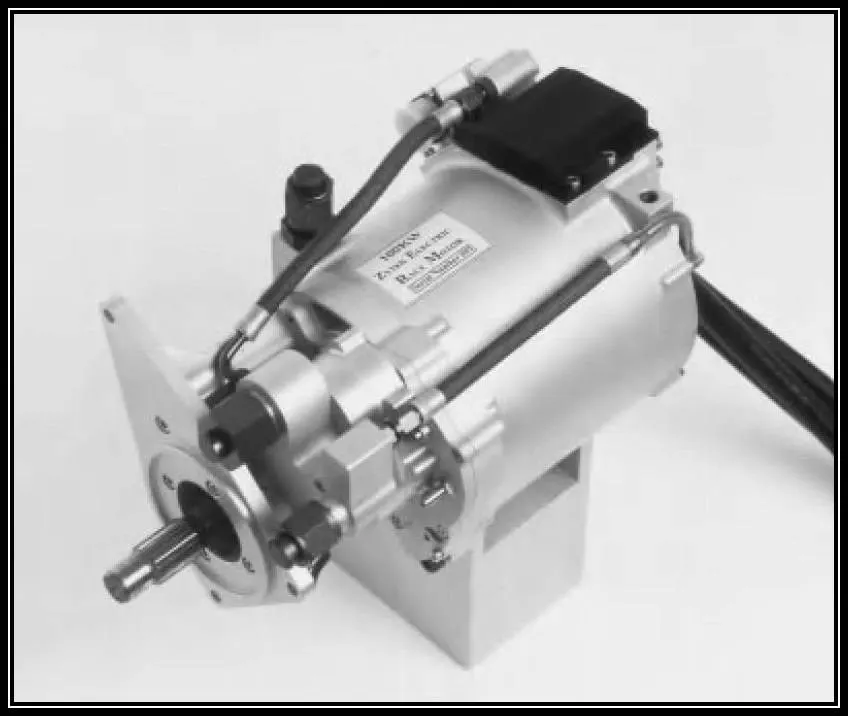
- This is a 100KW, oil-cooled motor, weighing just 21Kg.
- These BLDC motors need a strong permanent magnet for the rotor.
- The advantage of this is that currents do not need to be induced in the rotor.
- The advantage of this is that currents do not need to be induced in the rotor(as with, for example, the induction motor), making them somewhat more efficient and giving a slightly greater specific power.
- Permanent magnet synchronous motors which are a type of BLDC motors are increasingly used in electric vehicles.
- Modern electronics allow the supply frequency to be continuously varied so that it can be used to control the motor speed and hence the vehicle speed.
- Permanent magnet synchronous motors are highly efficient and tend to replace induction motors in many applications.
- This is due to the fact that permanent magnet motors have a higher torque-to-volume ratio as compared with induction motors.
- Also, the decrease in the manufacturing cost of permanent magnets makes the permanent magnet motors appealing.