Damping coefficient determination and Force vs Velocity shock curve
AIM:
1. Calculate the following parameters for front and rear suspension.
(i) Sprung mass critical damping
(ii) Unsprung mass critical damping
(iii) Sprung mass initial damping coefficient
(iv) Unsprung mass initial damping coefficient
(v) Low speed compression damping coefficient
(vi) High speed compression damping coefficient
(vii) Low speed rebound damping coefficient
(viii) High speed rebound damping coefficient
GIVEN DATA:
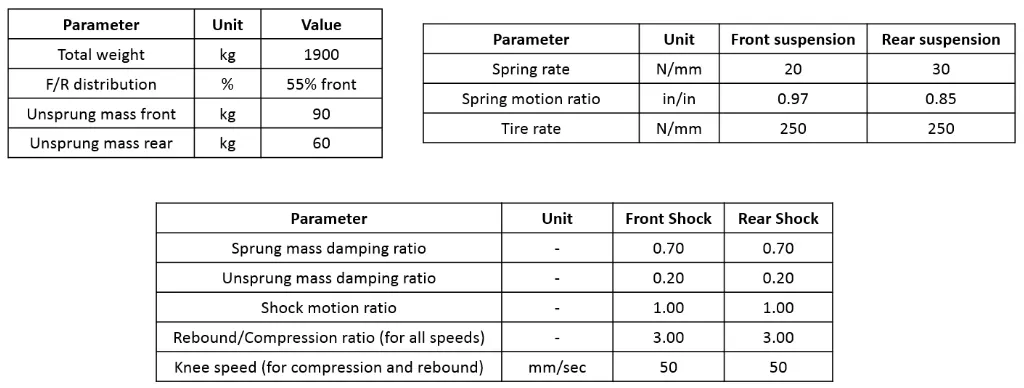
SOLUTION:
Workflow:
- Find critical damping and damping coefficient
- Find the low speed and high speed compression damping coefficient
- Find the low speed and high speed rebound damping coefficient using the given ratio
Formulae:
Sprung mass critical damping = 2 * sqrt (Ride rate * Sprung mass per corner)
Ride rate = (Wheel rate * Tire rate) / (Wheel rate + Tire rate)
Unsprung mass critical damping = 2 * sqrt [(Wheel rate + Tire rate) * Unsprung mass per corner]
Sprung mass initial damping coefficient = Sprung mass damping ratio * Sprung mass critical damping
Unsprung mass initial damping coefficient = Unsprung mass damping ratio * Unsprung mass critical damping
Low speed compression damping coefficient = Sprung mass initial damping coefficient / 2
High speed compression damping coefficient = Uprung mass initial damping coefficient / 2
Low speed rebound damping coefficient = Rebound/Compression ratio * Low speed compression damping coefficient
High speed rebound damping coefficient = Rebound/Compression ratio * High speed compression damping coefficient
| Parameter | Front Shock | Rear Shock | Unit |
| Sprung mass critical damping (`C_[cs]`) | 5781.549486 | 5631.489539 | N/m/sec |
| Unsprung mass critical damping (`C_[c us]`) | 6956.093731 | 5709.72854 | N/m/sec |
| Sprung mass initial damping coefficient (`C_s`) | 4047.08464 | 3942.042677 | N/m/sec |
| Unsprung mass initial damping coefficient (`C_[us]`) | 1391.218746 | 1141.945708 | N/m/sec |
| Low speed compression damping coefficient (`C_[comp-low]`) | 2023.54232 | 1971.021339 | N/m/sec |
| High speed compression damping coefficient (`C_[comp-high]`) | 695.6093731 | 570.972854 | N/m/sec |
| Low speed rebound damping coefficient (`C_[reb-low]`) | 6070.62696 | 5913.064016 | N/m/sec |
| High speed rebound damping coefficient (`C_[reb-high]`) | 2086.828119 | 1712.918562 | N/m/sec |
Excel Output:
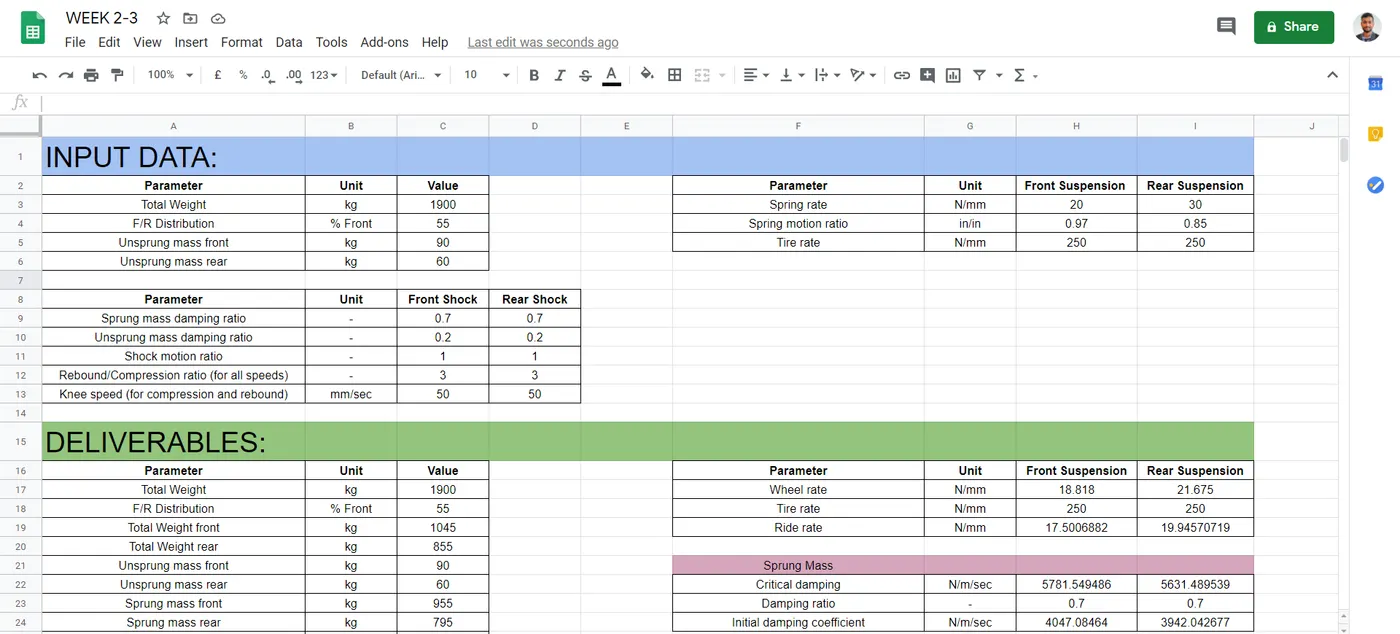
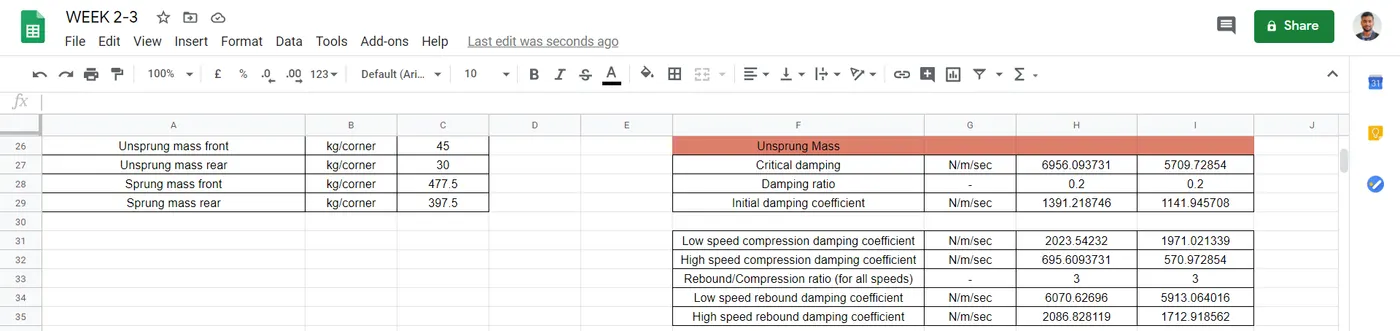
Excel Link: https://docs.google.com/spreadsheets/d/1o0grqwWKBKO17_VQh7kso6yP9AwlU4q7Fb9kJqgN6fg/edit#gid=0
AIM:
2. Using the information calculated above, come up with a force vs. velocity shock curve for the front and rear suspensions (velocity range = 0 to 500 mm/sec)
SOLUTION:
Formulae:
Below Knee speed (<= 50 mm/sec):
Compression force = Low speed compression damping coefficient * Velocity
Rebound force = - Low speed rebound damping coefficient * Velocity
Above Knee speed (> 50 mm/sec): (n = iteration)
Compression force (n) = Compression force (n-1) + [Velocity (n) - Velocity (n-1)] * High speed compression damping coefficient
Rebound force (n) = Rebound force (n-1) - [Velocity (n) - Velocity (n-1)] * High speed rebound damping coefficient
Front shock:
Code #1:
% Shock curve (Front)

% Inputs:

v = 0:5:500;    % velocity (mm/sec)
Cc_1 = 2023.54232;   % before knee speed - compression
Cc_2 = 695.6093731;    % after knee speed - compression
Cr_1 = 6070.62696;   % before knee speed - rebound
Cr_2 = 2086.828119;   % after knee speed - rebound


% Solution:

i=1;
for ct=1:101    % Divisions in plot

    % Compression curve
    if ct <= 10
        Fc(i) = Cc_1*v(i)/1000;   % force upto knee speed
    else
        Fc(i) = Fc(i-1) + Cc_2*(v(i)-v(i-1))/1000;   % force after knee speed
    end

    % Rebound curve
    if ct <= 10
        Fr(i) = -Cr_1*v(i)/1000;   % force upto knee speed
    else
        Fr(i) = Fr(i-1) - Cr_2*(v(i)-v(i-1))/1000;   % force after knee speed
    end

    i=i+1;
end


% Plot:

plot(v,Fc,'linewidth',3)
hold on
plot(v,Fr,'linewidth',3)
plot([0 500],[0 0],'linewidth',3,'linestyle','--','color','k')
xlabel('Velocity (mm/sec)')
ylabel('Force (N)')
title('Shock curve (Front)')
legend('Compression','Rebound')
grid on
hold off
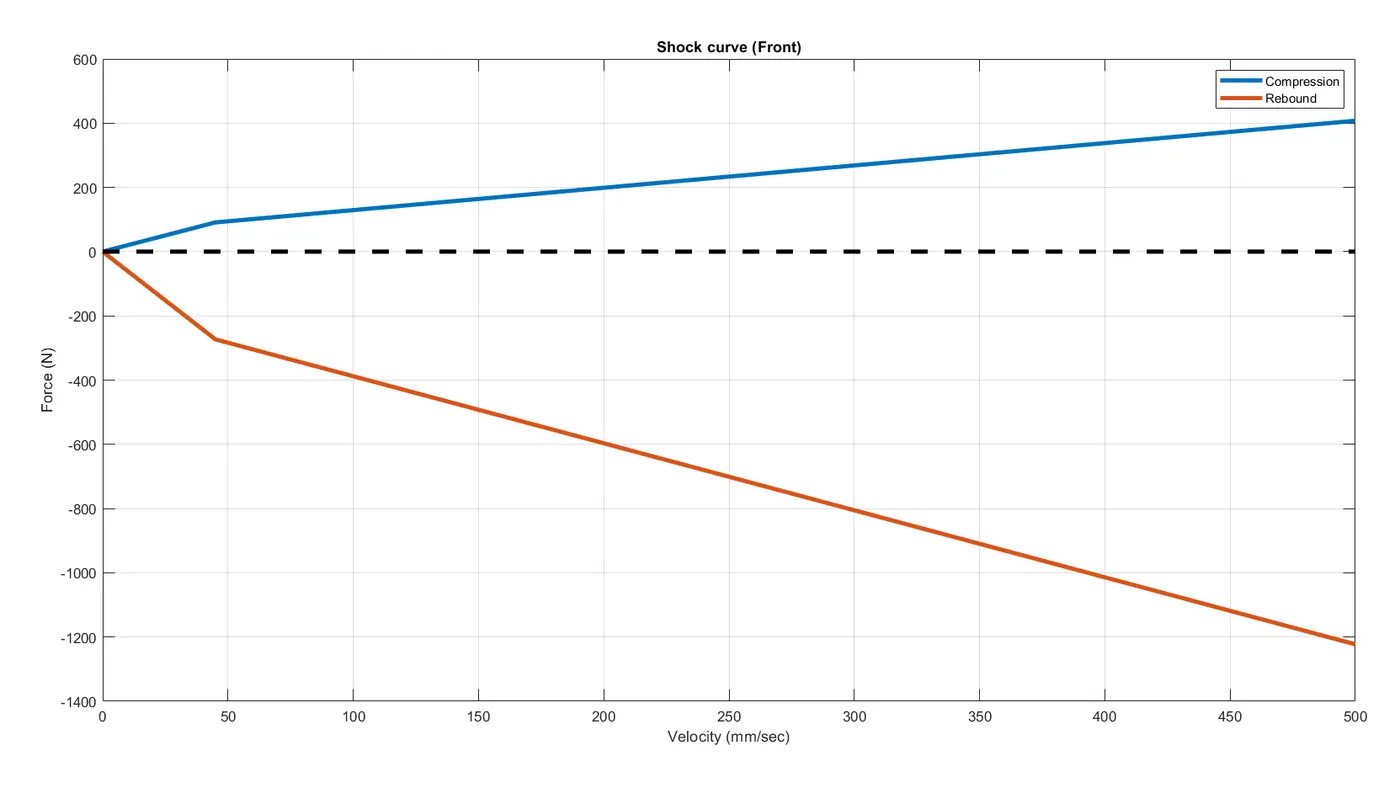
Output #1:
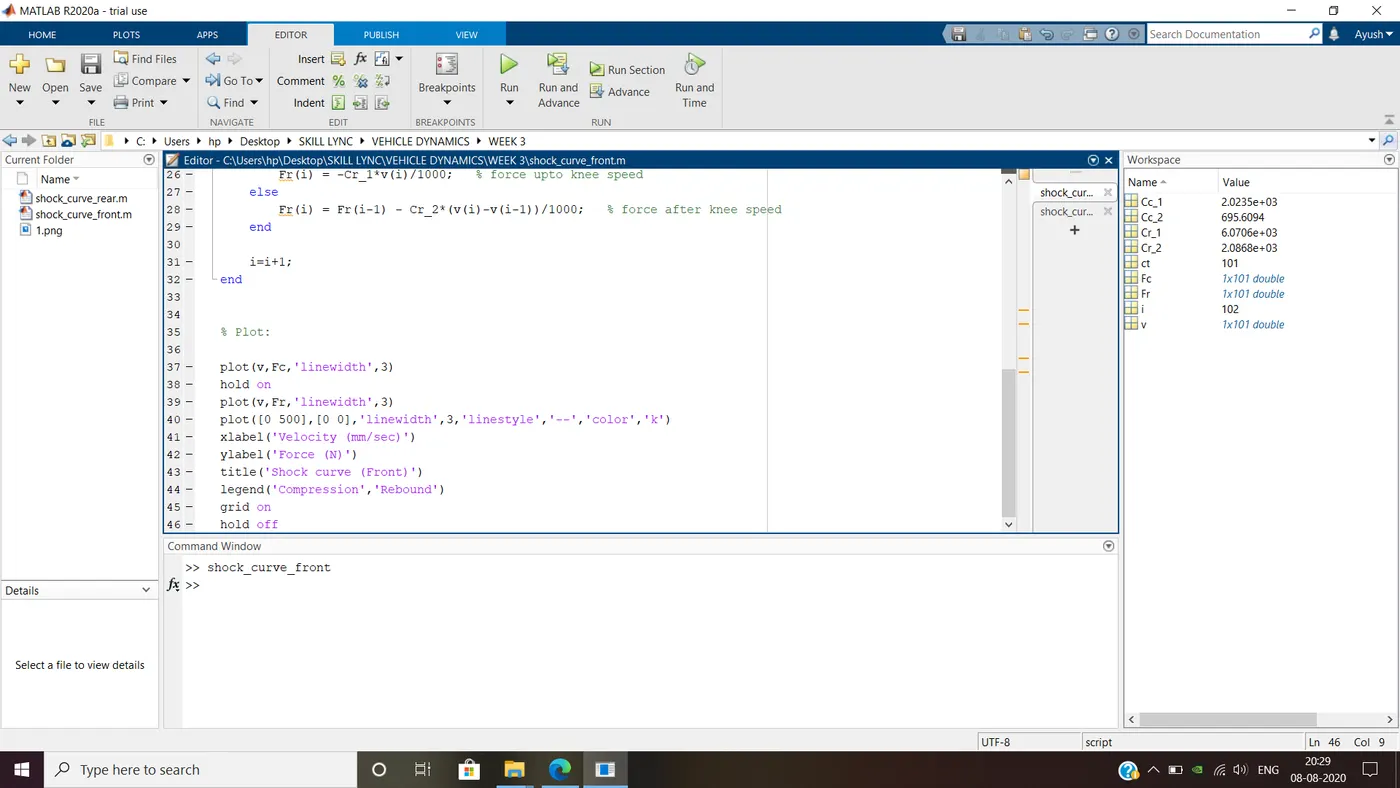
Plot #1:
Rear shock:
Code #2:
% Shock curve (Rear)

% Inputs:

v = 0:5:500;    % velocity (mm/sec)
Cc_1 = 1971.021339;   % before knee speed - compression
Cc_2 = 570.972854;    % after knee speed - compression
Cr_1 = 5913.064016;   % before knee speed - rebound
Cr_2 = 1712.918562;   % after knee speed - rebound


% Solution:

i=1;
for ct=1:101    % Divisions in plot

    % Compression curve
    if ct <= 10
        Fc(i) = Cc_1*v(i)/1000;   % force upto knee speed
    else
        Fc(i) = Fc(i-1) + Cc_2*(v(i)-v(i-1))/1000;   % force after knee speed
    end

    % Rebound curve
    if ct <= 10
        Fr(i) = -Cr_1*v(i)/1000;   % force upto knee speed
    else
        Fr(i) = Fr(i-1) - Cr_2*(v(i)-v(i-1))/1000;   % force after knee speed
    end

    i=i+1;
end


% Plot:

plot(v,Fc,'linewidth',3)
hold on
plot(v,Fr,'linewidth',3)
plot([0 500],[0 0],'linewidth',3,'linestyle','--','color','k')
xlabel('Velocity (mm/sec)')
ylabel('Force (N)')
title('Shock curve (Rear)')
legend('Compression','Rebound')
grid on
hold off
Output #2:
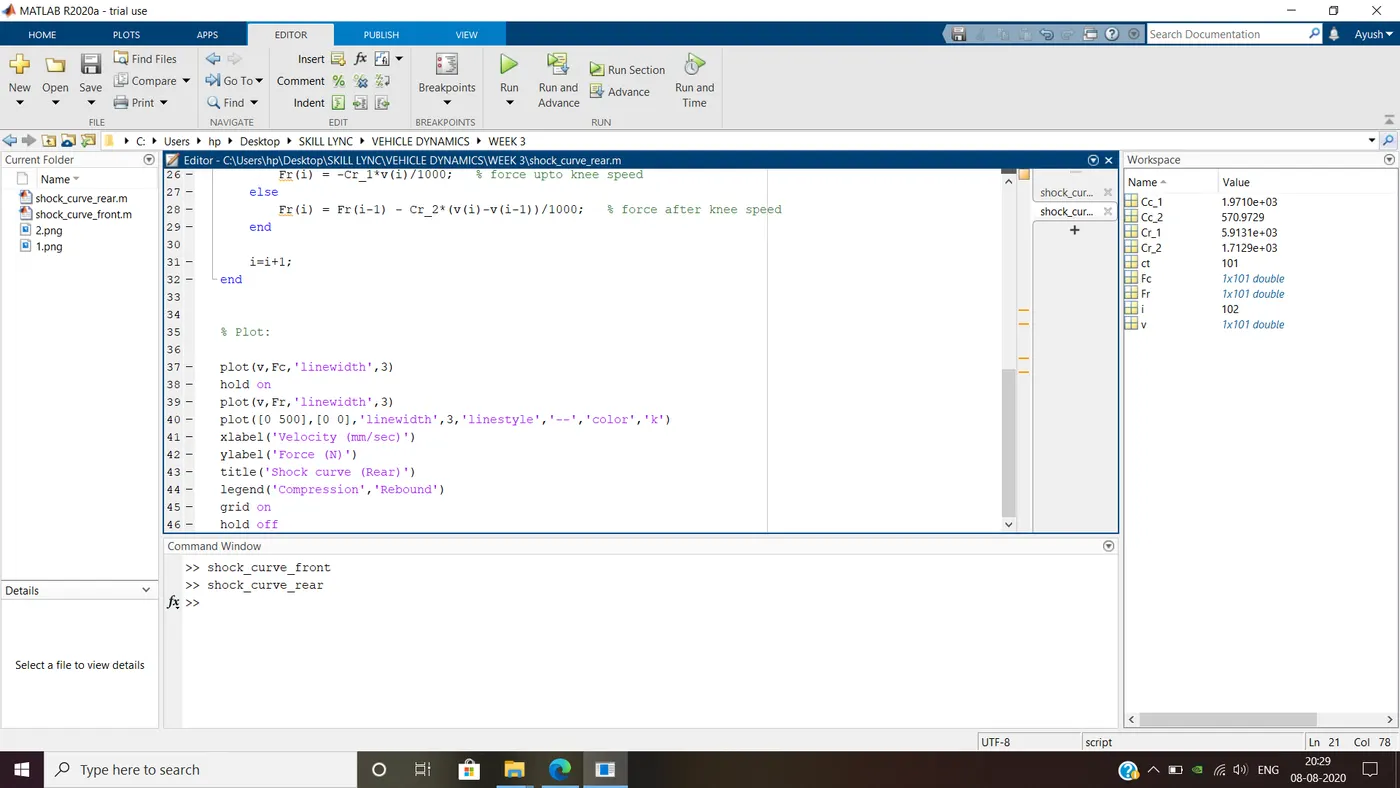
Plot #2:
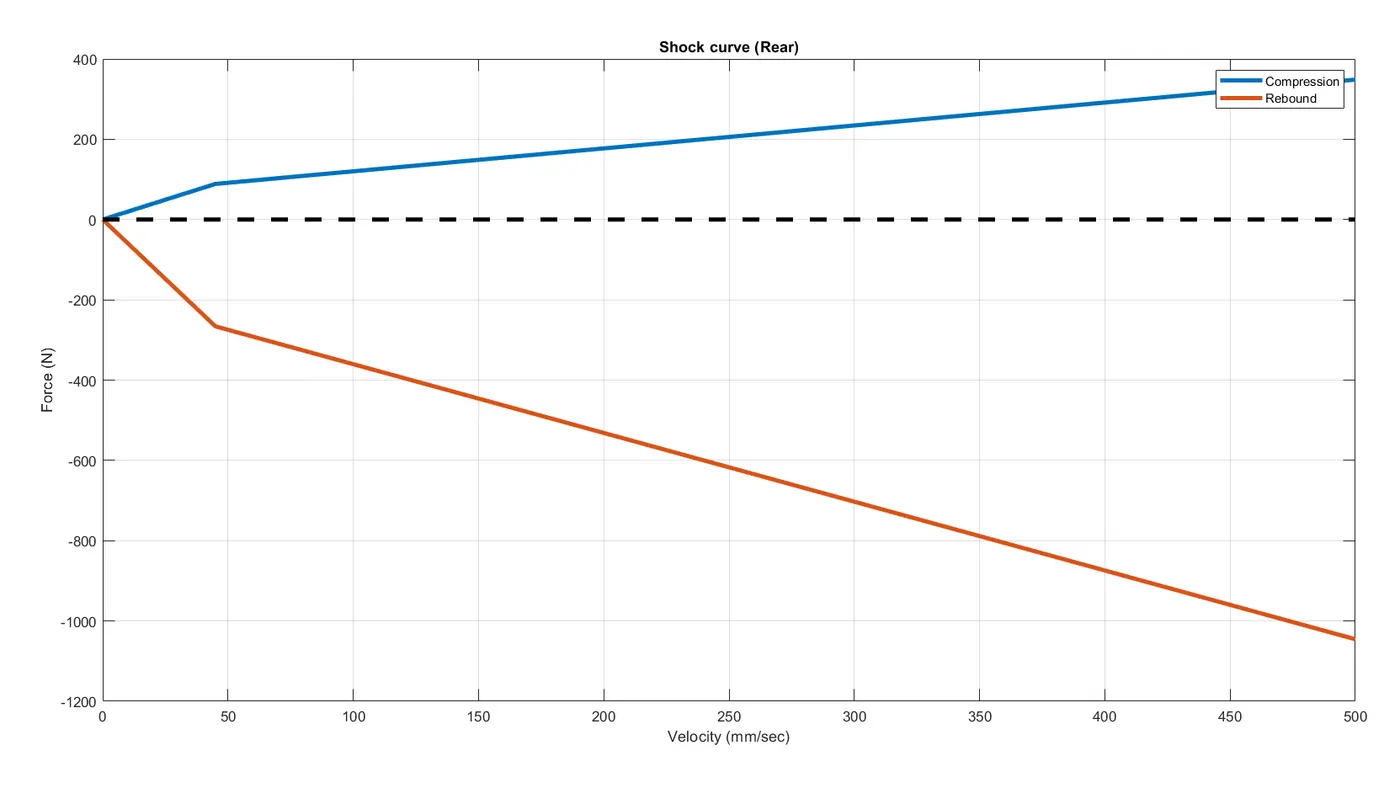
CONCLUSION: From the above results, we can infer that both the compression and rebound forces are high for Front shock as compared to the Rear shock.