Half Car Modeling
AIM: Owing to the wide separation of the natural frequency of the sprung parts from that of the unsprung parts, the bounce and pitch motions of the vehicle body and the wheel motions exist almost independently. The sprung parts of a vehicle weigh 9.79 kN (2200 lb), its center of gravity is 106.7 cm (42 in) behind the front axle, and the wheelbase is 228.6 cm (90 in). The combined stiffness of the springs of the front suspension is 24.52 kN/m (140 lb/in) and that of the rear suspension is 26.27 kN/m (150 lb/in). The radius of gyration of the sprung parts about a horizontal transverse axis through the center of gravity is 102.6 cm (40.4 in).
1. Calculate the natural frequencies of the pitch and bounce motions of the vehicle body.
2. Also determine the locations of the oscillation centers.
GIVEN DATA:
| Parameter | Value | Units |
| Sprung mass | 9.79 / 2200 | kN / lb |
| Center of gravity | 106.7 / 42 | cm / in |
| Wheelbase | 228.6 / 90 | cm / in |
| Front spring stiffness | 24.52 / 140 | kN/m / lb/in |
| Rear spring stiffness | 26.27 / 150 | kN/m / lb/in |
| Radius of gyration | 102.6 / 40.4 | cm / in |
GOVERNING EQUATION:
Moment of inertia: `I_y = m_s*r_y^2`
Constants:
`D_1 = (k_f + k_r)/m_s`
`D_2 = (b*k_r - a*k_f)/m_s`
`D_3 = (a^2*k_f + b^2*k_r)/I_y`
`D_4 = ((a+b)^2*k_f*k_r)/(m_s*I_y)`
Natural frequencies:
Bounce: `w_(n_1) = sqrt(((D1+D3) - sqrt((D1+D3)^2 - 4*D4)) / 2)`
Pitch: `w_(n_2) = sqrt(((D1+D3) + sqrt((D1+D3)^2 - 4*D4)) / 2)`
Oscillation centers:
Bounce: `l_1 = D_2/(w_(n_1)^2 - D_1)`
Pitch: `l_2 = D_2/(w_(n_2)^2 - D_1)`
SOLUTION:
Programming Language: MATLAB
Code:
% Input data:

W_s = 9.79;         % Sprung weight (kN)
a = 106.7;          % Center of gravity is behind the front axle (cm)
l = 228.6;          % Wheelbase (cm)
k_f = 24.52*10^3;   % Front spring stiffness (kN/m to N/m)
k_r = 26.27*10^3;   % Rear spring stiffness (kN/m to N/m)
r_y = 102.6;        % Radius of gyration (cm)


% Solution:

m_s = W_s*10^3/9.81;   % Sprung mass (kN to kg)
b = l-a;               % Center of gravity is behind the rear axle (cm)
I_y  = m_s*r_y^2;      % Moment of inertia (kg.cm^2)

D1 = (k_f + k_r)/m_s;
D2 = (b*k_r - a*k_f)/m_s;
D3 = (a^2*k_f + b^2*k_r)/I_y;
D4 = ((a+b)^2*k_f*k_r)/(m_s*I_y);

% Natural frequencies:
w_n1 = sqrt(((D1+D3) - sqrt((D1+D3)^2 - 4*D4)) / 2)   % Bounce (rad/sec)
w_n2 = sqrt(((D1+D3) + sqrt((D1+D3)^2 - 4*D4)) / 2)   % Pitch (rad/sec)

% Oscillation centers:
l_1 = D2/(w_n1^2 - D1)   % Bounce (cm)
l_2 = D2/(w_n2^2 - D1)   % Pitch (cm)
Output:
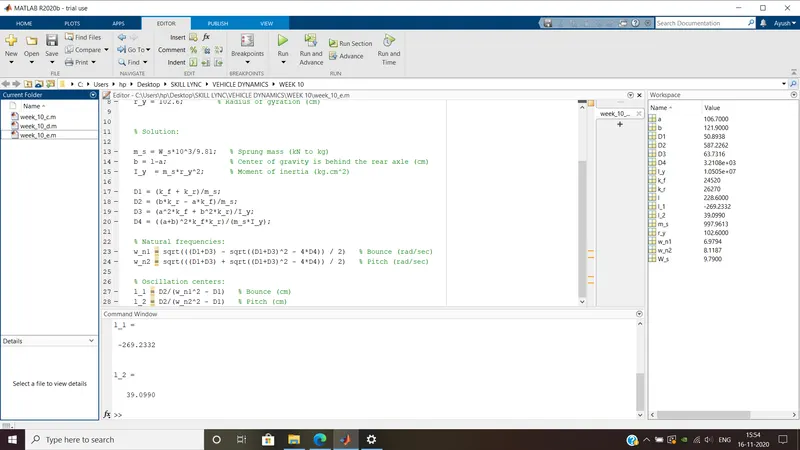
ANSWERS:
| Parameter | Value | Units |
| Bounce natural frequency | 6.9794 | rad/sec |
| Pitch natural frequency | 8.1187 | rad/sec |
| Bounce oscillation center | -269.2332 | cm |
| Pitch oscillation center | 39.099 | cm |