Week 6 Fuel cell powered vehicle model
Aim: To simulate the Fuel cell powered Electric vehicle using Matlab Simulink
Working Principle of Fuel Cell:
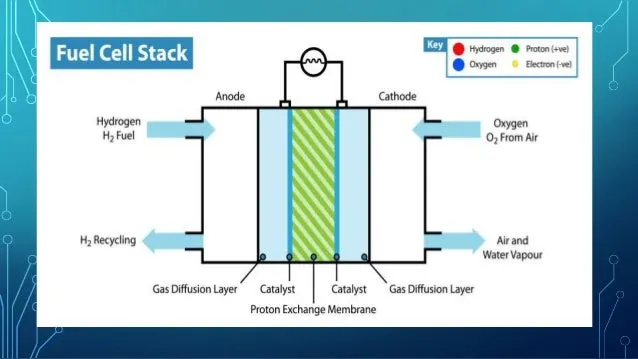
The fuel is oxidized on the anode and oxidant reduced on the cathde. One specied of ions are transported from one elctrode to the other through the electrolyte to combine there with their counterparts, while electrons travel through the external circuit producing the electrical current.
Fuel cell powered Electric vehicle:
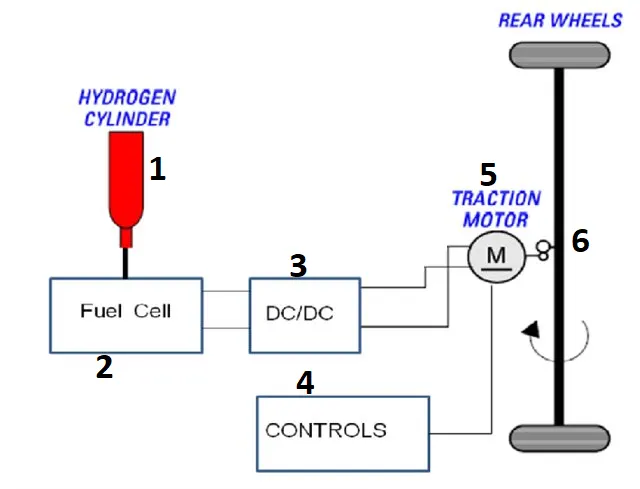
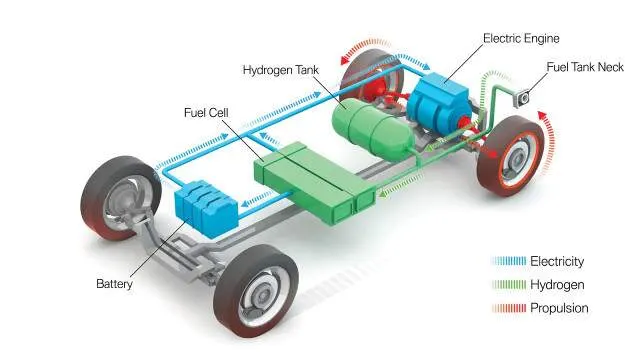
The block diagram of fuel cell powered electric vehicle (FCEV) is shown in the above Fig. The parts of the FCEV is given as follows
1. Hydrogen cylinder
2. Fuel cell
3. Dc/Dc converter
4. Control system
5. Traction motor
6. Mechnical transmission system
fuel cell:
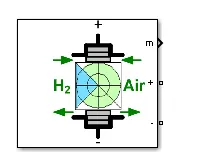
The Fuel Cell Stack block implements a generic model parameterized to represent the most popular types of fuel cell stacks fed
with hydrogen and air.
The block represents two versions of the stack model: a simplified model and a detailed model. We can switch between the two
models by selecting the level in the mask under Model detail level in the block dialogue box.
This model is based on the equivalent circuit of a fuel cell stack shown below:
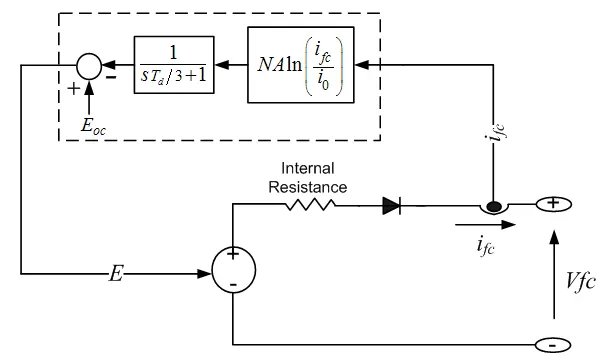
The simplified model represents a particular fuel cell stack operating at nominal conditions of temperature and pressure. The parameters of the equivalent circuit can be modified based on the polarization curve obtained from the manufacturer datasheet. You just have to input in the mask the value of the voltage at 0 and 1 A, the nominal and the maximum operating points, for the parameters to be calculated. A diode is used to prevent the flow of negative current into the stack. A typical polarization curve consists of three regions:
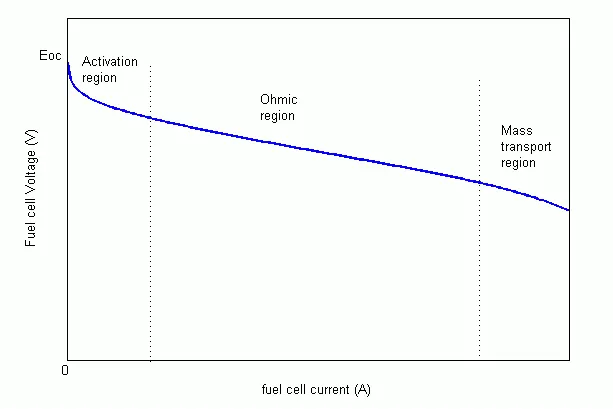
The first region represents the activation voltage drop due to the slowness of the chemical reactions taking place at electrode surfaces. Depending on the temperature and operating pressure, type of electrode, and catalyst used, this region is more or less wide. The second region represents the resistive losses due to the internal resistance of the fuel cell stack. Finally, the third region represents the mass transport losses resulting from the change in concentration of reactants as the fuel is used.
The matlab simulink model for the fuel cell along with DC/DC converter is shown in fig
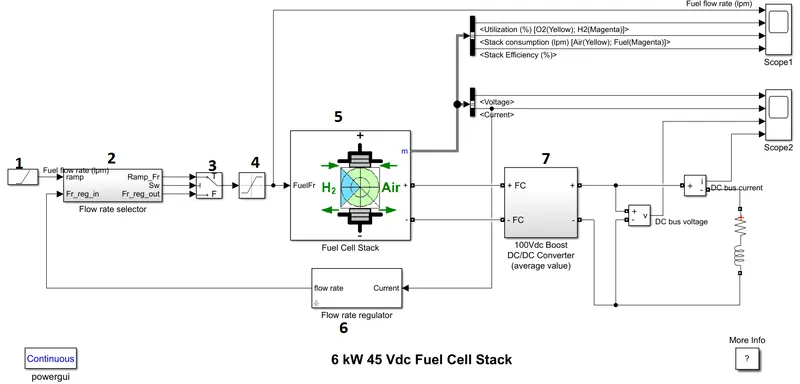
The parts of the simulink model is as follows
1. ramp
2. flow rate sensor
3. selector
4 saturation block
5 Fuel cell
6 Flow rate regulator
7. Dc/Dc converter
1. Ramp

The Ramp block generates a signal that starts at a specified time and value and changes by a specified rate. The block's Slope,Start time, and Initial output parameters determine the characteristics of the output signal.
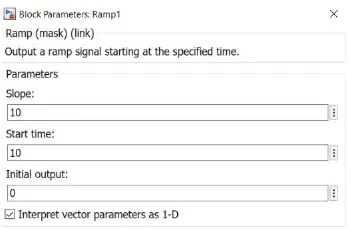
Here we can change the value of slope according to our configuration but it is fully depending upon the vehicle drive cycle. So here I am using 10 as a slope value.
2. flow rate sensor
The flow rate sensor senses the rate of flow of the hydrogen to the fuel cell stack.
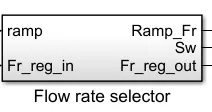
Theere are two inputs and three outputs for flow rate sensor. The ramp input and flow rate regulator as inputs and Ramp flow rate and flow rate regulation out and switch for selecting the among ramp and flow rate regulator out
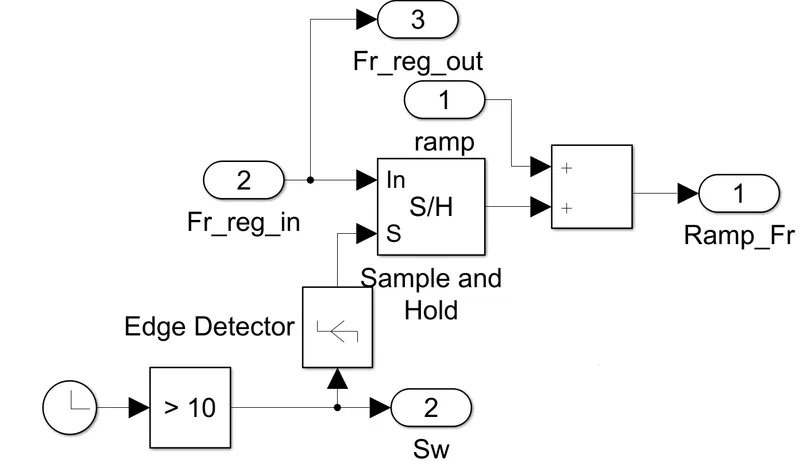
The sub system for the flow rate selector is shown in above figure. sample and holding circuit is fed by flow rate reg input and edge detector. if the fow rate is more than 10 then edge detectror senses and control the flow rate .
Saturator:
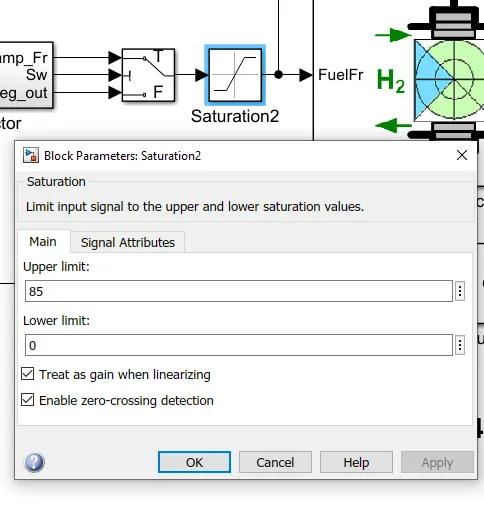
It will allow only flow rate of 85
Fuel Cell:
Implements a generic hydrogen fuel cell model which allows the simulation for the following types of cells:
- Proton Exchange Membrane Fuel Cell (PEMFC)
- Solid Oxide Fuel Cell (SOFC)
- Alkaline Fuel Cell (AFC)
From drop-down menu “Preset Model” we can switch to different model but here I am using PEMFC- 1.26kW – 24 Vdc modelwith full model details.
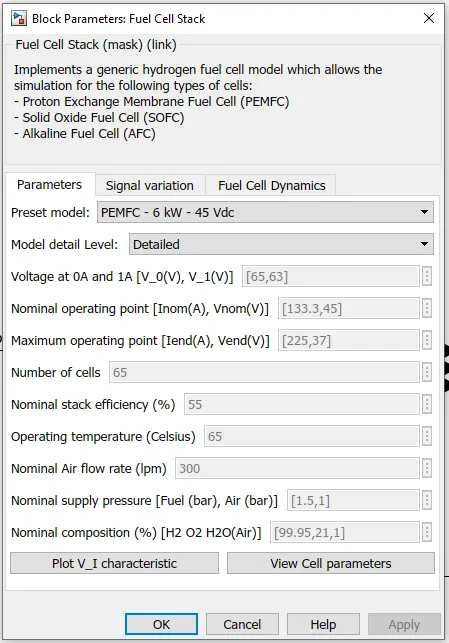
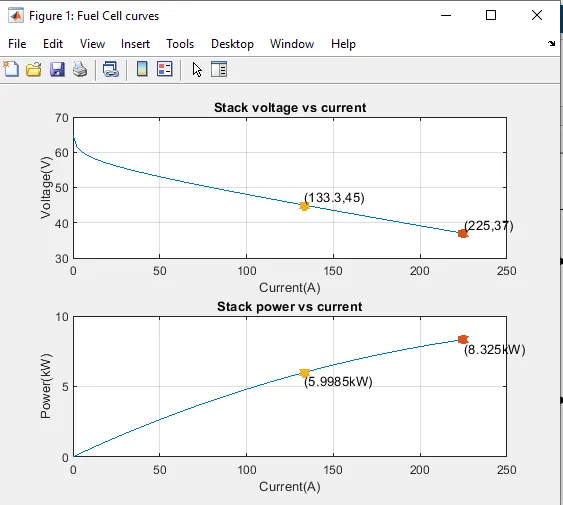
Plot V_I Characteristics
To plot the V_I Characteristic just click on “Plot V_I Characteristics” and we will see the plotted graph related to PEMFC- 1.26kW– 24 Vdc.
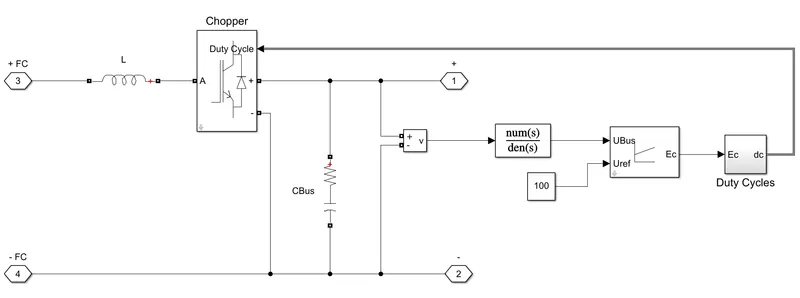
Boost Dc/Dc converter
The Dc/ Dc converter, boosts the voltage from low to high.
Output results:
PEMFC- 6KW – 45 Vdc
Scope 1 Result
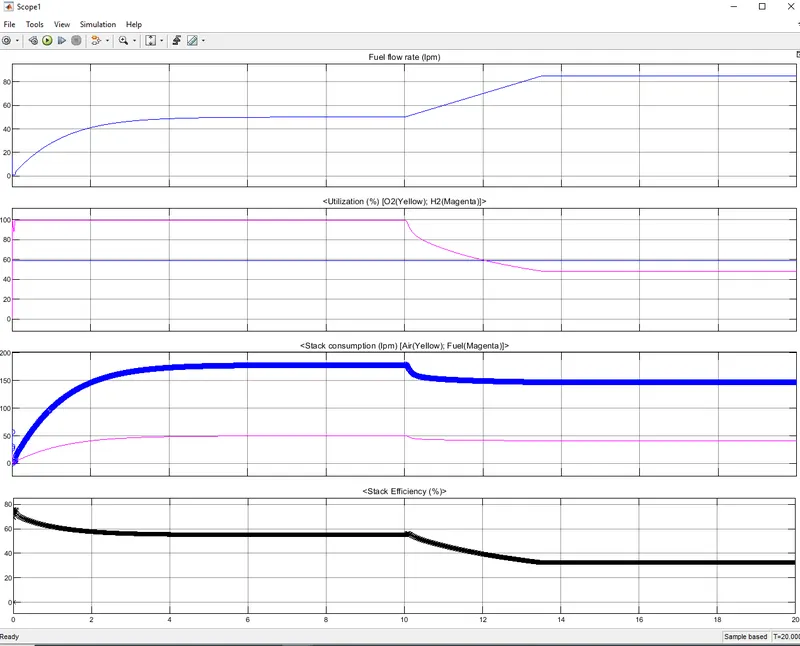
So here we observe that the fuel flow rate is changing 10.007s (1) to 15.000s (2) and the difference is 4.993s it is the absolutevalue of the time (x-axis)
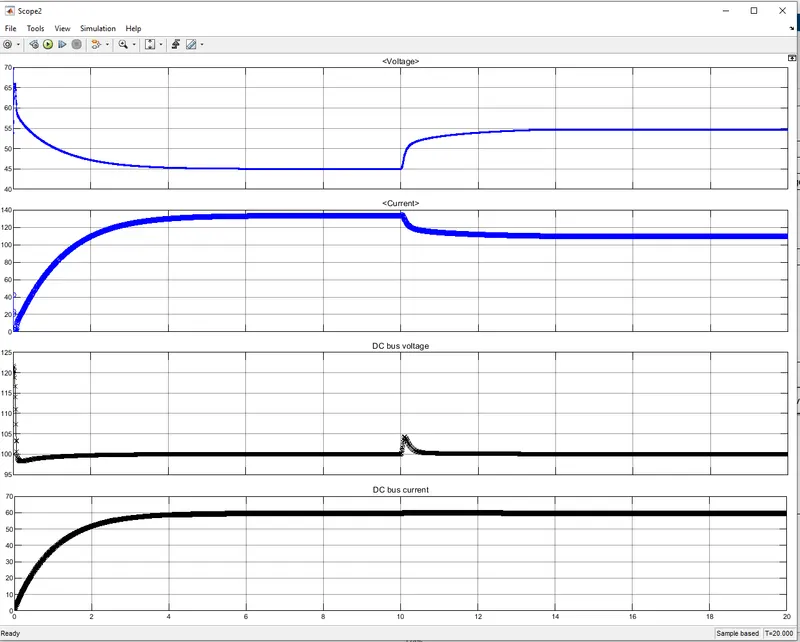
Also, we notice that the voltage and current are also changing from 10.020 s (1) to 10.805 s (2) and the difference is 784.574 ms itis the absolute value of the time (x-axis)
So, we can see that the average amount of time required for each rising edge to cross from the lower-reference level to the upper-reference level is 21.226 ms and it is Rise time.
The average slope of each rising-edge transition line within the upper- and lower-per cent reference levels in the displayed portionof the input signal is 407.184 s and it is a positive Slew rate.
Total number of negative-polarity or falling edges counted within the displayed portion of the input signal is 2
The average amount of time required for each falling edge to cross from the upper-reference level to the lower-reference level is101.493 ms
The DC bus voltage (Scope2) which is very well regulated by the converter. The peak voltage of 122Vdc at the beginning of thesimulation is caused by the transient state of the voltage regulator.
Conclusion:
The report is explained the working principle of Fuel cell and major functionlities in Fuel cell electric vehicle. The major functionalities of EV are source and converter. The road conditions are resembled with constant electric load. The input to the fuel cell is given bt ramp input which regulates according to the current required for the load, in practical conditions according to the road condition.