Week 5 Challenge
Consider a scenario where an aggressive driver is accelerating very rapidly and braking harshly in a city driving. Is battery better a choice to supply power than UC in this scenario?
- True
- False
Why?
False
If the driver is accelerating very rapidly and braking harshly, the current draw by the motor to achieve these conditions is too transient. So battery cannot provide the current to the motor in a less time. Hence UC which is high power density component can work efficeintly at trasient conditions. In braking harshly, regenrative braking mode is activated which is very ease to UC to store that power.
Question 2:
Consider the following components.
1) Lead acid battery 2) Nickel cadmium battery 3) Nickel Metal hydride battery 4) Lithium ion (specify chemistry) battery 5) Ultra Capacitor
Note: In case of a range of energy density, take the average value for the plot.
Create a plot with energy density on the X Axis and cell voltage on the Y axis.
Comment on the capabilities of these batteries based on the plot created.
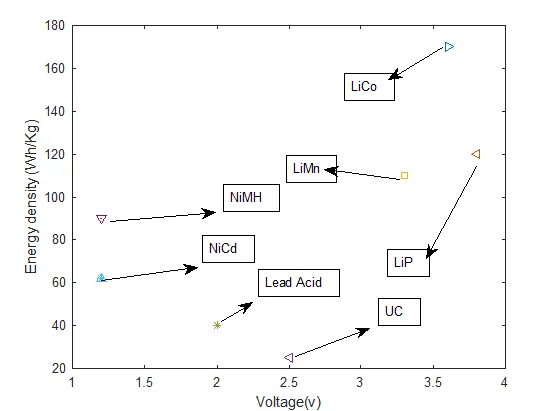
Li is the lightest element so that the energy density of the Li ion batteries are high among all the energy storage systems.
UC has the least Energy density
LiCoO2 has the highest Energy Density.
Question 3:
For the above-mentioned components on the same plot (retain the previous plot) created in the previous
Create a plot with power density on the X axis and cell voltage on the Y axis.
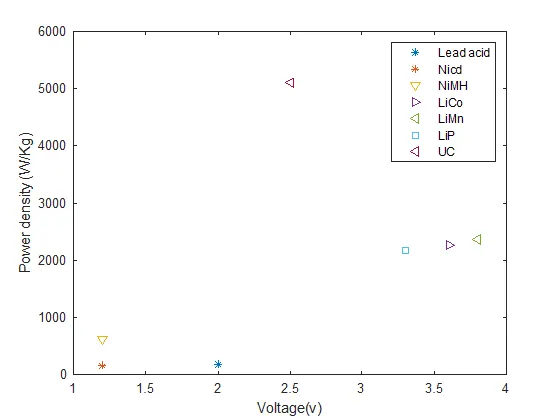
UC has the highest Power density among al Energy storage Systems (ESS). Lead acid battery has least Power density as the Pd is the highest atomic weight among all ESS.
Question 4:
Consider the following scenario:
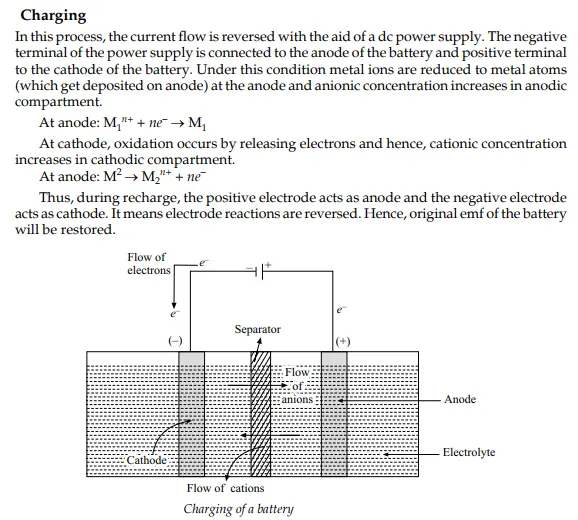
A battery has just been manufactured in the battery and has been connected to a charger for the first time. The electrode marked as (1) in the picture below is the negative electrode.
- True
- False
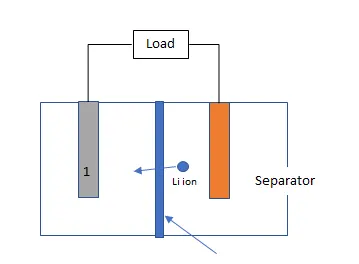
True