Week 2 Air standard Cycle
Aim:
To write a python code for the otto cycle and we need to create a P-V diagram for the otto cycle. And also we need to find thermal efficiency.
Otto cycle process & formulae :
The processes are described by
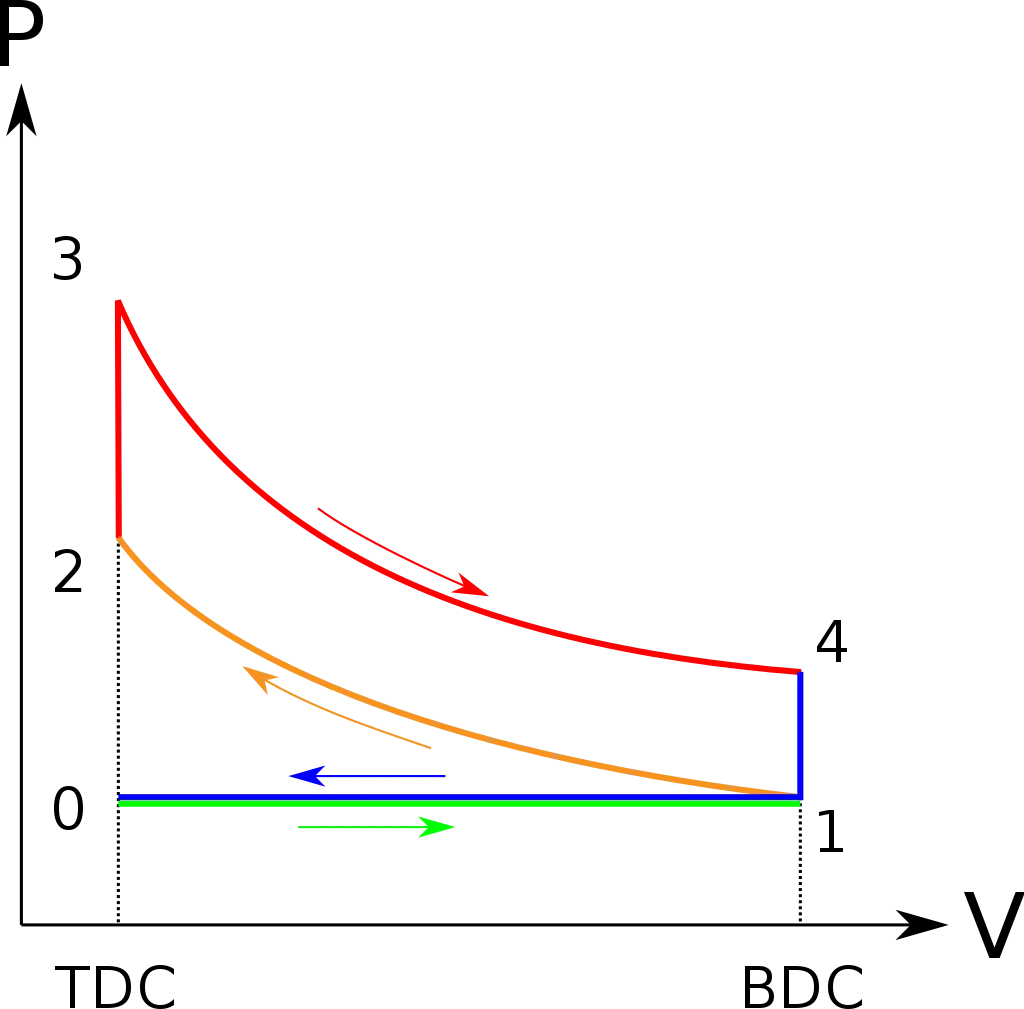
- Process 0–1 a mass of air is drawn into piston/cylinder arrangement at constant pressure.
- Process 1–2 is an adiabatic (isentropic) compression of the charge as the piston moves from the bottom dead center (BDC) to top dead center (TDC).
- Process 2–3 is a constant-volume heat transfer to the working gas from an external source while the piston is at top dead center. This process is intended to represent the ignition of the fuel-air mixture and the subsequent rapid burning.
- Process 3–4 is an adiabatic (isentropic) expansion (power stroke).
- Process 4–1 completes the cycle by a constant-volume process in which heat is rejected from the air while the piston is at bottom dead center.
- Process 1–0 the mass of air is released to the atmosphere in a constant pressure process.
The volume of the cylinder as a function of a crank angle:
V/Vc=1+1/2(Cr−1)[R+1−cosθ−√(R2−(sin^2)(θ)]
where:
a -stroke/2
R - con_rod/a
The thermal efficiency of the Otto cycle:
η=1−(1/(Cr)^ Υ−1)
η - thermal efficiency
Cr – compression ratio
ϒ – 1.4
swept volume:
vs=π/4(bore)^2*(stroke)
clearance volume:
vc=vs/(Cr−1)
# building otto cycle simulator

import math
import matplotlib.pyplot as plt

def engine_kinematics (stroke,bore,con_rod,start_crank,end_crank):
#geometric parameters
  a=stroke/2
  R=con_rod/a

#volume parameter
  v_s=math.pi*(1/4)*pow(bore,2)*stroke
  v_c=v_s/(cr-1)


  sc=math.radians(start_crank)
  ec=math.radians(end_crank)

  num_values=50

  dtheta=(sc-ec)/(num_values-1)

  V=[]
  for i in range(0,num_values):
	   theta=sc+i*dtheta
	   term1=0.5*(cr-1)
	   term2=R+1-math.cos(theta)
	   term3=pow(R,2)-pow(math.sin(theta),2)
	   term3=pow(term3,0.5)

	   V.append((1+term1*(term2-term3))*v_c)

  return V

#inputs
p1=101325
t1=500
gamma=1.4
t3=2300

#geometric parameters
bore=0.1
stroke=0.1
con_rod=0.15
cr=8

#volume consumption
v_s=(math.pi/4)*pow(bore,2)*stroke
v_c=v_s/(cr-1)
v1=v_s+v_c
#state points 2
v2=v_c

#p2v2^gamma=p1v1^gamma
p2=p1*pow(v1,gamma)/pow(v2,gamma)

#p2v2/t2=p1v1/t1 | rhs=p1v1/t1 | p2v2/t2=rhs | t2=p2v2/rhs
rhs=p1*v1/t1
t2=p2*v2/rhs

V_compression=engine_kinematics(stroke,bore,con_rod,180,0)

constant = p1*pow(v1,gamma)

p_compression=[]

for v in V_compression:
	p_compression.append(constant/pow(v,gamma))


#state point 3
v3=v2

#p3v3/t3=p2v12/t2 | rhs=p2v2/t2 | p3=rhs*t3/v3
rhs=p2*v2/t2
p3=rhs*t3/v3

V_expansion=engine_kinematics(stroke,bore,con_rod,0,180)

constant = p3*pow(v3,gamma)

p_expansion=[]

for v in V_expansion:
	p_expansion.append(constant/pow(v,gamma))


#state point 4
v4=v1

#p4v4^gamma=p3v3^gamma
p4=p3*pow(v3,gamma)/pow(v4,gamma)

#p4v4/t4=rhs
t4=v4*v4/rhs

#thermal efficiency
n=1-(pow(cr,(1-gamma)))
print(n)

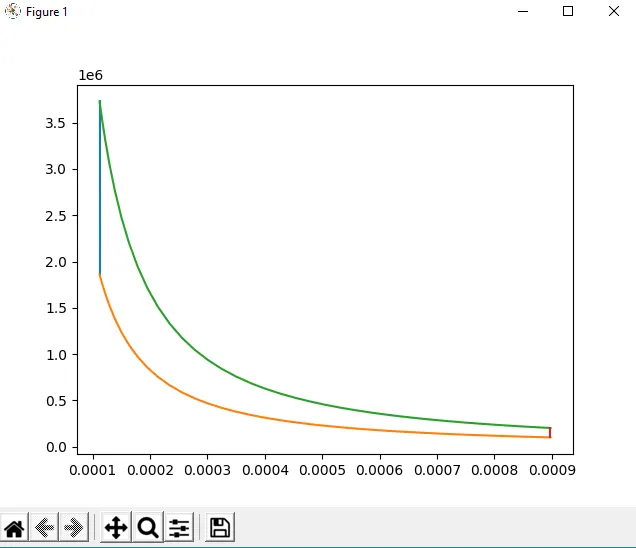
plt.plot([v2,v3],[p2,p3])
plt.plot(V_compression,p_compression)
plt.plot(V_expansion,p_expansion)
plt.plot([v4,v1],[p4,p1])
plt.show()
Thermal efficiency result:
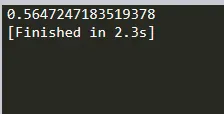
The thermal efficiency of the Otto cycle under the given operating condition of the engine for a given geometric condition is 56.47%.
P-V diagram: