Week 6
Objective :
The rear door model is given for the connections using different types of 1D connections whichever suitable and makes the proper connections and attaches the FE model to give a model for the simulation process.
connector :
Connectors are a geometric representation of connections between entities. The advantage of connectors is the ability to create multiple connections at a single time. Hundreds or even thousands of connections that would normally have to be created manually one at a time can be mass created, even before the part is meshed.
Types of connector :
- Bolt connector
-
generates Bolt connections between two or more holes, either of shell or solid mesh. The user determines the element types for the "Head", the "Body" and the "Nut" of the Bolt, by selecting among the provided options. The specified elements of the "Head" and the "Nut" connect the center of the hole to the nodes of selected edges (or the selected nodes) while the "Body" is created between the two "centers" of each hole.
-
- Seam weld connection
-
creates Seamline connections passing through the middle position of selected line elements, provided that these elements are defined on consecutive elements.Seam welding is the joining of work pieces made of similar or dissimilar materials along a continuous seam.
-
- Spot weld
- Spot welding is one form of resistance welding, which is a method of welding two or more metal sheets together without using any filler material by applying pressure and heat to the area to be welded.
- RBE elements
-
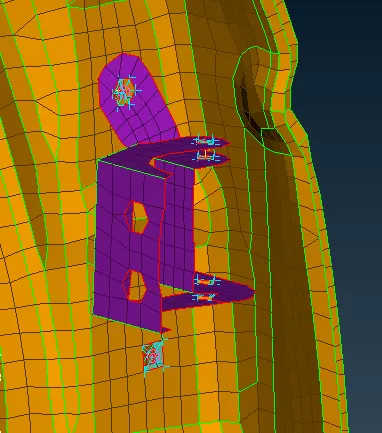
Defines a rigid body element of form 2 (RBE2) between selected grid points, 3D-points etc. This element is a rigid body with independent degrees of freedom specified at a single grid point and with dependent degrees of freedom at an arbitrary number of grid points. The RBE2 is represented by a set of thick cyan lines connected to the grid point with independent degrees of freedom (displayed as a small red cross). When the grid point with dependent degrees of freedom is only one, the RBE2 is represented by a yellow line connected to the grid point with independent degrees of freedom (again, displayed as a small red cross).
-
- Bush connector
- it is respresentation of brittle material between two parts
Procedure for creating the connector :
- Identify the connection area and ensure the type of connection used
- then convert the curve2cons or the COG. For seam line adhsive linetype weld generaly used in seam line or adhasive line and the COG used for spoat weld
-
This function turns a number of selected 3D-points, circle centres or Weld Points into Spotweld Points, Bolts or Gum Drops according to the preferred selection. These connection points may be used for the automatic definition and management of connection elements(MENUBAR>Assembly>Convert)
-
he Assembly toolbar hosts all necessary functions for defining, converting, editing and realizing all types of ANSA Connection entities. The Connection Manager is the primary tool for editing and realizing ANSA Connection entities.
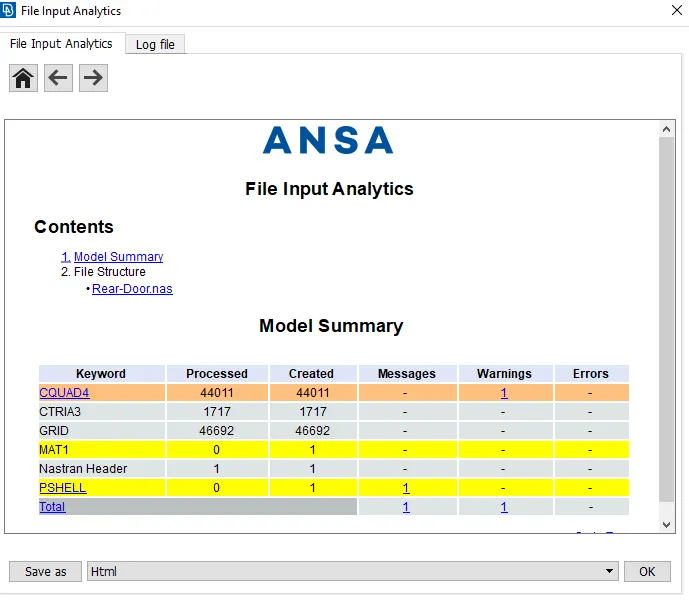
Importing .nas file :
Connection for handle :
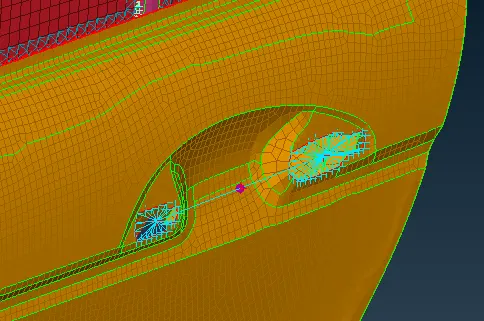
As the FE model of the door handle was not given however, it is required for us to consider the door handle during NVH simulation we showed the same using CONM where we entered approx. We created rigid connection at both ends and connected the master nodes using RBE3 connection with a master node at centre. Mass of the door handles and added it to centre of the connection. In this case1e−41e-4 tonnes.
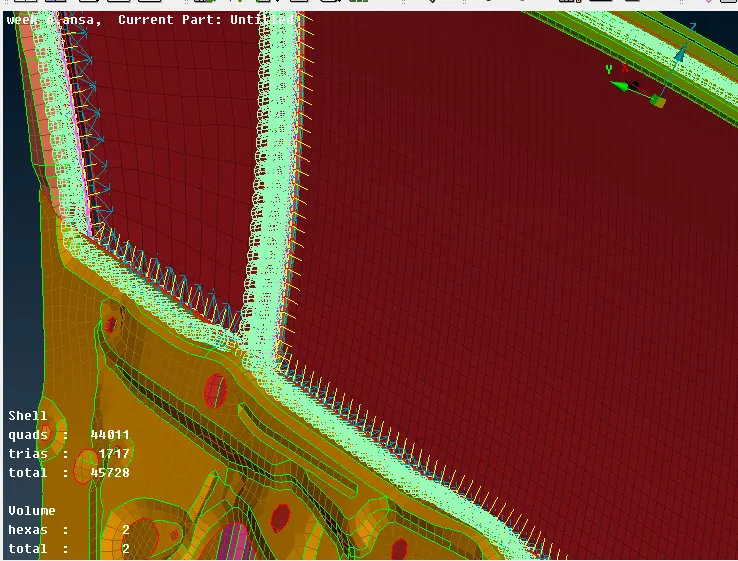
CBush for mirror :
The windows in actual practice are surrounded by weather strips however, for FE representation we can not use that. Firstly, we will convert the feature lines of the window into curve using FEATURE to CURVE. Now for each curve we will convert it into spotline using convert tool. Using the connection manager we will select the curve. Now, we will select PID of each part to be connected. We will give spacing as required between two elements.
In FE rep we will select RBE3-Cbush-RBE3, we will given search distance and enter PBUSH ID and apply to project the elements. The same will be done for rest of the sides. However,, for lower window panel, we will copy the curve to create elements in both sides. It is done to represent the damping member.
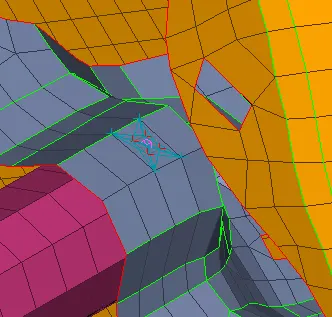
Spot Weld Connections:
This type of connection is used between two parallel surfaces overlapping each other, In order to establish a spot weld connection, we first have to create a 3-D point at any of the two surface. Now in order to realise the we have to convert it into spot weld, and then using connection manger and choosing FE rep type as RBE3-Hexa-RBE3 and slecting the two surfaces we can made the spot connection.
Bolt Connections:
Now for the parts where other components are attached and a hole has been provided for the same, we used RBE2> Many Node connection and joined using a master node. These connections are used where two parallel surfaces have a hole provided. The bolt connection are either provided by using the above method or it can be provided by first creating a 3-D point and then converting it into bolt. After that we have to select the parts PID which needed to be connected. For FE Rep type we will use Bolts.
Conclusion:
Hereby, all required connection in the given FE model of rear door were implemented. We can say that by establishing connections at all required places the model is ready for the NVH simulation.
Learning Outcome:
We learnt various type of connections like, bolts, spot weld, seam weld and got to know about FE representations of the same for. Got to learn how to use tolls like RBE2 and RBE3 in NASTRAN deck. We got to know about various aspects to be considered during designing of parts and how to prepare the parts for NVH simulation.